Archive for the ‘Uncategorized’ Category

#3 in a series… the best of the mary’zine that never made it to print

May 29, 2009

hi-tek lo-blo lim-bo

Back in the bad old days of dial-up Internet, a working telephone was, obviously, essential. In 1996, I was just beginning my editing business and was desperate for work, which I was getting mostly through e-mail. I had a big clunky car phone, which I could use when my regular phone wasn’t working, but of course it was no use in getting online. Funny how every advance in communications technology creates all new ways for communication to fail.

For months, my phone line had been shorting out whenever it rained. It was torture for me not to be able to check my e-mail. I imagined undelivered frantic messages from friends wondering why I hadn’t answered, or incoming work waiting to land in my in-box like planes circling over SFO. I was at the tail end of a big project and couldn’t afford to lose touch with the publisher’s editor, so one morning I had to call Connecticut from my car phone. Did I feel like a big shot sitting out there in the carport calling my editor back East? You bet—living the California dream I was. To really fit in, I should have taken the Honda out on the freeway and drifted from lane to lane while obliviously conducting my important business.

The car phone was expensive to use when I had to deal with voice mail and stay on hold for minutes at a time, so one day I called Pac Bell’s repair line, 611, from a greasy earpiece’d outdoor pay phone while a guy practiced revving his motorcycle right behind me. The recording took me through a dozen options and finally assured me in a cheerful canned voice that the problem was in my equipment. When I finally reached a human, whom I could barely hear because of the aforementioned motorcycle, she couldn’t find any problem in her computer. She wanted to know if there was someone at my house, because there was a busy signal, and I calmly answered, No—no one’s using my phone right now because IT DOESN’T WORK. I explained that I had been having this problem for a long time and that one of the service technicians had told me that the underground cable needed to be repaired. He had given me all his numbers, including his pager number, and said I could call him anytime. Then he disappeared off the face of the earth and took his pager with him.

So the woman transferred me to Cable Maintenance, which didn’t have a recording, thank God, but the human looked in her computer and lo and behold didn’t see any problem, said I should call 611. I was about to break down in tears at this point, but I kept it together and dialed 611 again. The motorcycle had left, but now another guy was out there rattling garbage cans. I went back through the whole recording, from “If you are a speaker of English, press 1” (because God forbid we make any crazy assumptions) to “If you want to speak to a customer service representative, press 0.” (If you tried to trick the voice mail by pressing 0 first, it refused to comply until you’d gone through all the options.) So once again I receive the news from the cheerful canned voice that I should check my equipment. Finally, a human comes on the line, but of course it’s a different human and I have to tell the whole story again, about the missing service technician (who was probably snuffed out for telling customers it was Pac Bell’s problem and not theirs), and she made some calls while I waited, holding the greasy phone, like am I getting old or what, that I even think about how disgusting it is to hold other people’s ear grease up to my ear, like how often do you suppose someone from Pac Bell comes by and wipes off the receiver?

So the human comes back on the line and is all self-satisfied about how there’s “trouble out,” like what does that mean, and she says there’s a dial tone going out to me, which means there’s some problem between the central place where they keep the dial tones and my condo, and the soonest she can get someone out there is Saturday, between 8:00 and 5:00. So I thank her for that gigantic “window” during which I have to be home, sitting on the edge of my seat waiting, and I’ll be sure to set the alarm so as not to miss the guy when he shows up at 1 minute to 5.

And so my only consolation is that it’ll be like Christmas morning when I finally get my phone back and check my e-mail, though I asked around at the studio when I went to paint, and no one had tried to reach me and I was like oh. Well. Probably Terry or Peggy or Diane is out there worried sick about me, like Where’s Mary? Where’s Mary? and boy will they be relieved when I finally write back and tell them I’m OK.

[Mary McKenney]

mary’zine random redux: #24 October 2002

April 29, 2009

Life, death, guilt, redemption, the F word, etc.

Dear friends. Well, I had this issue pretty much worked out—in my carefully planned but intermittently spontaneous way—when events interrupted my carefully planned but intermittently spontaneous life and I had to fly back to the Midwest for a funeral.

My brother-in-law Skip died of a heart attack. This is the brother-in-law I wrote about in January, to whom I hadn’t spoken in years. I was painting him last year when a verse from The Merchant of Venice, “The quality of mercy is not strain’d…,” started running through my head. After that, I felt better about him, but we never reconciled directly.

I had been dreading this trip back home, on a number of levels, ever since the last time I was there, 11 years ago. After my mother died, there seemed no more reason to go—I didn’t feel the same obligation toward my sisters. And I had no desire to see Skip, who had been emotionally intrusive to me when my mother was dying and then, in the following months, became even more possessive and demanding of my time and attention. When I tried to set boundaries (this was pre-J, when I barely knew what boundaries were, let alone how to enforce them), he withdrew, I got pissed, and it’s been a stalemate ever since. When I asked my sister if she wanted me to come for the funeral, she said it was up to me, but I knew she’d want me there. So I arranged for Pookie to be looked after, made my plane reservations, and called J to cancel our next appointment; when I told her I didn’t want to go but felt I had to, she said, “That’s what families do for each other.” And I whined, “Well, I guess they’re my family….”

I’m a little concerned about how I’m going to come across in this story, because I have certain expectations (and thus project them onto you) about what should have happened if I were truly a Good Person. First, I should have made up with Skip when he was alive—isn’t that some sort of Good Person rule, like never going to bed angry? Plus, funerals are supposed to be all about pain and regret. There’s supposed to be a lot of crying and not very much laughing. In extreme cases, there should be an attempt to throw oneself onto the funeral pyre.

I don’t know where I got those ideas, because my father’s family had classic Irish wakes. As adults, his 12 brothers and sisters only saw each other at weddings and funerals, and except for the bride and groom in the one and the casket in the other, you wouldn’t have known which was which. Maybe there was a bit more crying at the weddings. My mother and I always sat on the sidelines, dour-faced, uncomfortable, with an unwanted brandy and Coke in front of each of us. I wished I could be more like my partying aunts and uncles, but I knew implicitly that it would be a betrayal of my mother to trade her Scandinavian reserve for their Irish lack of inhibition.

Since the age of 14, when I rejected God, country, and motherhood (but not apple pie), I’ve sneered at the idea of family (Family is the F word), as if I were too smart for such a mundane commitment to people with whom I believed I had little in common but a few genes and a name—and not even a name anymore, since my sisters and their children are now K___’s and P___’s. The only McKenneys in our hometown are my father’s nephews and their wives, with whom I have no contact at all.

But on this visit home to my roots (rhymes with foots), for a variety of reasons, I was ready to embrace the clan, though I didn’t know it until I got there. When my mother was alive, I had to tiptoe around her moodiness and narcissism. Then Skip took up where she left off. Like her, he knew instinctively how to dominate by passive aggression and how to trip the guilt fantastic. Gee, maybe there’s a reason my sister married him.

I was a little concerned about flying—it was the 1st anniversary of 9/11—but the flights were uneventful and security was fairly minimal. I expected a long delay at SFO, but they only pawed through one of my carry-on bags and inspected my shoes; they didn’t touch the knapsack with the crucifix jackknife hanging from the zipper. In Chicago, where I had to transfer to a tiny DC-something to wing northward, they pulled me out of line, passed a wand over every square inch of my body, and pawed (it’s the only word for it) through both bags, still overlooking the potentially lethal crucifix. (I didn’t remember it was there until much later. I would have hated for it to be confiscated, since it’s a beautiful, quirky work of religious art and a gift from Tee.)

So I arrive in Green Bay, and my two sisters and my other brother-in-law are there to drive me the final 50 miles to Barb’s house. I’m hopped up on goofballs (3 Dramamine) and forget about my suitcase, but fortunately K asks how I managed to pack everything into two small carry-ons, so we traipse back into the terminal to get it. Finally, we’re headed out on the flat stretch of Highway 41 coming out of Green Bay.

I recently read a review of a book about the Great Peshtigo Fire of 1871, a catastrophe that, according to the New York Times, “remains somewhat obscure, due partly to its remote location [my emphasis] just west of the Green Bay, near Michigan’s Upper Peninsula….” That’s my home ground, folks, Remote is our middle name.

I could never live back there again [2009 update: Oh, how little I knew about myself], but as we drove north, I avidly watched the landscape for familiar sights and reminders of my childhood. (Traumatic childhood becomes wistful nostalgia; must be a survival mechanism.)

In Oconto, we pass our late uncle Al’s Riverside Tavern, still looking exactly the way it did 40-50-60 years ago. Throughout the area, I noticed that, while factories and businesses have closed and churches have been torn down, all the old bars are there—the Ogden Club, Dino’s Pine Knot, the Green Light Tavern. There’s always money for booze (she said, sounding exactly like her mother). But unlike my mother, I have a preternatural interest in those places. I don’t drink beer, but I collect Silver Cream (“The Cream of Beers”) bottles from the long-defunct Menominee-Marinette Brewing Company—probably because my father used to take me with him to bars when I was a preschooler. (That sounds worse than it was; he was mostly just socializing when I was along.) I still love eating in those old taverns. Proust can have his madeleines; I’ve got the aroma of deep-fried lake perch and stale beer to trigger fond memories.

In Peshtigo, we pass by another tavern that has a sign outside advertising a certain Milwaukee beer. I haven’t seen the name in years, so I blurt out, “BLATZ!” After a pause in which everyone else in the car probably thinks I’ve gone off the deep end, we all crack up.

I had thought that if I ever went back there after my mother was gone, I’d have to stay in a motel so I’d have my “space.” This is an unknown concept in the Midwest, apparently. When I used to tell Skip I needed my space, he’d call and say, “I’m going to take some of your space now.” But it was obvious that Barb didn’t want to be alone, so my niece fixed up a spare room for me, and I was able to have my space and eat it too (as it were).

Dramatis personae

Before I go any further, I’d better introduce the family:

Barb: Youngest sister, 48. Middle school teacher (math and science) in the town where we grew up. The new widow. Has heart of pure gold.

Skip: The deceased, 57. Estranged brother-in-law. Retired career Air Force/Vietnam vet/cross-dresser/tranny-wannabe. (This last used to be a closely guarded secret, but it seems everybody in town has known about it for years. A local store for plus-size women’s clothing sent flowers for the funeral. One of the unintentionally funny things the minister said during the eulogy was that Skip was “a man’s man.”)

Lorraine: Skip’s daughter, 31, from his first marriage, but Barb raised her from the age of 7. (Her mother died.) Funny, smart as a whip, lives on a farm. She takes care of three donkeys, a horse, at least one pig, lots of cats, and her two kids—A.J., 7, who wants to be a paleontologist, and Cody, 2, who has no career plans yet that I know of.

Aaron: Lorraine’s husband, who works on the “melting deck” of a foundry—a hot, dirty, exhausting job (same thing my father did). He’s quiet, very sweet, and is still Lorraine’s best friend after 10 years of marriage.

Brian: Skip’s son, 29, former n’er-do-well who finally responded to parental tough love and turned his life around. Unfortunately, fathered six children before doing so. Works two jobs as an appliance repairman. He and second wife Deb have a daughter, Sarina, and Deb has another daughter, Summer, who is half Thai. Summer, like A.J., is 7 and very smart. Sarina, age 2, is an unknown quantity. (I can’t relate to kids until they can form complete sentences.) Brian and his family live in a mobile home in a trailer park and so, in the minds of many Americans, are “trailer trash.” I saw a documentary on PBS about middle school kids. One snotty girl, surrounded by her fashionable friends, referred to a certain classmate with disdain: “We wear Abercrombie—he wears, like, WAL-MART.” If I were in charge, I would require two ongoing classes beginning in elementary school: (1) critical thinking and (2) socioeconomic class awareness.

K: Middle sister, 50, works in a factory. She makes couplings for tractors and such. Works a 10-hour shift 4 days a week and is an avid gardener and home decorator. She’s another one with a heart of gold. I guess our parents did something right.

MP: K’s husband, avowed (and proud) asshole. Fourth of 12 children and estranged from his entire family. Is a customer service rep, of all things, at a Ford dealership. Yells at the customers and dares his boss to fire him. Uses words like “nigger” and “faggot” around me, but I’ve learned not to rise to the bait. He loves my sister—they’ve been married 30 years—so I have to give him that.

“Little Mike”: K and MP’s older son, 25, with whom I bonded big-time when he was 14, the last time I saw him. Very sensitive and funny. (K said she didn’t know where he got his humor and brains; Barb said, “From his aunt.” [That would be me.]) He’s now an enormously large person, hence the irony of “little.” Works in Madison as a “fire equipment designer” (?), has two kids I’ve never met. He couldn’t get off work to come up for the funeral, so I didn’t get to see him.

Joshua: K and MP’s younger son, 21. Last time I saw him, when he was 10, we couldn’t relate at all. He was quiet, lost in little Mike’s shadow, but lo and behold he has come out of his shell, is almost as big as little Mike, wears several earrings and has a shaved head. We bonded on sight. He said I was a worthy replacement for his witty brother. Works at Marinette Marine, making parts for ships. Would rather be a long-distance trucker, but wife Jana is opposed.

The grand tour

On the morning after I arrived, we went out with K and MP to their favorite breakfast spot. K had called it a “dive,” but I didn’t see anything wrong with it, so I started to say, “Why do you think this place is a dive?” Fortunately, I noticed that the owner was talking to MP a few feet away. Whew! Open mouth, stop from inserting foot just in time. Afterward, we dropped MP off at home, and the three of us took a tour of our old homesteads. I had dreaded seeing the old neighborhood on Bay de Noc Road—I knew it had changed a lot, and I thought I couldn’t bear seeing strangers living in MY HOUSE and in my aunt and uncle’s house next door. (They sat with me at Mom’s funeral, and now they’re both dead, too.) But when I saw the man-made lake and the expensive houses that have replaced the woods where I spent hours in serene solitude, picking buttercups and violets, it was no big deal. It didn’t feel like mine anymore, but it was as if I’d already let go of it without noticing. It was just strange to consider that “rich people” (lawyers and doctors) now saw our old neighborhood as desirable. When we lived there, it was anything but. Our only neighbors—besides our aunt and uncle and their molester sons—were the Salewskys (on the land where my mother grew up), the Calcarys (house gutted by fire years ago, finally being remodeled), old Mr. Bael (in a little green shack), and Wallenders’ dairy farm.

I know this isn’t an original thought, but it’s too bad you can’t appreciate your environment more when you’re young. I loved the outdoors back then—the woods, the cedar grove, the sand hill, the sand road, the creek running through the cow pasture—but I only appreciate now how much freedom I had to wander and be alone.

We also drove over to North Shore Drive to see our first house, though I was the only one old enough to remember it. I wanted to stop and knock on the door and ask if we could come in and look around, but my sisters wouldn’t do it. It’s a nice two-story house at the corner of Highway 35 and a one-block street that ends in a tree-shrouded enclave called Northwood Cove. We drove back into the “cove” to check it out. The names of the three families who live there in luxurious seclusion are carved on a wooden sign at the entrance. How quaint. They have private beaches (on Green Bay off Lake Michigan), right next to Henes Park beach, where the hoi polloi go swimming. When I was a kid, I would cut through the cove to get to the public beach, and walking by the huge house where the Mars family lived, I was hardly able to conceive of having such riches. One of their kids, also named Mary, seemed as exotic to me as a character in a fairy tale. I thought she must have a perfect life.

michigan-trip-10-08-021

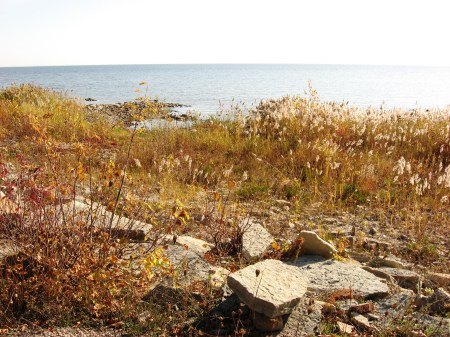
Of course we had to check out the park, so we drove in and made the familiar loop that gives you a stunning view of the bay after you round the first curve. (No picture, unfortunately. Peggy, you have to come back and take one.) The beach, which was my favorite place on earth when I was a child, now looks impossibly small.

green-bay-shore-11-07

Another view of the bay

michigan-trip-10-08-015

(All photos by P. DuPont.)

A few nights before I got the call about Skip’s death, I dreamed that I was trying to go into Henes Park but there was a huge concrete wall blocking the entrance, and I could only see the tops of trees beyond it. There was a big sign on the wall that said, “DEAD.” I’m not saying it was a premonition, or at least not a premonition about Skip. I think it had more to do with transformation —the death of the past that I had constructed out of selected memories.

One of the great things about having siblings is retelling all the stories you remember from your semi-shared past. Since K and Barb are 6 and 8 years younger than me, we were always at different stages of development, so we often have different memories of the same event. K remembered when I babysat them and made homemade French fries and pulled them down the linoleum hallway on a rug. (“What a great older sister I was!,” I exclaimed.) Barb remembered me and K repeatedly tossing her Raggedy Andy doll up on the roof (rhymes with hoof). Mom had to keep climbing up there to get it down, until she finally said it could stay up there and rot for all she cared. And it did. Barb said she would stand there looking up at it and cry. I had to take it back about being a great older sister, even though I don’t remember doing such a thing and she could have been making it up.

I was surprised to learn that Mom always bought Barb and K the same items of clothing, except K would get it in pink and Barb would get it in blue. Funny, I always had to wear brown. Also, Barb got the Raggedy Andy doll whereas K got Raggedy Ann. I have no idea why K was dubbed the “feminine” one. She turned out to be a broad-shouldered hard worker who built her kids’ bunk beds. Barb is now the girlier-girl, with a house full of dainty, pretty things, but a lot of that was Skip’s doing. Maybe Mom was attempting to do some gender retraining, having completely failed with me.

After driving around for a couple hours, I suggested we stop at the local drive-in for a hamburger. Barb and K were incredulous. “When we eat breakfast, we usually don’t eat lunch.” I protested that I had to eat three times a day, which they thought was strange. From then on, whenever I heard Barb mention my name to people who stopped by the house or called on the phone, she’d be saying. “My sister Mary is here from California. She has to eat three times a day.” It became my freakin’ identity. I did convince them to stop for lunch, though all they had were malts and deep-fried cauliflower (!).

Later, Barb drove me over to the high school to meet the woman I’ve been corresponding with about the $1,000 scholarship I donated. I realized that it was that sudden brainstorm to send the money back there instead of donating to any number of worthy causes in the Bay Area that laid the groundwork for this very visit.

Barb and I stayed up until 3:30 in the morning most nights I was there, sitting in the computer room (the only cool room in the house) and talking about everything under the sun, from family gossip to probability theory. One of my fears had been that I wouldn’t know how to be with her, considering how much she loved Skip and… I want to say “how much I didn’t,” but that would make me look like a real jerk, so I won’t. But she didn’t have to be treated like a fragile doll. Skip had already survived four or five heart attacks and had been living on borrowed time for years. In fact, every morning when she woke up, she’d check to see if he was still breathing. So she was obviously grieving but not self-pitying or in shock. She cried and laughed as the spirit moved her, and we all just went with the flow.

One night we talked about the molestation K and I had suffered at the hands of our cousins. Barb hadn’t known about it, and said it hadn’t happened to her. She told me that one of the cousins was convicted of molesting his girlfriend’s daughter and is reputed to be in prison now. Later, I had an epiphany about the abuse thing: K and I, as adults, have pretty good lives. (I turned gay, and she married an asshole, but other than that….) We were obviously deeply affected by what happened to us, but our cousins are much worse off—between them, they’ve had several bad marriages, debilitating migraines, multiple sclerosis (like my father), bad employment histories, and at least that one putative prison sentence. This really messes with my assumption that the molestee is the only victim, that the molester gets off scot-free. This is huge, and I’m still processing it.

The funeral

The funeral was on Tuesday. Barb and Skip weren’t church-goers, so she asked the minister of some good friends of theirs to conduct the service at the funeral home. First, there was a 3-hour visitation period. Barb was busy talking to people, most of whom we didn’t know, so K and MP and I tried to stay out of the way. We sat together in a foyer to be less conspicuous, but Mike (being an asshole) and K (being a giggler) and I (being I) kept having to shush each other when we got too rowdy. Maybe it’s the McKenney influence, but I think it’s perfectly natural to go giggly after someone has died, even when you loved them. After my mother’s funeral, Barb and Skip drove me to the airport, and as we walked into the terminal, laughing hysterically about something or other, I realized that I had to present my “bereavement certificate” at the ticket counter to get the discounted fare. It was all I could do to keep a straight face as I said, “Um, my mother died….” Death punches all the emotional buttons, not just the socially acceptable ones.

At one point, K was saying how much she admired Barb for handling everything so well. She said to MP, “If it were me, and this was your funeral, I’d be afraid… [short pause]… that no one would come.” This was so true that we all started laughing, even MP. Then, of course, we had to sober up fast.

There wasn’t much to the funeral service except a long sermon masquerading as a eulogy. The borrowed preacher turned out to be a born-again. The bulk of his peroration was about Our Lord Jesus Christ and how we have to accept Him as our personal savior or go to hell. Naturally, he blamed Eve for everything. I wished he’d hurry up and finish, but he had an Agenda. He got most of the crowd to recite “The Sinner’s Prayer” with him. (I AM A SINNER….) I had never heard of it, and, strangely, he didn’t seem to know it by heart either. He said, “I don’t know the exact words, but it goes something… like… this…..” And I had this immediate, vivid fantasy of him taking a top hat and cane out from behind the lectern and dancing sideways past the casket, “Hello my baby, hello my honey, hello my ragtime gaaaal….”

The whole service was surreal, and it wasn’t all my imagination. Skip’s elderly aunt Dell was there, and she was the first to speak up and tell the minister he was speaking too softly. So he raised his voice but not enough, apparently, because every few minutes, she’d loudly announce, CAN’T HEAR ANYWAY. Instead of 100 people droning I AM A SINNER, I would have preferred that we all chant CAN’T HEAR ANYWAY. The cadence and repetition were quite pleasing, as long as you weren’t related to her and trying to keep her quiet. One of Skip’s cousins was sitting between Aunt Dell and Aunt #2, whose name I don’t know. This aunt kind of slumped down in her seat at one point, and Cousin whispers, “Are you OK?” Aunt #2 bellows WHAT’D YOU SAY? and Aunt Dell chimes in, WHAT’D SHE SAY? Cousin gets a piece of paper out of her purse and writes “Are you OK?” and shows it to Aunt #2. Aunt #2, naturally, wants to know, WHAT’S THAT SAY? followed closely by Aunt Dell, WHAT’S THAT SAY?

Finally, it was over. We had to hang around so everyone could go up and pay their respects to Barb again, and at one point the preacher came over to me and began a who’s-on-first sort of conversation. He wanted to know “who was the oldest.” I said I was. He said, “I thought Skip was the oldest.” I could see where this was going, but I said noncommittally, “Skip was one year older than me.” So of course he said, “How can you be the oldest if Skip was one year older than you,” and I had to point out that I was, in fact, Barb’s sister, not Skip’s. I wanted to add, “I have to eat three times a day.” He was embarrassed, but it was only the beginning of his humiliation, because I purposely drew him into a conversation about religion. I asked him all the hard questions, to which he had all the easy answers.

Me: What about the Jews?

Preacher: The whole Jewish Nation will have to accept Jesus Christ as their Lord and Savior or they will all go to hell.

Me: What about homosexuals?

Preacher: Sinners. They will go to hell also. Marriage is a holy union between a man and a woman.

That was basically his whole message: “Everyone but me and my fellow fanatics is going to hell.”

The surprise for me in all this, and the reason I kept the conversation going, is that I’ve always had a hard time having an “agreeable disagreement” with anyone whose beliefs are wildly different from mine—especially when their wildly different belief is that I’m doomed to burn for eternity. But I felt calm, contained, and fearless.

Me: There are many major religions in the world that see things differently. Who are you to say that this book, written by men [and I should have said, translated by other men, from ancient languages about which there is much dispute as to the meanings of certain important words], is the one true word of God?

Preacher (opening his Bible, itching to read me some scripture): Because the Bible tells me it is!

Me (noting the tautology of his argument: the Bible is God’s word because the Bible says so): I have my own experiences, my own understanding, and my own beliefs. But I don’t go around trying to scare people by telling them they’ll go to hell if they don’t agree with me.

Preacher: I know it sounds narrow-minded…. [changing the subject] Evolution is a fairytale!

Me: I think what you’re telling me is a fairytale.

Despite our restrained and polite manner, this conversation really had nowhere to go. We would either devolve into a chorus of “Is not!” “Is too!” Or perhaps, on his part, “You’ll go to hell!” and on my part, “CAN’T HEAR ANYWAY.” I noticed Barb was gathering her things and getting ready to leave, and I was tired of playing cat with this clueless mouse anyway, so I said, “Well, I’m going to have to….”

But he was getting feverish, determined to save me from the inferno. He hit on a new argument.

Preacher: It MUST be a young earth, because in 1830 [somebody] measured the sun and discovered it’s shrinking by 5 feet per year!

Me: ????? I really have to go now.

Preacher: Can we continue this back at the house?

Me (in thought bubble over head: Shit! I forgot about the de rigueur post-funeral snacks!) No, sorry.

I stand up to make my exit, but he wants to sum up:

Preacher: Let me just say this: God loves you, and He has a plan for your life.

Me (thinking this through to say exactly what I believe): I know I am loved… and that there’s a plan for my life—can we agree on that?

Preacher (sly bugger): Yes—God loves you, and He has a plan for your life.

Back at the house, he left me alone and I sat out on the back deck with the (adult) kids who were smoking up a storm. We ate ham and cheese on buns and lemon bars and drank Cokes. I told Joshua my vision of the preacher with the top hat and cane, and he cracked up and said what a “cool aunt” I was. God, I love that kid.

Family—no longer the F word

On Wednesday, my last day there, we took Joshua and Jana out to Joswiak’s tavern for hamburgers and pizza (me happily inhaling the smell of stale beer). Later there was an impromptu grand finale just before dark when we all ended up down the road from Barb’s where Aaron was chain-sawing some tree trunks. A few years ago, Barb and Skip had been feeding the deer in a large vacant lot across the road until the city came and shot the deer. So they bought the land and created a park Skip called “Barbaraland.” They put in a huge lawn, picnic tables, a fire pit, and stacks and stacks of firewood. It’s mostly for their own family’s use, but now and then they host “A Day in the Park” for anyone to come and eat hotdogs and play games.

I hadn’t been down there yet, so we walked over to see it. K and MP, who live a couple miles away, rode by on their bikes and joined us. Skip’s cousin Bruce roared up on his motorcycle. Summer, the 7-year-old, and a whole passel of other kids came along. (Summer had finally started opening up to me. When Brian introduced me to her as “Aunt Mary,” she said, “I already have an aunt Mary” and ostentatiously ignored me. But then she and A.J. and the little kids kept ending up in the computer room with me, and we had a good time riffing about silly things and looking up Pokemon-related websites, and it was all of a sudden jolly good fun to be an aunt—a GREAT-aunt, no less.)

So we were all standing in the road, watching for the occasional car, as Aaron cut up the wood and threw it in the back of his truck, and except for the unbearable noise of the chainsaw and the multitude of mosquitoes, I felt this warm glow, like I was one of the freakin’ Waltons. Even better than that, I felt as if I had suddenly (after only 10 years of therapy!) crossed an invisible line and become an adult. Several years ago I told J that I didn’t see the appeal of being an adult. I wanted to be taken care of, wanted someone to look up to (wanted a mother, let’s face it). I saw adulthood as nothing but an energy drain, a vast wasteland of duty and obligation. But now it was a pleasure and a privilege to have this incipient relationship with 4 new little kids and a reconnection with my grown-up nephews and niece. I promised everyone I’d come back for a visit next June. And I can hardly wait!

***
A few nights after I got back to California, I was chopping broccoli for my favorite pasta dish; it was after dark, but I had the back door open so Pookie could go in and out; I was listening to “Fresh Air” on the radio, feeling at peace; and I realized that I HAVE EVERYTHING. I meant “everything” in the sense of, well, everything. Most of the things I have could be taken away—material things, relationships, health, life—but this was different. It was like having no boundaries, but with a core that was the “me” I know day to day. I felt BIG, and I remembered someone seeing a vision of Dot after she died in which she filled the whole sky. It struck me that I must be feeling something like the expansion that happens after what we call death, when it turns out (as I imagine it) that the universe you thought you were such a tiny part of is actually inside you. This may sound far-fetched, but it felt totally real, familiar, and deeply reassuring. It was a sense of being infinitely large and yet competent to navigate the small self with the proper boundaries, like with the preacher. Everything felt exactly right and in proportion—as if I could hold the world in my hands but also thread the smallest needle.

When I told this story to J, she immediately understood it as being an experience of “enlightenment,” however fleeting. When I told my psychiatrist, she immediately thought: bipolar. Such are the limits of the medical model.

***
Barb and I have been e-mailing almost every day since I got back. When she wrote me about her and K and MP celebrating MP’s birthday at Schussler’s and everyone in the restaurant singing “Happy Birthday” to him, I wrote back that I wished I had been there. And I meant it. Strangely, I felt the same way when she wrote me about her recent roofing project.

Yesterday Aaron, Lorraine, Brian, Bruce, and Brian’s friend Aaron H. worked on stripping the roof down to the bare wood. They managed to get the tar paper on as it was supposed to rain today. Today, Aaron showed up at 7:30 a.m. and was surprised when I said good morning to him. I was outside painting an oil base primer on the barn. The weather forecasters predicted rain by late afternoon and snow tomorrow so it had to get done. Bruce came over about 8:00 with the intention of helping me with the painting, but I suggested he help Aaron instead as that was the more difficult and important job…. He helped him until Brian and his friend showed up to pitch in and then Bruce helped me with the barn. The rain came once and we stopped, put the paint away, and only had half the barn painted. The rain was short-lived and so we opened the can and started up again. Lorraine came in and helped with the painting. The roof was on and the barn was painted before the rains came again. We cleaned up the mess in the rain while 6 grandkids played in the dirt pile and were muddy messes from head to toe. It cost about $500 in roofing supplies, pizza, subs, donuts, and pop so I have a roof that should last 20 years for a lot less than it could have cost. Aaron was so tired this morning that he told Lorraine his eyebrows hurt.

[2009 update: It wasn’t a barn-barn, it was a storage shed. No idea where she got the word “barn.”]

That was probably really boring to read. Sorry, but I’m making a point here. As recently as 2 months ago, I would have shuddered to think of such a gathering—not just the discomfort, the rain, and the threat of SNOW, but the enforced socializing, the “boring” conversation and concerns of people who aren’t highly educated, the bonds of family obligation. Home may be the place where (as Robert Frost put it), when you have to go there, they have to take you in, but I always thought of it more as where, when you violate parole, they make you go back in.

But now I’m something of a matriarch—or at least a sistriarch—and I’ve found that I can be seen and accepted there for who I am. They don’t see all of me, but they see what’s important. Anyone you can laugh with until you’re both in danger of peeing your paints is kin—or might as well be. And if I absolutely need to talk about my painting-related insights or, I don’t know, the use of the subjunctive among my scientist authors, I have plenty of friends who can hold up their end of those conversations. I felt like a fish that had been out of water for a long time and was finally back in the pond—and it felt good. The thing is, Thomas Wolfe was only half right: You can’t go home again to the place and time you remember, but if you’re lucky, “home” has metamorphosed into a living, breathing thing that will surprise you and make you want to go back for a visit as soon as the #@?!!#% snow goes away.

Rest in peace, Skip.

[Mary McKenney]

#2 in a series… the best of the mary’zine that never made it to print…

April 25, 2009

sodden thawts

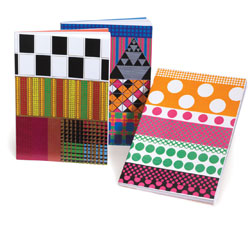
Would it be weird to start a collection of blank books and never write in them? I’m close to doing this very thing, as I stare at my “cart” page on MoMAstore.org where I have taken the first step toward purchasing three small (6″ × 4.25″) blank books with gorgeous reproductions from Eduardo Paolozzi’s Moonstrips Empire News on the covers, in an attractive slipcase yet!, for $18.95 plus shipping. Could there be anything less justifiable in this time of 40% less nest egg and 50% fewer editing jobs? Yes, the heart wants what it wants, but how to know when it’s OK to let yourself go and throw good money after something completely inessential? I have bought some really interesting and beautiful art in my day, and seeing it on my walls along with my own crazy-cool paintings doesn’t seem gratuitous at all. But to buy and display a bound book that has no excuse for being, or at least no excuse that I plan to use…?

I love blank books, especially now that there is a plethora to the nth power of beautiful, bizarre and unique ones available. For some reason, I wouldn’t think it strange to collect crosses, or anything else that has aesthetic or mysteriously subjective value, but these books are meant to be written in. Yet their practicality is often beside the point of their design, the look and the feel of them, the glossy, colorful (or leather or marbled) cover, the ribbon or elastic place marker, the gridded or lined or virgin white paper, etc.

I used to write in a journal daily and voluminously—with coffee, it was by far the best part of my day. Inspired hugely by The New Diary by Tristine Rainer, I had no rules, no expectation of sharing or even reading it again, just riffing about everything and nothing, drawing, making lists, sticking in or taping notes written elsewhere or articles I cut out of the newspaper, exploring my feelings, writing FUCK FUCK FUCK over and over again for several pages if that’s what it took. My favorite journals back then had black hard covers with red corners and opened flat with roomy, lined pages and came straight from the People’s Republic of China via Modern Times bookstore in San Francisco, until the Chinese stopped producing them or at least stopped selling them to us.

Occasionally I have succumbed to buying a blank book that I just can’t resist and have written in it for a well-intentioned page or two and then abandoned it on the bedside table or under a pile of papers on my desk because I just don’t enjoy that way of writing anymore. Now I funnel all my stray thoughts into the ‘zine (lucky you) or at least into the multitude of potential story files that will never see the light of day unless I get really, really desperate for material. Here are a few cases in point:

•    How My Body’s Production of Oxytocin after Intimate Surgical Procedures Made Me Want to Surrender Myself Utterly to Two Different—Both Extremely Unappealing—Male Gyno Doctors

•    How a Teenage Girl Held Me Hostage by Using a Hidden Phone Jack in Her Room a Block Away That Was Inexplicably Hooked into My Phone Line, Making It Impossible for Me To Dial Up {shudder} the Internet When She Talked on the Phone All Night to Her Boyfriend

•    Snowing and Blowing: Episodes 237-251

•    Reading a Year Ago That Scientists Have Discovered the Secret of Stonehenge—It Was a Burial Ground, Duh—But People Act Like It’s Still a Big Mystery

•    All the Ambiguous, Urgent Sounds Created by Electrical and Electronic Devices in the Home (“Is that the doorbell, or is my laundry done? Do I have mail, or is an ambulance pulling into my driveway?”)

•    The Millennial Generation’s Contribution to the Language by Changing the Spelling of “The” to “Teh” Because It’s Just Too Much of a Hassle To Keep Correcting the Typo

•    And a Corollary: Captioning Cute Pix and Videos of Animals with a “New Language” Called Lolspeak That Far Surpasses English in Conveying katz (& other aminals) thawts (“Wutebber u do, doan mesz wid teh kitteh”)

•    How My Long Career of Reading About Some Pretty Creepy Diseases Did Not Prepare Me for the Term “Cancer Cell Nests”—picture interlocking spiders or writhing snakes. How did such a nice word become the go-to metaphor to describe disgusting things in tight groups? And how does that change one’s mental picture of “nest egg”? When it comes to cancer cells, I prefer an empty nest.

•    Writing a New Alphabet Book in Which the Letters Aren’t A, B, and C, but A-word, B-word, C-word, etc. My thesis is that it won’t be long before our entire language (if it doesn’t succumb to Lolspeak first) will consist of nothing but euphemisms such as the ubiquitous N-word, and anyone who says the real word for N-word will be summarily arrested even if she’s talking about the word and not the people, and answering the question “Have you ever said the N-word?” will be as self-incriminating as “Have you stopped beating your wife?”

•    Finding a Beefcake Calendar That Was Hung (so to speak) in the Stall of a Women’s Bathroom at Work and Creating a Storm of Controversy by Taking It Down as a Mild Protest Against Heterogemony (hey! I thought I just made that word up, but someone beat me to it: “Heterogemony: A term that defines the hegemonic nature of heterosexuality, which, as the basic assumption of the dominant sexual group, invisibilises alternatives” [wow, “invisibilises”—I wonder how a kitteh would say that])

•    Radio DJs Talking About a Webcast They’re Watching on a Computer and Taking Calls from Listeners Who Are Also Watching and Who Are Writing Comments on the Website, and What They Are Watching Is a Guy Sleeping (so 99% of the comments are “When is he going to wake up?”), So I—Sheep, Lemming, Pick Your Metaphor—Go to the Website and Watch the Guy Sleeping, Too—Oh Wait, He Just Woke Up and Is Talking on the Phone with a Reporter About His Webcam! Ain’t This Internet Thing Grand?

***
I once read an article by someone who wondered why literate people—your writers, your editors—often use all lowercase letters, irregular punctuation and bizarre wordplay in their e-mails. It’s because we love playing around with words! also Punctuation?! and cAps. A very literate friend of mine and I like to chat by e-mail about certain TV shows (“Damages,” “The Shield”)—questioning each other about confusing storylines and making up idiosyncratic descriptions of the characters, such as NEM (Name Escapes Me) or BeardedGlassesGuy, FBIguy, BitchLawyer or, say, Sheriff Bullock or Ted Danson. What this tells you, obviously, besides our joy in neologizing, is that we keep forgetting minor details like major plot points. And both of us being d’un certain age, we’re this close to losing our minds anyway.

I would love to write an issue of the ‘zine half in my version of Lolspeak (“Isch schnowin agin!”) and half completely off-the-cuff/off-the-wall abbreviations and made-up words, fanciful stream-of-consciousness, full steam ahead, don’t give a damn if anyone can follow it—and, oh yeah, it all rhymes, at least intermittently. But no one would be able to decipher it and wouldn’t enjoy it if they could (like absinthe, these things are better taken in small doses). I’ve already had complaints about my few attempted raps. Maybe it’s time to make up my own damlanguage. I mean, if JimJoyce could do it….

[Interesting side note: On Merriam-Webster Online, the first definition of “neologism” is “a new word, usage, or expression”; the second is “a meaningless word coined by a psychotic.” I’m not sure how to take that. Et tu, Merriam-Webster?]

***
I once read a book called Anguish Languish (I just googled it, and the first result was the complete text!) published in 1956 and read on “The Arthur Godfrey Show” (“Hawaii, Hawaii” [“How are ya, how are ya”])—you kidz have sure missed a lot of great entertainment by being born so late. Anyway, the author, Howard S. Chace, wrote this book in which he took fairy tales and folk songs and substituted words that sound like the real words. “Anguish Languish” is, of course, “English Language.” Here are some lyrics to a song called “Hormone Derange.”

Harm, hormone derange,
Warder dare enter envelopes ply,
Ware soiled’em assured adage cur-itching ward
An disguise earn it clotty oil die.

I once spent a good 15 minutes raving about this fun book and reading humorous passages from it to someone I thought was a fellow language lover, and she just stared at me as if to say, “How do I get away from this person without alerting her to my utter disdain and confusion regarding this retarded book and her bizarre interest in it?”

***
That’s it for laffs. Here’s a more serious (though equally improbable) topic from the story files:

•    Compiling a Poetry Anthology That Would Constitute a Cryptic Autobiography of Yours Truly. Here Are Two Examples from Louise Glück.

Age 7:

Long ago, I was wounded. I lived
to revenge myself
against my father, not
for what he was—
for what I was: from the beginning of time,
in childhood, I thought
that pain meant
I was not loved.
It meant I loved.

Age 10:

I’m tense, like a child approaching adolescence.
Soon it will be decided for certain what you are,
one thing, a boy or girl. Not both any longer.
And the child thinks: I want to have a say in what happens.
But the child has no say whatsoever.

***
I still haven’t decided whether to order the beautiful blank books. But you’ve helped me take my mind off it for a while. Kthx.

mary’zine random redux: #19 December 2001

April 17, 2009

Wartime Edition (rated R for language and brief nudity)

Hello, people. Praise the Lord and pass the ammunition, it’s the wartime edition of maryzine.

When I was in Berkeley a few weeks ago, I saw posters on telephone poles advertising The Fuck The War Ball. To my lasting regret, I didn’t stop to get the details, but those lovely Anglo-Saxon words have been reverberating in my head ever since.

The times they have a’changed, all right. Back in the day, it was Make Love Not War. Now it’s Fuck the War. Where do we go from here? Nowadays, it wouldn’t be enough for John and Yoko to sit naked in bed to protest the war, they’d have to, well, you know, fuck.

But there are still flag-wavers in Berkeley, so I expect The Fuck The War Ball might get some anti-protest protesters. Perhaps a pro-war group will stage The Fuck The Fuck The War Ball Ball, which will in turn be answered by The Fuck The Fuck The Fuck The War Ball Ball Ball Ball. (Notice, in this flight of fancy, how Fuck and Ball keep getting repeated, and The War stays unchanged. That’s about how much effect The Fuck The War Ball is going to have on real life.)

***
I actually don’t have much to say about the war Out There. (Après la guerre, moi.) I’m experiencing my own warlike symptoms. In some weird way, I seem to be living out a parallel reality in which the armies of the night are gathering in me. Something inside me is raging, but I don’t know what or who the target is. It’s as if all the pent-up anger from my lifetime stockpile is rumbling just beneath the surface. (They don’t call me Mary Mary Quite Contrary for nothing.) I’m at war, and like The Fuck The War War, it’s an undeclared war against an unknown enemy. Am I projecting onto the world, or is the world projecting onto me? I’m a terrorist of my own self, unpredictable, unappeasable. Mentally I’m crashing into my own building, mailing anthrax letters to my own address. I’m on hyperalert for whatever I’m going to do to myself next. My inner President Bush gives stirring, morale-boosting speeches to a crowd of chanting dissidents, my alter egos. Fuck The Fuck The War The War The Ball The Ball, we echo, overpowering the voice of executive reason.

I cry out for something to be done. Call out the National Guard! Patrol the bridges! Arrest the racially profiled! Scare the citizenry! Pull around the wagons! No, that’s the wrong century!

I wanna be sedated.
—The Ramones

Terrorism and war—both the Inner and the Outer—are wreaking havoc with my personal mental health program. The psychiatrist has upgraded my dosage of anti-depressant, anti-anxiety, anti-obsessive-compulsive-disorder-sneezing-aching-coughing-so-you-can-sleep-better-to-feel-better medicine. It is my hope that 75 mg of Zoloft will soon calm the citizenry of my personal nation state. My economy is ailing, and it’s time to get out there and buy. At least I haven’t laid myself off yet.

(You think I can’t keep this up for 10 pages? Watch me.)

It’s like all this roiling, boiling feeling is rising to the top—“Double, double toil and trouble; Fire burn, and cauldron bubble.” The rage may have been triggered by 9/11, but it doesn’t seem to be about that anymore, though terrorism is certainly a handy point-of-reference/excuse/public domain/mass hysteria kind of deal. It’s almost like having permission, somehow, to feel whatever I’m truly, madly, deeply feeling, or as my friend D says, “Then there are the loons like me (and I think there are a lot of us) who are actually relieved because now the outside chaos matches the inside chaos/turmoil/uncertainty/certainty of imminent death!”

Yet despite the War on Terrorism, terrorism itself has become almost passé. The news people are all: Ho hum, another person has died of anthrax, and it’s a complete mystery because she was an elderly shut-in and never got any mail. Now for our main story, Are Americans going to spend a lot of money for Christmas this year?

***
On the other front in my personal war against self-induced terrorism is my therapist, J. Dr. P. gives me the drugs, but J has to deal with me. She’s always trying to bring me back into my body, and I’m always trying to escape. The classic therapist question is “How do you feel about that?” but J’s question is “Where do you feel it in your body?” My answer is always the same. “I don’t know!”

Therapy doesn’t follow a straight path. Why would it? Painting doesn’t; life doesn’t. It seems to go in waves—just as I’m approaching a central stumbling block-slash-snake pit in my psyche, like, for instance, my deep and scary feelings of Fuck The World (you’re all invited to The Fuck The World Ball)—bam!—something else comes up, some crisis of relationship or work or health that calls for immediate attention, and I have once again escaped facing my personal war-mongering tendencies.

If the Zoloft were still working—or at least working the way it did pre-9/11—I could possibly escape forever. But no such luck. Actually, Jeremy told me that he’s known several people on anti-whatevers who have had the same reaction. I suspect that the medication calms you down and diverts your attention from trivial frustrations, and then Just When You Thought It Was Safe To Go Back in the Water, your inner Godzilla rears its ugly head. (Godzilla, Jaws, whatever.)

By the way, Terry pointed out the synchronicity of the word “God” in Godzilla, which completely escaped my attention in last issue’s riff about the tableau on the back of my washing machine (Godzilla v. Buddha), but you can’t go home again to already-overblown analogies, so never mind.

Anyway, I was at therapy one morning recently, complaining about my constant headaches and other psychosomatic preoccupations, when I told J how angry I’ve been feeling since 9/11. I started crying, which is par for the course, and got up to retrieve the Kleenex from her bookshelf. She just moved our sessions to a new office, so the accoutrements so necessary to the therapeutic process are not yet in place, including an end table for the couch. I brought the Kleenex box back to the couch and “jokingly” said, “I’ll just put it on the TABLE” and dropped the box where the table should have been. Even as the Kleenex box was falling to the floor, I realized how much aggression there was behind my “joke.”

J is nothing if not sharp as a freakin’ TACK, so she immediately said, “Do that again—but organize it.” My somatic task was to exaggerate the gesture, bring the anger out from hiding behind my sarcastic wit. So I picked up the Kleenex box again and tried to throw it to the floor instead of just letting it drop. This was surprisingly difficult to do. I kept working at it—I must have thrown it down 10 times or more—and discovered that I was afraid to “hurt” the Kleenex (or something that the Kleenex represented?—Après la Kleenex, moi?) The box was starting to get torn and crumpled, and the tissues kept threatening to fall out. It was really strange to see how afraid I was to let my anger out, even against an inanimate object. (But then some physicists think subatomic particles are sentient beings. I kid you not.) (2009 update: That’s probably just as ignorant as Sarah Palin complaining about “fruit fly research in Paris, France, I kid you not.” For all I know, sentient subatomic particles are the Drosophila melanogaster of the physics world.)

So then J decided to give me something to abuse that would be a little more sturdy, so she rolled up a throw/blanket/shawl kind of thing that was on the back of the couch and told me to “beat it.” I started to leave—no—I started to bang it on the couch cushion. She wanted me to really get into it and even say words—whatever came to me—as I hit the couch. At first, little pipsqueak “nos” and “fucks” came out. But gradually, I lost some of my self-consciousness and managed to make a few loud noises, NO, NO, NO, as I beat that cushion into submission.

“What did you learn in therapy today?”
“Watch out or I’ll beat you with this SHAWL.”

When J let me stop, I had little time to be relieved, because then she wanted me to use the beating-something-with-every-fiber-of-my-physical-being VOICE to tell her how angry I was. It didn’t even have to make sense, it was just a way to practice coming from this other place. But that was even harder than beating the couch. All my so-called anger, even when I was making it up—“How dare you not bring me coffee this morning?”—came out in this thin, teary whine that I immediately recognized as my natural voice. I just couldn’t get down in my diaphragm and even pretend to be angry. I kept having an irresistible urge to laugh or make a joke—ah, what is that they say about the hostility in humor?—or I’d start crying again. The experience was mortifying—but then, “else what’s a therapy for?”

As I was trying to summon up my angry voice, this great analogy came to me. (When I’m trying to get out of working on somatic patterns and feeling feelings in my body, I like to impress J with my brilliant metaphorical skills.) I told her that I felt like Moses parting the Red Sea. (Inflated much?) I felt as if my attempt to speak with a clear, angry voice was like Moses parting the waters and then having to walk through the dry path with all his people while the temporarily suspended waves on either side threatened to drown them all. (Dry path = my anger; waves = my whiny tears.) I tried to fit J into the analogy, but casting her as the Pharaoh didn’t go over real well, and I realized she wasn’t chasing me anyway, she was on the other side of the sea urging me on. I said I didn’t know what was on the other side of the sea for Moses, and she said “the wilderness, the unknown.” That sounded about right. She also pointed out that Moses never claimed to know what he was doing, he was just obeying God, and that sounded about right, too—at least the not-knowing-what-he-was-doing part.

The reason this exercise was so hard for me was that I have perfected my mother’s art of “expressing” anger through silence and withdrawal, which had the all-important safety feature of putting her out of reach of a counterattack. The other person (usually me) could use the same tactic back at her, but then nothing was ever aired and no one was ever happy. Conversely, my father, a helpless invalid, raged and hollered all the livelong day and it never got him anywhere, because my mother could literally walk away from him. One time when he was bellowing about something or other—she had taken too long to come back from the store, or she had leaned her breasts on the table while playing Scrabble, and Vince, another guy with multiple sclerosis, had been eyeing them—she hauled him into his wheelchair and wheeled him out of the house, down the ramp, and out to our deserted country road where he could sit and rage at the woods to his heart’s content. Naturally, that stopped him cold. My mother never lost a fight.

Lately, I’ve seen what a dead end this tactic of angry withdrawal truly is, but I’ve despaired of learning new tricks at my ripe old age. It was probably a dead end for my mother, too, but at least she had us kids to pass the silent gene on to. I’ve noticed that my sister’s deepest expression of anger is a heartfelt, sarcastically tinged “Huh.” Since my mother was an aspiring writer, you’d think she would be a natural talker, a creative wordsmith of emotion. (But then my father, the Irish talker, never had the urge to read or write.) But I’m reminded of something Adair Lara wrote: “… you have to be pretty good at language to get the full savagery from silence.”

So my assignment for the next few weeks is to beat the bejesus (bemoses?) out of my mattress and holler like a banshee while I’m doing it. It should be easier to do this without an audience, although I’ll probably worry about my neighbor Kim hearing me through the wall. I just can’t seem to admit to myself that it’s the sound and fury itself that scares me.

***
This is what I dreamed after that therapy session:

I have a PENIS, which is fairly new, and I’m looking at it and thinking it doesn’t look very big. I remember that most guys measure theirs, so I decide to do that. I feel down at the base of it to see where to measure from, but then I remember that you’re supposed to measure it when it’s erect. As I have that thought, I immediately start to get erect, and the penis gets longer and longer and curves up and touches me between my eyes. I’m so impressed.

I also dreamed that I was really angry at a guy wearing bright orange pants, and I yelled at him and pushed him down and started shoving him with my foot.

Pandora’s Box much?

***
So, getting back to the world Out There, it’s becoming harder and harder to read the newspaper these days. There’s just too much information to absorb—every day, some shocking new report of a world that has forever changed. Take this headline from the S.F. Chronicle of November 11: “People turn to food to ease terror anxiety.” I was floored when I read this. A proven link between food consumption and anxiety? Get out! I scanned the article for more details about this amazing finding.

People across the country have turned to food—from chocolate to mashed potatoes to peanut butter and jelly—to deal with the anxiety of the Sept. 11 attacks and anthrax scares, according to dietitians and psychologists.

“What’s one more chocolate?” asks Almquist, 24. “It seems a little strange to be obsessing about something like that when there’s so much more going on.”

Zumberge, 49, typically would think twice about indulging his sweet coffee craving. “But now? Not so much,” he says.

[Some] say they don’t need the added stress of carefully watching what they eat. “Why do I want to put myself through that right now? There’s enough stuff going on,” said Johnson, 36, a Newport Beach receptionist.

I skip to the end of the article to see if there is some explanation for this stunning new evidence of the mind-body-food connection.

Clinical psychologist Emanuel Maidenberg said Johnson’s feelings are not surprising. “Food of that kind is typically associated with pleasant feelings—comfort, relaxation, calm,” said Maidenberg.

Whoa. Talk about food for thought. I put down my bag of chips—no, actually, I stuff another fistful in my mouth as I consider this possibly life-changing information. Could I possibly be—gasp—using food as a way to deal with my war-induced stress? I review my food choices over the past couple of months. Hmm. A steady diet of hamburgers, enchiladas, meatloaf and mashed potatoes, popcorn, chocolate, Ben & Jerry’s….. I know I have to take a long, hard look at myself to see if my eating habits have been affected by 9/11. Let me think. Nope, nothing’s changed.

***
This is how I torture myself. One day I bought a Hershey bar and put it in the cupboard, hoping to forget about it so that when I was desperately wanting a treat sometime, and I despaired of finding anything suitable in the house that would be a good substitute for whatever it was I really wanted, I’d suddenly spring up like Einstein discovering relativity and cry “Eureka! I have chocolate!” The problem with that plan is that first you have to forget the chocolate is there. I wouldn’t let myself have it if I couldn’t forget about it, but if I could forget about it, I wouldn’t have come up with such a ridiculous scheme in the first place. I was in a mental prison of my own making, and a bar of chocolate with almonds was my jailer. The more I rattled the bars of my cage, the harder the jailer laughed. “Eat me!” he cried. (I know it was a he, because it had nuts.) (Oh God. Now I’m channeling the teenage boys who used to torture me with this “joke” when I was working at the snack bar in the park.)

***
To distract myself from the thought of food, I hurry past the terror-anxiety news to the entertainment section of the paper, where I hope to escape into fantasy. But once again I am faced with shocking revelations:

“Shallow Hal” actress found she wasn’t the center of attention in a fat suit.

You’ve got to be kidding me! I can’t take this!

In this movie, Gwyneth Paltrow, beautiful movie star and daughter of a beautiful movie star and a movie producer, plays a 300-pound woman, a role for which she wears a fat suit.

She donned the fat suit and makeup for a day and walked around the lobby of a New York hotel…. At first she was concerned that the crowds in the lobby would figure out who she was right away. To her surprise, no one did. “People wouldn’t even look at me,” Paltrow says with astonishment. “They wouldn’t make eye contact with me at all. It was awful.”

The actress says she experienced a similar reaction whenever she wore the fat suit on the set. “I felt no sexual energy from men,” she says.

After I pick myself up off the floor, I go straight to the cupboard, fall on the Hershey bar, and tear off the wrapper. I think about saving half, but—ah-hahahahahaha. Later that afternoon, I have that moment I had been waiting for—the moment of despairing of finding anything suitable in the house that would be a good substitute for whatever it was I really wanted. But by then, of course, it’s too late.

C’est la guerre.

I’m going to lick this food thing yet. But first, I have more to say.

***
I do not seek novelty.
—Kay Ryan, poet

I am an enjoyer of repeat experience. Others are drawn to the new; I’m drawn to the been there–done that–enjoyed that–let’s do that again. I generally order the same food in the same restaurants, and I can identify my menu item of choice in just about every restaurant I’ve ever been in. I’m a serial monogamist when it comes to food. In Ann Arbor one summer, when I was 23 and very much alone, I ate a chili dog for lunch every single day. Peggy can attest that I have been searching for a chili dog of that caliber ever since. Maybe it was my need for comfort, not the chili dog itself, that made it such a tasty, satisfying treat—the old mouth-of-the-beholder theory.

Actually a lot of my favorite comfort food comes from Michigan, which is odd in one sense, because my home state is not exactly a culinary paradise. But I guess the whole point of comfort food is to remind you of your childhood. Except, if I wanted to be reminded of my childhood, you’d think I’d be craving pasties (not the little circles that cover a stripper’s nipples but a horrible vegetable pie that the U.P. is known for); creamed salmon and peas on toast (known to my ex-Army dad as shit-on-a-shingle); boiled New England dinner; a dozen varieties of “hot dish” (hamburger or tuna casserole with noodles and canned vegetables); and lime or orange Jell-O with fruit cocktail suspended inside. True, in the summer there was corn on the cob (13 for a quarter, picked that day from the farm next door), potato salad, baked beans, hot dogs—to this day, my favorite food is picnic food—and my mother was an excellent baker. She made the world’s best pie crust—I have yet to taste its equal, and that goes for all the fancy-schmancy crumbles and crisps I’ve had in Bay Area restaurants. Sometimes, all we’d have for supper was strawberry shortcake, if the strawberries were fresh and that’s all anybody (i.e., my mother) wanted. Sometimes we’d have only rice porridge, a Danish rice soup that was basically dessert by any other name—rice cooked in milk, to which we added butter, cinnamon, and brown sugar at the table.

As a kid, I generally refused to play with any gender-appropriate gifts I got—especially dolls—but I did like the little Easy Bake oven I got for Christmas one year. Down in the basement, next to the wringer washer, I would bake little chocolate cupcakes from the tiny boxes of cake mix that came with the oven. I think what I liked was the miniature size of everything—the oven itself, the little pans and pink spatula, the bite-sized cupcakes—and the privacy, the solo adventure in micro-cookery that seemed almost scientific in its precision. Obviously, my mother had an ulterior motive for giving me this gift, because she kept hauling me up from the basement to the grown-up kitchen, where I was supposed to transfer my newfound culinary skills to making pork roasts and boiled potatoes for the family. I never really made the transition—I had my own ideas about what I was going to do with my life. When I got the Junior Betty Crocker cookbook as another gift (I never realized how pointed so many of those gifts were), I was drawn to the recipes primarily as esthetic arrangements. I wanted to make what looked good in the pictures. I was more interested in the art—the red tomato soup offsetting the white and yellow of the egg salad sandwiches—than in throwing together whatever leftovers were in the fridge.

I also tried out some of my irrepressible religious humor when I made this supper:
“It’s like we’re eating the body and blood of Jesus.”
Silence.
“I say, it’s like we’re eating the body and blood of Jesus.”
“That’s enough,” says Mom.

I thought of my Easy Bake oven experiences when I read about a panel of professional chefs who competed in the Easy Bake Oven Bake-Off. They had to use all the creativity and skills at their disposal to bake their dessert specialties in the tiny toy oven, which is nothing but an aluminum box powered by a 100-watt light bulb. The winning entries were a huckleberry tart topped with goat cheese ice cream and a chocolate flourless cake. The most surprising thing I read in the article was that the Easy Bake oven “was introduced to the market in 1963.” I figured it must be a typo, because that made me a junior in high school when I was playing cupcake chef down in the basement. And why was my mother giving me such a thing at that age anyway? Well, that’s more understandable. For my 21st birthday, she gave me Pat Boone’s book of advice for teens called ‘Twixt Twelve and Twenty. I guess she couldn’t do the math.

I was going to say that this ‘50s nostalgia thing is really getting out of hand, but I guess instead it’s this early ‘60s nostalgia thing that’s getting out of hand. However, I’m pretty sure paint-by-number was around when I was an actual child. Believe it or not, even that is becoming trendy, in an all-things-kitschy-are-in-again kind of way. Some guy has a huge collection of these paintings and is trying to make sociological/historical/cultural/financial hay out of this supreme example of noncreativity. In the article I read, he was quoted as saying, “Some people actually painted these paintings to hang on their walls,” and I thought, “Yeah, you got my family pegged.” Well, my mother never did that, but my aunt put up the paintings that my cousins did. I am so torn right now between being sarcastic about the condescension of trend-spotters who exploit unsophisticated people for financial gain and getting all condescending myself about the unworldly pleasures of the people to whom I was born. Or maybe I’m not really theirs, maybe they found me in a basket in the bulrushes. (I am inflated much.)

But when it’s all you can do to survive and raise a family and you aren’t exposed to art (except Norman Rockwell—who’s also making a comeback, by the way) or music (except Lawrence Welk, ‘nuff said) or books (except possibly Reader’s Digest condensed books), you really don’t know any better. And that is the eternal shame in being working class (a.k.a. white trash) in this country. You don’t have the right clothes, the right accent, or the right knowledge about the right things, because you never had the financial means to buy yourself 4 years of leisure (a.k.a. college) to become more discerning. If you’re lucky, your kids manage to elevate themselves enough to get an education and come back to make fun of you for your primitive preferences. I could go on and on about class and about what it’s like to have come from that background and then try to fit in with people who assume you had the same privileged background they did, and maybe someday I will.

But for now, I think I’ll call it a day. It’s a day. No comments from you-know-who (starts with “P” and ends with “e”). Our latest noteworthy encounter was when I gave him a “bath” with a waterless shampoo that smells (a.k.a. reeks) of tea tree oil, with which I had had no prior experience. It was frustrating not to be able to explain to him how lucky he was, that it was this or get hauled down to the professional cat shampooers for the full treatment. (They should have a cat wash, like a car wash; just strap ‘em in and run ‘em through.) Afterward, I felt sorry for him, because he kept trying to get away from the smell by getting up off the floor and hunkering down on straight-backed chairs for a few moments before moving on. I knew just how he felt. It’s hell not to be able to get away from yourself when you want to. I’ll have more to say about that next time, I hope—after beating my mattress with a towel every day and yelling FUCK YOU to the universe (The Fuck The Universe Ball, why not), possibly getting myself some bright orange pants in which to haul around my gigantic new PENIS—oh, and I suppose BALLS go along with that. And so we come full circle.

mary’zine random redux: #13, April 2001

April 12, 2009

desire → illusion → intimacy → passion

I don’t know, I may have bitten off more than I can chew this time. Desire, illusion, intimacy, passion; those are some mighty heavy topics, and I only have about 10 pages in which to wax wise. But if my eyes are bigger than my stomach (a phrase you don’t hear much anymore), well, maybe we’ll have leftovers next time.

If those words were plastic beads, you could snap them together to make a bracelet—desire into illusion into intimacy into passion into desire again—and of course you could make and remake that bracelet putting the beads in many different sequences. Indeed, you may question why I put illusion so close to desire. Hey, make your own damn bracelet. I haven’t included love in this word bracelet, because love is the background, the subtext, the raison d’être for all the others. The comparison with plastic beads doesn’t hold up that well, because all those words stand for states or experiences that are overlapping and interrelated, and each one has many different aspects. So this ‘zine bracelet is going to be idiosyncratic and incomplete. For sure, it will raise more questions than I have answers for. Are we done disclaiming yet?

During the writing of this issue, it became clear to me that desire, illusion, intimacy, and passion have been the primary themes of my several years of therapy. Therefore, I dedicate this issue to J, who has guided me through that difficult terrain with a steady hand and an open heart.

***

As soon as I finish each mailing of the ‘zine, I start thinking about what I want to write about next. It’s always a treat to be able to start over. The editing and refining process is fun, but by the time it’s done, I’m so sick of dogs, cats, or parallel universes that I just want to move on. Fragments of old stories start coming to me, along with a few words or feelings that I don’t know how to connect. It’s a lot like starting a painting—plucking images out of the air, out of the stream, dragging them up from my heart, trying to capture just the right one, the one that’s ripe, the one that “wants to be painted.” This issue in particular is like a painting, or a collage, or a pastiche, a riff on related topics and fragments and intuitions that want to be expressed… a hugely unscientific investigation into some of the secrets of the human heart.

desire

On the lazy days when I have no work, my round of errands out in the world provides the perfect amount of stimulation and human contact to offset a nice long afternoon nap. Today I make only two stops. First to Long’s for Sudafed and airmail envelopes. The checker in the express lane is a dull-looking young woman wearing an American flag pin who moves like she’s underwater. Note to Long’s management: Great idea, putting her in the express lane. I make a point of being nice to her, though she seems barely aware of me, and I wonder how many random acts of kindness are completely lost on the recipient. Do the kindness molecules of my good intentions, if wasted on her, land on more fertile soil elsewhere—or is kindness one of those things that are their own reward, like not cheating on your taxes? Actually, I’m being too generous to myself to call what I’m feeling “kindness.” I judged her from the moment I laid eyes on her, and I resent her inattention. And molecules can’t be fooled. My impatience molecules probably filled the store and spilled out into the parking lot before it even occurred to me to relabel myself as “kind.”

[That paragraph had nothing to do with desire; I’m just getting warmed up here.]

At Andronico’s, my second stop, the checker is the complete opposite of the one at Long’s: smiling, cheery, her happy wishes for a good day accompanying each shopper out of the store like an arm around her shoulder. She has great molecules, and I feel mine responding (no, not that way). This is an uncharted—or at least misunderstood—area of retail management. Don’t, like Safeway, coerce your employees into exuding fake good will and practically running customers down in the aisles to say “good morning” through clenched teeth. Make the employees happy and their molecules will do all the work. You’ll have customers humming and smiling (and buying) without even knowing why. This is good for your bottom line and good for humanity. I should write a book called The One-Minute Molecular Manager.

[I’ll be writing about desire any minute now.]

Gravitating toward the cheery checker, I unload my groceries on the conveyor belt and am a bit surprised to see that I have bought nothing but vegetables and fruit—apples, asparagus, bananas… looks like I’m shopping alphabetically. It’s a misleading indication of my diet, of course, a statistical aberration. But still an accomplishment. Getting in and out of the grocery store without being lured, Siren-like, to the popcorn and chips, the candy aisle, or the bakery is something to celebrate, even though the celebration wears a bit thin later in the day when I realize I have nothing to snack on but green bananas and the fruit that Eve inexplicably found so tempting.

The more common situation while shopping is that I’m overcome with base urges, as if I’m 10 years old again and coveting the red-hot fireballs or Hershey bars or Nehi pop, except that now I don’t have a mother to police me, and I have money in my pocket. (That’s the cruel irony of adulthood—once you’ve got the freedom and the cash, you can’t afford the calories.) But twice, recently, over the feeble protests of my conscience, when I marched over to a forbidden aisle to grab a Frappucino or a bag of popcorn before good sense and the memory of my profile in the bathroom mirror that morning brought me to my senses, the store was temporarily out of the product. And in both cases, I had a weird feeling about it. I’m standing in front of a solid wall of salty snacks, but the 4 square feet of shelf that is supposed to be filled with YaYa white popcorn is bare. (The cheese popcorn is there, but perversely, I like it too much to even consider it.)

I imagine a “Twilight Zone” episode in which everything the middle-aged shopper decides she wants is mysteriously missing from the shelf—sending her careening more and more frantically through the store as she gradually comes to the realization that her desire for something is precisely what is making it disappear! She tests her dreadful hypothesis by pretending to desire things she’d never really want, like circus peanuts or Brussels sprouts, and those are gone too! And the moral of the story, delivered in the sepulchral tones of Rod Serling, is that she has unwittingly made a bargain with the devil to keep herself on a diet, asking him to remove temptation from her path, and now she can never have anything she wants ever again! A world without cake and cookies and chips and ice cream—a tragic episode on a par with the one where the man who wants to do nothing but read finally gets his wish when everyone else dies in a nuclear holocaust, but then he breaks his glasses. Be careful what you wish for, indeed!

This fantasy tells you everything you need to know about me and desire, especially when it comes to relationships. For as long as I’ve been aware of other people as romantic prospects, I’ve been chasing the ones I can’t have—the teachers, the straight girls, the married women or men—the ones who are never really a possibility in the first place. Looking for love in all the wrong places has caused me much needless suffering. Thanks to J, I’ve come to understand that I’ll never get what I should have gotten as a child—the mother love that was so erratic and elusive as to be “Twilight Zone” material in itself. I’m pretty sure my days of lusting after the unavailable ones are over. [2009 update: Yup, it’s all gone.]

But I’m still a work in progress—it’s still hard for me to admit what I really want—or even that I want anything. I suspect that I resist knowing what I want, because then I would have to do something about getting it. So I substitute food—a commodity that, though easily acquired, necessitates much time-consuming thought and drama, the perfect distraction. This is hardly an original observation. When I went to NutriSystem several years ago to lose 20 pounds (which I did—and then they magically found their way back home), the mantra was “Don’t eat for emotional reasons.” Yeah, right. Might as well tell me not to breathe so often. Anyone can substitute a carrot for the cake that is a substitute for mother love, but it’s a temporary fix at best. Enjoy your five minutes of self-congratulation over choosing the carrot, because tomorrow you’re going to face the same choice all over again. Desire is relentless when the object of desire is a replacement for something much more fundamental. And maybe that’s all desire is, anyway—a misdirected passion. But I’m getting ahead of myself.

(p.s. Meaningless sex can act as an effective distraction, too, but I’m hardly an expert in that area. Food is from Venus; sex is from Mars.)

illusion

Love is giving something you haven’t got to someone who doesn’t exist. (Jacques Lacan)

I could write all day about how illusion has manifested in my life, but I’ve chosen just two examples that are cruelly, ironically, and instructively complementary.

When I was in high school, my senior English teacher, Ruth, almost literally saved my life by seeing me as a real person (“not a young adult, but an adult-adult,” as she put it) at a time when I felt completely unseen by anyone. She was only 29 years old, but she was the prototype for my later attachments to older women who were wry, intelligent, and completely unavailable. Former high school athletes like to relive their glory days on the football field or the basketball court; my equivalent of that was being Ruth’s prize student. Her amazement when I pointed out the obscure rhyme scheme in a Robert Browning poem (which she had never noticed) warms my heart to this day.

Ruth and I corresponded through my early college years, but my student radicalism was too much for her (according to her mother, with whom I was also friendly), and the letters tapered off. I wrote her again when I was in my mid-30s, to bring her up to date on my life, and she seemed delighted to hear from me. In her last letter to me, she confessed, “You were always my favorite.” But then she stopped writing. She was an extremely reserved person, and I thought she was probably having second thoughts about taking the student-teacher relationship to the friendship level.

In February 2000, right after I mailed out the first issue of the ‘zine, I had a dream about her:

I’m at a reunion where I meet up with some former teachers. One of them praises my writing. I wrote a story back in high school that they say I could finish now and it would be really good. Ruth is there. We’re all saying good-bye, and I ask her if she remembers that story. She doesn’t speak. I ask her why she stopped writing to me. Again, she doesn’t speak. I say, “It’s really great to see you.” We hug, but she breaks away first. As we’re leaving, I feel as if I can finish that story now.

I told my “dream counselor,” Jeremy, the dream, and he encouraged me to send Ruth a copy of the ‘zine. I realized I had nothing to lose and thought that after several years of therapy I was more capable of relating to her as another adult rather than as the figure on a pedestal where I had placed her so many years before. I sent her the first couple of issues without including a letter. When I heard nothing back, I wrote to her, making it clear that it was up to her how much, if any, contact we would have. She never responded, and the ‘zines and the letter never came back to me, so I can only assume she received them and made a conscious decision not to reply.

A few months later, I dreamed about her again:

Peggy and I go on a trip to see Ruth. I have sent her several of my writings, and she hasn’t responded. There’s a feeling of heaviness in the dream, because I’m not getting what I want from her. Ruth doesn’t talk to me directly but tells Peggy that she’s feeling pressured because of my expectations of her. Peggy says I’m like my mother, and Ruth says, “There’s nothing to be done about Mary or her mother.” This makes me feel even worse. Ruth has written a book called A Full and Complete Explanation of the Entire Universe. I read a review of it, and the reviewer ridicules the book, disputing her claim that a certain event is “seven-eighths into the history of the universe” because how can she know when the universe will end? I take the review and place it where I know Ruth will find it, so she’ll see that I know she isn’t perfect. Then I realize that this is the topic for my next ‘zine. The dream shifts, and we’re with Jan (a painter from our group who moved to Taos), and we’re about to make masks. Jan says to make plain masks, no decoration at all.

I don’t think I ever got to tell Jeremy this dream, so the nuances are lost to me; but on the simplest level, the dream was a wake-up call. I had idealized Ruth when I was at a difficult place in my life and desperately needed an adult’s respect and encouragement. But I remained emotionally 17 years old in relation to her (or 5, or whatever my real emotional age was then). Although I mourn the loss of her, or rather the loss of the illusion, I respect her for not giving me the false hope of resuming a relationship she wasn’t comfortable with. How could she ever live up to the image I’ve been carrying of her all this time? The dream is stark, with a fellow painter telling me to create a plain, undecorated mask—which I think means to face the truth. Ruth [four-fifths of truth, I just realized] did rescue me, but that was in the past, when I was a child. Such a relationship isn’t meant to survive—the child has to grow up.

Because it seemed that the dream was literally telling me to write about Ruth in the next ‘zine, I drove myself crazy trying to make it work, but it wouldn’t come together. Instead, I wrote about caffeine and food “addiction.” And maybe in a roundabout way, I was writing about her after all, or about the underlying truth of the dream, because my attachments to unavailable women were an emotional crutch similar to my use of food and coffee.

Ruth and I never hugged in waking life, though we’ve hugged many times in my dreams. She always breaks away first. I think it’s time for me to finish that story.

***

I was reminded of my “Ruth story” a couple of months ago when I got a card from a woman, A*, whom I was friends with in grade school and junior high. But in high school, I moved on to my bohemian stage, and she, to put it mildly, wasn’t intellectually inclined. We have had virtually no contact since then; the only time I’ve seen her since high school was at my mother’s wake 10 years ago. She never left our hometown, never went to college. She still runs into my sister quite often, and the last time she saw her, she asked if I was ever coming home again. My sister cheerfully replied, “Probably not.”

The grade school we both went to had a reunion last summer, and A* took pictures of the group of ex-kids and our teacher, Mr. Mayer. She sent the photos to me in a greeting card that had a sentimental message about “old friends,” along with a tea bag that I guess was meant to represent us getting together. She wrote in the card that she missed me and thought of me often. The stalker music from “Jaws” rang in my head when I read that.

I feel terrible, knowing how much she wants to recapture our childhood friendship. I want to judge her for being delusional, since I have given her no reason to think I would ever be receptive to her—but when I think of my continuing fantasy about Ruth, I wonder, what’s the difference? Well, I have Ruth’s statement of “only” about 15 years ago that I was “always her favorite.” A* has had no such statement or sign of encouragement from me. But clearly, she has made something huge out of our being Girl Scouts together in the fifth grade and is revisiting the past just like I am—only it’s a different past. I’m delusionally trying to recover an important relationship with a teacher, and she’s delusionally trying to recover an important relationship with a grade school pal. I have no intention of revisiting the past with her, as Ruth apparently has no intention of revisiting the past with me. (I can’t even write that sentence without the word “apparently”—just in case she’s been in a coma for the past year and doesn’t know I’ve been trying to contact her.)

It’s weird to be on both sides of this waiting game—to seriously consider that Ruth might want to be in touch with me again but to be incredulous that A* thinks we could go back to being 10 years old. I want to say to her, “What are you thinking? That was 44 years ago!” But then I’d have to say to myself about Ruth, “What are you thinking? That was 37 years ago!”

It’s sad. It’s sad that we keep the past alive for a lifetime, never allowing reality to reset our clocks, insisting on staying on childhood saving time forever. I haven’t answered A*’s letter, even to thank her for the photos. I feel bad about that, but it doesn’t seem like a kindness to encourage her. Ruth is apparently doing the same “kindness” to me by not encouraging me in my never-completely-extinguished high school crush.

intimacy

It seems pretty obvious what we mean by intimacy, but when you get right down to it, is it about the close contact of two separate people, or is it about the two dissolving into one? Is it the two coming together, or the One becoming ascendant? Or are those both ways of saying the same thing? Intimacy implies, at the very least, a blending of molecules, a contact that dissolves the boundary between the two people somewhat, on whatever level. This blending of molecules, as I have previously postulated, can take place between strangers and even between strangers engaged in a financial transaction over fruits and vegetables. The human heart is always available, if not always put to use.

For me, and I suspect for many people, friendship is a more acceptable source of intimacy than a “love” relationship, because it tends to have stronger boundaries—but within those boundaries you can go far into another’s heart, and allow them into yours. I’ve been blessed to have many intimate friendships as well as intimate contacts with people—especially other painters—with whom I don’t necessarily share much on the surface. Sometimes the intimacy is expressed in special moments, more often as a solid foundation that is known to both parties whether it’s spoken of or not.

Anyway, for my purposes here, I’m more interested in exploring some of the far borders of intimacy. If we say that one form of intimacy is about the One becoming ascendant, then the most intimate moment of my life was with a man I did not even like very much. It wasn’t about the two of us at all, which is the interesting thing for me, since we tend to assume that intimacy is attraction verging on merging. The “intimacy,” if that’s what it was, between me and this man was an accident but one of the most authentic experiences I’ve ever had.

I was with a group of friends, and we were all hugging and saying good-bye in a dark parking lot after a workshop we had done together. The then-object of my affections had just said something hurtful to me, and I was crying. I distractedly hugged this one friend, and before I knew it, something extraordinary happened. I didn’t know at the time that he was also suffering in a love relationship, but when we hugged, my tears and desperation must have triggered his own grief, and as I collapsed into him, he collapsed into me. The result was that we lost all barriers between us to the point where we did not exist as separate entities. I am not being metaphorical or intellectual here. It was absolutely real. Somehow, in our coincidentally self-involved suffering, the two of us merged into one sufferer. I was still aware of myself, but I knew that the “self” I was aware of was not me, it was—and I don’t quite know how to put this—more like a state of suffering or a kind of archetype of suffering before it becomes differentiated into what we think of as our individual, separate pain. Think of Life as the contents of a huge funnel, and the funnel empties into each individual consciousness-of-self through separate little tubes. This man and I were temporarily in the wide part of the funnel above where the tubes dispense the doses of “individual” suffering.

When we broke the hug, I didn’t say anything, but he said, “We were one person there for a minute, weren’t we?” So that confirmed what I already suspected, that the experience had not been just a one-sided insight. It will be terribly embarrassing if it turns out (and I only now had this thought) that this wasn’t such a unique, amazing experience after all, that it’s exactly what people mean when they say they lose themselves and merge with their partner in sex. (That has not been my experience of sex.) So if I’m being ridiculously naïve here, will someone please clue me in?

In our case, the disappearance of the self left only a pure form of suffering, as if there’s a vast reservoir out there (the funnel) that contains or embodies or expresses the aching of all the hearts that have ever suffered. We were not interested in each other, we were not “sharing,” we were not one person comforting another or even two people comforting each other. We were simply two collapsing selves disappearing for a moment into a greater reality, and in that sense, there was something comforting about it. It was like getting a glimpse of death and seeing that death is only a shifting of perception from the little “I” to the universal “I” that encompasses everything. Even when the little “I” no longer exists, something does—and it’s something huge! And yet anyone who wants to know about “life after death” wants the assurance that the little “I” will still exist and know itself. As if this limited form we inhabit is of the utmost importance—like a falling leaf worrying so much about its own death that it doesn’t even consider that the tree lives on. It’s all a question of what we identify with.

So, was that intimacy? Can you get more intimate than being One in the Greater Reality?

***

I want to talk about another unusual form of intimacy I experienced, though I’m not sure that’s the right word for it. I was not a direct participant but only a witness—but perhaps the witness becomes a participant in intimacy by the very act of witnessing, as long as her intention is not voyeuristic or exploitative.

In the early 1970s, when I was working at a small college in Minnesota, a couple of famous blues musicians—Buddy Guy and Junior Wells—played a gig on campus. After their set, they called a couple of students up on stage who played in a local band. This one boy, a short, chubby guy, got up there with his guitar and started “jamming” with the Buddy Guy band. He looked thrilled and ready to piss his pants at the same time. After he had played for a bit, Buddy Guy came up close behind him, put his arms around him so he could reach the strings, moved the boy’s hands into position, and played with him, showing him a few riffs. They made quite a contrast—the taller, muscular black man with his arms surrounding this soft white boy, pressing up against the boy from behind—and I swear, the kid was either gay already or turned gay on the spot. The shiver of ecstasy that crossed his face was the most naked expression of desire—or rather, fulfillment of desire—bliss, really—that I have ever seen.

The image of that face is impressed on my brain forever. It was such an intimate moment that I felt that I—and everyone else in the audience—was an integral part of the experience. Who knows what happened to the boy later, what disillusionment or disappointment he may have felt in the aftermath, like a hangover of the heart—every fantasy realized comes to an end, after all—but it was one of those once-in-a-lifetime moments.

Now clearly, this was not a story of two coming together—at least not the boy and Buddy Guy—nor was it about the One becoming ascendant. But as I watched, I felt myself merging with the boy’s deepest feelings—not in the Greater Reality sense but in the deeply human sense—and that, for me, constituted the intimacy. The intimacy was in my role as an unintended witness to another’s intense experience of himself. Instead of being “touched by an angel,” I felt I was touched by humanity—the humanity in all our hearts, expressed by one boy having his dream come true.

passion

To be nobody-but-yourself—in a world which is doing its best, night and day, to make you everybody else—means to fight the hardest battle which any human being can fight; and never stop fighting. (e.e. cummings)

Throughout my therapy, J has challenged me to identify my passion. When I had a job, work was all-consuming, at least of my time, and then when I became self-employed, work was really all-consuming. I was terrified of becoming a bag lady, so my whole focus was on survival. The friends who were so confident on my behalf had no idea how hard it was for me to believe it would all work out. Emotionally, it was like being thrown back to my childhood, when I worried that we would literally have to go live in “the poorhouse.” (This idea must have come from one of my father’s colorful sayings.) While my mother worked as a clerk at Montgomery Wards, I weaved potholders and sold greeting cards and built picnic tables with my father (who had MS) to make ends meet. For a couple of summers, when he could still walk, we picked green beans out in the fields with the migrant workers—now there’s a job from hell. And speaking of hell, may one Mr. Johns of Menominee, Mich., rot there for cheating me out of a week’s wages at the end of our last summer. I can only imagine what he was doing to the migrant workers. I would never have believed, as a child, that someday I would not know to the penny how much money I had. I am unimaginably wealthy now, in comparison, but the fear of falling into poverty again is very real—as if I’ve managed to crawl halfway up the slippery slope of the middle class and have nowhere to go but down from this point on.

But I’m supposed to be talking about passion. It’s safer, in a way, to concentrate on where my next dollar is coming from than to act from a place of—what’s that new age word?—abundance. I think passion is related to abundance in the sense that you have to believe that something beyond sheer survival is worth having, worth doing, worth sticking your neck out for—and possible to achieve. I not only don’t believe that I can have abundance, but I’m afraid of it somehow. Even when I had nothing, I was always afraid of what would happen if I had too much. Like when our high school debate club needed to borrow a car to go to an out-of-town tournament—everyone else was saying, what if we don’t get one, and I was thinking, what if we get two? I know at least one other person who has this same tendency, so I know I’m not the only one.

I seem to have a fear of desire, a fear of wanting—a fear of having? I can want what I know I’ll never get. I can want the little things, the potato chips of life, but then I have to put them out of reach, too. And so goes the merry-go-round of desire and substitution and unrequited longing. It’s not worth having if I can have it. Something like that.

***

One of my better found-TV moments was coming upon a talk by Anne Lamont at Chabot College. She was talking about writing, of course, and she had good news and bad news. The bad news was twofold: (1) what you write will never be as good as what you had in mind, and (2) not everyone will like it. These are just two facts of life that you really can’t do anything about, though it can be depressing as hell. The good news, according to her, was that, after an indeterminate period of difficulty and striving, inevitably “the phone rings” and you get the recognition you so richly deserve. Her point was “never give up,” but of course it’s easy for her to say, she’s already proved herself.

On the one hand, I was encouraged that she—famous writer—has all the same insecurities as I do. She complained about getting a bad review of her last book in a Tiburon newspaper. She’d had 34 good reviews and 2 bad ones, and she was obsessing about the bad ones. It’s tempting to think, “I wouldn’t complain about a thing if I had her [fill in the blank]—talent, acclaim, success.” But of course I would, because that’s the nature of being human. That damn glass is always half-empty of something.

On the other hand, her version of “the good news” terrifies me, and I don’t know which is scarier—that the phone will never ring, or that it will—that a publisher will have seen a copy of the mary’zine on his cousin’s kitchen table and wants me to write a book. Sure, I want to be “successful,” I want to know that I’ve made a difference. That’s why I crave your responses to the ‘zine. Diane once asked me, “Do you want people to respond so you know that you are good?… or… that you exist?” And I answered: “Is there a difference? I want them to respond so I know that I am good because that is the only possible excuse for existing.” Diane purported to find this dead-on funny, but I was completely serious.

A mostly unpublished, largely unacclaimed writer can’t help but feel that if she doesn’t find a mass audience and end up in the limelight, then she has failed—not just in a small way like getting one bad review, but as a human being, as someone unworthy of her “gift.” Saying “I am a writer whether I ever get famous or not” makes me feel laid bare, like a passable trumpet player who declares that the trumpet is henceforth her life. It’s one thing for Anne Lamott to get up there and parade her honesty over her insecurities and her envy and hostility toward other writers—she can make just about any flaw sound charming—but she’s got the books and the speaking engagements to give the lie to her supposed shortcomings.

And yet, what would happen if I got all the acclaim I supposedly want, proving conclusively (supposedly) that I’m worthy of existing? Anne Lamott herself has talked about the loneliness of publication day, when your book appears in the world’s bookstores along with the thousands of others and you see that nothing has changed, you’re the same person you were before. And if anyone ever invited me to give a talk anywhere—to be shown on TV, no less—I think I would die on the spot.

Why do I think I want this acclaim, anyway? Is this just another case of chasing after something I can’t have and wouldn’t know how to deal with if I got it? I’m like a donkey following a carrot dangling from the end of a stick. I’ll never get the carrot, and if I did, I’d probably want a piece of pie instead. The point is, nothing dangling out there is worth a damn. My former teacher Ruth is dangling out there, withholding her approval—but what if it all turned out to be a misunderstanding and she actually loved the ‘zine? (“Just came out of my coma and was delighted to find….”) Then I would have from her what I already have from several other people who are just as important to me. Having the approval isn’t enough for me, I have to have it from the one who’s reluctant to give it. It’s not worth having if I can have it. Talk about setting yourself up.

The only sense I can make of all this is that my ambivalent quest for recognition is driven by desire, not passion. Passion isn’t about the response of an audience, even if that response is exciting and deeply affecting. Passion, for me, is about engaging in the creative process, whatever form that process may take. I watched part of the Academy Awards this year, and I was actually moved to tears by one of the acceptance speeches. Steven Soderbergh, who won for best director, said, “I want to thank anyone who spends part of their day creating. I don’t care if it’s a book, a film, a painting, a dance, a piece of theater, a piece of music—anybody who spends part of their day sharing their experience with us. I think this world would be unlivable without art.” To which I say, “Amen.”

For all my desire to be praised for my writing, I can honestly say that my true interest in writing this ‘zine is the experience of entering into the creative process and feeling it churn around inside me and bring me gifts to spill out on the page. The ‘zine has been a stressful but very satisfying endeavor, more suited to me (I think) than being published in a conventional way. I chose my own audience, and they get to choose me back or toss me in the circular file or pass me on to a friend. The audience for the ‘zine is incrementally increasing, but whether or not it ever reaches critical mass, I couldn’t be happier with the depth of response I get. I’d rather touch one person deeply than scratch the surface of a million. (And sure, I’d love to touch a million deeply, but that probably requires appearing on TV.)

There’s nothing I love more than to finish a mailing and feel the engine start to rev up again with images, memories, and metaphors. The finishing process can be a little dicey—do I really dare to send this newborn creature out there, so exposed, not knowing how it will be received?—but the beginning, the clean page, the fresh start when anything can happen, that’s where I get my biggest thrill. Fragments of old stories start coming to me, along with a few words or feelings that I don’t know how to connect. It’s a lot like starting a painting—plucking images out of the air, out of the stream, dragging them up from my heart, trying to capture just the right one, the one that’s ripe, the one that “wants to be painted.” This issue in particular is like a painting, or a collage, or a pastiche, a riff on related topics and fragments and intuitions that want to be expressed… a hugely unscientific investigation into some of the secrets of the human heart.

End of bracelet. Desire → illusion → intimacy → passion. I think I’ll go eat something.

[Mary McKenney]

mary’zine random redux #3 April 2000

April 9, 2009

So—you there, dear reader—I’m trying to decide how to start this, and all I can think of is the mayor of my hometown, who used to go on the radio every week to pontificate to the multitudes [or perhaps “minitudes” in this case]. His opening line was always the same: “Helloooo Menominee! Dis is yer mayor John Reindl spickin’….” For years afterward, whenever my friend Jerry called me, his first words were “Helloooo Menominee!” and I would crack up. We were such smart asses.

It seems appropriate that these memories of the U.P. (Upper Peninsula of Michigan) are surfacing. When you write about the past, all sorts of strange bits cling to the story you went back in time to retrieve. Or is it about time at all? I think of “time” as being out there, separate from me. But in some ways this feels more like going into the body, down deep to the cellular level, perhaps the molecular level. (Time travel through the body? Come to think of it, the body is a kind of time machine, retaining memories like geological layers.) As I write this, the feelings that come with the memories all seem to be centered in the chest. Interesting that I’ve been having persistent gas pains in my chest in the weeks I’ve been writing this issue—like bubbles arising from a disturbed sunken treasure at the bottom of the ocean. I don’t want to get too corny (oops, too late!), but the turgidness and pressure I’ve been feeling around my heart seem appropriate to the task of going back… back… back to the past… Helloooo Menominee!

the autobiography of my mother

This story starts wherever I say it starts, so I say it starts here, after an amazing therapy session with J. I went to her today, my belly knotted with anxiety about my writing voice. Why can’t I write about my childhood with the same detachment and lightness I bring to more contemporary stories? Am I doomed to write about my cat forever? I don’t want to write self-pitying narratives about all the awful things my mother did to me, yet I seem to be stuck back there—the aggrieved 8-, 10-, 12-, 19-, 36-, 53-year-old clinging to long-ago injustices, holding tightly to my pain. I loved my mother, but she was a very powerful person, probably narcissistic. They say you can drive rats crazy by rewarding them inconsistently. That’s my mother all over, the erratic dispenser of love pellets. And that’s me—the crazy rat. Your authoress. Let the tale begin.

Actually, let the tale take its sweet time. First, let’s establish mood, character, get a bite to eat.

Funny how I can never predict how I’ll feel after therapy: depressed, weepy, excited. Today I felt drained but exultant. I felt like celebrating—and like writing. I used to write extensively about what happened in every session—what she said, what I said. It was an attempt to prolong the intimacy of that contact. I don’t do that anymore, which I take as a sign of progress. Now I extend that intimacy out to all of you. Next thing you know, I’ll be having reLAtionships.

So after the session, I drove to Chevy’s and sat there in a daze through two margaritas, writing in my head, wishing for some paper to capture each dazzling phrase: “What a tangled can of worms we weave….” Just as well I didn’t have any paper. After lunch I went over to Molly Stone’s and walked around staring at all the goodies I don’t usually allow myself. Sometimes looking at them is enough, and I can get out of the store unsugared and unfatted. This time I succumbed (as I knew I would) to a giant pecan-caramel cluster that had my name on it. Like my mother before me, I am perpetually engaged in the ancient female art of indulging first and berating myself later. In fact, I remember now that my mother liked those pecan clusters too. The last time I was back home for a visit, when we were settling in to watch a video we had rented, she plopped down in her recliner with her huge carmelly treat and never thought to offer me a bite. I could judge her for that, or I could admit that I have no intention of sharing mine, either.

I could probably write a book about me and my mother and food—with a long chapter on sweets. We both liked Callard & Bowser butterscotch candies. One time, on the day of my departure after a visit home, I hid a roll of the candies, wrapped in an “I love you” note, under the TV listings where I knew she’d find them later. In her first letter to me after I got back to S.F., she wrote how thrilled and touched she was to find them. This form of communication was typical of us. It had the element of surprise, the element of sugar as a love offering, and, most important, the element of being in the same house when the feelings arose but on different sides of the continent when they were expressed.

But to get back to my story. By now I’m home (after therapy, after Chevy’s, after Molly Stone’s, after my pecan-caramel-inspired Xanadu of reminiscence). I’ve popped a couple of aspirin for my margarita headache, and I’ve decided I’m too distracted to work. Why not wait until tomorrow to follow up on my Italian author’s question about eosinophilia? (This is the beauty of self-employment.)

Oh, and I’ve listened to part of an old tape I made years ago, when I used to save important messages from my answering machine (why don’t we call telephones “calling machines”?). The message in question was probably the only one I ever got from my mother, who was calling to thank me for the trip to Denmark I had given her. On the tape she rattles on happily, wondering every so often whether her words are being recorded—I don’t think she even knew to wait for the beep, because the message starts in mid-sentence. The tape ends with, “Thank you and I love you”—pause while she chokes up—“good-byeee,” in this high, flutey voice. I burst out crying, as I knew I would. (She’s been dead almost 9 years, I should tell you.)

That’s why I can start this story anywhere, because I’m discovering that our stories don’t necessarily belong to the past, they just keep looping around. If there’s no time except for the body, then all our experience is available all the time. My mother’s voice on the tape was speaking to me now, in the present. Was there any real difference (besides 13 years gone by) between hearing it today and hearing it back then? Was her voice any more alive during this first hearing, and is it any less alive now? I thought about the time some of the painters listened to our friend Dot’s message on Alice’s machine, which she had left a few days before she died in a river rafting accident. Barbara said quietly to Alice, “Listening to it won’t bring her back,” and Alice erased the tape. But today I felt like I was doing precisely that, bringing my mother back, or rather, amplifying her voice which already lives within me. Not bringing her back, just bringing her.

The theme of this meandering monologue—you knew I’d get back to it eventually—is voice. I’ve been obsessed lately with the idea that my mother stole my voice at a young age, that she silenced me and forced me emotionally underground. (One of the little-known facts about the U.P. is that it’s home to the largest known organism in the world, a giant fungus that extends for 37 acres underground. When I read about that impressive mass some years ago, it seemed like the perfect metaphor for my life—as if I had contributed to its growth somehow, perhaps by burying a piece of myself, like the eye of a potato, in a hole in the back yard.)

(If I were painting right now, I’d paint my back yard with dozens of eyes underground, growing roots, connecting up with other eyes. Eventually, they’d spread to take over the house, too, and the sky, and fill up the tree trunks, and hang from the ends of branches, until eyes would seem to be the very molecules of my world.)

Lots of stories have come to me since I identified this theme of my stolen/suppressed voice—all the times my mother wrote essays and school assignments for me, how she entered a radio contest pretending to be me writing an essay about her, how she reacted ferociously to a particular example of my own writing, and on and on. With these stories, I had quite a stockpile of ammunition, and I prepared to enter battle. When I fired one volley after another—by writing each story down, bare bones, my voice redeemed and reclaimed—I pictured myself sending cannonballs across a smoky battlefield to where my mother sat unarmed, silenced in death, unable to fire anything back at me. Finally, I get the last word!

Part of my revenge is the title to this piece, “the autobiography of my mother,” as if I’m firing the cannon right at the heart of the matter, paying her back for the time she wrote my autobiography for school when I was in the fifth grade. The first line was, “I was almost born a witch baby,” because I was born the day before Halloween. I regret that I have not come up with an equally pithy line with which to begin her autobiography. In fact, I haven’t really said much about her life so far, and maybe that’s my revenge too, this insistence on inserting myself into her story, even starring in it, you might say.

But what I learned in therapy today was that my voice—written or not—is not an isolated treasure to be guarded and watched over, for fear it will be stolen. For one thing, my voice isn’t just my own. My mother’s voice is now part of me—whether on tapes or in letters or in my heart. Her voice is inside me, as my voice was inside her—was born inside her and grew in response to her. Where did I ever get the idea that a voice is something separate, something that must never be influenced by another or shared with another? (Every time I type “another,” I hear “a mother.”) This feels big, like there should be a Greek myth about it. Something to do with thunder, maybe, but the female kind. Sorry, I’m not up on my Greek myths.

Here are a couple of brief, telling anecdotes about my mother.

Once, when a police car came up behind her car, lights flashing, she kept driving the two blocks or so to her friend Janet’s house. When she pulled into the driveway and rolled down her window, the furious cop wanted to know why she hadn’t stopped. “Well, I was practically here!,” she indignantly replied.

Another time, when driving me and Jerry down to college in lower Michigan, she missed an exit. We were on a divided highway, but she didn’t let that stop her. Without missing a beat, she made a U turn and started driving the wrong way back up the road. She drove a quarter of a mile in the right lane—which was the fast lane for cars going in the right direction—around a curve blinded by trees, so that it was impossible to see if any cars were coming at us head on—and when I mildly protested (mild protestation being my way of expressing stark terror around her) that we were going the wrong way, she said, testily, “Well, I have to go back!” My mother—driving to the beat of a different drummer.

Today I told J I had been trying to write about some of these old stories, but they sounded wooden, stilted. Yes, like I was trying to stand above the past on stilts, trying to keep my voice out of the clutches of the actual participants, one in particular. But I had surprised myself by accidentally slipping a bit of my mother’s point of view into one story. I had written, “Over the years, my mother routinely wrote the beginnings of essays for me—to win scholarships, to enter contests—always leaving the pages on my dresser. My heart would sink as I saw them sitting there, all hopeful and fresh with her own unused voice.”

I had startled myself with those words, “hopeful and fresh with her own unused voice.” It unnerved me, in fact. Whose story was this? Mom, get out of my story! I know how it goes, I know how I felt when I saw those pages, as if you had so little confidence in my ability that you felt you had to do it for me. How dare you try to suggest you had a motive that had nothing to do with demeaning me?

As I was launching into yet another Mom-stole-my-voice story that J had heard many times before (me still marshalling and lobbing my cannonballs of righteousness at the surrogate mother sitting across from me, her legs curled up in her chair, willing to listen, someone who enjoys my voice, Mom!), J asked me to tell the story in her—my mother’s—voice. Well, that stopped me dead in my tracks. Tell it in her voice? But it’s my story. In fact, it’s the quintessential story, the heart of my childhood, the brink of my adolescence. (The fifth grade autobiography was nothing compared to this.) It’s the story of when my mother entered a local radio contest in my name, writing an essay on “Why My Mother Deserves To Be Queen for a Day.” I really, really didn’t want to tell this story from her point of view. What would happen to me then? I would be swallowed, finally—obliterated by her powerful voice once and for all.

But I dutifully switched to my mother’s point of view and started the story again. “I heard about a contest on the radio. It was a contest for children, but I’m a pretty good writer and I had a good story to tell. I just knew I could win it!” As I continued to tell the story, I could feel her excitement—J said my body seemed to wake up. I felt the vast difference between her motives and the ones I had assigned to her long ago. Not only could I see that she had her own voice, her own story, but I could acknowledge the fact without crumpling under its weight. In fact, I felt lighter, as if I were no longer clinging to the injustice of it all, insisting on staying 12 years old.

I interrupt this story—hers and mine—to bring you up to date on what is happening as I write this. More proof of the never-dead past. A letter from my sister Barb comes in the mail. She writes that she ran into my fifth grade teacher, Mr. Mayer (the one who thought I wrote clever lines like, “I was almost born a witch baby”), and he told her I had written him a nice letter. She had just heard from our other sister K the day before that my best friend from the fifth grade had heard about the letter too. So the letter to my teacher is hot news in my old hometown, the word is spreading like wildfire. That’ll teach me to underestimate the power of my voice. It was just a “here’s what I’ve been doing since fifth grade and you were always one of my favorite teachers” kind of letter, prompted by my having received an invitation to a grade school reunion.

I’m happy that I got to reach back into the past and stir that old cauldron again. See? It’s as if everything is happening at the same time—or is all infinitely able to be affected somehow. Maybe in a parallel universe—or somewhere hidden within this one—my mother herself is sitting at a computer… no, too unlikely… at a kitchen table at 3 a.m. writing a long letter to her “dead” (because who knows if the dead are dead to themselves or if we are dead to them) daughter like she used to. I tell you, this Time thing is getting stranger and stranger, the more I think about it. For one thing, I’ve discovered I have absolutely no control over the constant changes in tense as I’m writing this. Sometimes today is in the past and 40 years ago is now. I struggle to give in and let it go where it wants to go.

My sister also writes that the town fathers came to the little park across from her house and shot (with silencers) 77 deer that my sister and her husband had been feeding. I am sick, thinking about this. I wish she hadn’t told me. Let me dwell in the house of fifth grade synchronicities forever.

People in my family have a tendency to take a very long time to tell a story, have you noticed? They usually do this by starting at the beginning, and the beginning is always way back there. After my mother died and people would ask us what she died of, my sister would always start, “Well, five years ago, she went to the doctor…” and after a few retellings of my mother’s entire medical history, I took to groaning and leaving the room when I would hear those magic opening words.

Perhaps my one variation on this tendency is that I’m jumping all over in time. I don’t know if that’s an improvement or not. Do you want me to start back when my mother’s parents immigrated here from Denmark? I didn’t think so.

I have stories to tell about how my mother appeared to me in dreams—including one amazing lucid dream—after she died, but I have barely said anything about her life yet. Let’s face it, this isn’t going to be much of an autobiography of my mother, but then her autobiography of me wasn’t any great shakes either. (Take that, Mom.)

***
I just realized I haven’t actually told the radio story yet. Approaching the telling of it, I don’t know if I can do it. I feel like I’m perched gingerly on the end of the high diving board, looking down at the impossibly far away goal, the water that will slap and swallow me, take my breath away. Up here on the board, all time stops, as time seems to do when you least want it to, and I marshal my courage. Jump!

So the local radio station, WAGN, is sponsoring an essay contest for kids, and the topic is “Why My Mother Deserves To Be Queen for a Day.” The term “queen for a day,” of course, is taken from the popular TV show, on which working class housewives compete to outsob each other for prizes and a phony cape and crown that they probably don’t get to keep. The stories are uniformly heartbreaking. Contestants learned early on that the winner is always the most selfless one. “I don’t want anything for myself, but my crippled child would love a new bike.”

I see the radio contest as a great opportunity. I love my mother desperately, and I want so much to win—not only to get her all the prizes, but so she’ll be proud of me, amazed at the power of my love for her. On birthdays and Christmas, I never have much to give her, because I don’t have an income. Our family barely has an income. So this would be a way to give her something really big that I could never afford. There’s something O’Henryish about this story, but I won’t push it.

And my mother totally deserves to be queen for a day. She works fulltime in the service department at Montgomery Wards to support three children and a husband with multiple sclerosis. My father and I run the concession stand at Henes Park that summer—when he can still get around with a cane—where we manage to eke out a few dollars selling Hershey bars and soda pop to rude boys in bathing suits in the dank, dark concrete building. On weekends my mother joins us at the counter, and of course she has to do most of the work at home, too. She rarely gets a break.

Rereading that paragraph, I can see that my father has a point of view here too. Good lord. His days of being king of the castle are long gone, he’s on a long, slow slide into total helplessness. The family itself is sinking, would sink if not for my mother’s diligence, faith, and, yes, stubbornness (see driving stories above). But it’s easy to forget my father in this story; I have a habit of trying to forget him.

I don’t remember if I even tried to write anything for the contest—again, her words overshadow mine. She writes a sprightly essay in what she thinks is a 12-year-old’s voice about how hard she (“my mother”) works. The clincher is a postscript about how my father is OK too, except that when he cooks he puts onions in everything and “I hate onions!” At 12, I am so far from being the person who could have written that essay, it isn’t even funny. I would have written something very earnest and stiff, intoning the sad story of our difficult circumstances.

It doesn’t get any funnier when she submits the essay in my name and wins the contest.

What is probably a high point in her life is certainly a low point in mine. It’s as if we’re obeying some natural law of mothers and daughters in which the feeling state of one is inversely proportional to the feeling state of the other.

She is thrilled—and undoubtedly vindicated in her belief that she has taken the most efficient, direct route to the goal—which was, of course, to win. We all benefit from it, after all. The prizes are practical, but many are luxuries to our strained budget. I get all the glory as the “author,” she gets the satisfaction of knowing she actually won something with her writing. I should say here that she didn’t get to go to college, though she was the reader and dreamer in her family. She married right out of high school, took care of her ailing mother and newborn me, bore a second child, a son, who died of leukemia at the age of 2, battled with her alcoholic husband until his life sentence of MS was pronounced at the tender age of 33. But the bare facts don’t tell the whole story. What doesn’t come through is her strength of spirit, the “hopeful, fresh” voice that kept us going through all those hard times. That she wasn’t fully—or even dimly, as far as I can tell—aware of what her actions might mean to her 12-year-old daughter is, perhaps, finally?, 41 years later, a little easier to understand.

So the “winner” and her mother get to spend a glorious day driving around town to collect the loot from all the merchants who had donated prizes: sweet rolls from Lauerman’s Bakery, nylons from the Bell Store, a bag of groceries from Ray’s IGA, that sort of thing. Of course, I am introduced at each store as the good daughter (good writer, cruel irony) who has won all this fabulous stuff for her deserving mother.

I can only imagine what my face looks like as we make the rounds that day. To say I am humiliated is an understatement. I hate the lying, I hate the phony congratulations (worse yet, the heartfelt ones), I hate feeling bested by my mother, to have my gift for her thrown out in favor of something she has picked out for herself. But I am still 12, not yet 14 and in full-blown rebellion, when I would sneer at God and the 4th of July, visibly rejecting everything I was raised to believe. At 12 I will still do anything for my mother, and I am indeed being called on to do something big that day, which is to keep my mouth shut. I discover I’m good at it, and I spend my entire adolescence in sullen withdrawal, to my mother’s uncomprehending chagrin.

The biggest prize from the contest is dinner for the whole family at the Silver Dome, a local supper club. My mother laps up the attention as if she’s literally wearing the faux cape and crown, luxuriating in the high-falutin’ (to us) surroundings and crowing excitedly over her triumph. Perhaps a few brain cells are registering the sight of her daughter, sitting there in stony silence as if something has robbed her of her voice, her gift of love. But this is my shining moment—the subject of this autobiography interrupts—me, the mother, the deserving queen for a day who has won for a change, with my own words. (They may have been put in my daughter’s mouth, but they were my words.) This is my story, regardless of who’s writing it down how many years later. I am not just a mother, I have my own dreams. God knows, I’ve sacrificed and held this family together through a little thick and a whole lot of thin, and no one’s going to take this away from me.

As I tell this version of the story to J (remember her?), I am struck by the similarity in the voice problem, then and now. I have come to J concerned because I’m too lost in my own painful point of view to tell the story in anything but the voice of an injured, humiliated 12-year-old. My mother, too, would never have won the contest with a voice of doom and despair. She won by taking another voice. Though I thought, not surprisingly, that it was my voice, it was really the voice of my “character.” She instinctively knew that only this character, the spunky, cute 12-year-old daughter, could tell our story lightly and convincingly, with humor and self-deprecation—surely, the winning touch was my hatred of onions. The implication that shines through that simple postscript—“my father is OK too, except when he cooks he puts onions in everything”—is that I loved my father, too. (It was generous of her to include him.) This character would have argued for him to be crowned as royalty for a day, too, if only there had been a contest to honor fathers.

What my mother knew that I didn’t was that we were all in this together. Maybe no one knew best all the time, like on TV, but we were a family, and what we had, we shared—the pain, the laughter, the ups and the downs, the prize winnings, the glory, the truth and the lies that get so confused sometimes.

J says that to write truthfully about my mother, I need to see her as a “character.” That’s what will help me see her side of the story, because there is really nothing left to prove anymore, we’re not in court bringing suit against my mother for all the mistakes she made. I have gotten my own delayed revenge—in the sense of “living well”—because I eventually discovered that I have a voice after all, one that is unique and unstealable and maybe even directly attributable to my mother’s sensibilities. In the old cliché, the older I get, the more I remind myself of her, in both the good and the bad ways. When she wasn’t scowling and dispensing the silent treatment she perfected as punishment of her loved ones, she was laughing, seeing the funny side of things. She had a hard time looking me in the eye—it was easier to express her love on answering machines and in letters—but she was irrepressible in the face of great challenges. No wonder a puny policeman or a wrong-way highway couldn’t stop her.

I like to think I have inherited something of her stalwartness and humor, despite  my injured persona, the character I have created for myself—the character that is changing and deepening with the help of another character named J, who does not take sides in the drama of Mary versus her mother but who is always rooting for me, the amalgamation and fruition of all my mother’s hopes and dreams. When I told J my mother’s words to me as I left for college—“Do it for me, girl”—she gently pointed out that my mother got her wish. She sent a little piece of herself out into the world (not, after all, buried in the back yard), and I brought the world home to her, sometimes literally—the trip to Denmark, if you recall. There was a true partnership between us that I have never been able to acknowledge, for fear of being cast as the silent partner only. She may have won the radio contest, but my later essays, in the form of letters home, convinced her to go to college at the age of 50. She attained her dream of working in a library and surrounded herself with books that filled every room of the house after the rest of us were gone.

In a sense, she pulled herself up by my bootstraps. She got to share in all the stories I brought her from the wider worlds outside our hometown, to learn about points of view beyond her own—the gay world, the world of religion beyond her Lutheran upbringing, even the world of radical politics. (She professed to disapprove of my rabble-rousing college years, but in her fury at her pastor’s support of the hospital administration in a nurse’s strike, she didn’t just write letters to the editor, she barred the doors of the church during a Sunday service!) She got to see me earn an astronomical (to her) wage with the talents of language she herself had passed on to me. She got to see that she could truly surpass the mother role she had been cast in and could mold herself and her life into a real work of art, of excitement and possibility, of constant learning, of irrepressibility in the service of her own good without, any longer, the danger of clumsily stepping on her daughter’s development.

***
I once drew my mother a comic book (“The Midwest Meets the Mideast”) based on the story she had told me about her hilarious/disastrous adventures on a church trip to the Holy Land. She wrote me later that she laughed so hard when she read it, she practically fell off her chair. She said it was the most precious gift I had ever given her. One of the characters in the comic book was her pastor, Ruge, with whom she had something of a love-hate relationship. He was a grandstanding type, a showman, and she was a perpetual thorn in his side, teasing and goading him mercilessly. He was no match for her, poor guy. The final drawing in the comic book is of her and Ruge wearing t-shirts. Hers says, “I survived the Mideast.” His says, “I survived Lorraine.” Nine years after her death, still sifting through the rich, complex compost of our relationship, I realize that I survived Lorraine, too.

Louise Lorraine Larsen McKenney, 1921-1991. Rest in peace.

[Mary McKenney]

mary’zine random redux: #15 June 2001

April 5, 2009

(the underground sensation that’s waiting to happen… and waiting… and waiting…)

Saturday, May 12, 2001

I have the afternoon unexpectedly free, because I finished editing the latest Manual of Clinical Laboratory Immunology chapters, and more work isn’t due to arrive until Monday or Tuesday. This sort of lull always feels like a double-edged sword (if a lull can be compared to a sword, and I’m pretty sure it can’t), because there’s always that guilty voice in my head that says, You shouldn’t be lying in bed reading—or sitting at the computer typing—you should be sorting out the clothes you’ll never wear again (all those Levi’s with the shrunken waists) or dusting around the daddy longlegs that has taken over the bottom shelf of the bookcase (I’m the first person to actually live on a web site, ha ha). But for now, anyway, I’m going to ignore that voice. That’s one of the perks of living alone, or I should say, living with an animal companion who gives even less of a damn about housekeeping than I do.

I just got home from my little foray into the world. Usually, I try to avoid the world on Saturdays, because that’s when everyone else is in it, doing the chores that I could theoretically do any day of the week. It’s always a nightmare trying to find a parking place in Montecito shopping center on Saturday, but I manage to snag one next to an SUV that’s taking up two “compact” spaces. Why is it that you read annoyed letters to the editor in the paper every day about how much everyone hates SUVs, but whenever you leave the house, they’re everywhere? It doesn’t seem like there are enough people left to hate them. At some point, the regular car drivers are going to feel like manual typewriter enthusiasts complaining about those newfangled computin’ machines, and no one will care—not that they do now. To quote an SUV buyer who was informed of how much damage those things can do to a regular car in a collision: “All that matters is that my family is safe.

What I want to know is: Why is everyone so goddamn self-absorbed? Why do we insist on pulling around the wagons (or the light trucks) and seeing everyone else as the enemy? Why is the basic construction of social reality “us versus them”? “Us” can be a country, a political party, a state, a city, a school, a neighborhood, a block, a family. The square root of “us,” of course, is “me.” Me and mine. Screw you and yours. Does this antagonism toward “the other” stem from a childhood of choosing sides for Red Rover? Or is it our “selfish genes”? Are we trying to survive as the fittest by constantly walling ourselves off and defining ourselves as different from everybody else? It’s as if we’re all aliens with—instead of exoskeletons—exo-immune systems, wearing our star wars defenses on our sleeves as we go around attacking one “nonself” after another.

I include myself in this, never fear. There are the rare feelin’-groovy days when I can leave the house and more or less float on a cloud of good will and compassion. On those days, it feels like it’s my karmic duty—even my pleasure—to be courteous to other drivers, patient in long lines, solicitous of harried store clerks. Some days, I’m on the borderline, don’t know which way I’ll fall in a crunch. That’s when a friendly clerk or a bitchy fellow customer can make or ruin my day.

In the last issue of the ‘zine, I wrote about how we stereotype other cultural and racial groups. When someone makes a bad move in traffic, we check out the driver and think, uh huh, Asian. If someone’s driving too slow—uh huh, Hispanic. But when it’s someone of your own general complexion and geographic origin, you have to find something else to pin on them—uh huh, SUV, talking on a cell phone. Like this one—pulls ahead of me into the parking lot when no way is it her turn… then sits there blocking my progress to wait for someone else to pull out who hasn’t even gotten in their car yet, when she could have kept going and found another spot farther away from the store and would it have killed her to walk the extra 10 yards?? In our cars, we dehumanize one another on a regular basis—idiot! asshole! Maybe the true pollution of the planet is coming not from our exhaust pipes but from our toxic thoughts.

So at the ATM, I deposit the $15 “tax break” I received from the DMV. How stupid is government (or Republicans), that they’d rather give a dime to every man, woman, and child than fund schools, libraries, and fire departments??

Excuse me, I seem to have stumbled into the Department of Curmudgeonly Rants.

After making the deposit, which will swell my bank account hardly at all even as it bankrupts California’s, I go next door to Silver Screen Video to rent the first few episodes of “The Sopranos”—I have finally broken down and decided to see what all the fuss is about. [Thumbs way, way up!]

Then I drive down to Woodlands Market in Kentfield, which is an absurdly long way to go, but they have the best gourmet deli in Marin, and I’m addicted to their pan-fried filet of sole, chicken tacos, quesadillas, and even (gasp!) roasted vegetables. The problem is, I never know when they’re going to have my favorites, so I’m trekking over there every few days. I justify the extra mileage by reminding myself that at least I don’t drive an SUV. (Apologies to my dear readers who may be thusly vehicularly endowed; if it’s any consolation, I shall soon turn my attention to a group you probably have issues with, too.)

(As I was typing that last sentence, I saw a little bitty object floating by—the smallest spider I have ever seen. I grabbed the thread it was presumably hanging from—surely it wasn’t doing the Australian crawl in mid air—and started pulling it back in the other direction so it would drop to the floor and not into my keyboard. It fought me, flailing its little legs to keep going in it original direction, as if it had an important appointment on the other side of my desk. But I proved to be the victor in this little struggle between Woman and Nature. I flicked my fingers a few times to get the spider to drop, and now it’s probably crossing the desert of the plastic mat my desk chair sits on, cursing [in tiny spidery nonverbal epithets] the surface roads and me—that huge invisible [i.e., too big to comprehend] force that pulled it off its path. Of course, when this sort of thing happens, you can’t help but make it into a metaphor for your own out-of-control life and wonder what giant being is sitting at its cosmic computer typing the latest issue of the cosmo’zine when you float by, hanging by your own tenuous thread, thinking you know exactly where you’re going until you are plucked out of thin air and made to start over on much rougher terrain. Can you?)

In my high school, the reigning “pet peeve” was “people who think they’re better than other people.” I used to make fun of this cliché—I thought I was better than people who spoke in clichés—but I’ve come to believe that this is the universal complaint. Arrogant America hates arrogant China. Arrogant men hate uppity (arrogant for women) women. Arrogant bike riders hate arrogant car drivers who hate arrogant pedestrians. We are not our mode of transportation, as closely as we may identify with it at times—I mean, SUV drivers, if you prick them do they not bleed? But we all seem to be convinced on some deep molecular level that other people are the problem, when in fact the problem is us, and we are all, all of us, us. The next time you’re cursing the traffic, think about who you are at that moment—traffic. And sure, work toward alternative modes of transportation and all that, but how about addressing a root cause or two, such as our bloody insistence on separating self from nonself when there is no earthly reason to do so. Cooperation would get us across town more quickly and more pleasantly, but that doesn’t seem to occur to anyone. (Oh, how I exaggerate. There are plenty of mensches out there on the road, and whenever I encounter one of them, my gratitude is boundless.)

Being as self-centered as the next person, I hate all other operators of transportation—maybe especially the arrogant bike riders—who hate me for driving anything with a combustion engine, no points for fuel efficiency or, for that matter, physical limitations that make it impossible for some people—your aged, your infirm—to peddle to and fro morally superiorly. I barely notice the thoughtful, careful bicyclists, because I’m fixated on the ones who shoot through stop signs and force cars going in their direction to cross over the center line and risk head-on collisions so as not to run them over. And the thanks we (car people) get for not wanting to crush them under our wheels is to be excoriated as selfish road hogs and polluters, as if everyone who’s not 25 and physically fit and a vision in spandex and God forbid has to carry a passenger or several bags of groceries should just die now and leave the spoked-persons to live out their joyful green existences until they too turn 40 or 50 and have to start riding sitting down with the help of four wheels and a seat cushion and then we’ll see…. I find that one of the consolations of aging is that you get to see what’s in store for the young whippersnappers who think they invented youth (when everyone knows it was invented in the late ‘60s).

So Woodlands Market is overflowing with people—I really should have known better. And of course in my current frame of mind, I notice every inconsiderate shopper who leaves her cart sitting in the middle of the aisle or—worse—pushes the cart into the store and stops just inside the door to gape around at all the motion and color or to root in her handbag for her glasses or shopping list, then shuffle forward just as I’m trying to go around her. Naturally, I don’t see myself and my cart as a hindrance.

Well, the only item the deli has today that I want any part of is the flank steak quesadilla, so I manage to swim upstream far enough to get my number called and get waited on and then gratefully leave the main tributary for one of the smaller streams that will take me to the less-populated produce department where I can pick up my obligatory broccoli and bananas and gaze longingly at the raspberries, which are still $3.99 for a package of about 10.

I check my shopping list, pick up the Sunday Chronicle, and, right on cue, start hearing the siren call of the Mountain of Baked Goods over on the other side of the store. My cart weaves its way through the crowds, suddenly as agile and single-minded as a horse heading for the barn, and I spot some individually wrapped cookies and actually pick up and hold in my hand a huge, fat peanut butter cookie, squeezing it just enough to see that it’s soft the way I like them…. I will hate myself if I don’t buy it, but I’ll hate myself more if I do, so I heroically put it down and get in the checkout line like the martyr that I am. It would be nice to think that my act of self-sacrifice will really make a difference, i.e., produce weight loss, but nooooooo… the only thinness in my future is the thin moral victory of occasionally taking the high road and leaving behind the peanut butter or chocolate chip cookie, only to succumb to the key lime tart at the next stop. As I leave the store, I wonder, How can I believe in a God who created a world in which fat and sugar are both ubiquitous and off-limits? It’s the Adam and Eve story all over again—He puts temptation in your face and then punishes you for succumbing to it. “You call this Paradise??,” I cry in frustration. (If I’m struck by lightning before the next issue comes out, you’ll know I went too far with my religious humor.)

Last stop, the post office to mail some invoices, a birthday card to my sister, and the last of the ‘zines. Arriving home, I look forward to a lazy afternoon napping followed by an evening watching “The Sopranos.” The red light on my answering machine is blinking, and I push the button, wondering why leaving the house seems to create a force field that attracts incoming phone calls. The message is from someone I don’t know who has found my ATM card in the machine next to Silver Screen Video. Needless to say, she didn’t have to interrupt her own busy day to look my name up in the phone book and call me, much less offer to meet me somewhere to hand the card over in person. When I call her back, she’s on a cell phone, no doubt cruising the area parking lots in her SUV, annoying everyone in her path. Maybe she already annoyed me an hour or so ago as I was leaving the shopping center unknowingly sans my ATM card, railing against her choice of transportation and her total arrogance and disrespect, never dreaming she would turn out to be such a decent person.

Opposite of the Life Force

Recently, I spent 5 days painting the Opposite of the Life Force. It’s amazing, the things you learn while painting intuitively for long periods.

For example, Death, contrary to popular opinion, is not the Opposite of the Life Force. The Opposite of the Life Force, at least in my world, at least for those 5 days, is or was a kind of sucking, dragging force that operates from within—like a parasite that attaches to a host and sucks it dry. It’s closer to what we call depression, which is an involuntary refusal to face up to Life and its demands.

Day 1: I have not been looking forward to this painting intensive, because I’ve been depressed, probably as a result of barricading myself (figuratively) in my condo for the last 6 months, leaving the house only to do battle with my fellow drivers on the way to the supermarket, where I fight a different kind of battle (in which the word “bulge” figures prominently). In the morning session I feel temporarily liberated, as if indifference to product can be equated with freedom, but that pseudo-confidence quickly breaks down. I spend the afternoon struggling, “trying to surrender” (an oxymoronic phrase if I’ve ever heard one). In the group sharing at the end of the day, I call it Mind Participation Day because I spent the whole day trying to keep up with or stay ahead of or stay on top of or in some other way be in control of the creative process. Barbara talks about “contraction,” and I feel the word echoing in all my dry and clenched parts. My whole life feels contracted lately, as I retreat into greater and greater isolation. And my body conveniently carries out the theme, with a sensation in my upper abdomen that’s like a fist, or a glacier—an example of my lifelong tendency to curl various parts of myself up into a tight, defensive knot.

Day 2: It seems like a good sign that I get weepy in the shower. Maybe my inner glacier is starting to melt. I arrive at the studio sodden with tears and tell Barbara half- (or maybe 10%) seriously that if I could kill myself but make people think it was an accident, I’d do it. Barbara shoots glances at me during the sharing, and I finally say a few words that I can’t remember now. The words aren’t important, anyway; what’s important is that I’m starting to shake and crack. My carefully constructed façade—“I am a rock, I am an island”—is falling apart. No one has yet been able to satisfactorily explain how standing in front of a sheet of paper all day, painting whatever wants to come out, reflects so faithfully what’s going on inside. But it does. The mind may run along behind, like a dog trying to catch a car, but the creative process goes from zero to sixty in nothing flat, and it’s good-bye to your carefully calculated avoidance.

I paint myself embraced by—or crushed between, is that the same thing?—my dead parents, the three of us bound together by golden ropes. Then I paint some of the other people I’ve known who have died—Grandma and Grandpa Larsen; Aunt Doris and Uncle Sonny; my baby brother Mike; Francis the drowned 10-year-old friend; adult friends Jo, Sue, and Dot—and finally I paint the anonymous dead. It’s soothing, believe it or not. (I’m taking a chance by writing about this for people who don’t paint, because it’s bound to sound weird. But it’s liberating to paint taboo or scary images. It’s as if exaggerating the fear collapses it, revealing the lie it’s based on.)

It feels good to cry while I paint, but at lunchtime I just want out of there, so I get in my car and start driving. It’s Bay to Breakers race day, and the city is inundated with people in tiny shorts carrying water bottles. It’s a beautiful, sunny, windy, foggy-over-the-Gate day, and I have the sun roof open and “The Sopranos” soundtrack on tape. I’m blasting The Lost Boys, Elvis Costello, The Stones, Bob Dylan, the Pretenders, Van Morrison, and the Eurythmics—like a real California girl, driving down the road with the wind in my hair and a song on my lips. Before I know it, I’m over the bridge into Marin. I have lunch at a food court in a shopping center, of all places—it’s surreal to walk among the Sunday shoppers in the 90° heat, as if I’ve been beamed to another planet. I’m close to San Rafael, so afterward I go home and take a nap. My 2-hour lunch has turned into 3, but somehow it’s what I needed—to touch base with the familiar. As I drive back to S.F. across the windy bridge, I hold tight to the steering wheel. It’s not so much that I want to live after all as that I don’t want Barbara to think I deliberately crashed if God does decide to take me in a head-on collision.

In the sharing at the end of the day, everyone is giddy with nonlinear thought, having abandoned the left side of the brain for 2 days in favor of this other, nonverbal language. What people are saying would sound strange to a nonpainter—“I tried to paint the flesh first but I had to paint the bone and put the flesh on after! And it turned out exactly the same!”—but everyone is nodding knowingly. It’s like discovering that words float on the surface of an ocean we’re usually not aware of. It’s only the second day and we’re already submerged deep in that ocean, waving to each other as we glide by, pointing and gesturing with words that work better on dry land but that carry our meaning nonetheless.

As always happens in a painting intensive, I connect with my old friends and discover one or two people I’ve never really noticed before. In the sharing, an Israeli woman talks about feeling “unsafe.” Later, I ask her what she meant, and she tells me about being born in Israel right after the Holocaust and feeling unsafe in the world as a Jew. Because I’m blasted wide open at that point (painting = an explosive force for good), I find myself responding from my heart, without my usual self-censorship.

I say, “I think this is the perfect place to be Jewish.” (My mind looks on in amazement: What are you talking about?)

Then I say, “I’ve always felt deeply connected to Jewish people.” (Oh Lordy, what a lame thing to say.)

But my words seem to touch her, and we hug and beam at each other. It’s a mystery and a gift how these sudden, inexplicable connections happen after a few days of painting. There we are, standing literally with our backs to each other all day, and yet when we come face to face afterward, it’s as if we’re looking into our own eyes.

The sky was dark with chickens coming home to roost.
—Line from some old movie

Day 3: I’m tired, wrung out. Trying not to pop an Excedrin for the energy boost. (Barbara has asked us to consider our unspoken beliefs, and I realize I believe that I can only get energy from caffeine.) It’s that horrible feeling of no escape. Barbara works with me to see how I can get my own energy going on the painting. She asks how I feel in my body, and I say it’s like a force dragging me down. I call it the Opposite of the Life Force. This sparks something in me, so I start painting the Opposite of the Life Force as a monstrous-looking, multicolored creature. My interest and energy level pick up immediately, but after I paint for a bit, I start to feel physically tortured, as if the Opposite of the Life Force (OLF) and the Life Force (LF) are using my body as a battleground. I can’t sit still, can’t stand still, my back hurts, I go outside, can’t stay there, lie on the couch, can’t lie there. I feel like I’m being mangled and battered and beat up. I tell Barbara this, and she says, in all seriousness, “That’s exactly what’s happening to you.”

If there are states of Grace in painting, when painting is sheer bliss, there are also states of Torture—which may be the same thing in the end. The only thing that keeps me going, besides the fact that there’s no rescue anywhere, no fucking Choice, is that I know it means “something is happening”—the iceberg is melting and the contraction is painfully releasing, at least on some level. It’s like some sort of visceral fight for life, the natural desire of the mind-body-being to live. I spend 2 or 3 hours in this physical torment, and there’s no relief even after I finish the painting. When there’s only about 10 minutes left in the session, Barbara works with me on how to start a new painting. We talk about various possibilities, and finally she asks how the OLF sucks the LF out of people. It takes me a minute to come up with the obvious: sucking tubes that attach to all the tender places.  So I start a new painting with another big OLF creature with all these tubes attaching to my body, and—I swear—I immediately become completely calm and quiet inside… it’s that dramatic. And a good thing, too, because it’s almost time for my friends Liz and Eric, who are visiting from Oklahoma, to come by and take me to dinner. I’m exhausted from the day’s battle, but instead of wanting to rush home and hide, or sleep, I look forward to seeing them.

the world—bring it on

It can feel strange to go out into the world after painting all day, especially in the company of nonpainters, but this time it’s exhilarating. We end up at Goat Hill Pizza on Potrero Hill, where’s it’s all-you-can-eat night, so it’s filled with pizza lovers partying like it’s 1999. We eat salad and pizza and drink wine and catch up on our news. I feel great, and I can’t explain why. I tell my friends about the OLF, and instead of my usual feeling that I have to portion myself out to suit the sensibilities of whichever “type” of friend I’m with, I realize I can be myself in all my complexities and contradictions, like an actor with a meaty, complex role instead of a walk-on part. What a gift.

Day 4: Now we come to the more challenging part of my story, because you’d expect me to be in painting bliss for the next two days, after my “breakthrough.” But I revert to depressed mode. I have a slight hangover and didn’t get enough sleep, still want the temporary boost from caffeine, and don’t feel up to another day of fighting the OLF. The thing about painting is that, though there can be periods of deep peace, you can’t know ahead of time which way it’s going to go. So there’s no choice but to keep painting and deal with whatever the moment brings. (Barbara has pointed out that, when we say we want to live “in the moment,” we usually have an image of “the moment” being all peaceful and serene—when actually, “the moment” is constantly changing.)

On my new painting, I enjoy creating gruesome combinations of colors—smears of blue, black, yellow, and red. Strangely, the uglier I try to make the OLFs, the more colorful, cheerful, and lively they look, as if they’re being transformed into their “opposite” as I paint them—the Opposite of the Opposite of the Life Force. Eventually, I notice that I no longer know what these creatures are about—they still have sucking tubes coming out of their bodies, but they also have crosses on their foreheads, and the image I’ve painted of myself getting devoured by them looks quite peaceful. It’s such a relief when you say good-bye to the duality of the thought process—all those either/or’s. Painting—to return to the ocean metaphor—is like submerging in deep waters, leaving behind the panicked, bobbing lifeboat of our surface lives. Such drama up there on the surface!—thinking we know what Life is all about—or that we’re supposed to.

At the end of the day, John Irwin, our beloved physicist friend, comes to talk to the group about life and the universe from a different point of view. As he tells us about cell division and the Big Bang and the “100,000 Club,” his words wash over me. More than the scientific facts, what I’m receiving is his deep love of studying the physical universe. I marvel at how we all have something inside that drives us to greater depths—none of us lives on the surface, not really—regardless of how different it may look from what drives other people.

Day 5: Painting is easy, but I get caught in looking for a result—not the result of a beautiful painting, which is what I used to want, but the result of having my physical symptom subside. It’s tempting to think of painting as a panacea, a switch I can turn on to eliminate whatever problem I’m having. In the afternoon, Barbara and I discover that I’m avoiding painting anything on the “peaceful me” that’s being “peacefully” devoured by the suddenly “peaceful” OLF. So I paint two black wedge shapes on the body at waist level (where I feel the pressure in my actual body), and I immediately know that Death is standing behind me with its “wings” gripping me from behind. So I paint the hooded, skull-faced Death figure, and I realize that death is not the opposite of the life force, that Death and Life are just doing a dance—they’re the Fred Astaire and Ginger Rogers of the Universe (Life does everything Death does, but backwards and in high heels). But my stomach symptom is bothering me more and more. I’m disturbed that all my breakthroughs in the painting haven’t affected my somatic reality (at least not for the better), and so I climb on my “vicious cycle” and pedal back down the path of hopelessness.

Again, writing for nonpainters, it’s hard not to feel like painting’s earthly representative, its priestess or pope, as if it’s my job to hand down the received wisdom from on high. If I were writing a propaganda tract to convince you to try it, I probably wouldn’t include such information as “I was just as depressed at the end of the 5 days as I was at the beginning.” This is one of the many mysteries of the creative process. You don’t put your quarter in the slot and punch the button beneath the treat you’ve decided you want. Like God, painting works in mysterious ways. Like prayer, it’s a surrender to a higher will, not a wish list you mail to Santa. What it does is to get something moving, and it may be weeks or months before you get a clue as to what was really going on.

In the final sharing, the woman from Israel who had felt “unsafe” earlier in the week talks about how strongly she had felt while painting that she was “stopping the war” with each stroke of the brush. (“Making a cup of green tea, I stop the war.”) She feels that by doing this deep inner work we are “in service of something”—though it seems impossible to name what that “something” is—a thought I’ve had before, too. As Krishnamurti said, “You are the world and the world is you…. You do not have similar consciousnesses, you have the same consciousness.” Though the mind has its place—like seeing how I project my own bad thoughts onto other drivers and shoppers and people in general—this knowledge has to be felt deep in consciousness, at some core level of being where there is only you (=the world), no escape, no choice but to respond honestly and fully. The reward is a deep feeling of connection with all of life. This is what I trust about painting and about the wonderful community of souls with whom I share it.

pookie sleeps around

It’s a mystery how cats decide where their favorite “spot” is and an even greater mystery why it changes from day to day or week to week. Pookie has a perfectly good bed; in fact, he has the mezzanine suite (upstairs hallway). His sheepskin bed is tucked in the corner by the water heater closet, and across from that are a large piece of cardboard and a couple of wine corks for his batting pleasure. The cat dancer dangles invitingly from the stair railing, but he ignores it unless the human motivator (yours truly) gets it bopping up and down and bumping against his back and swinging just out of reach of his paws. This is not a cat with a whole lot of get-up-and-go. (As my father would say, his get-up-and-go just got up and went.) Despite this perfectly comfy arrangement, he adopts various other sleeping spots, which I suppose, for one who sleeps 23 hours out of every day, is appropriate—[Note to self: Explore metaphor of Eskimos having lots of different words for snow—oops, someone’s at the door]—

ha who is she kiddin theres no one at the door and if there was she wouldnt answer it. shes as bad as howard hughes for gods sake. shes probably down in the kitchen trollin for snacks which believe me in this household are few and far between at least the ones that are any good. she hoards that tuna flavored laxative like it was gold. in case you havent guessed this is pookie god help me with such a name. it wasnt easy gettin up on this blasted chair its got wheels and its hard for me to balance   ohhnooooo… 23erghmffffbb blxxxxzz,,, sorry about that i almost took a tumble. ok ive got a lot to say and not much time so listen up. i am not the weird one in this family believe me. the stories i could tell… shes a wild one when no one is watchin no one except me of course not that i count for beans around here. youll have to fill in the exclamation points which believe me this paragraph is full of at least in my head but i cant seem to work the bloody shift key. oh oh here she comes xxzgaluuffffmmb…

Well, there was no one at the door after all, sorry about that [munch, slurp]. Now where was I? Well, one of his favorite afternoon sleeping spots is under a stepstool in the bedroom. I thoughtfully keep it draped with my clean laundry so he has the illusion of privacy, at least that’s my excuse for never putting my laundry away, ha ha! He thinks he’s hiding but doesn’t realize that his big furry rear is sticking out the side. Sometimes I’ll be looking distractedly in that direction and realize there are two big green eyes looking back at me from between the sleeves of the draped t-shirts. As soon as we make eye contact, he comes lumbering out, creaking like an old man, sometimes one leg buckling slightly under his considerable weight. [Hold that thought, I think I hear the mailman…]

hi its me again geez any excuse to go down to the kitchen eh// considerable weight can you believe that111111111111 big furry rear1111 you should see her in the bathroom in the mornin now theres a sight111. i mean if there was ever a case of the pot callin the kettle black … o shit njxkmv,bn/mbbf//,,,,

That’s funny, I could have sworn I heard the mailman [gulp, crunch]. Let’s see. Oh yeah, lately he’s adopted the cramped space between the dresser and the nightstand, where he lies on a bed of Kleenex (never mind how it got there), crammed in between the books strewn under the nightstand and the crowbar I keep for earthquake- and intruder-related emergencies. He has to climb over the duffel bag I still have packed from Y2K to get in and out of there… weird… [Now that’s got to be the mailman…]

who the heck is she kiddin///// what could she be findin to eat down there///// nkkkco886hfjfl;lsamd;;;/

Ah, that’s better. I feel quite refreshed after walking up and down the stairs a few times. Hmmm, how come my chair is moved every time I come back here? And what are those cat litter crumbs doing—POOKIE!!!!! OK, just for that, I’m going to dish some real dirt. You think the name Pookie is undignified? Well, how about I tell the nice folks what your previous humans called you, the ones who abused you. SQUEAKY. There, how do you like that? And furthermore, I’m done telling cute stories about you, you ungrateful little… hey!—NO FAIR—don’t you dare cough up hairballs at me! why I oughta… Get over here!!

i will not use the computer without permission
nkkaakco88p0hhfjfl;amd;;;/

THE END.

[Mary McKenney]

mary’zine random redux: #1 February 2000

March 30, 2009

Welcome to the first issue of my vanity rag (all Mary all the time), the result of wanting to expand beyond the reach of my process letters to painters. It does feel a little unseemly to project myself so shamelessly into your mailboxes like this, but something is pushing from within and it appears I have no choice.

To use the lingo of the day, this is a ‘zine, not a newsletter, and it’s content-driven. (In the new world order, writers have become “content providers.”) That means there won’t be a lot of snazzy design elements. I’m just a content provider sitting at a keyboard, hoping someone out there will want to input my output. I don’t have a web cam trained on me at my work station, or even a website to send you to. So 20th century. [2009 update: Well, it only took me 9 years to get a website.]

The other day I woke up, stumbled downstairs to make coffee, and turned on the radio. I had forgotten to change the station away from NPR (I’d rather hear music in the morning than reports on starving refugees), so the very first sentence I heard was, “Time does not exist.” I mulled this over as I squinted in the bright kitchen light and poured the water for coffee. The speaker went on to say that, although we constantly make the inference that there was an “earlier” and will be a “later,” there really is no such thing—everything that happens is really like a snapshot. I turned off the radio and trudged back upstairs to check my e-mail. Sometimes the Unknown is just pushing too hard for comfort, and I have to bring myself back to the simple truths: Coffee is good, time is a useful construct, and we are just floating in a great big Mystery anyway. (Literally! I woke up one night with the in-my-body stark realization that we live on a BALL suspended in midair!)

I am an editor and I work at home, alone. I listen to the radio, watch TV, read books, have the occasional out-of-house experience, and think many profound and silly thoughts—all of which I have plenty of time to process between work sessions. Let’s face it, I am easily amused. And I like to share my observations and quirky thoughts, preferably in writing. I write a lot of e-mails, but something in me wants to go to the next level. I write about painting for the painting group every couple of months, but there’s a lot more buzzing around my brain. You are about to find out just how buzzy it is in there, and I hope it doesn’t come as a shock.

I’m not terribly interested in the conventional Writer’s Way, which is to send one’s hopeful prose stylings off to publishers or magazines, trying to fit someone else’s profit-driven idea of what people will read—how about another article on baby boomers turning 50? If this is a copout, I will find out: Truth has a way of getting in my face when I’m making other plans. So in the meantime, dear reader, I am undertaking this experiment, putting my literary toe in the water and waiting for further instructions. These pages are snapshots of my reality and of the nonexistent time in which I wrote them.

You are a hand-selected audience, and this reaching out is a gift. If it’s the kind of gift you could do without, like the crocheted Kleenex box covers your grandmother sends you, please politely decline further mailings. If you are in favor of remaining on my list, I welcome your comments, questions, requests, petty complaints, and personal anecdotes. Feel free to share these writings with anyone who might be interested. I am not much of a self-promoter, but if any of you enjoy promoting others, feel free.

This first issue consists of three personal favorites from my writing archives. Enjoy.

***
Y2K (how passé did that term seem by about January 4?) was, to not coin a phrase, a wake-up call. I’m grateful that the uncertainty about what was going to happen on 1-1-00 moved me to buy some extra cans of chili, assorted energy bars, enough water to take up most of my downstairs bathroom, a sleeping bag, and a duffel bag, which I packed with items that seemed, on December 31, to be at least remotely useful should I find myself in a Red Cross shelter or hiding out in a friend’s spare bedroom. The bag is still packed, as I’m reluctant to dismantle the preparedness fantasy. It’s such a great feeling, this illusion that exactly the right emergency will happen in such a way that I’ll be able to make a clean exit with this nice new shiny nylon bag containing many of life’s essentials, including aspirin, toothbrush, and a printout of my address book. I was looking for something in it the other day, and the extent of my preparations was embarrassing. Some t-shirts and pants I don’t usually wear, that’s OK, but a roll of toilet paper? two radios? I tucked the bag back in the space between the nightstand and the dresser—maybe someday it’ll come in handy, along with the crowbar and the light stick, the extra pair of shoes, and the all-important wrench for turning off the gas (a necessity in the event of eaRthQuaKe). Oh, and then there’s the paperback book I bought especially to keep in the bag, by an author I don’t read anymore because she’s so gory—Patricia Cornwell. I guess I figured that in an emergency, huddled over a plate of beans on a cot somewhere, I’d be grateful for the diversion of a story about rotting corpses being autopsied.

Anyway, I wrote the following true story several years ago, and it’s as relevant as ever. Still crazy after all these years.

1. preparing for the earthquake

I’ve been living in the Bay Area for 27 years, and for 16 of those years I was utterly unprepared for a major earthquake. Like a lot of other people, I would read the slew of articles about earthquake preparedness that ran in the papers every April (because that’s the month the ’06 Big One happened), and I would worry. I wouldn’t do anything about it, but I would worry. I didn’t like to feel so unprepared, but on the other hand, the fact that it hadn’t happened during the previous years made me feel somewhat justified in not having bothered. If you did everything you’re supposed to do in this life, you wouldn’t have time for anything else.

Finally, in April 1989 some company makes it easy for me by marketing a kit of the necessary items and displaying it at a booth where I work. All I have to do is pick up a brochure and order. When the kit arrives, I am thrilled; now I have all the necessary provisions and accouterments in one handy knapsack. I stash it in the trunk of my car and drive it around for the next six months. At last, I am prepared.

On October 17 at 5:04, I am about to leave work and go to the hospital cafeteria for dinner before my weekly painting class. Suddenly, the building starts to lurch. I grab onto my friend Rick and hold on. In a few seconds it’s over. Although it’s the biggest quake I’ve ever felt, I don’t take it too seriously. The lights go out in my building, the cafeteria closes, and there are little groups of people standing around listening to transistor radios as I walk to my car. But the sun is shining and everyone seems to be in a good mood. An earthquake produces euphoria after the initial terror, because it’s over very quickly and you find out immediately if you’re OK. My everyday mind keeps insisting that I still have to eat dinner and go to my class. It’s as if a little part of me is saving the knowledge, or foreknowledge, of what has happened for a later time. Soon it will say to me gently, “Sit down, dear, I have something to tell you.”

I drive to my friend Barbara’s house, which is only a few blocks away. She is home and glad to see me. We mill around, exchanging our little stories. Then I remember my survival kit. In high excitement, I go out to my car and retrieve the batteryless radio/flashlight I had specially ordered on the assumption that I wouldn’t have working batteries by the time the disaster came. Preparedness in action.

Back at Barbara’s house, I set about reading the instructions and cranking up the radio. The flashlight comes on, but the radio will only stay on while I’m cranking, and it’s hard to hear it over the cranking noise. I finally give up, deciding that I’ll try it again in a “real” emergency. Barbara finds her roommate’s Walkman, and we take turns listening at the headphones.

Then the foreknowledge starts growing wings and sprouting. A house in the Marina blowing up! Fires! Bay Bridge! I suddenly remember my two cats at home in Marin. What’s happening over there? I commit the sin of using the phone. The painting class has been canceled. I get through to some friends in Marin, and they agree to go to my condo and check on the cats. I’ll meet them there as soon as I can.

There are many stories of heroism from the earthquake. Mine is one of blatant self-interest. I lose my enthusiasm for sitting around with Barbara, speculating on bits of news. Suddenly I have to get home! I run to my car and head for 19th Avenue. By then it’s a sea of cars being parted at every intersection for the sea that goes the other way. All the traffic lights are out, and we have to rely on ourselves and others not to panic and create gridlock. I sit in the interminable traffic wondering (a) whether the Golden Gate Bridge is still standing, and (b) what I will do if I have to go to the bathroom. At what point do social conventions break down and allow you to pee in the street? Could I pee in the street?

I make it home in an hour and a half. The cats are fine. A large bookcase has fallen down, breaking some Mexican pottery. My friends and I eat burgers from Jack-in-the-Box and listen to the radio.

The next day I sit around in a complete stupor. What to do about lunch becomes a problem of enormous proportions. When I finally figure out that I can go somewhere and buy it, I leave the house without money. My brain is denying the news of some darker foreknowledge that is working in me.

I decide to step up my preparedness plan. I pack 3 days’ worth of old clothes and my sleeping bag in the trunk of my car, in case I get trapped in the city next time. I buy a regular transistor radio, two flashlights, and extra batteries. I close every barn door through which a horse has gone.

Over the next year I am struck now and then by the nagging thought that I’m not quite as prepared as I should be. For instance, what if I were separated from my car keys? They could be buried in rubble on the floor beneath me as I sleep. (I would—hopefully—end up on top of the rubble—with just the small problem of the roof over my head being really “over my head.”) On the first anniversary of the quake, I step up the plan another notch. I imagine being at home when the Big One strikes, with just enough damage that I won’t get buried but will need to evacuate in 15 minutes. I make a little stockpile of clothes, radio, flashlight, and shoes next to my bed. In a closet I pack a bag of food that will be slightly more palatable than the energy bars in the survival kit: a box of Raisin Bran, some crackers, two small packages of trail mix they gave me at the blood bank, three of those sealed-in-a-bag dinners that will last forever, some dried chicken noodle soup and hot cocoa that are past their expiration dates, a gallon of water, and a third of a bottle of vodka that I’ll never get around to drinking otherwise. I attach a note reminding me to retrieve the bag of processed cheese, mixed nuts, Hershey bars, and extra batteries I’ve stashed in the freezer. I put the two cat carriers in the closet too, with 3 days’ supply of dry food and a plastic dish. What about litter? Well, I’ll try to grab one of their litter boxes if I can. I put two portfolios of my paintings in the closet, choosing them out of the many I will have to sacrifice. What about valuable papers? My will, passport, credit card information, addresses, photographs? How can I be sure to find stuff I use every day, like my checkbook, money, sunglasses?

Suddenly I realize that I’m not just taking a few practical precautions in case I’m in the right place at the wrong time. I’m trying to create an entire parallel universe, duplicating my life with a weird combination of essentials and odds and ends, ready for any contingency but the one that will surely come. They say there’s a 60% chance of earthquake. Well, there’s a 100% chance of death. But that is foreknowledge that I’m not ready to taste just yet. I’ll keep building my stash, making my plans. I see myself living in the room nearest the back door, surrounded by everything I hold dear, wearing the sturdy boots and work gloves and dust mask, the cats ready to go in their carriers, listening and watching for the first sign of disaster so I can escape with everything, lose nothing. Yes, there I am, under the dining room table with the gas wrench in my hand, itching to get at those Hershey bars.

Prepared.

2. adventure day

Adventure Day was so-named because I spent it going to the dentist. Normally, going to the dentist is no big deal, but on this day I was in for a molar extraction and bridge-sawing, and, worse than that, I had to drive the Monster Truck into downtown San Francisco.

I was driving the Monster Truck because my car broke down because of some mysterious “fuel contamination” which it was taking AAA forever and a day to analyze. Fortunately, I had been able to borrow a friend’s Ford pick-up—an unassuming little thing from the outside, but high up in the driver’s seat I felt very butch, like I should be wearing work boots and a flannel shirt and smoking a cigarette. It also required me to be very Buddhist-like “in the moment” to do the fancy footwork on the clutch, be aware of the greater space I occupied, etc. Butch and Buddhism, interesting combination.

Much timing and thought went into this trip to the dentist. I awoke at 3:30 that morning, realizing that I was not about to drive the truck up the steep Gough hill—shades of 20 years ago when I had to drive a VW bug around the city and sweated out every slight grade that had a stoplight at the top. So I got up an hour early, drove to UCSF, where I worked, and parked in Golden Gate Park. I dropped some manuscripts off at the office first and then took Muni downtown to the dentist’s office. I just barely made it there in time, arriving at the stroke of 9:30.

So far, so good. But my careful planning and mindfulness broke down as I found myself lowered into one of the rings of dental hell. First, the chair was moved back and down until I was practically standing on my head, and my gentle dentist loomed over me with two fistfuls of gleaming instruments. After innumerable shots of lidocaine, he set to work. The assistant seemed to be new, and I had a feeling she’d been warned that I’m “sensitive.” (A strange idea my dentist got from the fact that I broke down and cried the first time I met him.)

Time becomes ALL PRESENT TENSE from here on.

I detect a note of panic in the way the assistant is handling the sucking tube—she stabs at my inner cheeks, searching for saliva that isn’t there because it’s hidden on the other side of Dr P’s hand and the giant doohickey that is propping my mouth open. So I am being stabbed and sucked on one side while rivers of saliva cascade down my throat on the other. As I am about to drown in my own juices, I manage to call time-out (by struggling and grunting… ever the lady) and get myself into a sitting position and swallow—no easy feat with the doohickey in place. I am crying and trembling. I suspect some of the trembling is due to the lidocaine, but that doesn’t make me feel any more dignified about it.

After a brief respite, I’m lowered back down into my rightful position as helpless infant. Dr. P goes to work again in my unnaturally small mouth with several steel instruments that clang against each other, bang my teeth, and split my lip. The assistant sucks and stabs while the dentist yanks and tugs, crooning, “Pressure, Mary, pressure, pressure….” This reminds me of the Jimmy Cliff song, as if he’s about to burst into reggae, and I want to giggle. But being in the dentist’s chair is like being in the womb again, no way to express yourself.

I am desperate to laugh, sing, shout, do anything but sit there immobile with my mouth propped open with a 5-pound door stop. Buddhism comes to my aid again, bringing me the phrase, “Chop wood, carry water.” This helps keep me focused, or at least in the chair, in an Isness/Suchness kind of way. I try to think of an appropriate verb/object to complete the phrase. “Chop wood, carry water, yank teeth”? Nothing quite works, but it gives me something to chew on besides Dr. P’s glove.

My next attempt at self-possession is to tell myself it’s Adventure Day, after my favorite Wonderful World of Walt Disney episodes. For some reason, naming it helps me bear it. “I am in pain. Well…. it’s Adventure Day. I can handle anything on Adventure Day.”

I must return to the PAST TENSE for a moment, to achieve some therapeutic distance.

The actual extraction (the bridge-sawing turned out to be a piece of cake) was horrendously painful. All time stopped. Unfortunately, it stopped at exactly the moment of greatest pain. If this had been a movie, there would have been a 5-minute close-up of my gaping mouth, my bulging eyes and gurgling throat, Dr. P. crooning as sweat popped out on his brow, struggling and wrenching and twisting as if to remove a vertebra from my spine, and, finally, the sound of a redwood crashing in the forest where, as luck would have it, there was someone to hear it fall because it was falling in her mouth.

I had naively thought I’d be able to go back to work after this experience, but I quickly see the folly of that as I stumble out of Dr. P’s office with my chipmunk face and bloody gauze and NO-CAFFEINE-YET incipient headache. (I had forgone my usual morning coffee so as not to be at the mercy of my bladder.) I then have to take the Muni back to work to collect the truck but am insanely, undeservedly lucky that there are no delays or incidents, despite a mental landscape that is ripe for trains being derailed or homeless drifters falling onto the tracks.

So I make it back to UCSF, scurrying into my building through the basement entrance like a rat, feeling totally incapable of using the left side of my brain or face. I do the very barest minimum of chores: fill out my time sheet, deliver some chapters to a coworker, collect the mail. When forced to speak, I emit strange vowel sounds and scurry away, hiding my swollen, bloodied cheek from the humans.

At last I take the long walk back to where the truck is parked, carrying a heavy satchel full of new manuscripts. With every leaden step, as my cheek bulges and my gauze leaks, as I slog through gelatinous gray air (caffeine withdrawal coming on fast), I repeat my mantra: “Adventure Day, Adventure Day.” (“Chop wood/carry water” is now a thing of the past, I am stripped to the bare bones of inspirational thought.)

I finally arrive at the Monster Truck, and Adventure Day continues as I hoist and shift and crank and roil my way through tourist traffic, including a scary moment on the Golden Gate Bridge—me in the suicide lane, a line of cars to my right with brake lights popping red, back ends shimmering as if they are about to slide over and shove me (Adventure Day Person) into oncoming traffic. With each mile, my discomfort, pain, and general leadenness become more palpable. By now it is after noon and I need desperately to eat but don’t know what I could eat, even if I had food, since I am unable to part my jaws. I ask myself, “What would go good with the taste of blood?” Finally, I detour to Real Food for a protein juice smoothie, the perfect thing for sipping through clenched teeth. I fight on through the heavy air, the streets filled with hurtling vehicles, the constant shifts and clutches of Truckness Being Suchness…. Adventure Day… Adventure Day….

Finally I arrive home and therein begins my recovery, almost imperceptible in its beginnings and yet complete in its potentiality. Caffeine withdrawal defies a whole thermos of coffee to have the slightest vessel-expanding effect—and yet I know that it will not fail me, it is The Answer. Coffee has not taken me this far only to drop me now. So I dip, I slurp, I savor. And I am home, I am Free. Adventure Day has come to an end….

3. story looking for an ending

And they wonder why some people take everything so personally….

At the time of this story, I worked in San Francisco and lived in Novato, a town about 25 miles north of the city. One day on the way home from work I stopped to do some shopping at Macy’s in San Rafael, which is about 15 miles north. (These distances are relevant later on.) So I’m walking down 4th St. in downtown San Rafael, and no one else is anywhere to be seen except for this old man sitting in a wheelchair. He calls out to me, and I feel there’s no way I can just ignore him, so I stop to see what he wants.

He wants something very simple—for me to wheel him down the street to the hardware store to buy an alarm clock. I really can’t say no. I think it’s partly because my father was an invalid for a long time, and every man in a wheelchair reminds me of him. So I wheel him to the store and he asks me to wait while he picks out a clock. This process seems to take forever, but he finally makes a purchase and is then ready to be wheeled back to the corner (I think). I notice as we leave the store that various passers-by are greeting him as if they know him and throwing little smirks my way. This troubles me.

He then mentions that there is one other store he would like to visit, and I know I am caught. He knows I can’t say no, and he is going to be merciless about it. I push him around the corner, but we encounter some construction on the sidewalk that forces us into the street. I am now feeling like a character in a Greek tragedy (or at least a Roman melodrama), acting out my personal fate, pushing this stranger in a wheelchair through rubble, past cars that are rushing by just inches away.

Our shopping tour goes on for about an hour, maybe less, but time has become meaningless. I have been here before, held in some strange man’s sway, unable to break the social fiction and step out of the script he has written for me. Years before, a black man in Ann Arbor had kept me in “conversation” in a parking lot for what seemed like hours. I remember being rooted to the spot, waiting for a pause in his monologue that would allow me to say I really had to be going. He never paused (duh!), and I couldn’t bring myself to interrupt him, even when he told me about the Swedish stewardess who liked his “blue dick.” I had learned somehow that pretending nothing was happening was the best means of survival. I have no memory of how I got away.

Back in the present moment, the last stop is a liquor store, where the old man buys a bottle of vodka and asks me to help him hide it in his clothing. I am dissociating by now, unable to assess what’s a reasonable request and what isn’t. Is this the equivalent of the “blue dick” moment? I’m finally nearing the end of my patience, and I decide this is it. I’ve done my bit.

Sensing this, he asks for one last favor: to be wheeled home. Figuring that this at least signals the end, I agree. By now, I feel completely responsible for this helpless man. It takes me days to figure out that he had somehow gotten himself downtown in the first place, and probably not for the first time.

“Home” is uphill from downtown. But I am still dissociating, still thinking the only way out of this nightmare is to follow it through. So I push him up-up-up to this huge institutional-looking building, and then he wants me to lug him up the steep stairs so the authorities at the wheelchair entrance won’t find the hidden vodka. I know I won’t be able to do that, so I go off in search of someone to help.

When I get back, he’s gone, and I am strangely annoyed. I feel more abandoned than released. Somehow, I guess I’ve been expecting to be rewarded for my efforts, at least with a thank you. I feel empty as I face the fact that I have again participated in my own victimization, waiting for the victimizer to let me go rather than take a stand myself. I walk back down to Macy’s and buy my sheets or whatever, and I drive home, berating myself for my spinelessness.

About a month later, on Christmas Day, I decide to go out for a run. It’s a beautiful sunny day, and no one, but absolutely no one, is out on the streets. If you remember my set-up at the beginning of the story, I lived 10 miles north of the scene of the encounter with the old man. OK, so I’m running along. Far up ahead, I see a small figure. As I get closer, I see that it is a man in a wheelchair. An old man. MY old man! Alarm bells are going off, and all I can think is, GET AWAY! As I approach him, panting and panicking, he calls out to me, “Do you know if Lucky’s is open today?” Of course he doesn’t recognize me. I fly past him, afraid that some magnetic force will catch me in his field again. “I don’t know!” I wheeze, as I sail by.

His angry old trembly voice floats behind me on the crisp air: “You wouldn’t help your grandmother if she was dying!” (Side note: why grandmother and not grandfather?) I run and run, and run around the corner, and run and run some more until I get home. I don’t leave the house for the rest of the day.

What I want to know is: What does this mean? I’ve spent enough time in therapy to understand boundary issues, the victim mentality, etc.; I think I would react more moderately in both situations today. But here’s the thing: If the second encounter had been with some other old man in a wheelchair, I would just see the obvious lesson: that an inability to say no when appropriate leads to extreme aversion to saying yes in the future. The fact that it was the same old man is what has me shaking my head. The story is overdetermined, like a dream or a fairy tale. Is it possible that waking life is that finely tuned?

I don’t know the ending to this story. I still think about the old man now and then and wonder if he’s lurking around the next corner, sent to test me again. More than that, I wonder how to live responsibly, consciously, in a universe that is paying such close attention.

***

Little brown bird sits half hidden
in a bush. The breeze ruffles
her feathers like leaves.
Subtle markings on her back
a perfect match for the dappled branch.
Then she betrays the camouflage
with a song.

[Mary McKenney]

mary’zine random redux #17 Sept./Oct. 2001

March 26, 2009

life goes on within us and without us

You can kill birds. But you can’t kill all birds.
—Krishnamurti

dear friends,

I have started writing this issue many times, in many different moods, and with uniformly disappointing results. Whenever I reread what I’ve written, I see there is no way I can send such disjointed, inappropriate, maudlin, not maudlin enough, one-sided, too-many-sided musings out into the world. You are probably being overwhelmed by points of view just as I am. You are teetering between your own constantly changing states of mind. You are feeling connected and disconnected, close to your heart and far away, back and forth, on again, off again, just as I am. Why should I add to the deluge? I think the answer is simple: I want to take part.

My hopes and expectations for this issue can never be met. I want to strike just the right balance between horror and hope, sorrow and inspiration, with just the right tone—not too heavy, not too light, juuuust right. You’ll note that the word “right” keeps popping up. My way of dealing with most things is to figure out what’s “right” and then plant my flag, so to speak, there. That was a lot easier to do when I was younger, I’ll tell you. Or maybe it’s the nature of what happened, the complexity of an enemy without a face—or with one face that we’ve demonized so we can think there’s a clear target. Regardless of the terrorists’ extreme methods, they do reflect the feelings of a certain segment of the world’s population. “One person’s terrorist is another person’s freedom fighter.”

***
Sometimes it has felt as if there is just too much to take in—too much sorrow, too much suffering, even too much beauty. I can’t watch the crying firemen anymore, or hear the beautiful stories of sacrifice and love. The tireless rescue effort, the photos of loved ones. The two people who jumped from one of the towers hand in hand. The immense grief, the immense generosity, the immense compassion. My heart resists the workout it’s getting. My brain, too. Every time I turn on the TV or read the newspaper, there’s new input to consider, new tragedies, new strategies, new acts of heroism, new acts of scapegoating, new warnings that we have entered a new world in this new millennium. I am tired of the new.

I see us all creating narratives out of what happened, as if we’re little kids wanting a goodnight moon story before bed. And maybe, at heart, we are. Some people have fashioned a scenario of how Flight 93 went down; it’s just a story, but we have powerful incentives to believe it. In our minds, we’ve already cast the movie—Tom Hanks, Ben Affleck, and Matt Damon, ordinary/extraordinary guys who heroically band together to bring the plane down to save the lives of their fellow Americans.

Other people are trying to “decode the message” sent by the hijackers—September 11 is 9/11, get it?, and two of the flight numbers are eerily close to the latitude of lower Manhattan. I told Peggy about this, and she said, “I think we got the message.”

Everything I read and see gives me a different perspective and wipes out the one I had five minutes ago. My spine unwillingly tingles when I hear “God Bless America.” Some part of me responds to the fist-shaking of G.W. Bush and despairs of the “give peace a chance” crowd who don’t seem to have both feet in reality. But another part of me—the legacy of the ‘60s—will probably never be able to fully embrace the American flag. Too much horror has been perpetrated in its name. Bush’s disingenuous use of the term “bully” to refer to the terrorists strikes me as ludicrously inaccurate. If the U.S. is Goliath, which by all accounts it is, then the stone that David throws at us is not the act of a bully, it is the act—no matter how misguided—of an underdog who sees no other way to bring the giant down. We Americans should understand this better than anyone, we the proud historians of our own revolutionary beginnings. But I suppose that is one of the lessons, that the underdog grows up to be the top dog and adopts the posture of top dogs everywhere: We’ll do what we want—because we can. And those of us who live in the top dog’s kennel (am I getting carried away with my dog metaphor?) have been so complacent, so entitled as “Americans—leaders of the free world.” Like we really deserve all our riches.

I wrote the following to Terry late in the first week:

My feelings and thoughts are all over the map. Mostly there’s just a disconnect and confusion, dotted with moments of anger—no fear, though, strangely. Alternately heart-open and heart-closed, for no apparent reason. Going grocery shopping, I’m half extra-kind and compassionate, and half irritated if anyone gets in my way…. It feels like the best of times and the worst of times. Yes, the best of times. It truly does feel as if good could come of this, though it’s often only temporarily that people realize the preciousness of life and have good will toward their fellow humans. I keep being surprised and not surprised and angry and not angry. I am not about to start flying the American flag. Is that a vestige of my misguided youth, or is it good to keep a level head and not dive right into rabid nationalism? Confused, confused, confused…. I read the widely circulated Canadian journalist’s defense of America (which was written in 1973, by the way, not this week) and I think, yeah, we always help out other countries, rah rah for us, and then I think about all the havoc we’ve wreaked in the world in the name of patriotic zeal and anticommunism—defending our oil interests, making alliances with dictators; we’ve been on the wrong side so often. And now I’m identifying with this “we”? Who are “we”? I’m impatient with both the left and the right, with any politics at all, though I know it must come down to that….

Intermittently, I stop thinking and just let myself watch and feel. Jon Stewart of “The Daily Show” choking back tears as he describes the former view from his apartment—the World Trade Center—and the view he has now—the Statue of Liberty. Dan Rather crying on David Letterman’s show—not discreet, manly tears but a crumbling of his stern newsman face. I’ve never seen so many men cry.

And then my brain takes over again. Dan Rather asserts that this “war” is not a clash between cultures, between religions, or between wealth and poverty—it’s about good and evil. They hate us for no reason. They just want us dead. And so I lose my previous (five minutes ago) certainty and start questioning again.

My questions chase their own tails.

***
Dust settles, mind does not.
—headline over Joan Ryan’s column in the
Chronicle

It’s unreal. It’s scary. I can forget it; I can’t forget it.
—my friend E in Washington, D.C.

***
I thought about writing this issue as a series of journal entries so I could focus on what I was thinking and feeling on a given day. But I realized that the entries would have to be constantly updated:

9:05 a.m.—Heart touched by the plight of Afghani refugees fleeing their country in advance of war.
9:10—Anger at people who think they’re the only real Americans because they came here from lighter-skinned parts of the world.
9:15—Grateful for national leaders who emphasize that Arab Americans are—hello!—Americans. At least we’re getting a much-needed education in Islam.
9:30—Anger at headline, “Falwell says U.S. has lost God’s protection because of spiritual void.” Is he HIGH?
10:05—Heart touched by hug from my favorite grocery store clerk.
10:40—Irritated by “violence only leads to violence” argument.
11:15—Fearful of “violence is the only thing they understand” argument.
11:20—Feel I have to choose one argument over the other. Can’t.
11:30—Horrified by images I can’t get out of my head—scads of shoes on the ground from falling bodies. [2009 update: A TV ad (for shoes, I guess) has shoes falling all over a city street, and I gasp: Did the imagery not ring a bell for anyone at the ad agency?]
11:42—Moved by stories of firemen’s heroism and self-deprecation (“just doing our job”).
12:05 p.m.—Up to here with images of wistful beauty and elegiac sadness.
2:10—Sick that this happened after Bush became president.
2:15—Wondering if Bush could be the right man for the job after all—can’t see Al Gore doing much for the national morale.
2:20—Friend I say this to writes it off to shock.
2:21—Realize she’s right.

And so on.

***
Some of you know that I put the mary’zine on hold this summer because of an unintended side effect of taking Zoloft, the anti-depressant, anti-anxiety, anti-obsessive-compulsive-disorder medication that I have come to know and love (and just in time). No one could have been more surprised than I that I lost the desire to sit on some literary observation deck above my life and describe its ins and outs, its ups and downs, in witty or soulful terms for the edification of dozens. My “new self” no longer felt it had to justify its existence by writing or publishing.

But that was one of the few down sides, and I was willing to give up the ‘zine if I had to, because Zoloft rocked my world. Or I should say, it steadied it. It was as if my brain, body, and soul—victim(s) of brain chemistry or life experience or unexplained personality defects—soaked up this neuron-connecting drug like a parched begonia, leaving me calmer, less self-conscious, less afraid of what other people think of me, less judgmental of others, content to do the little tasks that are required to maintain a household. I first noticed the drug was working when I realized, to my amazement, that I was perfectly happy to be sitting on a stool out on my patio in the morning sunshine washing and laying out on a blanket approximately 5,000 separate sand tray items that hadn’t been dusted in years, from skulls to plastic hearts to spiders and beyond. I had a sublime moment of realizing that there was nowhere to get, nothing to achieve—that doing this task mattered more than finishing it. At last, I knew what it meant to be “in my body” and to simply be without the usual internal litany of “I’d rather be [reading, sleeping, eating]” (not necessarily in that order).

And then the Events of September 11 happened (“Event” is my chosen euphemism, a good substitute, I think, for “first war of the new millennium”). It’s a cliché, but my foundation felt shaken, like after the 1989 earthquake. After a couple days of total shock and media overload, I e-mailed Diane, saying in part,

… by turns I’m a prickly pear and a dish of mush and an unconcerned Zoloftian and a selfish Bay Arean who doesn’t know anyone directly involved and was damn glad to know that you, my chick-a-dee-dee, were driving and not flying on the fateful day.

In her reply, Diane suggested that I had the beginnings of the next issue of the ‘zine. So she was the first to put the bug in my ear, the bee in my bonnet, the ants in my pants to get the ‘zine back on track. I began to hear the call of the blank computer screen, even as I wondered what I could possibly add that would be of value to a world already saturated with expressions of grief, loss, anger, and love.

***
All week, I kept hearing people in the media talk about how in times of tragedy, everyone instinctively reaches out to make contact with their loved ones. I sat here alone in my home office, editing yet another book about microbes, wondering why my loved ones weren’t reaching out to me. Of course, I wasn’t reaching out to them, either. But I did turn on the ringer on my phone, way up to 4 rings, which is huge for me—to dare to answer the phone without knowing who is there. Eventually, some of my loved ones did reach out, and I want to thank Kerry, Sissypuss, Diane, Terry, and Kate for calling or e-mailing during the freshness and rawness of that first awful week.

***
A week after the Events, Rob Morse wrote in the Chronicle,

Last week we were slammed over and over again with the most horrendous reality TV of all time. Then the electronic media decided to censor anything that could conceivably trigger memories of the violence they had broadcast.

Some radio stations were dropping any song that referred to airplanes, plus REM’s “It’s the End of the World as We Know It.” But besides the contradiction Rob Morse pointed out, protecting us from reminders is a hopeless cause. Most popular songs are about love or loss, so there’s no way to avoid thinking about our own vulnerability. Just being alive is a reminder.

With predictable timing, the pundits began telling us to try to get back to normal. For once, they were right. I felt palpably relieved whenever I turned off the TV and stepped outside to breathe the fragrant, cool air, or when I listened to the blue jay splashing away in the bird bath on the patio. It was good to be reminded of the natural world. Laughing with a friend on the phone eased my heart and soothed my nerves. Going out to dinner at the Lark Creek Inn to celebrate a friend’s birthday felt alternately like a relief and a guilty pleasure. After we ordered dinner, the waitress informed us that there were candles out front in case we wanted to go outside for the national moment of silence at 7 p.m. We didn’t. We had had our fill—one friend had already sung two “Amazing Grace”s and had two moments of silence at the school where she works. It seemed more important right then to be sitting at a table together, waiting for our petrale sole and our heirloom tomato salad and our butterscotch pudding to arrive, talking of little things and big Events and laughing when we could.

My goddaughter Kelly, age 25, was having dinner with us. I told her I might not be writing the ‘zine anymore. She said I couldn’t stop now. Why? “Because you haven’t written about me yet!” So I teased her that I was going to dig up some embarrassing stories from her childhood. She mentioned the time she peed in my bed, which I don’t even remember. But Peggy said to her, “No, she’s going to write about your saying you want her to write about you.” The woman knows me, I must say.

This year I’ve been struck by the fact that Kelly is the same age I was when I met Peggy 30 years ago. Let’s have a moment of eerie silence to contemplate that horrific number. (“Eerie silence” and “horrific” were the terms we decided we were most tired of hearing in the wake of the Events.) Even though my political agenda back then was quite different from hers (she’s an ardent environmentalist, health-foodist, bike rider), I feel the connection of having been, like her, an idealistic young person with a desire to create change.

But what’s also fascinating to me, beyond seeing the similarities and differences between our life paths, is that contemplating her young life puts my middle-age-hood in perspective. It’s interesting to see some of the ancient truisms coming, in fact, true—such as the one that says the older you get, the more you realize you don’t know. That’s not as frightening as it may sound. It even makes life more interesting and less depressing—there is more to learn, more windows of opportunity, more ports in a storm, more facets of every diamond in the rough, more complexity and more grace. More ability to change, rather than less, which is what I used to think. So to all those who fear growing older—you won’t know the benefits until you get here.

***
In the newspaper the other day, there was a photograph of Ukrainian Americans in Golden Gate Park celebrating the 10th anniversary of Ukrainian independence. One of the women in the photograph leaped out at me. (Not literally—I have not completely lost touch with reality.) Sturdy and rather grim-(or determined-)looking, as if she’d seen it all and then some, she reminded me of my Danish peasant grandmother. Wrapped in a warm coat, her purse on her lap, she held a small American flag. And in that moment I got it about the flag. How it’s the immigrants from poor or war-torn countries who carry the American dream forward, who claim the flag as their own, who consecrate it rather than embarrass it. She wasn’t holding a symbol of world power or hegemony, she was holding a symbol of freedom and all the other American ideals that seem so false and fragile at times. I was humbled by this. In my youth, it was easy to disavow this symbol of America’s hypocrisy. But this woman wasn’t holding the same flag that’s waved by the patriotic jerks who want to bomb a country of innocents into the Stone Age. In her hands, it meant something good and true.

I cut out the picture of this woman and taped it to the side of my computer. At first, I thought I may have to take it down, because the wrenching of my heart every time I looked at it was hard to take. The picture gave me something important, something I valued, but the brain (enjoyer of certainty and habit) fights any attempt of the heart to be open, to let love and suffering coexist in a contradiction that will always be linked.

Soon the picture became part of my desktop landscape, and I had to strain to reexperience what had felt like “too much” only days before. This is the other part of the contradiction: the love, the suffering… and the ability to move on. Thomas Friedman, who has written extensively about the Middle East, said on NPR’s “Fresh Air” that people who live with terrorism every day are either survivors or thrivers. The survivors are consumed by fear; the thrivers are appropriately careful, but they don’t let fear rule their lives. He wished for us all to be thrivers.

One of my friends flew back East 5 days after the Events. Another friend doesn’t want to fly again until she knows what’s going to happen. I wonder if we will ever “know what’s going to happen.” One thing I have not felt much during this topsy-turvy time is fear. It could be the Zoloft working its magic, or it could be the enormity of the Events, the vagueness of the threat, and the pointlessness of being afraid. It seems likely that the terrorists who are still out there won’t target the airlines again—we’ve already rushed to close that barn door after the horse was gone. For all we know, having made their symbolic statement about American finance and military might, they will start planting bombs in random small towns and cities throughout the country—San Rafael, Boulder, Taos, Ashfield—but it’s all too amorphous. Why not just go ahead and worry about Death and be done with it? For me, at least, the Events have not so much struck terror in me (though I could still be in the shock stage) as they have made me realize it’s pointless to fear the unpredictable and the unexpected—which is to say, Life itself. I could die on a hijacked airplane or be hit by a bus or get crushed in the next earthquake. Speaking of which, to quote myself, “They say there’s a 60% chance of earthquake. Well, there’s a 100% chance of death.” Who are we trying to kid?

***
Overall, I’d have to say that during these last weeks, thanks to the Zoloft, I have been more forgiving of myself than I would have been in the past. I have mostly allowed myself to experience whatever life brings me: the sweetness of the only cartoon in this week’s New Yorker (a violinist with her head bowed, stopping the music, and her cat covering its eyes), the sadness even when it does not bring tears, the irritability when it does not achieve righteous anger, the hardening and softening of my heart in seemingly alternating pulses, the occasional fear, the love, the lack of fear, the lack of love, the political confusion, the selfishness, the compassion. I think I have never before felt so much a part of humanity. I don’t want to give up that feeling—that sane connection with reality—but I don’t know if I can stand it. Sometimes it is just too heartbreaking to be alive, and to feel so much.

***
Almost last, but certainly not least, Diane sent a group of us the following poem. My first thought when I saw it was, “I don’t want a goddamn poem.” I was already up to here with beautiful expressions of loss, love, and gratitude. But the poem is exceptional, and so I share it here.

Thanks

Listen
with the night falling we are saying thank you
we are stopping on the bridge to bow from the railings
we are running out of the glass rooms
with our mouths full of food to look at the sky
and say thank you
we are standing by the water looking out
in different directions

back from a series of hospitals back from a mugging
after funerals we are saying thank you
after the news of the dead
whether or not we knew them we are saying thank you
in a culture up to its chin in shame
living in the stench it has chosen we are saying thank you

over telephones we are saying thank you
in doorways and in the backs of cars and in elevators
remembering wars and the police at the back door
and the beatings on stairs we are saying thank you
in the banks that use us we are saying thank you
with the crooks in office with the rich and fashionable
unchanged we go on saying thank you thank you

with all the animals dying around us
our lost feelings we are saying thank you
with the forests falling faster than the minutes
of our lives we are saying thank you
with the words going out like cells of a brain
with the cities growing over us like the earth
we are saying thank you faster and faster
with nobody listening we are saying thank you
we are saying thank you and waving
dark though it is

—W.S. Merwin

from The Rain in the Trees, copyright© 1998 by W.S. Merwin.

***
And now—I don’t know about you, but I need a freakin’ break. So here is a guest contributor to take our minds off our own species’ troubles.

my life with mare—a work in progress
by pookie (poet manqué)

so i live with this human… they call her mare like a horse haha…. ive been studyin her for about 14 years now… observin her closely takin copious mental notes. i do my surveillance with eyes half closed so she thinks im sleepin but im always on the job.

mary is remarkably unselfconscious in front of me which tells me she has no clue as to my true mental capacity. i play the dumb kitty cat pretty good if i do say so myself. she doesnt even check for my whereabouts when she gets out her magic wand. i have to say, thats kind of insultin, i mean what am i, chopped liver/she thinks i can sleep through that racket/well someone has to maintain the proper boundaries around here so i quietly leave the room and find somethin to do downstairs like visit the litter box… though i usually like to save that for mealtimes, just to get her goat….

i used to enjoy a little self-diddlin myself; she had this fuzzy lavender blanket that i just loved; but as soon as i got my paws on it and got my mojo workin, shed grab it away. but those days are long gone and not even kitty viagra would help me now.

its hell to get old.

i have to admit that not that much happens to me. its a big day if she lets me go out on the patio to lie on the sticker plants. i dont much care for the sticker removal process but its so nice to get a whiff of fresh air that isnt comin from a window three feet above my head. lots of interestin smells out there. i try to hide in the honeysuckle vines, hopin shell forget im there but she never does. ive been studyin the fence, which has a possible way out if i could dig deep enough… but im not gettin any younger….

ok heres the big confession. i was abused as a kitten. i know its very trendy to talk about those things now, but i had to get it off my chest. this horrible man used to throw things at me and even throw me when he could catch me. it was pretty brutal but it was the only life i knew. then mare took me in when no one else would have me and for that im grateful. but there was that time she almost let me die of a bladder infection. for once i wished i could speak cuz she sure wasnt gettin the first clue about how much pain i was in. i have to admit since then her attitude has changed for the better… she pets me a lot more and talks to me in that high, funny voice they all have when they like us, and i gotta admit it feels pretty good.

sorry i was so cranky last time i wrote. thats what happens when you dont get your tuna-flavored laxative when you want it. i gotta admit the spoken vocabulary of my species leaves much to be desired… meow… mew… erkk… there just isnt a lot of range when youre askin for somethin specific. she has this cartoon of a cat lyin on a shrinks couch and hes sayin to the shrink im startin to feel dependent and boy can i relate to that.

anyway i came into her life when i was a tough young tomcat with a chip on my shoulder and a few problems with anxiety and depression… from the kittenhood abuse of course. when i was just startin to get the hang of the new place and still had the strength to jump up on the dinin room table and the washin machine and actually look out the freakin window she brought in a little girl cat that she called tweeter and i called ms priss… oy gevalt… i think mare thought she was doin me a favor but what favor thats what i want to know. ms priss was a connivin little thing actin all sweet to mares face but talkin mighty catty behind her back… meow… she even played this stupid game fetchin little wadded up pieces of paper that mare would throw and then bringin em back and droppin em at her feet lookin up at her all cutesy gag me with a spoon. i tried to get on mares good side by runnin after corks but i was too proud to bring em back so little ms priss got all the best seats in the house like the bed and that damn lavender blanket. i used to pounce on her when she walked by… ms priss that is… what a brainless girly girl she was shed squeal and mare would come runnin.

since ms priss went away life has been pretty uneventful. i eat sleep beg for treats lie on cardboard sometimes walk back and forth between mares legs when shes workin on the computer which is pretty much all the time unless shes stretched out like a corpse on the bed. it’s not a bad life all in all.

well i guess id better skedaddle. til next time yrs truly
p

p.s. good luck people, god bless humanity and all creatures great and small

[Mary McKenney]

mary’zine random redux: #11 pt1 February 2001

March 21, 2009

sex, shame, and videotape

I used to think, like Tom Petty, that “the waaaiting is the hardest part….” After mailing each issue of the ‘zine, I’m on pins and needles, waiting for the responses to trickle in. I’ve never yet managed to feel confident enough about my writing that I’m—like—whatever…. But after “mary’s first porno” hit the streets (see #10 January 2001), I was especially nervous. I had great fun writing that piece, and I thought it turned out fairly light and humorous, compared with, say, The Story of O. But you never know if something that’s funny or interesting to you is going to translate to anyone else. And the responses I received to that issue tell me that the beauty (or not) of every piece of writing is in the eye of the beholder. I always thought that if only I were a good enough writer, everyone would like what I wrote. And now I know it isn’t true. What the reader brings to the page is every bit as important as what the writer puts on it. This is huge, for me.

But I’m getting ahead of myself. I discovered that waiting is not the hardest part. As it happened, the first response I got, two long days after mailing the first batch, was from someone I love and respect who was very uncomfortable with the porno story and said she would “never have gone there.” Instead of taking this at face value as an expression of her own feelings (which it was), I panicked. My blood ran cold, then red hot. It was my worst fear. I had crossed boundaries, broken taboos. I had offended my readers’ sensibilities. I had exposed myself, and now I couldn’t take any of it back. It felt like the biggest mistake of my life.

I didn’t know what to do. I had already mailed out most of the copies and was imagining that everyone I knew and cared about was cringing at my words and calling me a pervert. I pictured mouths dropping open across the land, one time zone after another. Why had I ventured out on such a creaky limb? What was I thinking? I planned all sorts of desperate measures. There were still eight copies to be mailed, and I thought about cutting that story out of those copies and pretending it was just a short issue. Restaurants and cats—let’s stay on safe ground from now on. I even thought of canceling my session with J that week. I couldn’t imagine facing anyone who had read that story. I spent most of the day in bed, under the covers, rigid with shame.

I tried to tell myself that people are responsible for their own feelings—that I was just the messenger bringing the message of their own shame or lack of it. But it didn’t really help. It simply wasn’t possible for me to believe that my friend’s response was hers alone. It triggered something too deep in me, too shameful, something of long standing—just as, probably, my story had done to her.

[2009 update: Recently, my friend asked me to send her the issue again, and she enjoyed it this time.]

***
Shame isn’t rational; it’s a powerful emotion, learned early. I can trace my earliest experience of shame (my earliest memory of it, anyway) back to the age of 4 or 5, when my cousin Donny and I—partners in pre-pre-pre-pubescent crime—were playing house. Husband comes home from work and finds wife taking a bath—naked, of course. I don’t know why we had chosen that particular scenario; we were much too young to have lascivious thoughts, and there was no touching. But I imagine kids play house in an attempt to manage feelings about the family, especially the feelings of powerlessness of being a child. And in a completely mundane sense, you don’t take a bath with your clothes on, and Daddy doesn’t come home from work naked! Anyway, when my mother came upstairs and found us like that, she completely lost it. I remember lying in bed later, banished to my room, hearing her turn away another friend who had come over to play: “Mary can’t come out now, she’s being punished.” More than the words, I felt the anger and disgust in her voice pour directly on my heart and brain, branding me. I was a tiny computer, processing the information: The body is bad. I have a body. Ergo, I am bad. (I was a tiny computer that hadn’t yet learned the classical logical fallacies.)

***
Back to the ‘zine. I e-mailed apologies to those I had addresses for and wrote notes to the rest. The responses have been incredibly affirming. I can’t quote from the wonderful phone calls I received, but here’s a sample of some of the mail (apologies in advance for the self-horn-tooting):

… I absolutely loved it; I laughed out loud the whole way through…. I hate thinking you spent one minute feeling you had to apologize. I guess that’s human nature though. And, just like painting, I imagine really putting yourself out there can result in major contraction and self-doubt as the mind scrambles for safe ground….

*

… I appreciate your writing about the taboos and daring to go somewhere most people wouldn’t dream! So keep writing!

*

i say hurrah for MMMMMMaaaaaarrry. you crossed a line. marched straight into the wilderness of our shames and humiliations and sang out loud in a  manner that for others like me the air opened up, creating more space for courage and play and fun. i could FEEL the fun you had writing the piece, and that was a flavor that gave me a passport to enter into a space that has been off limits to me. limits guarded by my own quivering fearful shamedness. hurrah hurray for mary….

*

Dear Editor w/Vulnerable Heart….. I thought your porno piece was a riot! I loved it….

*
No apologies needed. Your writing, as always and no matter what the subject matter, is bright, funny, touching, and engaging. You bring renewed life and validity to the inner personal world, carrying your readers through the intriguing maze of observation and reflection. How’s that for a review?! Carry on!….

*

I was saving my mary’zine to savor with Sunday morning coffee, but the note I received today carried the imperative to learn the nature of your distress. I was sorry to hear that one person’s reaction to your recent edition caused such remorse that you felt compelled to apologize to your readers. Then I think, perhaps the apology wasn’t directed to your entire readership. Maybe I am on the list of “questionables.” If such is the case, please edit my name from that database, as I’m a true blue Mary McKenney fan. Your stories may be unique, but the feelings, and quite often, the experiences, are universal. Please, don’t stop taking risks with your writing. Please don’t stop exploring, and please keep sharing. Always a grateful and appreciative recipient of “mary’zine”….

***
Now that I can hold my head up again and face my adoring public, I can see that it was a liberating experience to write that story, because I unburdened myself of one of my darkest secrets: Yes, I used to be a librarian. But seriously, folks. As I replied to the last person quoted above, “In the past few days, I’ve learned a lot about the isolation of shame, and about the beauty and generosity of people like you who have welcomed me out of that isolation.” To hear so many strong words of support was like being welcomed back into the human family, from which I had exiled myself—to my own bedroom, to lie in the dark, being punished. My mother is gone now, but the software lingers on.

To be fair, not everyone was wildly appreciative of my story. One person bemoaned the fact that I had put the image of *n*s l*ck*ng into her head for the better part of the day. Actually, it was probably the worst part of the day. She said she wouldn’t want to pass this issue along to any of her friends who have small children. I agree wholeheartedly. You must treat the mary’zine as a controlled substance. Keep it out of the hands of precocious preschoolers, nosy fifth graders, randy teens. Avoid sharing it with the frail elderly, the weak of heart, the humor-challenged. Keep it away from homophobes, right-wing fundamentalists, cat haters, the mentally unbalanced, the stark raving mad, and anyone who’s likely to come after me with a gun. Other than that, please share the ‘zine (the blog) with your friends. Do your part to make the mary’zine (the blog) an underground sensation.

See, with the mary’zine, you never know what you’re going to get—hard-hitting news, human interest stories of compassion and rollicking humor, shocking revelations. Well, not so much hard-hitting news, I guess, unless you consider it news that my cat likes tuna-flavored laxative. Oh, and by the way, he l*cks his *n*s regularly.

lost weekday

Here but for the grace of God go you.

If it had been up to my mother, I would have had all my teeth pulled when I was 13. She herself had gotten full dentures at the age of 30, so to her it was just a matter of time, and why wait? “You know,” she’d threaten, “I wouldn’t be at all surprised if Dr. NEM [Name Escapes Me] decided to pull them all and get it over with one of these days.” I was terrified whenever she talked like this. I thought frizzy hair was bad? I thought having pimples was bad? Try starting high school with FALSE TEETH. I lived in mortal fear of the dentist. Everyone in my family had bad teeth, but he held me personally responsible for every cavity. And the bastard did manage to pull most of my back teeth, but I escaped with the ones you could see. I had to eat like a chipmunk for years.

As an adult, I’ve had to endure countless hours in the dentist’s chair, making up for Dr. NEM’s handiwork. In the mid-‘70s, I had long bridges installed in all four corners of my mouth, and they have required continual maintenance over the years, usually involving ghastly feats of mechanical engineering. The record so far is 7 STRAIGHT HOURS in the chair as the valiant Dr. Johnson tried mightily to save a tooth by doing a root canal but had to give up eventually because it kept crumbling under the drill. By the end of the 7 hours, I don’t know who was a bigger wreck, me or her. I think we were both ready to jump off the Golden Gate Bridge—me with my mouth locked wide open, her leaning over me with the drill, making one last stab at saving the tooth.

Dr. Johnson quit the profession soon after that, I hope not entirely because of me. My current dentist, Dr. Potter, is a worthy successor. And he knows when to quit. When I went in for yet another root canal recently, he sawed off the bridge, examined the offending tooth, and declared it hopeless and pulled it instead. Unbeknownst to me, this was the high point of my day.

Dr. Potter is a great dentist and also one of the kindest men I’ve ever known, but he tends to say things like, “Let’s get Mr. Tongue out of the way” as he comes at me with yet another new contraption to stick in my mouth. I’m always on the verge of hysterical giggles when I’m there anyway, and that kind of remark doesn’t help. This time I beg him for a Valium or something to calm me down—apparently he doesn’t believe in nitrous oxide—and he gives me a pill called Atanol. I think it should be called Notatall, because it doesn’t do much—except I find it slightly easier than usual to deal with the tray of goop he puts in my mouth to take an impression for the new bridge. To keep from gagging, I have to YELL at myself (internally, of course), “Think about your nose!” for the 2 or 3 minutes it takes for the goop to set. He also gives me a high-dose “cocktail” of ibuprofen and acetaminophen before he pulls the tooth. And of course I’ve had several shots of Novocain. I neglect to tell him I have already taken two Excedrin that morning. I am better stocked than your neighborhood pharmacy at this point.

Getting on toward lunch, I start to feel a little weak, so I drink two small cartons of soy milk I have brought with me. I congratulate myself on my foresight. Dr. Potter finishes up and I leave, feeling a little sick to my stomach. The soy milk went down pretty good, but it comes up even easier in the restroom of the Sutter-Stockton garage. Also, my body chooses this moment, this place and time, to let me know that I now have urinary incontinence while barfing. Nice. My pants are soaked, so I get a plastic bag out of the trunk of my car to put on the driver’s seat. I pull out of the garage into the pouring rain, praying to make it home without further incident. I make it out of the city and through the rainbow tunnel into Marin, but by then it’s hailing, and I’m not feeling so hot. So I pull off at the Spencer Ave. exit above Sausalito and throw up in a paper bag. I look out the window and vaguely register that there is snow on the ground. I feel like I’m in a dream. A police car cruises slowly by. I wonder if they do police escorts for nauseated dental patients. I kind of hope he’ll stop and ask me if everything’s OK ma’am. I could use a knight in shining armor about now.

Suddenly, I realize the bag is leaking. I grab a newspaper to put under it, but not before my urine-soaked pants get dribbled on. Believe it or not, this sounds more gross than it felt at the time. There was a surreal quality to the whole thing, a kind of state you get into when it’s all about survival and you can’t afford to dwell on the gory details. I spend so much of my life worrying about things that could happen, and then when something does happen that I could never have anticipated, I just do what I have to do. It’s reassuring, in a way.

So I get home, throw up once more for good measure, and crawl into bed. I feel like I have had a day of chemo. Every time I get up and try to eat something—some nice hot soup, some nice hot tea—I feel too sick to finish it. Strangely, the only thing I’m able to eat all day is some leftover rice and lemon chicken at 8 p.m. Go figure. I sleep all night and get up at 5 a.m. feeling great.

I drive to Berkeley for my 9 a.m. therapy appointment. J has read the ‘zine by now, so we spend the whole hour talking about masturbation and other sexual topics. Before I wrote that story, I hadn’t used the word “masturbation” in 8 years of therapy. I have since used it approximately 82 times. It’s liberating. On my way home, I sing along with the Divinyls on the radio: “When I think about you, I touch myself.” I tell you, it’s everywhere.

I know this whole sex thing seems like a tempest in a teapot to some of you, but we don’t get to pick and choose our challenges. Sometimes it’s about telling it like it is and risking offense by “oversharing.” Sometimes it’s about enduring—improvising, surviving—when you thought you knew what the big challenge of the day was going to be. Root canal? Forget it. You’re going to spend the day losing your bodily fluids in a freakin’ hailstorm. And I have a feeling the challenges are not going to decrease as I get older. Time is accelerating—the past is bumping up against the future—and events are accumulating meaning like a snowball rolling downhill. Let’s get Mr. Tongue out of the way, shall we? It looks like it’s going to be a wild, wild ride.

[Mary McKenney]