Archive for the ‘Uncategorized’ Category
beautiful holy music 2
February 17, 2012beautiful holy music
February 17, 2012beautiful music 3
February 16, 2012beautiful music 2
February 16, 2012beautiful song, beautiful singers
February 16, 2012mary’zine #53: January 2012
January 8, 2012
Masquerading as a normal person day after day is exhausting. —Unknown
The above saying came to me by way of Diane D, who gave me an elegant magnetic notepad with that quote and a funny old-timey picture on it. We laughed at how hilariously appropriate it was.
I suppose it’s possible to masquerade as someone you’re not at the CCE Painting Studio in San Francisco, but mostly, the acute self-knowledge—or at least self-seeing, self-experiencing—that comes along with the brush strokes, vivid paint colors, and previously unimaginable imagery reveal you for who you are, to yourself and to others. It’s a gift, but there’s also a price to pay: your most fondly held beliefs may be challenged, your own hypocrisy, bad social skills and defensive postures can be highlighted. But the upside to revealing the difficult parts of the self are the deep love and compassion that can also come—the realization, on a level below that of ordinary thought, that we are all human, deeply flawed, but/and lovable. It’s one thing to face the white paper and expose our ids and egos to whatever may appear from the collective or personal unconscious, but it can be more difficult to do the same with one another in the group or, indeed, one on one. One woman’s worst, most humbling day can be another’s best, most compassionate day. And that can all be reversed in a minute or overnight: no one has a monopoly on self-judgment, or the judgment of others: or grace, or simple gratitude. Somehow the painting process breaks down our defenses, our belief about our own specialness, our habit of competing with others or judging them to make ourselves feel superior, or at least normal. We all recognize ourselves in one another, making identification and thus compassion the only reasonable response. It’s not a painless process, obviously. Feelings can get hurt, misunderstandings can arise. But it’s strange how having even a minor conflict with someone can open the doors (the eyes) to a new way to see that person. It’s an odd way to bond. There’s also, obviously, the usual case of being drawn to one another through the common understanding of what lies in the human heart. In the outside world, as I said one day in the group, “Fear is King.” But in the studio, in the process, the secret is: “We are one.”

I had been freaked out about flying back to San Francisco for the December ’11 painting intensive ever since, well, the December ‘10 painting intensive, which ended in my being stuck at the Chicago O’Hare Hilton for 3 days during a massive snowstorm. (You can read about it in mary’zine #48, January 2011.) One of the worst parts, besides the unexpected extended stay, was the excruciating symptoms of restless leg syndrome I suffered throughout both cross-country flights. I had since gotten a prescription for a drug that helped to alleviate those symptoms, but I didn’t know how it would interact with the Dramamine I have to take to fly.
I had decided, quite definitively, not to go this year, but finally bowed to the inevitable. At my age, I feel I should make the effort as long as I’m physically able to do so, despite the huge expense for a first class ticket (“I just can’t do coach anymore,” I announced, like the 1%’er I most assuredly am not), 9 nights in a hotel, and myriad other costs.
The intensive turned out to be one of the best I’ve ever been to, and there were no problems with the flights. I repeat: there were no problems with the flights. I only got tsuris from one TSA at SFO, because I had forgotten to take the bottle of water out of my bag. This was at 5 a.m., after I had gotten up at 2:00 to be sure to make my 6 a.m. flight. Mr. TSA took me to a separate contraband/confrontation area to read me the riot act about how I’d have to “surrender the water” or be “escorted out.” From his stern demeanor, I could have been smuggling hashish. I asked if I could take a pill before surrendering—I get anxious about taking my Dramamine in plenty of time before a flight, so I try to have water on me at all times—but no, I had to have taken it in the pre-security area. I would have loved to hear his reasoning for what tragic consequences would result from my swallowing a pill 10 feet one way or the other, but he wasn’t about to discuss it with me. I’m sure the TSA is chomping at the bit to emulate the sudden rise in status (and matériel) of the campus police state (UC-Davis). How humiliating it must be to have absolute power in their little sphere but no weapons to back it up. I wanted to mouth off, but of course I surrendered. I have a lifelong problem with authority, but in my advanced years I have learned, like John Mellencamp, that “I fight authority, Authority always wins.” Also, thanks to the world-wide-webs, I have learned that “Scorpios are ruled by Pluto, so there are bound to be power struggles with unreasonable authority figures,” an explanation that is as good as any, I suppose.
I was going to tell my story in reverse order, like in the movie Memento, but that sounds like a lot of work, so I’ll just go back more or less to the beginning.

Change is a bitch. Where others seem to have an insatiable desire for the new, I strive to repeat experience as much as possible. When I take the huge leap of faith that is entailed in traveling, I attempt to replicate the known by using the same airline, same flights, same rental car, same hotel, and so on. This works out about as often as you might expect, which is to say not often, because the world keeps changing—adding, subtracting, and probably doing a bit of calculus on things I’ve come to rely on.
Terry and I stayed at the Laurel Inn, as we always do, and practically the first thing we discovered upon checking in was that they no longer provide the continental breakfast we used to enjoy before setting off for a day of painting. It bummed us out to the point of thinking we would have to find a different hotel in the future because this was simply not acceptable! It finally occurred to us that we could buy our own eggs, English muffins, and orange juice, and we had even tastier breakfasts on our own. (We both had kitchenette rooms, a must for boiling eggs and refrigerating leftovers. Hopefully, they will not eliminate that necessity/luxury.)
At the studio, we found our expectations beautifully met: same bright painting space, same great friends—old (30+ years) and “new” (<10 years)—same beaming Barbara welcoming us to another 7 days of intense inquiry.

my friend and teacher, Barbara (beautiful subject; blurry photographer)
However, we soon learned that changes were afoot there as well. There would be a different schedule: starting half an hour earlier in the morning, and cutting the lunch hour from 2 to 1.5 hours. We would then stop half an hour earlier at the end of the day and have long, glorious evenings to do as we pleased. I wasn’t happy about this, because I preferred to spend my free time (a) sleeping longer and (b) luxuriating in a long enough mid-day break that I could have a leisurely lunch with my friends and then investigate various chocolate shops, bookstores, or other attractions, maybe even have a nap in the car.
Barbara said she also wanted to experiment with bringing in music to the group and changing the final sharing on day 7 from each person’s recitation of gratitude and awe to a “love offering” given in any form we wished: a poem, a painting, a story. Both those things—the music and what sounded like “show-and-tell”—rocked me to my core. Painting had always been the sole focus of the studio, the raison d’être, the ne plus ultra, the sui generis, I think you get my point.
But at first it all seemed kind of abstract, a remote possibility, except for the schedule changes. Nothing else was written in stone, and Barbara was not one to write in stone anyway.
On day 1, Barbara read us this beautiful poem. It felt almost scarily relevant, not an abstraction or sentimental in any way, just solid, earned knowledge of the heart.
For a New Beginning
by John O’Donohue (1956–2008)
In out-of-the-way places of the heart,
Where your thoughts never think to wander,
This beginning has been quietly forming,
Waiting until you were ready to emerge.
For a long time it has watched your desire,
Feeling the emptiness growing inside you,
Noticing how you willed yourself on,
Still unable to leave what you had outgrown.
It watched you play with the seduction of safety
And the gray promises that sameness whispered,
Heard the waves of turmoil rise and relent,
Wondered would you always live like this.
Then the delight, when your courage kindled,
And out you stepped onto new ground,
Your eyes young again with energy and dream,
A path of plenitude opening before you.
Though your destination is not yet clear
You can trust the promise of this opening;
Unfurl yourself into the grace of beginning
That is at one with your life’s desire.
Awaken your spirit to adventure;
Hold nothing back, learn to find ease in risk;
Soon you will be home in a new rhythm,
For your soul senses the world that awaits you.
I was blessed to have a wonderful, easy week of painting. It just flowed. But at the end of one especially good day—no conflicts, no doubts, no intense huddling with Barbara over how I could possibly get out of the corner I had painted myself into—suddenly, music filled the air. It was a beautiful song that I don’t know the name of and that I wasn’t remotely willing to enjoy. It was like Painting: The Musical. I was angry. It felt like a violation, an imposition. An unwanted change.
In the interest of full disclosure, I am going to fully disclose my own reactions but will protect the privacy of other painters as much as possible. So I told Barbara that I “voted” not to have music in the studio, at least during the painting hours. What anyone does afterward, whether it’s speaking groups, Byron Katie work, or karaoke, is of no concern to me. And Barbara cheerfully replied that I could stay or go, my choice.
I had been conditioned from years of “pure” process that nothing was needed to “enhance” the painting process. In fact, introducing other forms, such as dance or singing, could be a distraction—or worse, a form of avoidance. So when I heard the music ringing out at the end of the session, I was appalled, and I refused to join the afternoon group sharing.
I felt ridiculous, sitting alone in the painting room, just behind the wall from everyone else, especially because it seemed I was the only one who had a problem with the music. So I hid, indignant, embarrassed, wishing that the studio had a back door. I swear I would have sneaked out and left Terry behind to find a ride back to the hotel. In my wildest fantasy, I thought I might change my ticket, fly back home, and never darken the door of the CCE again. (This is a common fantasy, actually; more than one painter has threatened to quit forever when they’re having a bad day.)
I know this makes me sound like a prima donna maker of mountains out of molehills, but there you have it. We painters know that strong feelings don’t necessarily come from the trigger—the precipitating comment or event. They are usually reactions to what we’re painting, or memories or feelings that arise from it, or from other people in the group. But in the grip of those feelings, I don’t always know what the true source is, and I’ve long since lost the ability to just stay quiet about whatever’s bothering me, if indeed I ever had it.
Also, we’ve all felt alienated from the group at various times: when everyone else seems to be having an easy time painting or is feeling blessed and happy, and we think we’re the only one feeling out of sorts, annoyed, or bored. It helps everyone when this is brought out, because painting (and, by extension, sharing) is about being how we feel in the moment, not about achieving some ideal state.
So the sharing began, and after a while Barbara asked if anyone knew where I was. She wanted to reconsider her response to me, because she felt she had reacted defensively. She “invited” me to come in and join them. “It’s not the same without Mary in the group.” So I went in and sat in the back and cried some and tried to explain what was going on with me, that it felt like an imposition to have music played in the studio and to have no choice about it. What I love about Barbara is that she is open to being questioned and is willing to reveal her own vulnerability. I felt much better having the opportunity to talk about my feelings. Her willingness to hear me out made all the difference.
But I felt sensitive afterward, because I was afraid that I would forever be associated, even as a joke, with “hating music.” The day after the incident, someone joked about the group singing “Kumbaya,” and she looked right at me. I coldly asked her why she was looking at me. (Geez! I can be such a jerk!) She later shared in the group that she had said something that was met with a defensive attitude, so I, center of the universe, took her aside afterward and apologized. Lo and behold, she had been talking about her husband! I told her why I had reacted that way and she apologized for being “insensitive,” though of course she wasn’t at all. We hugged, and I felt so much closer to her afterward. There’s something about telling the truth, exposing oneself, that can turn a misunderstanding into a real connection.
Also, I had completely forgotten that I had told Barbara earlier in the week that I wanted to learn to stop taking everything so personally. “Be afraid of what you ask for” has never seemed so true.
Oh dear, I just remembered I had another meltdown a couple days later, but I don’t think I’ll go into it. Too complicated, involved other people, made me feel like a jackass again…. But it was resolved, and I felt even closer to Barbara. We’ve never been afraid to sit together, look into each other’s eyes, open our hearts, and let the truth pour out. No defenses. A blessing I cannot overstate.
One of the poems read in the group that week was “Allow,” by Danna Faulds. A line that resonates with me is: “practice becomes simply bearing the truth.” I experience “bearing the truth” (a fear, a self-judgment, a humiliation) as feeling like a nut or a knot (or a pit) in the pit of my stomach that I can’t ignore or rationalize away. The nut-ness, though not a pleasant feeling, is actually the good news. If I can’t contain it / bear it, the fear or humiliation just washes over me and I react blindly, defensively. Feeling the nut (I should find a more genteel way of saying that) is like M. Cassou’s “when you paint the wall, the wall comes down.” The nut feels like it is lodged there forever, never to be digested or dissolved. But when we look at / bear (and paint) “it all,” it all takes on its true proportions. Only then can we truly feel our own humanity and thus the humanity of others.
The painting was intense all week. Barbara would come around occasionally, mainly just to make contact. I would look at her and smile with a demented energy that could hardly be explained by the circles and lines and dots I was applying to the paper. The process happens in the person, not on the painting.
I had never before painted dead people doing anything other than being dead. Sure, I’ve painted my share of bodies in graves, in caskets, hanging from crosses, divided into body parts—who hasn’t??—but one day I left an area at the bottom of my painting to wait and see what “wanted” to be there. I didn’t have much hope that anything new and mysterious would come, because you can’t make it happen and you can’t predict it. But when I finally got to that white part and started to paint a casket with my body in it (ho-hum), I was amazed to see something completely new: My head was in the regular place, but one arm was flopped over the side! Then the opposite leg went over the other side! It was a revelation! I painted crosses lying crookedly on the ground along with discarded flowers, as if they had been flung off the casket. It felt awesome. What would become of me, rising from my death like that? In the next painting, I started with the hole (the grave), and painted myself big, standing up with my arms spread wide. I put nail marks and blood in my palms, I don’t know why—don’t exactly see myself as the risen Christ, but the things you paint often passeth understanding. When I shared in the group later that my body on that painting didn’t have feet “because they cut them off, or so I’ve heard,” this was greeted by a collective gasp, and I quickly backed off—“Never mind, I probably made that part up!” (From About.com: “The Saxons of early England cut off the feet of their dead so the corpse would be unable to walk. Some aborigine tribes took the even more extreme step of cutting off the head of the dead, thinking this would leave the spirit too busy searching for his head to worry about the living.” Good thinking, ancients! I’m so glad we’re using one of your books of wisdom—The Bible—as a guide to living in the 21st century!) Then I painted the dirt underground, the grass and flowers above, and the cross at the head of the grave toppling over. I then proceeded to paint a million dots and circles, very satisfying.
It amazes me that I can get right back into the process after not painting on my own all year. Is that proof that time does not exist? On a certain level, emotions don’t matter, time is never lost, there’s just The One Moment of honest exposure of yourself in color and form on the white paper. Here’s a mysterious but possible explanation (that I wish I understood better):
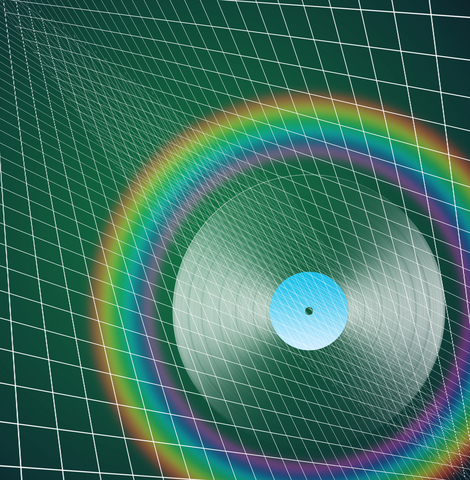
Our consciousness animates reality much like a phonograph. Listening to it doesn’t alter the record, and depending on where the needle is placed, you hear a certain piece of music. This is what we call “now.” In reality, there is no before or after. All nows, past, present and future, always have existed and will always exist, even though we can only listen to the songs one by one. —Robert Lanza, MD (author of Biocentrism)
Other highlights and lowlights
- On the night before the intensive started, Diane L had a showing of her paintings in a beautiful, spacious home on Potrero Hill. She glowed with excitement among her many friends and colleagues who had come to see her work. I felt so happy for her. This was definitely a highlight… except for the challenge of driving through an unfamiliar area of San Francisco during rush hour on a Friday night.
- One morning, an old woman appeared outside the door of the studio, her hands and face pressed against the glass, peering inside. She opened the door and announced, “My name is Michelle, and also Michael.” I thought, Here we go. “You know that if you kill people, God will forgive you.” The narrative quickly devolved into sentence fragments: “… something in her belly… the family…,” and finally she said, “I’ll be right back.” And she left.
- On the same day, after lunch at Chloe’s with Diane, Diane, and Terry, I was hobbling across the road with my cane, my friends several yards ahead of me, when a man stopped his car at the stop sign, let my friends pass, and then started revving the car and jerking it forward, impatient at having to wait for me. I stood in front of his car and yelled, “What’s your problem?” I couldn’t see the man’s face clearly, but I was lucky he wasn’t looking to kill a pedestrian that day. After that, Terry made sure to hang back with me when we were out. Not that it would have helped much if we had both been run over by a maniac, but it was sweet of her. Throughout the week, I drove the rental car and she was my lookout (as in “Look out!”), and I’m sure she prevented several needless injuries to bicyclists and pedestrians who rode or strode through the black night in dark clothes. (At least the bicyclists twinkled.)
- We all sort of forgot about the strange woman at the door, but in the afternoon sharing Karine mentioned her again—she had been thinking about her and was still kind of apprehensive. In my favorite line of the week, she summed up the woman’s message: “It’s OK to kill people. I’ll be right back.” We all laughed, and thus a lowlight turned into a highlight. And God didn’t have to forgive anyone.
- I want to reiterate the great fun I had with my close friends, and the tenderness I felt for everyone in the group. Besides our tightly scheduled lunches, Diane, Diane, Terry, and I had dinner one night at the beautiful, Christmasy/sparkly Buckeye Roadhouse in Marin. On the last night, several of us gathered for one last time at the Clement St. Bar & Grill. On several nights after painting all day, many of us stayed past the official closing hour and shared laughs or long, full silences, a blessing either way. Throughout the week I had intimate, meaningful interactions with… again, just about everyone. Special shout-outs to Martha, Carol, and Kate. It was truly a special week, and one I would have missed if I had chosen to follow my fears instead of my heart.
I had dreaded the final sharing (“love offering”) on day 7 and had just about decided not to do anything for it (we had a choice). But that afternoon I quickly prepared something and was glad I did. It was one of the most amazing experiences I’ve had at the studio. Everyone brought something very personal—from stories and pictures of mothers and grandparents who had died, to Alyssa playing her guitar and singing a beautiful song she had written, to the sharing of paintings that had been done during the week, Liat telling us about her beloved dog, Kate leading us in singing a round of an old folk song, and several beautiful poems and reminiscences. I felt tenderized and tender and cried practically nonstop. Everyone’s offering was so moving. There’s an old story about how the world rests on the back of a turtle; when someone asked what held up the turtle, the storyteller replied, “Turtles all the way down.” For me, this sharing felt like love all the way down.
Linda H, the only brand-spanking-new painter, who, coincidentally (?), was the one who provided the music over which I had freaked out earlier in the week, played a recording of Johnny Cash singing “Bridge Over Troubled Water” with his daughter Rosalind, from an album he recorded just before he died. I cried so hard during the song that I felt I had to explain afterward… he had been my father’s favorite singer, and my father had played his songs on the accordion. The tears and memories and tragedy of my father’s life washed over me as I listened. It was a special gift, and when I asked Linda later if that “made up” for my protest over the music earlier in the week, she said simply, “It’s forgotten.”
At first I was concerned that my “love offering” wasn’t in sync with the rest, but I went with it—first showed and talked about my death paintings, then did what I called an “infomercial” about the mary’zine, with information about how to read it online or subscribe. Later, a few people gave me money for the privilege of receiving paper copies, which I painstakingly print out at home so I can include the color photos.

All week, my eyes were opened to the beauty of ordinary people on the streets, in stores, in restaurants. I found myself intently observing everyone around me, marveling at their humanity, our commonality. One night at an Italian restaurant near our hotel, I was so focused on other people that Terry asked, “Have we said everything?” No… but there was so much to look at, to overhear, to speculate about: young, permissive parents trying to bargain with their tantrum-throwing child; a large party of friends or family who individually left and returned, changed seats, you couldn’t tell which children went with which adult, like they were one moving, changing organism; a waiter with ready-made jokes that were often incomprehensible (holding out two identical glasses of wine: “Pick one.”). Everywhere we went that week, we remarked on how everyone was so nice (with the obvious exceptions of the God-forgiven murder fan at the door and the impatient man behind the wheel). One day at the hotel, waiting for the slowest elevator in the world, I noticed a doorknob sign that didn’t look like the usual zzzzz or please clean room. I couldn’t see the words clearly, but I thought it said Everything is fine. Hmm. But on closer inspection, it actually said, Housekeeping in room. I felt like I was looking at the world with new eyes. What if all it took to “change the world” was to change one’s way of looking at it? Perception could be everything.
The officious TSA at SFO notwithstanding, my trip home was a breeze. At the Chicago airport, I had plenty of time to get to the other side of forever (O’Hare: The Nightmare) where the small plane would fly me northward. Being whisked over to concourse F in a wheelchair is fine, but I prefer the large multi-seat cart that makes me feel privileged rather than infirm. The driver was a young Pakistani man who proclaimed his love for America (“no discrimination!” “jobs!” “free speech!”). At one point, another Pakistani got on and rode with us for a while so he could bond with the driver over the tragedy of their homeland (partition of India). He was either a traveler who happened to be walking nearby, or a plant put there to advertise diversity, as if I were a bit player in an infomercial for Freedom. (I’m not being cynical, just fanciful.)
In the waiting area for my blessedly short flight to Green Bay, I observed a mentally disturbed woman and her grown son who were sitting near me. The son was patient but clearly stressed about dealing with her. She got up at one point and stumbled over her bag, falling facedown and setting in motion a parade of United Airlines representatives to ask how she was, perhaps to forestall a lawsuit. I hadn’t exchanged words or even a glance with the son, but when he went to gather his things, he mistakenly started to go for my book, coat, and messenger bag; in one of those sweet encounters with strangers that could easily have been unpleasant, we both laughed at his error. It wasn’t a big deal, but it made me wonder if World Peace could start at home, as it were, in the smallest exchanges between people with no chip on their shoulder and no axe to bear.
It was a relief to land at the Green Bay airport, claim my luggage, and plod over the vast tundra of the parking lot to my Jeep. The sky was gray and leaden, but it had never looked so beautiful to me: I had made it through 10 days of Unknown! I somehow managed not to fall asleep on the 50-mile drive home, having taken the various travel downer pills. (The lorazepam worked!)
The cats were confused by my arrival—Luther even hissed at me—probably because I and all my things smelled like California. I would rather be greeted by cries of ecstasy, but oh well. Hauling my suitcase into the bedroom, I noticed a wine bottle… black, with hundreds of white dots painted on it, some surrounding large circles that remained black. It was quite synchronicitous, because I had been conscious of painting dots and circles all week. Clearly, it was a gift from my sister Barb, who had been tending to my cats. I saw her the next night to catch up on the episodes of “Homeland” and “Dexter” that I had missed, and she gave me a black ring display hand (I have a thing for those), that she had spent all day painting white dots with large circles of black on to match the wine bottle. I was blown away. She said to me once that I was the artist in the family and she was the craftsperson. But she had shown true artistry and love in giving me these gifts. 

Happy winter!
Mary McKenney
mary’zine #52: November 2011
November 10, 2011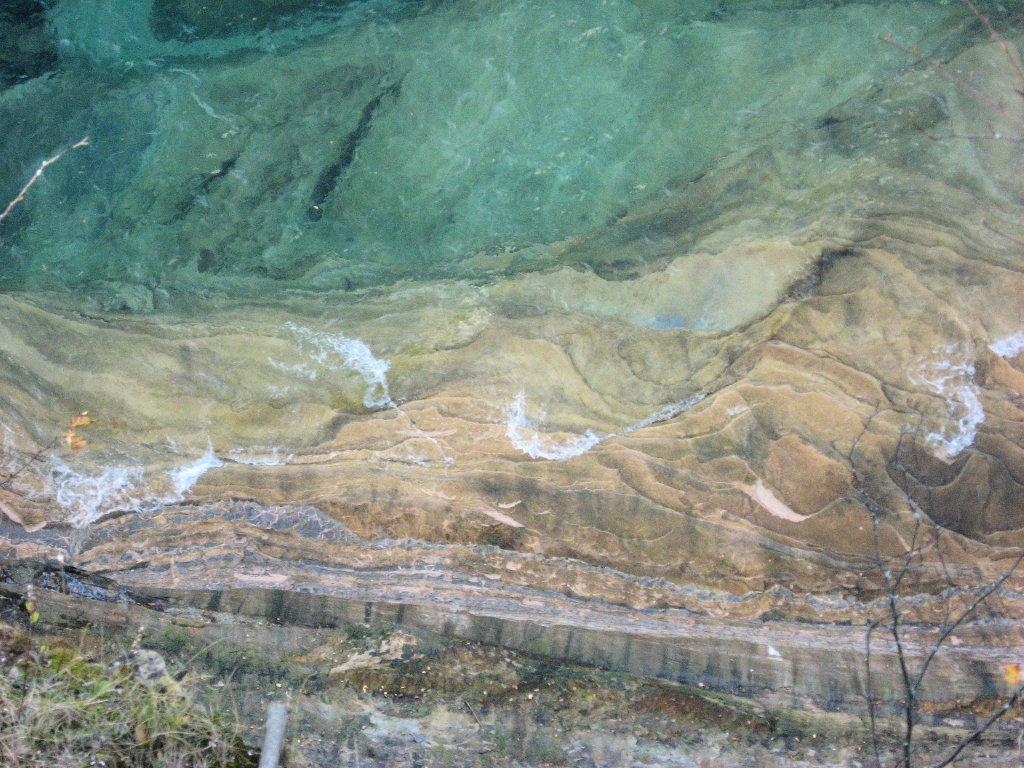
Looking down into Lake Superior from a high bank above the water. Photo by P. DuPont.
P made her annual trek to Menominee for my birthday, and we spent a day in Munising, on the southern shore of Lake Superior. It was beautiful, and I was delighted to prove to her that the U.P. does have mountains (as I call them) or at least rolling hills. Below are two views she took of ”Miner’s Castle,” a sandstone formation on Pictured Rocks National Lakeshore.


Hills or mountains aside, there are some great natural sights in Menominee, too.


*
*
SOS
Before P got here, I had to renew my driver’s license, in person, at a Secretary of State (SOS)’s office. I wanted to get an “enhanced” driver’s license so I can walk amongst the Canadians on their own soil if need be. There’s an SOS office about a mile from my house, so I figured it would be easy enough to bop in there with all the required documents in plenty of time to get the new license before my birthday. The office shares a little building with Stephenson Bakery—one of many odd juxtapositions around here.
I set out at 3:00 in the afternoon on a Wednesday, but I arrive right in the middle of their Wednesday lunch hour. (All other days, it’s 12:30-1:30.) I take care of some other business downtown despite the beckoning bakery, which is leering at me through its windows as if to dare me to come in for just an itty-bitty snack. (“You’re already here,” it seems to be crooning, “and you have to wait anyway”), but I am resolute. I go home empty-handed and empty-mouthed.
I come back at 4:30, there’s no one in line ahead of me, and a pleasant young woman wearing purple eyeshadow greets me. I’ve put all my documents in a plastic envelope, so I start dumping everything out on the counter and then discover, O damn!, that I took my wallet out when I was doing the other errands and didn’t put it back. I gather everything up again and head back to the house. I run upstairs (I use the word “run” very loosely), and my wallet isn’t where I usually keep it. Damn again! Then I have a terrible feeling. I run back downstairs and check the plastic envelope, and there it is, hiding below the fold as it were! What an idiot. I drive back down to the SOS and start presenting my documents again. I haul out the “Notification of Birth Registration” that I’ve been carrying around for just shy of 65 years. Purple Eyeshadow brings it to a faceless bureaucrat in a back office who, after making a phone call, sends her back to me with the news that they can’t accept it, because it’s not a true birth certificate, it’s only a “souvenir.” Who would want to keep a useless piece of paper that doesn’t even prove your baby exists? My parents, that’s who. It’s an original, highly creased and yellowed document with my whole name, place and date of birth, my parents’ names, and a “State File Number.” On the back in big capital letters it says, “IMPORTANT—READ CAREFULLY.” It states that my birth certificate is permanently filed in the Bureau of Records and Statistics, Michigan Department of Health, Lansing 4. The following clinches it, in my opinion: “This notification should be carefully preserved. It is a valuable document” [my emphasis].
But no, it’s not good enough for the SOS. Eyeshadow tells me I can go down to “the courthouse” and get something-something that’s more official. (I don’t even know where the fucking “courthouse” is, there’s an old one that’s been there since the Cleveland administration, and then there’s a new set of municipal buildings about a mile away.) I yearn to tell Eyeshadow to “bite me”—yeah, I know she’s just doing her job, but I’m too pissed to care—but I just sigh dramatically and roll my eyes and hand her my old driver’s license and my brand spanking new Medicare card. She says I can’t use the Medicare card as proof of my Social Security number, even though the number on my Medicare card is my Social Security number with an apparently distracting, corrupting “-A” at the end of it. She starts telling me what I need to give them to prove what my SSN really is, but I curtly turn and barge out of the office. I almost head into the oh-so-conveniently located bakery (is that why they’re still in business, to cater to the pissed-off citizenry who can’t produce acceptable documents?)—but I’m beyond even crullers at that point. And that’s saying something.
I get home, look for the metal file box of my Mom’s that I can’t remember the contents of, and—lo and behold—discover that I have a “real” certified birth certificate in a nice folder that I got back in 1986 when I needed one for some reason. Who knows if a 1986 certification will stand up to the high standards set by the SOS, but it’s the best I’ve got.
Now I know how Barack Obama feels—well, except for the wars and the Republicans and stuff.
I have received dozens of communications from the Social Security Administration over the years—all those statements that verify that in my first year of full-time employment I made a grand total of $4,104. So I pull out the file and start going through it. And guess what? The SSA is loath to put the recipient’s full SSN on their documents, because they want to “help prevent identity theft”! Great! Looks like they will also “help prevent the SOS from giving me a driver’s license.”
I finally come across two documents mailed to me by the local SSA office in Marinette. One is a computer printout, not on any letterhead, that states “MY NAME IS…” and “MY DATE OF BIRTH IS…” and “MY SOCIAL SECURITY NUMBER IS….” This “IMPORTANT INFORMATION” about my “CLAIM FOR SOCIAL SECURITY RETIREMENT INSURANCE BENEFITS” is signed by a “Mrs. Seefeldt,” but I’m not at all sure that this document will hold up under the intense scrutiny of Purple Eyeshadow and her shadowy boss.
The other document is a “Voluntary Withholding Request,” a “Form W-4V” (the SOS instructions say that a W4 form is acceptable for proving SSN). This form has been filled in by computer, but couldn’t I have gotten hold of a blank form and filled in the LYING, CHEATING FALSE INFORMATION myself? There, in black and white, it says: “2. Your social security number,” and indeed my actual social security number is typed in there as bold as anything, without the offending “-A” from my Medicare card. But the form is red-stamped “COPY.” Will a mere copy be acceptable to Eyeshadow, Shadowy Boss and the SOS her- or himself? We shall see.
After perseverating on it for a few days, I realize I have to get this taken care of sooner rather than later. But I dread going back there. I envision a string of irrational demands that I can’t fulfill. I mean, how do people with falsified documents do it? I was born in this very town, and I have “proof” galore that I am who I say I am. But finally I go back, and it couldn’t have been easier. Eyeshadow waits on me again, and when she sees me I think she gets a little tense, doesn’t look me in the eye as she says, “What can I do for you?” Yeah, I’m that much of a badass, I had sighed at her and didn’t say thank you. First thing, I say, “I’m sorry about the other day,” and she says that’s OK. Then it’s like we’re best friends, we’ve been through so much together and I get to show her the calm, sane, reasonable person I am down deep, and I can see she appreciates it. When I tell P this later, she wonders how this faceless, eyeshadowed bureaucrat would even remember me. Honey—this is not the San Francisco DMV, it’s down and personal, or UP and personal. Like once when I approached the deli counter at Angeli’s, and one of the clerks asked me, “Do you want egg salad today?” and I’m a little taken aback. Why does he remember me? It’s hard to know how personally to take these commercial interactions. I’m usually “nice”; I strive to have a persona that makes the clerk think, when she sees me coming, “OK, this one doesn’t cause any trouble,” but I think I prefer being anonymous. My new documents meet the high standards of the SOS and Eyeshadow and her now visible boss, who looks to be about 23 years old. I feel ancient, but not quite as ancient as the really old woman at the other window, who is surrendering her license. When asked if she’s an organ donor, she quips that no one would want any part of her body anyway. I have to say, I can relate to that. Oh, she meant after she dies. I had not been looking forward to the eye test, but it’s a very quick matter of reciting the perfectly legible letters displayed in a little machine. Likewise, the photo-taking is innocuous, you stand right there a few steps away from the counter, and Eyeshadow tells you to smile if you want to, which I appreciate. The picture comes up on the screen and she asks if I’m happy with it or do I want to try again, and I say that it’s not going to get any better than that… she chuckles… she’s probably never heard that one before… yeah, right… and indeed it’s probably the best driver’s license photo I’ve ever taken. For the next couple of days, as I do errands around town, I feel almost attractive. We finish our business, she tells me to have a nice day, I say “You too,” gather my stuff together, and surprise her by saying “Bye!” She founders a bit—does no one else have the decency to utter a friendly farewell?—again says “Have a nice day,” and voilà, I have rehabilitated myself in her eyes, and in my own.
*
*
patient does not wish to share…
Had my annual visit with the handsome Dr. T. The front office person always asks me if I want to authorize anyone to call them to get information about me, and I get confused and always say no. They have my power of health attorney, or whatever it’s called, on file, but they never seem to want to trust what they already have, it all has to be new. So I had to sign a paper that said, “PATIENT DOES NOT WISH TO SHARE ANYTHING WITH ANYBODY.” I think that’s a bit harsh.
Dr. T. is his usual charming self. He congratulates me on my 25-lb. weight loss and says he’d smile bigger but he’s afraid he has a piece of carrot in his teeth. My laff of the day.
Then he kind of takes the wind out of my sails about my 0% calcium-in-my-arteries test result from earlier this year, because there can still be “soft” plaque and I still have high cholesterol. So I have to double down on my cholesterol medicine.

I’ve written a lot about my personal experiences and outlook on this site, but now I feel like revisiting some of the influences on my reading, writing, and editing life. Maybe “influences” is the wrong word, implying that external forces shape who we become. Ever since I read that Picasso was kicked out of school at the age of 10 because “all he wanted to do was paint,” 1 I’ve found it fascinating to look back at the “acorns” that have turned me into the tall, strong oak tree I am today. Ha! Anyway, the point is, I’m not an existentialist (“existence precedes essence”)—first, because it’s a bleak world view that seems peculiarly male (all abstract, Man Turned Hero in the Face of an Uncaring Universe sort of thing), and second, because I do think we are born with an “essence” that manifests throughout our life. When looking back from the vantage point of great age, or even medium-great age, I think it’s possible to see that, in a way, things were meant to happen the way they did. “Meant to happen” is a loaded phrase; I don’t mean that an old man in the sky decided what sort of life to give each of us and marked all the plays on the blackboard with X’s and O’s like John Madden and then BOOM that’s who we are. I see it more as if an internal engine or fire (a fire engine?) pushes us to blaze or blunder down a path that we appear to create as we go, but that is truly driven. We see it after the fact, when it manifests. Until then, we can only perceive the fog of the so-called Future as we stand on the edge of the ever-Present cliff, every nanosecond new and impossible to predict but also in some strange way making total sense.
I once asked my painting teacher if the painting—the paper with the paint on it—“mattered.” Her answer: “It does and it doesn’t.” Which sounds like a non-answer, but I knew what she meant. In one sense, the process you go through while painting is what matters the most, but what shows up on the paper is the mirror to which you respond, stroke by stroke. And later, looking back at your paintings can help you track your journey—at least in theory. My paintings, many of which I have framed and hanging on my walls, still seem as mysterious to me as when I painted them. They radiate feeling and intensity but don’t necessarily give up their secrets. Which is fine with me.
Likewise, one’s individual life matters and yet it doesn’t. In the grand scheme of things, we are but dust in the wind, and other song lyrics from the ‘70s. From what we can tell from this side of the life/death divide (if there is a divide, or only a full stop, a colon, or even an em dash—who knows what punctuation will ultimately define us?), we may matter to a few or multitudes of other people, we can accomplish magnificent things for which our name will live on forever (J. Christ, S. Jobs), or we can be known to only a few, but deeply known and loved. We will live on in their hearts until they too pass on, and then at some point, if we don’t make the history books, there will be nothing left of us. But as we are living it, Life is everything, no matter how small its manifestation appears to be.

I don’t remember my mother reading to me, but I know I must have had Little Golden Books, because the way my stomach drops when I see the illustrations on the paperboard covers with the gold spine, it’s a sense memory from way back, from little Mary Lou still intact within me, like a nested doll.
When I was very young, my aunt Dagmar gave me a book called Dear Heart. The only thing I remember about it is the sentence, “You can’t be too careful.” I puzzled over what this meant. It was the first time I remember thinking about language and wanting to know how it worked. Later, I spent the summer after 7th grade pondering the use of the subjunctive: if I were, not if I was…. It was definitely a WTF moment, if only that expression had existed at the time.
Over the years I visited Spies Library every week, taking out the maximum number of books, and I was finally let up in the adult section around the age of 12. I already had my heart set on going to college, so I found all the books I could that had college as a theme. It seemed like the most glamorous life.
The first witticism I remember making was when I was 10 and hanging out with my cousin Donny. He gave me a cherry Lifesaver, and while I was still savoring it, I announced that I had to go home (next door). I half-seriously told him, “I hate to eat and run,” and he laughed. It was the first time I felt the power of humor, and the inkling that I might be good at it.
(When P was visiting, I often had to point out that I was joking. She said she used to be able to tell, but now I don’t have an “affect.” I said, “I’ve never had an affect,” but it’s possible that I’m taking “deadpan” to an extreme: merely dead.)
Some of the most significant reading I did was in the World Book Encyclopedia, which my parents bought me when I was in the 5th grade. I would read the difficult entries and practically will myself to understand them. It’s exactly the same way I now approach the editing of scientific manuscripts, especially when I’m not familiar with the subject: take one word at a time and just figure the damn thing out.
In 6th grade I heard about something called Pocket Books, which was a publishing company that sold books for fairly cheap. I had never heard the term “paperback,” so I went into a dime store and asked if they had any “pocket books.” So they ushered me over to the ladies’ purses. I was so disappointed. It must have been that Christmas that my mother somehow got her hands on a publisher’s catalog and ordered me a large box of paperbacks, in all styles, reading levels, and subject matter, from Elephant Toast to Robinson Crusoe to The Adventures of Huckleberry Finn to The Call of the Wild to Journey to the Centre of the Earth (possibly my favorite book of all time) to Julius Caesar. It’s the single best gift I received in childhood, from a parent who could barely afford to put food on the table. I guess that goes a long way to making up for her ghostwriting my autobiography the year before, come to think of it.
At that point, the library couldn’t hold me. I wanted my own books. In 7th grade I had to start going to the high school, about 2 miles from home. I usually took the city bus, which cost 12 cents each way. But when I discovered that Everard Drugs sold paperback books on a revolving rack, I would walk to school and back and save the bus money until I could afford the 25- and 35-cent books. I got some pretty racy books, because I hadn’t yet learned how to judge a book by its cover. (Or maybe I had.) I remember reading about a boy who showed a girl his “wiener,” and I haven’t felt the same way about hot dogs ever since.
I joined the Detective Book Club, subscribed to the Saturday Review of Literature, and devoured all the reading assigned in my English classes, except for Charles Dickens, whom I hated at first read. BLEAK House, good choice of adjective, Charles. Once, I brought one of the Erle Stanley Gardner (Perry Mason) books to school—The Case of the Calendar Girl—and this cute boy who would never have talked to me otherwise asked to look at it. Of course I was thrilled, but he was obviously just looking to see if there were any dirty parts in it. There weren’t.
Just as often as I would happen upon a classic like Seventeen by Booth Tarkington, I was drawn to books based on TV shows. My 9th grade English teacher, Mr. Eidt, who had also been my mother’s teacher (so you know how many decades he had on him), shamed me when he did a locker check and found a Leave it to Beaver book in mine. I turned the shame inward but didn’t understand exactly what was wrong with it. It was like being pre-sexual (though I was already post-)—you’re just going along, doing what feels good, and suddenly the Adult World starts judging.
I joined the Adult World when my friend Jerry turned me on to The Catcher in the Rye. I still have my original paperback copy, which might be valuable by now, but I went through and underlined all the funny parts; one doesn’t have a sense of “This will be worth cash money someday” when one is 15. It’s a cliché now, but I cannot overstate the significance of that book to my world view. I was done with Beaver and Wally; started reading “real” books and listening to Bob Dylan records. I had no idea that I was falling into step with my generation. I wasn’t aware of having a generation. But when I got to Michigan State a few years later, there was a whole culture, counter to the established one, that felt tailor-made for me.
In high school I joined the debate club, a really odd choice because I hated public speaking. I had a serious crush on the debate coach, Mr. Malechuk, so maybe that’s what motivated me. There is no more dreaded memory in my life than the mornings I had to get up before dawn and prepare to spend a winter day being driven to Houghton or some other way-northern town to (a) throw up and (b) debate. We won most of our debates, but I truly hated doing it. My specialty was taking the negative side, which may have been inevitable given the “Mary Mary quite contrary” mantra that I still hear to this day. Inexplicably—again—I took the $100 I had inherited from my grandfather and rode a Greyhound bus downstate to MSU one summer for a week-long debate clinic. Did I tell you this already? Well, long story short, my assigned debate partner broke his leg on the first or second day and got to sit out the rest of the week, while I had to take both affirmative and negative sides in every debate and got no credit for it whatsoever. I don’t remember much else about the experience, except that (a) a girl named Lois Lust was teased mercilessly about her name, and (b) the predominant flora on campus, especially around the student union, exuded the smell of loneliness. I’m not trying to be poetic, it was the oddest thing, like having synesthesia. That smell followed me through the 5 years I later spent there, and I can recall it perfectly to this day. Oh, and (c) the bus ride home was hell on wheels, because a dirty-old-man/evangelist sat next to me and tried to molest me in the name of Jesus… because I had to “open my heart,” you see, and he had to “help” by touching my oh-so-conveniently located heart-area. I didn’t dare speak up, tell the driver, or anything. It was just one more in a series of impositions that I had to endure, and that I never questioned.
I wrote a column in the Maroon News, the high school paper. It was a Herb Caen-esque gossip column that featured little news tidbits and jokes about my classmates. Just about the only words Nancy Hartz said to me in high school were about my question of who had dropped a penny during nap time in kindergarten and made the whole class stay after because she wouldn’t confess. It was her. I think she enjoyed being singled out like that. It was my first foray into ‘zine land, another territory that didn’t yet exist, except in the “inarticulate speech of [my] heart” in the words of Van Morrison.
Except for the kindergarten mystery involving Nancy, my jokes were often at the expense of others. I also drew comic books, many of which also made fun of friends and classmates. It was very satisfying to make other kids laugh that way (I was too shy to talk), and I never considered the effect on the kids I made fun of. I hope I have grown out of that unconscious cruelty by now. Humor can be a way to keep people at arms’ length. I’m not sure that’s the right way to describe it… something about keeping myself safe and separate, unimpeachable—protecting and distinguishing (simultaneously hiding and showing) myself.
In my senior year, I placed fourth in an essay contest with the theme, “What Freedom Means to Me” (my angle: I don’t know, because I take freedom for granted). The top 5 winners had to recite our essays into a microphone and be re-ranked according to the effectiveness of our oral presentation. This moved me from fourth to second place, surprisingly. Then we all got together with Mr. Eidt to polish our essays. The first place winner, Vicky Lundgren, who was beautiful and “rich” (middle class), had written a good essay, but her last sentence was clunky. I don’t remember what the problem was, but I suggested a slight rewording and impressed the heck out of Mr. Eidt… until Vicky persuaded me to tell him we didn’t want to read our essays to the whole school in assembly, and he never spoke to me again. That’s when I learned about the fickleness of “mentors” who drop you if you ever dare to question them. (I’ve experienced this many times through the years.)
As a freshman in college I was placed in an advanced English class with 10 or 11 students, one of whom was a 10-year-old boy genius (now a grown-up computer guy, gasp). I loved the professor, Perry Gianakos, who gave me an A+ on a paper I wrote about Death of a Salesman that apparently changed his mind about whether American literary characters could be tragic heroes according to Aristotle’s definition. I also joined the campus newspaper and wrote headlines that I then cut out of the published paper and mailed back to my favorite teacher, Ruth, eager to show her how well I was doing. I wasn’t really interested in journalism, though. I took many creative writing classes but never got the hang of making stuff up. In lieu of writing fiction, I wrote long, detailed, spirited letters that another of my mentors deemed belles lettres. Another precursor (unbeknownst to me at the time) of my eventual writing style.
Going to library school was a desperate measure designed solely to keep me in academia for another year after college. I went to the University of Michigan but disliked Ann Arbor and hated the so-called graduate-level classes. I was a radical brat and a terrible snob. One of the professors wrote on my evaluation that I “did not present a professional image and should be interviewed in person.” What, knee-torn blue jeans and surly looks weren’t considered professional?? It was 1969! Years later I met him at an ALA convention where I was accepting an award for a friend, and he said, “Oh, so you’re Mary McKenney.” My name had become quite familiar to librarians because of my reviews and articles in the library press. I still looked pretty much like I had in library school, but that was the beauty of the counterculture. We could have it all: do what we wanted, dress like we wanted. That has been my credo ever since.
I had to have a work-study job to pay my way through library school, and the UM library didn’t have any openings, so I was lucky enough to (“meant to”?) land an editing job in the Bureau of Business Research. I turned out to be good at it, and my non-librarian fate was (nearly) sealed. After classes and work, I wrote short reviews for Ted S., a professor who compiled several editions of his book From Radical Left to Extreme Right. I was thoroughly enthralled by underground newspapers and comix and loved writing about them. He paid me $5 apiece for the reviews, and when I asked for a raise he lectured me on how it was supposed to be a labor of love (sure, but he got royalties). The same thing happened when I wrote for Bill K., a library publishing professional who edited many reference books, including Magazines for Libraries. He didn’t pay me much more for longer reviews, and he dropped me when I asked for a small raise. I learned that I rarely get what I want by asking for it. A dubious-sounding lesson, but it seems to be true in my case.
After library school I couldn’t face the thought of working in a library, so I accepted a near-volunteer position at Carleton College (Northfield, MN) on a previously student-run publication, Alternative Press Index. In some ways it was a dream job: I spent most of my time in my tiny office reading underground papers and corresponding with volunteer indexers. I had an attic room in a house owned by the college, and I was thrilled to be living my dream of working in the counterculture. It paid $15 a week, plus government surplus food (canned bulgur: you haven’t lived…). The dominant credo of the time was to have no distinction between work and life… which is where I am right now, come to think of it. (I don’t know why I’m throwing the word “credo” around.)
Thanks to a radical publication called Vocations for Social Change, I got an actual library job at St. Mary’s College in Maryland, where I hobnobbed with the student and faculty radicals and became infamous for being one of the first “out” lesbians on campus and then for being fired and starting a student revolution (actually, I was a just figurehead wrapped in an enigma). I’ve written about this, too, so I won’t repeat it. I wasn’t really cut out to be a librarian. The mantra of my fellow librarians, even the radical ones, was “information.” I never cared that much for information as a goal. Weird that I ended up editing science, which is sort of the ultimate in information.
P was an older student at the college, and looking back it seems like a fateful moment when we passed each other on a country road, at dusk, no one else around. We knew of each other’s existence—we were the campus feminist matchmaker’s dream, an “angry Navy wife” and a “virgin dyke”—but didn’t speak. I can hardly believe that that was 40 years ago. After she graduated, we moved to the Bay Area and lived with her grandmother and great aunt for several months. We found jobs, moved to the City, and climbed the respective ladders in our professions.
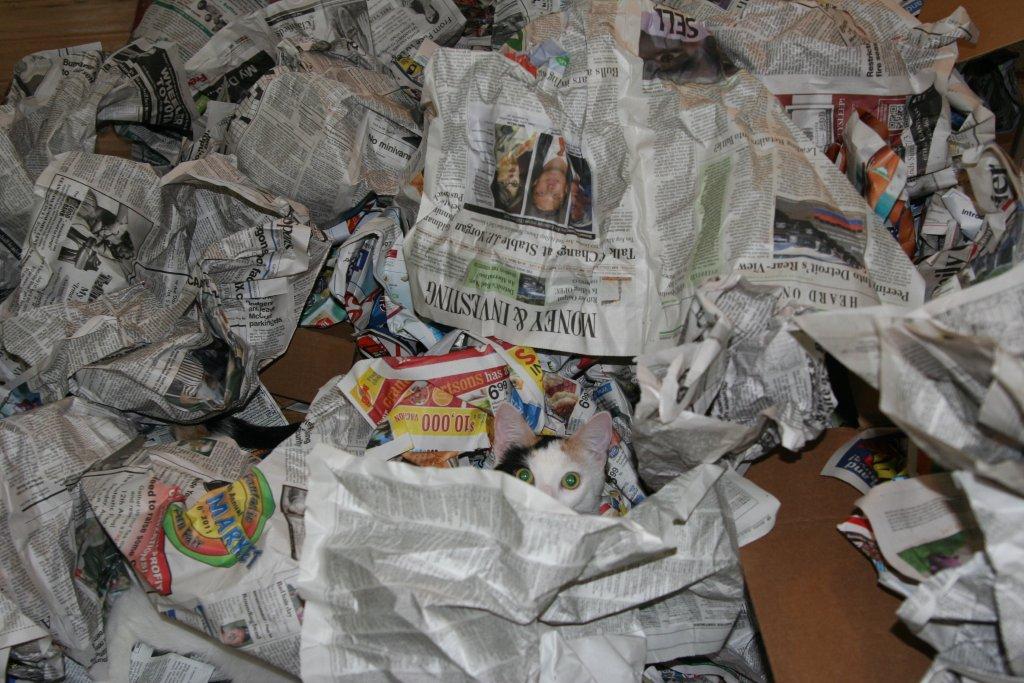
I could go on and on (and already have), but that’s enough for now. For some visual relief, I present two photographs, taken by P (of course), of her cat Maddie.

A few postscripts:
- In one day’s mail recently, the only two things I received were a check for my editing work for $105 and a water bill for $105.11. I told P, who commented, “You’re losing ground.”
- The other night, I dreamed about my h.s. teacher Ruth (whom I recently found out has died). Unlike all previous dreams of her, this one was completely gratifying. She gave me a beautiful pin with my name on it, and I wept and hugged her 3 times. It felt upon awakening that I was giving myself back to myself, in a way. She gave me a great gift back then. My mistake was in confusing the giver with the gift.
- 1 Remember there was a footnote way back there? J. Hillman and M. Ventura, We’ve Had a Hundred Years of Psychotherapy—And the World’s Getting Worse.
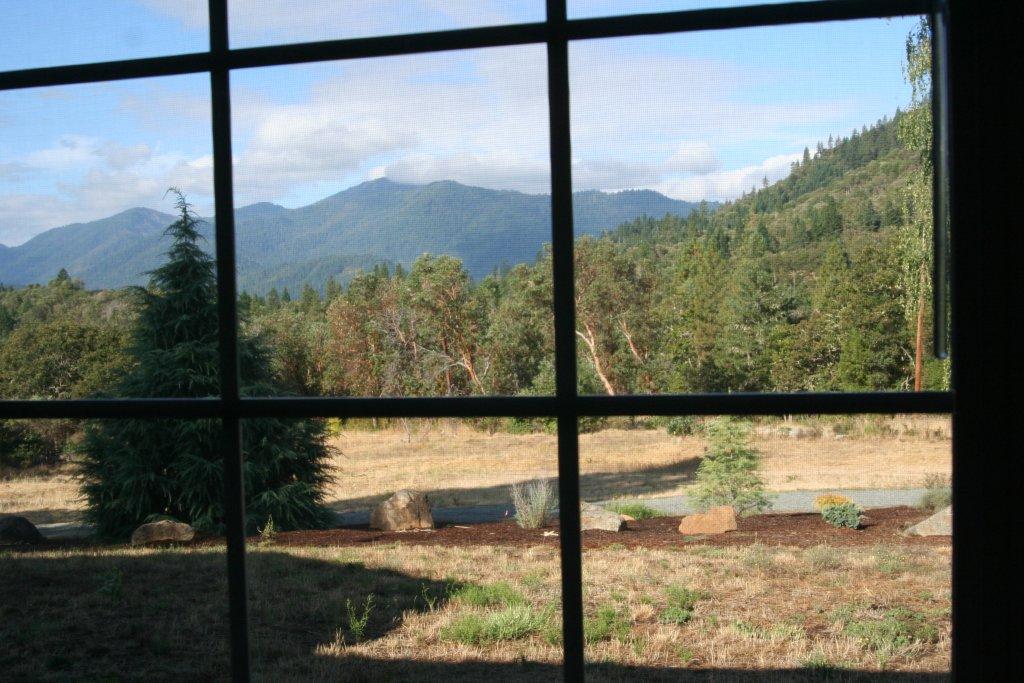
- Below: View outside P’s new house. OK, so Oregon has some pretty sights, too.
Mary McKenney
mary’zine #51: September 2011
September 17, 2011ode to Michigan
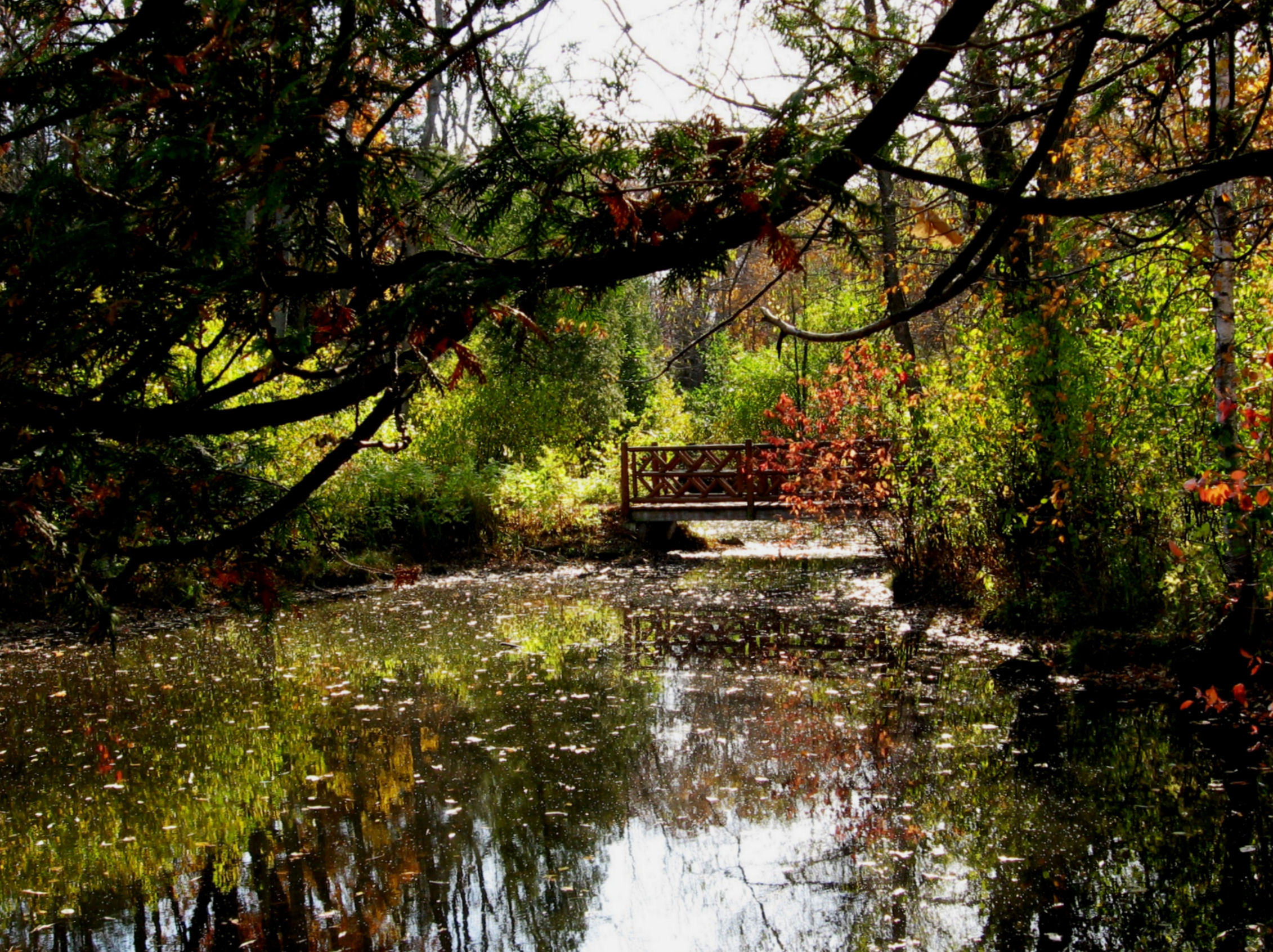
Henes Park, Menominee (photo by P. DuPont)
*
*
*
A PRIMER
by Bob Hicok
I remember Michigan fondly as the place I go
to be in Michigan. The right hand of America
waving from maps or the left
pressing into clay a mold to take home
from kindergarten to Mother. I lived in Michigan
forty-three years. The state bird
is a chained factory gate. The state flower
is Lake Superior, which sounds egotistical
though it is merely cold and deep as truth.
A Midwesterner can use the word “truth,”
can sincerely use the word “sincere.”
In truth the Midwest is not mid or west.
When I go back to Michigan I drive through Ohio.
There is off I-75 in Ohio a mosque, so life
goes corn corn corn mosque, I wave at Islam,
which we’re not getting along with
on account of the Towers as I pass.
Then Ohio goes corn corn corn
billboard, goodbye, Islam. You never forget
how to be from Michigan when you’re from Michigan.
It’s like riding a bike of ice and fly fishing.
The Upper Peninsula is a spare state
in case Michigan goes flat. I live now
in Virginia, which has no backup plan
but is named the same as my mother,
I live in my mother again, which is creepy
but so is what the skin under my chin is doing,
suddenly there’s a pouch like marsupials
are needed. The state joy is spring.
“Osiris, we beseech thee, rise and give us baseball”
is how we might sound were we Egyptian in April,
when February hasn’t ended. February
is thirteen months long in Michigan.
We are a people who by February
want to kill the sky for being so gray
and angry at us. “What did we do?”
is the state motto. There’s a day in May
when we’re all tumblers, gymnastics
is everywhere, and daffodils are asked
by young men to be their wives. When a man elopes
with a daffodil, you know where he’s from.
In this way I have given you a primer.
Let us all be from somewhere.
Let us tell each other everything we can.
(Reprinted with permission of the author)
*
*
*
Friday night light
I ended the #50 mary’zine by wondering if I was the “gorilla” in my family, the one everyone has to tiptoe around when s/he’s being moody or all judgmental and withdrawn. I am happy to report that the answer is “No”! (Or at least “Not that often!”) Turns out it was my brother-in-law MP all along. I know this because he’s come out of whatever funk he was in for several months, and he’s like a different person. Is it because he (a) retired from a job he hated? (b) is finally getting help from the VA? or (c) was released from the torment of a mandatory weekly visit from his sisters-in-law? Maybe (d) all of the above. For whatever reason, he’s been a joy to be around lately, and our Friday nights have a completely different feel. So far, there have been only 3 of these post-gorilla occasions, but I’m hopeful that it’s a permanent change.
Barb and I now wait for an invitation to join K&MP at their house, order takeout, and have television-cum-conversation in sometimes surreal combinations. MP still has control of the TV remote; some nights it stays off entirely while we chat and reminisce and make off-color references (me and MP) or converse like ladies (Barb and K), and K gets up repeatedly to fetch pop (“soda” to the rest a yooz) or bring a load of laundry down to or up from the basement. The rest of us sit on our asses until we have to use the bathroom. I more and more think that the content of the conversation is not the point, it’s the contact. So MP and I exchange “witticisms” while Barb and K and sometimes my nephew JP and his girlfriend have entirely other conversations that I only barely attend to. Or, JP and MP get talking about cars and trucks, while we “girls” try to make our voices heard on more domestic topics, the cats and so forth.
Sometimes, MP’s trigger finger gets itchy, and he randomly turns on or off the TV… just to see what’s on, I guess, and then to decide he’s bored. So all of a sudden, the news or a movie will come blaring on, to which we do or do not pay attention, depending. At one point we’re watching the news about a guy who spent 11 hours treading water while waiting to be rescued after his small plane went down in Lake Huron, and we see him in the water holding briefly to the tail of an airplane (which had to have been a reenactment—weird). He’s describing how he held on as long as he could, and then he says, “And then… she’s going down…,” and I pipe up, “Honey, this is neither the time nor the place,” and only K hears me, but she laughs harder than I’ve ever seen her laugh before, a kind of one-two punch as she registers the joke and then really gets it. MP and Barb have been talking about some problem with her car, and MP sees K laughing and wants to know why, and I’m like, you had to be there. Nothing worse than having to repeat a punch line. (And yet, that’s exactly what I’ve done here. Oh well.)
The next time we got together, I happened to have 2 Netflix DVDs, Source Code and The Adjustment Bureau, both sci-fi, not usually my cup of tea, but they were both a hit with the group.
One night, while K and Barb were picking up our burgers from Mickey-Lu’s, I asked my nephew if he was serious when he said he would have driven down to Chicago to get me when I was stranded at O’Hare Airport for 3 days last December. I was trying to think of a Plan B that would make me less terrified of flying to San Francisco the next time I go. He said he would do it (he used to be a long-haul trucker), but it would be nice if I chipped in for gas, and I assured him that I’d pay him whatever I would have paid for a night at the Hilton, and he was all for that. Then MP said he’d like to go along for the ride. The conversation got increasingly fantastical as one of them proposed that they could drive me to San Francisco, spend the 7 days of my painting intensive going up to Oregon to drop in on my friend P (whom they know), and then pick me up and drive me back home. MP figured out how much the gas would cost, while I silently considered the cost to my sanity of riding with those guys for several days. When K and Barb got back with our food, we told them what we had been talking about, and K grinned and said she could use a break. Barb thought she meant that she would come with us (whereas Barb would have to stay here to take care of all our cats), but I’m quite sure she was referring to a break from her dear husband.
So, recent Friday nights have been quite raucous, in a good way—though now and then the spice of contrarian politics rears its head. We’re watching a true-crime show when JP announces, “Criminals have more rights than I do!” I think he’s talking about rights in the courtroom, so I say that it’s not that “criminals” have rights, but “the accused” have rights, and any of us could be accused and would be glad for that. But he’s referring to the fact that the killer on the TV gets to keep filing appeals to have his sentence reduced. (It never was.) Then MP starts listing all the perks that prisoners get: “3 squares a day,” a bed, free education, free lawyering, etc. I point out that they can’t leave, and I suggest he go out and rob a bank and join them, if he thinks they have it so good. He gets frustrated and says I don’t understand. “I believe in an eye for an eye and a tooth for a tooth: If you steal, you get your hand cut off,” he says. I tell him he should go live in an Arab country then. For every point he makes, I’ve got a response—a glib one, true, but it’s something, and I’m kind of having fun with it. But finally K chimes in and threatens jokingly, “I’ll have to send you all to your rooms if you can’t get along.” She would let the 2 guys rant and rave all night, but if I express even the mildest objection to something they say, oh-oh, it’s time to call it off. This annoys me no end, but OK, that’s just the way she is, can’t stand any vocal disagreement (though I know she disagrees with plenty). She’d rather everyone keep their head down and keep their opinions to themselves. So our “argument” winds down with one last response to the TV show, in which the mother whose son was killed says she’ll never forgive the killer. (I wish I could make my family watch Dead Man Walking, one of the most profound movies ever made.) JP leans over to me and says quietly, “I have trouble forgiving,” and I say, “Everyone does.” With that, our “point/counterpoint” is over, and I don’t get the sense that either of the guys holds my liberal-wacko opinions against me. In fact, MP goes on to talk about his horrible upbringing, getting beaten by his dad, no money, no privacy or individual ownership in a family with 12 kids, etc. etc. I listen sympathetically to this story I’ve heard many times before, and I feel deep compassion for him. I ask him why he’s feeling better lately, and he says his migraines are mostly gone now that he’s away from that job. This makes me happy, and not only because our Friday nights are more pleasant. Now if only K could retire from her factory job.
JP takes me outside to show me the trailer MP bought for hauling their 4-wheelers around. He’ll use it when he comes over to Aunt Mary’s house to plow the snow away and denude my lawn. I feel like I’m making a difference in this small town and in the lives of my family. A big part of it is financial: I pay good money for the plowing, the house cleaning, the what-have-you. And I love them, whether or not they “deserve” it, and whether or not I deserve to have it reciprocated. It’s a big feeling in this small town, in this big house, in this sometimes constricted heart. We all have trouble forgiving, trouble loving, trouble being true. But the more I leave it alone, trust myself, and not beat myself up for my many lapses in compassion, the more true I feel. And that feels good.
*
*
*
inhabiting my life
I have a couple of friends who are going through some big changes, and it got me thinking about how I’ve probably made my last big change and I have nothing much to say when someone asks me “What’s new?” I dined out for years on my story of moving back to my Midwestern hometown from California, but I’m no longer special on that front. I had the same feeling of “This is it” when I was working at UCSF. Then, I had the “end of the line” feeling again when the Radiobiology lab got shut down and I was just old enough to retire from UC. My new “final” change (I thought) was starting my own editing business. No way was I prepared to even consider moving myself and Pookie lock-stock-and-barrel back to the formerly despised place of my birth. And now, after that miracle, for which “I changed my mind” is a woefully inadequate descriptor, here I am… rooted in my Michigan rootedness, not foreseeing any major changes coming up for me except, you know, death. (My deepest wish is that death will come before “human warehousing.” That was my mother’s deepest wish, too, but when her wish came true she resented it bitterly. Is there no pleasing some people?)
My friend T and I were talking about this, because she had had the same feeling of “OK, this is where I’ve ended up,” but now she had taken the huge step of leaving a long-term relationship and moving into a place by herself. I was feeling kind of envious of her new single life, because I remembered what a big, scary, exciting life-changer it was for me, back when I did the same. But she said something very wise, which was that, far from being confined and defined by my roots, I’m inhabiting my life. What I tend to think of as an absence of newness and potential is a genuine letting down and letting go of a lifetime of anxiety. I’m no longer searching for my self and my life’s work and meaning: I’m living it. Inhabiting one’s life may not have the gleam and glamour of being perpetually on the move (the famous rearranging of deck chairs on the Titanic); it’s a different way of being. Long familiarity with depression and anxiety—and political and spiritual peer pressure at different times in my life—makes me suspicious of “being happy,” of enjoying my quotidian life “too much,” as if it’s a crime to just be. I’m following my interest wherever it takes me, the #1 lesson I learned from painting. Currently, it’s watching all the past seasons of Friday Night Lights, one of the best TV shows ever. And filling my head with ideas and my house with books. Enjoying my cats and my “yard birds” and other critters. Phone-talking and e-mailing with friends in faraway places. Getting together with sisters for trips to Green Bay or the movies. Watching Breaking Bad with Barb on Sunday nights. Writing this ‘zine. A life of quiet, which is essential to me.
So now I have a new way to view my life, not as an absence of Big Stories but as the reality of living: the gerund that trumps the abstract noun (grammar is life): the rootedness that is appropriate to my age and ideal to my space, my big house* and my beloved Henes Park, the memories that swim up from the depths as I drive past Bay de Noc Road and look down it toward the site of so many traumas and good things, too, the buttercups and violets, the freedom of woods and sand hills and no supervision as long as I stayed out of sight of the house. It all delights me now, the trees, the smokestacks, the beautiful bay and river, the working class feel of the place. The trust in myself to remain open to possibilities, to follow my (as it were) bliss. I’ve never been happier.
*Finally, for the first time ever, someone—my contractor’s brother-in-law—referred to my “big house” as a “nice big house.” And it is, but it was gratifying to be reminded that not everyone thinks I’m insane for occupying all this space.
***
I suppose I could have ended on this positive note, but now I’m going to explore a potential outcome with darker overtones: the aforementioned human warehousing, a.k.a. forced group living reminiscent of ye olde dormitory life, with or without dementia.
*
*
*
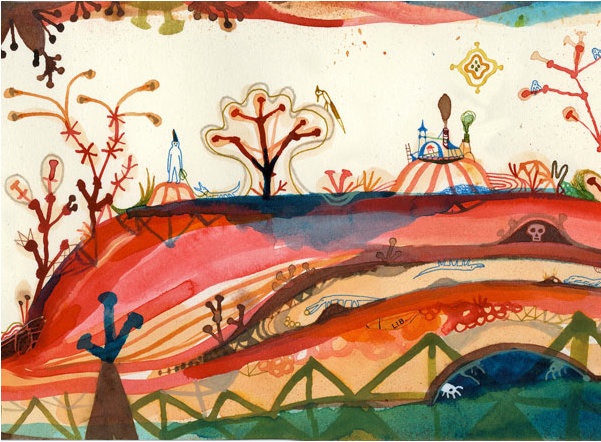
(illustration by Souther Salazar)
*
*
*
the scariest F word (Future)
The world is subdued today. Like I am behind a veil, looking out. The colors pastel and faded, my senses dulled. My vision slightly obscured by the veil. It’s not unpleasant. But it can be dangerous. You think that you are hidden from them, behind your veil, and suddenly you realize that you’ve been visible the whole time. Exposed. —Alice LaPlante, Turn of Mind
Turn of Mind is a novel about a 64-year-old woman with Alzheimer’s. Nothing to do with me, of course, though I am 64, soon to join the entitled ranks of the Medicare’d for. I’m glad I don’t have the A-word disease yet, because, between the University of California and the federal government, I can hardly follow the instructions for filling out the forms for Part A, Part B, Part C, Part D, the plans (the plan… the plan…), the requirements, sign here, group number there, Do you still work? (not if I can help it), the dire warnings if you sign up for the wrong plan. A thick book Medicare & You (which is even more intimidating than Menstruation & You was, in the day) arrives in the mail, along with a virtually incomprehensible “explanation” of my future benefits from the Social Security Administration. For months I’ve been getting eager letters of invitation from every insurance company in the Midwest, hoping to snag some Alphabetical Part of my geriatric lifestyle. Before I started throwing them out unopened, I read one that tried to play on my Boomer sense of entitlement by asking, “Did you ever think you would be so popular??” “Why no!,” I thought. “Tell me more!”
The quotation from the novel elicited both a queasy memory and a sense of foreboding. I remembered, as a kid, singing to myself while seated under a hairdryer at the beauty salon, unaware that the sound that drowned out my voice in my own head did not prevent the other women in the place from hearing me. When I realized this, I stopped singing, mortified. (But why?—a question for another day.) And the foreboding thought was, Will that be me someday, “coming to” from a period of unself-consciousness only to wonder what I did or said while dissociating?
(When I looked up Dictionary.com to check the meaning of “foreboding,” I noticed an ad for Miracle Whip—a great name, you gotta admit. “We’re not for everyone,” it boasts. “Are you Miracle Whip?” This seemed an odd way to phrase a sandwich spread preference. Is it a new construction riding the coattails of “I am Mac” and “I am PC”? I’m not going to say “I am Mac” [though I am], and I’m certainly not going to say “I am Miracle Whip”—or maybe that’s one of the embarrassing-in-retrospect comments I will make while demented, especially since there’s bound to be some slippage: “I am Miracle!” “I am Whip!”)
Anyway, I’m of two minds about all this, because if you lose one mind it would be nice to have another one to fall back on, ha-ha {THEY’RE COMING TO TAKE ME AWAY}. In my present state, in which I am blessedly sane and composed {HAHAHAHA}, my desire for control of all aspects of my life is absolute. Never before have I had such freedom to indulge any whim… to sleep whenever, eat what- and whenever. And it kills me to think about having none of those freedoms anymore. Yet I have a concurrent fantasy of being so far beyond self-control that I would be relieved of responsibility or choice or filling out forms or paying my bills on time, or even having bills. Wouldn’t it be nice to wake up from that dissociative state and know you can’t be blamed for anything untoward that happened, leaving someone else, probably some poorly paid immigrant, to clean up the mess? As usual, I’m caught between extremes, and what will surely happen instead is that I will not be demented but will simultaneously have no control, like when I lived in a dorm at MSU. There, I quickly established myself as a rebel who sneered at mandatory group activities intended to socialize me into polite society. At least there was an alternative culture waiting to greet me in the late ‘60s, but who will I be forced to rub shoulders with if I end up in a nursing home? Will dementia be a preferable alternative to my lifelong social uneasiness, or will it make things worse? Will I be able to write about it? … because I think it would be quite interesting, if I could periodically regain lucidity long enough to turn on my laptop and send a few salient observations to my blog—they’ll let me bring my laptop, won’t they? or am I supposed to revert to the old-timey kind of old person who can’t see, hear, or walk and loves Lawrence Welk? I don’t live in the most modern-thinking area in the world, so I’m not sure how far I’ll be able to take my Web, Zine, and Painting lives. Speaking of which, what will happen to my paintings? And my painting process? Will I be allowed to paint naked women and eyes on trees during the Arts and Crafts hour, or will I have to go stealth and pretend deep satisfaction with outlining my hand to make a turkey for Thanksgiving? (The other side of the paper will hold my true imagery, the hearts, tubes, knives, blood, and “fabric of the universe.”)
I know I’m getting myself all in a dither over something that may never happen, but I am nearing the narrow end of the funnel, the last grains of sand in the hourglass (and no turning it over; Life does not work like Boggle), the final ride over the hump of the waterfall*, nothing known or (maybe worse) something known and horrible waiting at the bottom of the plunge, like reliving all my most embarrassing moments. The fact that I don’t think I’ve ever forgotten an embarrassing moment in my life may protect me from being blindsided, though blindsiding is exactly what happened to the woman in the novel I quoted, to my child self under the hair dryer, and to my adult self hobbling through SFO with a toilet seat cover hanging out the back of my pants. Is it too much to hope for to be conscious but not self-conscious, to be free and not care what anyone thinks? I’ve always felt unable to bend or blend, to go with the flow, skip over the rough parts. As a “psychic chiropractor” once told me, “You feel every bump in the road.” (Though I don’t think it took psychic abilities to discern that. I think it’s written all over my face, along with the map of Ireland.) I seem to be doomed to remain painfully aware of all my shortcomings: awkward, insensitive, judgmental yet lacking in judgment (“common sense”)—stop me if I’m being too hard on myself—and determined to be special if it kills me. In the plus column, I believe I have a good heart, but even that can turn on a dime and give a nickel change.
*Apropos of absolutely nothing, there are pictures circulating online of Niagara Falls without water. They had to dam the river in 1969 to do some sort of repairs (not sure how you repair a waterfall). I don’t know why it should affect me so, but there’s something about that big dirt-brown, naked-looking, scraggly cliff atop a giant collection of rubble, ugly without the flashy and powerful force of nature’s elixir tumbling down, stripped of its glory to reveal nothing but an ordinary sharp drop-off with the promise of a hard landing. It was like seeing the squat man behind the curtain, nature’s own Oz demystified…. as if all the great wonders of the world could be similarly deconstructed to expose the fact, finally and forevermore, that we live on a big, slowly-spinning-in-mid-air ball of dirt and rocks.
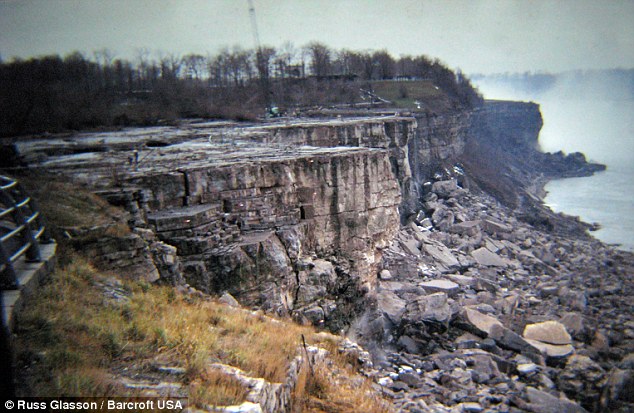
nude Niagara Falls, 1969
*
*
*
“Twenty, twenty, twenty-four hours a day…”
Once a year, I have to drive down to central Wisconsin for a 15-minute drug-monitoring session with my psychiatrist—I’m still taking sertraline, a generic Zoloft. (“Sertraline” sounds like a top-of-the-line mattress.) Recently, Dr. V.’s office moved from Oshkosh to Neenah, thus shaving 40 miles off my round trip—from 200 down to 160. No, I couldn’t find anyone closer. And I like the guy a lot. (I wonder, though, how much satisfaction there is in being a psychiatrist these days: You’re basically a glorified pharmacist.)
 Because I hadn’t been to this office (or Neenah) before, Barb lent me her GPS device. All I had to do was drive straight down US 41 for most of the way, but I discovered that global positioning doesn’t always help when you’re trying to position yourself locally. Turns out I was not prepared to navigate the Neenah version of “roundabouts.” I thought I had conquered the concept of a roundabout: Car goes in, car drives in a semi-circle, car goes out. But these ones were devilish, because there was a lot of traffic and I didn’t know where I was going. At the first one I encountered, the GPS voice, which I will call Gloria, told me to “enter the roundabout,” but I got confused (quelle surprise!) by the myriad of lanes and made a right turn instead. So Gloria directed me to make a left down the street, another left, another left, and a right and back to the roundabout. I didn’t fare any better this time. I didn’t know what she meant by “take the second exit” and I wasn’t at all sure who was to yield to whom. While watching for cars, I was trying to get a glimpse of a street sign, plus count “exits.” Again, I didn’t get off at the right place and I ended up going back the way I had come. Gloria, with the patience of a saint, or a robot, told me where to turn, turn, turn, turn and get back. Unfortunately, down where I was turning, I had to go through another roundabout, where there was less traffic, but I still made at least one wrong turn there and had to try again. I headed back to the Mother of all roundabouts, and this time I again missed the correct “exit” and found myself on the street going off to the left. (Actually, I may have repeated the “back from whence I came” move. It’s almost as difficult to describe it as it was to do it.) Every time I made a mistake, Gloria hesitated for a suspenseful 2 seconds and then said, “Recalculating.” Which I found re-dispiriting. By the end of my ordeal, I was saying out loud, “Don’t say ‘recalculating’!” So I approached the roundabout again, and this time the only option left open to me was to go straight, if only I could figure out which “exit” would take me in that direction.
It’s a miracle that I whipped in and out of 2 roundabouts a total of 6 times without getting creamed, or creaming someone else. I suspect that the locals watch out for us out-of-town bozos who’ve never been to the big city before: More than one driver waved me on when I hesitated, not knowing who was to yield. Frankly, I’d rather wait for a red light. As I said, I get the concept of the roundabout, but not knowing where I was going did a number on my brain. Plus, my brain takes everything literally and returns to zero after every mental calculation. It takes me a while to integrate what I’m seeing with what I already know; therefore, I’m not burdened by “knowing too much.” Boy, am I not burdened by knowing too much. This has served me well in my work, believe it or not, because every manuscript is a new puzzle to solve and I’m delightfully unbiased—that’s it, unbiased—as if seeing the words and ideas for the first time.
Fortunately, I had left myself enough time to make any number of dumb mistakes, so I still had half an hour to wait once I found Dr. V.’s office. When I got in there, I told him that I’m having the dreaded “restless legs syndrome” several times a week. (I should call it RLS, because “restless” sounds so trivial. “You have an ‘urge’ to move your legs? Well, I have an ‘urge’ to eat a dozen doughnuts at a time, but I restrain myself.”) You may remember that I spent an excruciating 8+ hours flying to and from San Francisco last December because of that terrible sensation in my legs. I had read that SSRIs can exacerbate the problem, so I had wanted to ask Dr. V. about reducing the dosage of sertraline. But I’d recently been reminded of what happens when I’m left to my own emotional devices (story for another day), and no way was I going back to a life of constant anxiety relieved only by bouts of debilitating depression.
So anyway—is it too late to say “long story short”?—Dr. V told me about the various medications that can help with RLS. He cautioned me about the side-effects, though. One class of these drugs is highly addictive, and the other can make you psychotic. I pondered the dilemma for a moment, forefinger to my chin, and finally said, “I’ll take addiction.” He said he wasn’t worried about that in my case anyway, because I don’t have “an addictive personality.” I asked how he knew, and he said, “Because you don’t drink a case of beer every night.” I almost asked how he knew that (I’ve spent 15 minutes a year in his presence, for a total of about an hour and a half), but I didn’t, because time was almost up. I’m not going to tell you the name of the drug, because one or more of you would surely look it up and tell me all the horrible things it could do to me. Come to think of it, one or more of you will probably tell me I shouldn’t be taking drugs at all. Well, forget that noise! (as we say in this part of the world). I remember when I had a 9-pound (as it turned out) ovarian tumor growing inside me and I was about to go under the knife in 3 days, when a “holistic” friend of mine urged me to drink some sort of special organic tea instead. But now I’m older, wiser, and definitely more stubborn, so I appreciate your (hypothetical) concern, but no thanks. I can’t get on an airplane again until I deal with this problem. Which reminds me, also, of the time another well-meaning friend assured me that my air sickness was psychological, so the next time I flew I didn’t take Dramamine. I figured, the plane doesn’t really have that much motion, like a bus does, so what the heck? But as the plane started to rise into the air, my stomach rapidly descended to wherever it goes when it wants to throw up. I hurriedly popped a Dramamine and held on tight until the nausea subsided. Actually, it’s not really holistic solutions I object to… it’s advice.
After I left Dr. V.’s office, I entered the address of El Sarape in Green Bay into Gloria’s positioning system, made it through the Problem roundabout with no trouble, and went on to have a delightful Mexican lunch. Then another hour to get home, where I collapsed in my comfy chair with my comfy cats and slept the day away. I was whipped. It was a miracle.
And now I shall say adieu. Make of this hodgepodge what you will. And like me on Facebook! (just kidding)

gratuitous woodpecker image (so many pretty things on the webs)
*
*
Mary McKenney
mary’zine #50: July 2011
July 21, 2011It isn’t necessary that you leave home. Sit at your desk and listen. Don’t even listen, just wait. Don’t wait, be still and alone. The whole world will offer itself to you to be unmasked, it can do no other, it will writhe before you in ecstasy. –Franz Kafka, Zürau Aphorisms
Everywhere I turn lately, it seems I’m getting a message about silence. Even the comedians Marc Maron and Garry Shandling talked about it on Maron’s podcast—the beauty and significance of it, the desperate need for it, both onstage and in real life. Something is drawing me to notice these references. Maybe it’s because The Painting Studio in San Francisco was holding its 7-day spring intensive the week that I started writing this. After painting for a few days, the silence is palpable. Thoughts may pass through, like the 36 Teresita bus that comes rumbling past the studio several times an hour—odd how the inner silence can flourish in less than ideal urban conditions—but they gain no purchase. Image and color are your only tools, “all ye know and all ye need to know,” like Keats’s truth/beauty.
It’s not that silence is empty. In silence is everything. What silence silences is the mind, that chattery, self-interested, superficial retainer of life’s minutiae. The mind comes in mighty handy when you need to remember something, like how to get home from the store, but it is limited. It is limited in exactly the ways that it would need not to be limited for it to understand what goes on beyond itself.
The mind will chatter on, but it has no power if you (i.e., the mind itself) aren’t afraid that it is all you have, that the chattering and worrying and faux planning (as if there truly is a thing called “tomorrow”) is all that supports and proves its existence. I worried a lot about death at an early age, when my brother died and I couldn’t understand how he could be under the ground—forever. I would lie in bed trying to imagine forever… better than focusing on under the ground, I suppose… this long and this long and then still dead. It was like trying to hold my breath indefinitely, the mind was not up to the task of imagining such a thing. Even if death didn’t enter your life as a child, you put the same expectation and fear of the future on the unimaginable changes that would have to occur for you to become what they called an adult. I worried that I would stop getting toys as presents, unable to imagine not wanting them. In the 3rd or 4th grade, I saw that my older cousin had to read Time magazine for his 6th grade class. I couldn’t imagine being asked to comprehend anything so complex. Adulthood seemed to me like a never-ending series of requirements, disappointments, and “pills to swallow,” because I had no way to imagine being other than who I was.
And that’s what I think the fear of death is in adults. We can’t imagine not having the mind, personality, and characteristics that we have now… we can only imagine having (No More)Time magazine to somehow comprehend… receiving “gifts” we don’t want, longing for and holding on to the life we know, rejecting the new reality because only the old reality is familiar or even credible. Religious people convince themselves that we will somehow remain “ourselves”: veritable children playing with our toys and reading our Beginning Reader books instead of complicated magazine texts requiring an ability to comprehend beyond our present state of semi-literacy.
In my analogy of the misapprehensions of children imagining adulthood, at least as children we have models for the coming transformation—our parents and other adults who claim to have once been “our age,” though we can’t imagine them as children; even photographs of them looking much like us aren’t compelling evidence, because it isn’t quite believable—the alchemy of growth, like metal into gold, yeah, right: How could there have been a world without my mother as herself (i.e., as my mother) in it? So the algebra of “child is to adult as life is to death” seems to break down, because the irreligious adult has no model for what comes “later,” not even photographs. There is no believable future that can be accommodated by our childish adult minds. We think we know all the possibilities: placed in the ground, or burned up and scattered, or existing (if you can call that “existence”!) as ashes in a jar on somebody’s end table. Our limited minds lead us, as our limited child minds once did, to fearful projections based on unrealities and unknowables. This throbbing litany of fears is the mind acting on itself, trying to escape itself, out-think itself, imagine itself as no longer existing technically but still somehow self-aware. Even if you reject the traditional promise of heaven or the threat of hell, the “spiritual” promise is an equivalent bargain in which you still expect to be yourself in some theoretical state—sacrificing the body if only you can retain your sense of identity. I happen to have experienced the level above the personal for a few brief moments (though even referring to “levels” and “above” or “beyond” is misleading), and it’s not as if I can come tripping down the mountain with stone tablets that explain everything in 10 simple bullet points, it’s more of an evanescent memory of a certainty—perhaps the only true certainty I have ever experienced—that not being me is not a contradiction or an impossibility.
So I do believe that silence is the irreducible core of our existence, but it’s not as if I myself forgo the silence-fillers of eating, drinking, listening, watching, reading, thinking. Sometimes, when weather permits, I’ll sit out on the back porch and watch the birds, but I’m not sure that qualifies as silence either, because it’s like watching the Discovery channel: There’s still content. But it’s just more detritus of the mind to worry about what one is or isn’t doing to fulfill some assumed criteria, as if the mind can bargain with the depths (God/etc.), “I’ll sit still for 30 minutes a day,” “I’ll stop eating meat,” “I’ll only read spiritual books.” You can’t get there from here. You can’t create or mimic it, or punish yourself for thinking, faking, avoiding. “You” are the vehicle, not the fuel, the origin, or the destination. (The painting is one of my first, from 1979 or ‘80.)
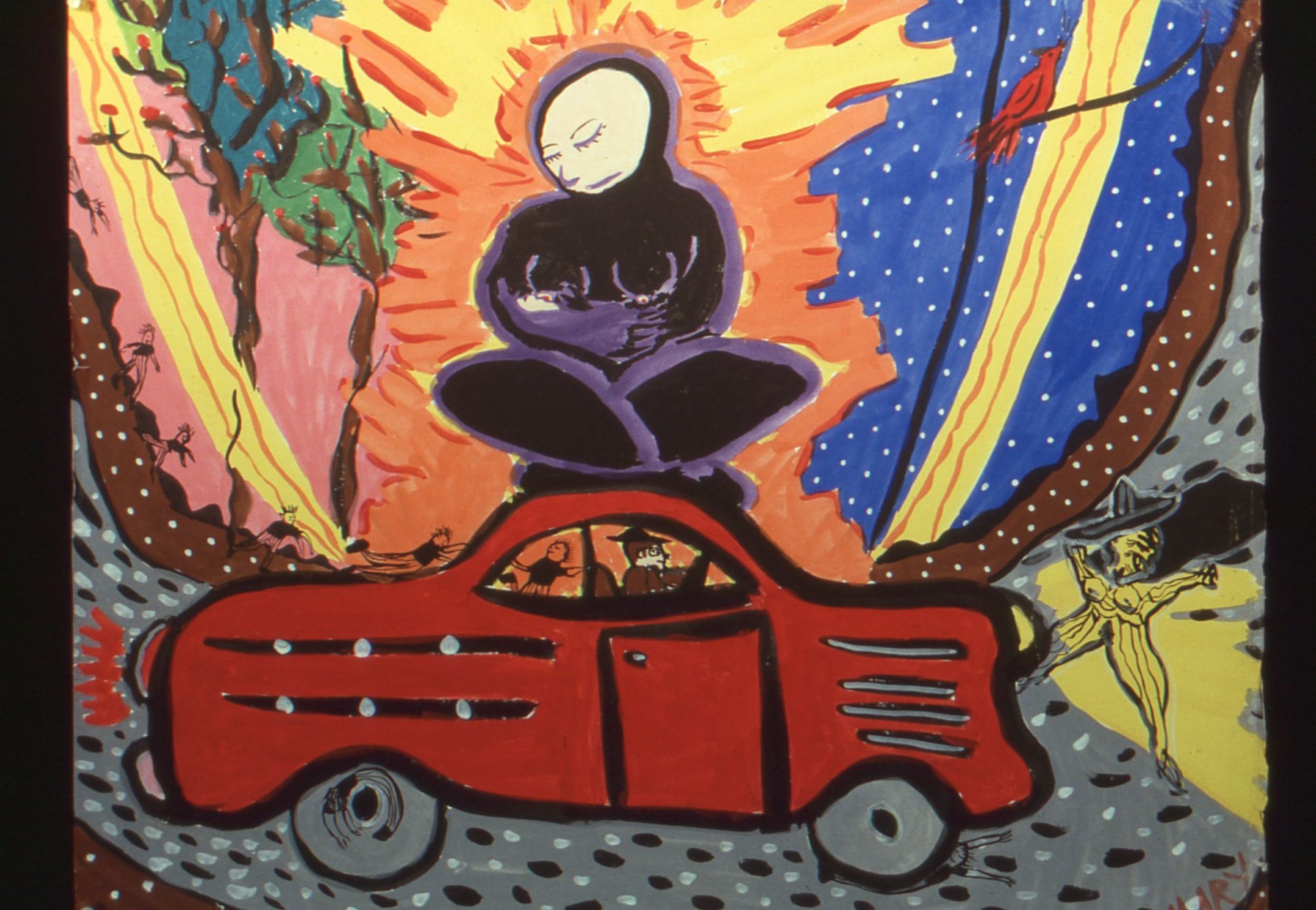
Bird Bath and Beyond
At last, I am enveloped and enriched by the green, green flames of leaves that I sorely missed all winter. It’s funny how you change in ways you could never have predicted. By the time I left home at 17, I hated the color green, partly because of its ubiquitousness in the environment (the U.P. was green way before it was fashionable) and partly because it was my father’s go-to color for painting everything around the house, including the lawn furniture we built in the basement and sold in the front yard to people in (hardly ever) passing cars. Now it feels as if, without the color green, I would only be half alive.

There are new kids on the block, birds of and of not a feather—a red-headed woodpecker looking like a painted image—a bird-shaped Mondrian, perhaps—and the usual suspects, the little yellow finches, bright-red cardinals, iridescent pigeons, dull-brown (but lifelong loyal, they say) mourning doves, blue-blue jays, and those little brown and striped sweeties that are still (to me) UFOs—along with a couple of chipmunks that run like the wind when my shadow darkens the glass in the back door. The neighborhood crows finally figured out that the lawn at 4216 4th St. is paved with gold (and dried corn), so they come strutting across the grass or dive bombing like F-18s, scaring off all the other critters.
Indoors, my pampered darlings, Brutus and Luther, live their lives of Riley, barely moving except to find a more comfortable position on the “family bed” (armchair + oversized ottoman). Brutie’s favorite thing lately, and I don’t know what he gets out of it, is picking up one of my old slip-on shoes that I leave by the front door and lugging it all the way across the living room and the kitchen and up the stairs, where he dumps it and then ignores it until I bring it back downstairs and he retrieves it again. Tag team Sisyphus?
By the way, I’ve come up with a U.P. version of the famous line after which he was named: Eh tu, Bruté? or Brute, you tu, eh? (Words are fun.)
***
The weather is odd, as always. Between one day and the next, the temp can go from 90 degrees to 40. I suppose it has something to do with the Great Lake that borders our flank. Right now (well, “now” when I started writing this—I’m always at least a month behind in my weather observations) we’re in a very small window during which, speaking of which, I get to keep my windows open rather than spending money on either heated or cooled air. Would that this would last. Have I told you that Menominee is in a “banana belt”? And yet, No, we have no bananas. It’s probably the safest place on earth, from both Old Man Weather and Young Man Terrorist… at least until those Canadians start getting uppity. One of my favorite novelists is Steve Hamilton, who writes about the way-UP north by Lake Superior and the Canadian border. But he makes me feel lacking in UP-ness. Down here with the faux bananas, we’re neither fish nor fowl nor “Soo” denizens nor Wisconsinites, whom we resemble most closely as fans of the g.d. G.B. Packers. The small talk that figures into any medical visit or restaurant meal usually starts with, “Are you going to watch the game?” or “Did you watch the game?” or possibly even, “Are you watching the game right now?” No one ever has to specify which game they’re talking about, because there’s only the one. When I was a lass, the Milwaukee Braves were my dad’s and my team, despite being even farther away than Green Bay. I still remember many of the players’ names: Hank Aaron (of course), Eddie Matthews, Warren Spahn… OK, not that many. If I’ve told you this before, you can skip ahead. One of my favorite childhood memories was going to an actual Braves game when I was about 10. (I swear, age 10 was perhaps the best year of my life, at least until about 40, when I realized that life was actually getting better; that 30-year in-between span was hellish.) I think it was just Mom, Dad and I who went to the game, because my sisters were very young. Dad was still in the navigable phase of his MS. I was amazed when we entered the stands and everything on the field was so brightly colored! I’d only seen baseball (or anything else) on our black-and-white TV. The green was so green, the red was so red, you get the picture. I don’t remember the game itself, or even who won, but I cherished the baseball bat-shaped pen-and-pencil set Mom bought me from one of the vendors. Of all the sports I played as a kid (in the driveway, in the road, at the Grant School field), I loved baseball the most (I’m quite sure we used real baseballs, not softballs). In junior high, PE was usually the near-nadir of my school day (actual nadir was trying not to vomit in 1st period)—unendurable gymnastics; nausea-inducing dodge ball (not strictly psychological as when I was in class; the continuous running made me sick), awkward and uncoordinated folk dancing, embarrassing (1) and scary (2) swimming (1: trooping past the PE boys in my bathing suit; 2: getting cannonballed on by a klutzy girl while trying to hold my breath underwater)—odd that I joined GAA, the Girls’ Athletic Association, in the 9th grade, but that was for fun, not a way for our dyke gym teacher to humiliate the likes of me—am I still in the same sentence? BUT… the only really wonderful day or days of the year in PE were in the spring when it was nice enough to be outside and we would play actual baseball games. The other times I got to play were in the summer when there were group picnics in Henes Park, usually sponsored by the VFW or similar militaristic organizations. I learned a few things about myself at those picnics: 1: One of the guys manning the food tables (hot dogs! Nehi pop! Heaven!) asked me my name and then disingenuously replied, “Oh, are you Skip’s daughter?” He was trying to catch me in a lie, which I really resented. My dad’s name was Bill. Uncle Skip didn’t belong to the VFWhatever. I guess I hold a grudge longer than even the meanest crow, because I’ve always hated being accused of lying or being tricked in any way. 2: I also discovered that I was very good at avoidance: In a game in which each kid had a balloon tied to the back of their ankle and had to try to pop the other kids’ balloons without getting their own popped, I won. I just instinctively knew how to make myself small or functionally invisible and to never turn my back on anyone. Huh. Funny how those traits get revealed at such a young age.
Ah, where was I? I thought I was talking about birds. Or trees. Well, I have one more thing to say about baseball. I couldn’t possibly care less about watching other people play it, but I deeply miss playing it myself. I saw on Facebook that one of my sister’s granddaughters (who’s 10, not coincidentally) loves, well, softball. That brought it all back and caused me great pangs of… is it nostalgia, or just missing something I can no longer do? Or are they the same? I definitely don’t want to go back there, I would just love to play like that again. Another “sport” (unorganized) that I truly miss is ice-skating… from the same era, when they flooded the field at Grant School and my sisters and I would skate in the evenings. I thought I hated winter (turns out… not so much), but I loved skating and was good at it. (It’s weird to remember how I used to love being physical.)
The “nostalgia,” or whatever it is, continues. It’s all about age 10, 5th grade. I looked forward to the town librarian’s coming to our school once a week; I read lots of library books, but my favorites were the Hardy Boys. Once, I helped the librarian by alphabetizing the check-out cards, and (more shades of the future to come) she was astonished that I had made no mistakes. I must have been the first among dozens or hundreds of previous speller-attempters to get it right. I was not impressed myself, since, you know, I had known the alphabet for some years already. But it stuck in my mind, 1, because I was and am vain about my felicity with language (and desirous of praise from authority figures), and 2, because it was such a perfect prefigurement (it’s a word) of my adult vocation. I love spotting the seeds of what I was to become, and I urge anyone who hasn’t yet figured that out for themselves to look back to childhood and see what really thrilled them. (Contrary to expectation, I didn’t become a professional athlete, but after 9th grade my path veered sharply into the language arts and philosophy, and away from everything requiring a body with moving parts.)
And now I am led, inexorably, to the memory—skipping a few years to 12th grade—of my lifelong attachment to my English teacher, Ruth, who did more for my self-esteem in a scant 9-1/2 months than I ever would have dreamed possible. In one of life’s cruelest lessons, I had to learn the hard way that being a protégé is stage-specific; you can’t have the same relationship with your mentor when you hit your 40s as you did when you were 17 and she was barely older than you at 29. (Likewise, my male 5th grade teacher, whom I adored for similar reasons, was 25 to my 10.) That teenage infatuation, to which I clung and later attempted to transfer to other female teacher-guru types, was obviously a maladaptation, but does anyone get through life without a maladaptation or two? I’ve ceased getting down on myself for my unmet infant needs. They’re still there—aren’t everybody’s?—but I accept the fact of them. In that sense, I’m no longer avoiding getting my infantile balloon stomped on (see above picnic; game; early life lesson), I’m just dragging the spent plastic around—popped by life, there’s no avoiding that—like dirty, ripped pant cuffs, aware of the time that’s gone by and the struggles that have taken up so much of it. Why begrudge myself the years of illusion, confusion, exclusion, intrusion, reclusion, and failed relationship hoo-hah that took up the vast majority of my mid-life? Now that I’m nearing the end-life, I feel like Judy Collins reflecting on the both, the many, the all sides now, just in time, right on target for my demographic boomer cohort. For all my vaunted contrarianism, I’ve marched right along with my contemporaries, going through each life stage more or less in lockstep, though ‘twas lockstep that I freely entered into. I regret nothing, as they say. Well, of course I regret un peu, but I did it all in good faith, how else could it have been? I only now see the ridiculousness of thinking that one can be someone other than oneself, that one can choose in a broader sense than just “I choose pie” or the like. My life feels whole, I have inclusion to add to the list. Does that mean I have finally gotten too big for my britches—oh snap, I have, but that’s not what I meant—as I claim to now embrace the whole of my life, even the pain that took place a mere 2 blocks away in an upstairs bedroom, or in a cedar grove across town, or in a college town beyond my UP boundaries, or in that delightful Shangri-la, San Francisco?
But what did my point start out to be? Well, on one of my recent trolls up and down the intertubes, looking for proof of Ruth’s continued existence, I discovered the opposite, her death. Nothing too specific, just an asterisk by her name in documents from Calgary, her lifetime home after Menominee. After confessing to me in a letter that I was “always [her] favorite [student],” I foolishly tried for more—when what more could I have asked for?—and got nada back in return. I tried humor (“You have a delightful sense of humor!” she wrote on the first paper I wrote for her), honesty, apology, the first 2 or 3 issues of the mary’zine, but I could not extract another bite past the whole enchilada she had already generously given me before disappearing from my life forever… leaving behind the 40-year-old going on 17, looking for a reprise of the closest-to-fulfillment-of-infantile-need I have ever experienced*, a need that is more intransigent than the desire for alcohol, sugar, or glory. I could call myself(ishness) merely greedy, but it was a perfectly understandable desire to repeat perfection once achieved but tragically undefined and ill understood at the time. Who can be blamed for wanting such a thing? I have now learned the true delayed life lesson of the popped balloon, the burst, irretrievable delusion of infancy, the poof of the certainty of my ability to avoid.
*Not true, actually. I achieved the ultimate in that department with my ex-therapist J… an even better example of the impossibility of continuing self-centered bliss in the unconditional positive regard of an older (well, 6-months-older in this case) mother surrogate. I’ve cycled through my allotment of mothers and mother substitutes, only to be left to my own maternal devices in my own behalf. Je regrette un peu, but again, that’s a balloon that will never lose its fill of air because it lives in the belly of my own beastly breast and breath. (I should have been a 19th century lady poet.)
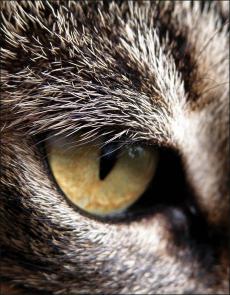
wild thing
My cat Luther is a wuss. A wimp. His brother Brutus antagonizes him, and he just takes it. He waits to eat until Brutus is finished, even though there are two bowls of food, and he follows me around and makes the French doors rattle when I shut myself in my bedroom. He’s a big baby full of needs that can never be fulfilled. I know how he feels, but it’s frustrating to be on the other end of that. Anyway, I have to take him to the vet every 5 or 6 weeks to get an allergy shot. We don’t know what he’s allergic to, but he scratches his chin and the skin around his eyes bloody. It’s never been a pleasant experience, but now it’s starting to resemble the apocalypse.
At the vet’s, we always have to wait past the appointment time to get into the exam room. There are no apologies, no “It’ll just be a few more minutes,” just the interminable passing of time, like No Exit for animal lovers. The waiting room gradually fills up with cats and dogs—the cats in their carriers, the dogs strutting about, straining at their leashes to get at one another and the cats. This last time, we waited for at least 35 minutes. It was torture for both of us, because we were intruded upon by a huge panting, stinky dog. This dog, named Kitty (how clever), insisted on being up on the bench about 2 feet from me, and she continually strained at her leash in my direction. I understand why people love dogs—I do—but they certainly have an entitled attitude. Most dog owners will intuit from my leaning as far away as possible that I’m not interested in being slobbered on, but this woman was a little light in the vigilance department. She would tug on the leash and castigate him casually just before he was about to get at me, keeping me in a constant state of tension. Every now and then Kitty would get down off the bench and walk past Luther’s carrier, sneezing on it, raking the side of it with her toenails, oblivious to Luther’s hissing through the air holes.
The bench where Kitty clamored and cavorted was quickly covered with puddles of drool (which her owner laughed merrily to see), which made me wonder what dried animal residue I was sitting on and whether they ever cleaned the bench. I finally got up and stood by the door because I couldn’t take it anymore. It was somewhat reminiscent of my visit to the dentist a few days before, when every muscle in my body strained to guard against the possibility of the drill’s hitting a sensitive spot. (I was not pampered with Valium or nitrous this time.) Even though there was no pain per se, there was a lot of noise from the drill, water spattering my face and glasses, and the suck stick doing its sucking and sticking, usually when it no longer mattered because I had already swallowed. Every muscle was wound as tight as anything, and though I tried to relax, my whole body would constrict again immediately with the sheer physical unpleasantness of it all.
Back to the vet…. I was relieved when we finally got into the exam room, but I knew there was going to be trouble when I started to unsnap the things on the side of the carrier to open it up and Luther hissed at me—a first. Fortunately, the vet and the assistant are good sports, but as soon as they took the top off the carrier, Luther went ballistic. He lashed out, he hissed and yowled, he practically launched himself out of the carrier at the assistant. (The vet knew to stay out of reach.) Luther fought for all he was worth, got covered with a towel and quickly stabbed in the butt, but he wasn’t going down without a fight. They tried to put the top back on the carrier, but he was still lashing and slashing and trying to get out. The assistant tried to get his attention down at the far side of the carrier while the vet struggled to get the door back on. We were all sweating by the time it was over, and the vet suggested I give him pills next time.
Then we had to go back in the waiting room until someone came out with the paperwork and the pills, but at least “Kitty” was gone and there were no further outbursts from Luther. We got home, and all was copacetic except for his eyes following me with suspicion whenever I came near him. I had a mad fantasy during the whole thing in which I imagined going wild myself—in the dentist chair or on the bench next to the stinky dog—starting to thrash and lash and hiss like crazy…. Needing to be covered with a towel and having one or more professionals try to keep their hands away from my sharp claws (if I had sharp claws). Maybe someday, when I forget who I am and lose my need for approval and don’t know why I’m being made to sit still and get shots or endure other indignities, I’ll fight like a wild thing and scare the bejesus out of everyone around me.
update on the folks
Recently, the sisters and brother-in-law and I had a rare Friday evening of no TV, just desultory conversation, no pressure, nothing of importance, but several fits of laughter among the womenfolk. I love making my sisters laugh. (Why is it always described as “making” someone laugh? Sounds kind of coercive.) So much silliness… Somehow the question arises: Do snakes have tails? They’re all tail. Well, they have a head, they must also have a tail. Then I mime throwing a snake up in the air and slapping it down on the back of my other hand, then peeking at it. “Call it,” I say. “Heads or tails?” We decide that the tail (or head) is going to be hanging down, so it’s a pretty easy call to make. I become enamored of myself doing this mime—in my opinion it’s way better than pretending to be stuck in a glass box. Barb says it’s like a Gary Larson cartoon… but his snakes tend to wear old lady glasses and have serious expressions on their faces. (Do snakes have faces?) (Why are we talking about this?)
While we burst into laughter over our silly word plays, the manfolk sits in his recliner like a stump, not appreciating our funny bones (do snakes have bones?), or possibly envious of our bond(s). This is us at our best, when no one’s giving a long-winded status report and no one else is parsing the goings-on. Just batting the conversational ball around (do snakes have balls?). Nothing serious, like I said, just whatever comes up….
… K’s work in the yard… A guy from the Eagle-Herald photographed her building a stone wall, and her picture appeared on the front page of the paper.
… Cars need washing. I calculate that I haven’t washed my Jeep (I mean, taken it through the car wash) since September ’09. The simplest things evade me sometimes. Before I had someone to clean my house, it would take me 6 months to spend 5 minutes cleaning the refrigerator. My mantra lately is “I do what I have to do,” but guess who’s deciding what “has” to be done? I feel like a mythic hero(ine) when I take out the garbage and fill the dishwasher and get the dirty laundry out of the way before my niece comes over to clean. Add to that the enormous task of carrying heavy bags of bird seed out to the back yard and filling the feeders. A semi-retired homeowner’s work is never done.
… A retelling of the whole plot of the season finale of “The Mentalist,” which I haven’t seen because… (another mantra) “I don’t have a TV.”
… Garage sale purchases… who made a haul, who didn’t find anything. It’s a lot like gambling. But the rich don’t put out much of any value because (I suppose) they’re keeping it, and the poor don’t because they don’t have anything of value. Baby clothes and double strollers seem to be big this year. Has there been a mini baby boom? But Menominee’s population has gone down to below 9,000, so I guess as soon as they’re born they start planning their escape. Few of us move back. Shore Drive with its 20 or so sales, too far to walk up each long driveway. I’d go with if they didn’t start at 7 a.m.
But I’d rather not have used stuff anyway. I’ve always been like that, even when I had no money. I want(ed) new books, new clothes, new toys. My sisters got my leftovers. I always forget that, so I’ll describe a rust-colored skirt and blouse outfit that I hated, or a gray felt poodle skirt that I sort of liked, and K will say, “Yeah, those got handed down to me.” They had to play with my handed-down dollhouse and listen to my 45 rpm records: Strawberry Alarm Clock, The Association. We each bring up memories, but rarely do we all remember the same things. One of us is always saying, “I didn’t know that!” “I don’t remember that!” I secretly suspect that my sisters’ memories are so bad—or their child gullibility so extreme—that they’re passing off imagined or joking comments as gospel: like our grandfather telling them that he was in the circus when he was a kid. Grandfathers say things like that, but does that make them true? A lot of things they bring up happened after I left for college at 17, put my family in my rear view, and drove away.
… What colors were the walls, who had a twin or full-size bed? Who dried the dishes while Dad washed, and who got in trouble when Mom found out he was teaching us to take two wet dishes at a time and dry the top of one and the bottom of the other, then switch. Men are forever inventing new ways of escaping household drudgery, much to the chagrin of their control freak wives. One of the things that prevent men from taking over their share of the household duties is the woman’s fear of the man’s lack of “doing it right.” (“Easier to do it myself,” which is fine with the guy.) Way to go, guys! I will add this seemingly anti-feminist proviso, though: Women who want their men to do their share of housework and baby diapering tend to be strangely reluctant to do the “man” things like getting the car repaired or climbing up on the roof to fix the antenna. I’ve never seen this addressed (by women). Although I hate the argument that men and women should have fixed gender roles, I do have sympathy for the guys whose wives don’t want to cook or sew but don’t want to do the other stuff either. Of course I mean the women who don’t work outside the home.
Why do I care? One of the beauties of same-sex relationships is that each partner gravitates to doing what they mind the least. Not that there are no “male-female”-type divisions of labor, but there’s still freedom to, say, prefer to cook over doing the dishes, or rake leaves rather than vacuum. You make it up as you go along.
But again: Why do I care? I have to do it all, except for what I can get other people to do for money. It’s not that I feel I’m above doing dirty tasks—remember that garbage gathering and that dish(washer) washing—I’d just rather look at words on paper than do even the slightest form of physical labor. And I’m helping the e-con-o-my!
… Gossip about my nephew’s ex-wife’s second divorce, so satisfying to he who went through the trauma of her manipulations and criminal behaviors, such as forging his name on checks that were intended for him. He was a saint, supposedly, and she was a lying, cheating bitch. And the other nephew’s ex makes him drive to her town to “babysit”! The mothers of sons have a unique perspective on these things.
We’re still playing Friday nights by ear, Barb and I waiting to be invited over. I whip myself into a lather over my brother-in-law’s apparent dislike of having us around. (After previously whipping myself into a lather over his never letting K come with us without him.) He refuses to go with us to Schussler’s for K’s birthday dinner. I don’t want to go back to their house afterward but do anyway, because that’s what we do. MP is out on the deck, still seemingly avoiding us. After a while he comes in and plops down in his recliner next to me, and I deliberately don’t look at him or say anything to him for maybe half an hour. I don’t think anyone notices, but I could be wrong. The TV stays off, a minor miracle. At one point K mentions what they do when they get up in the morning at the ungodly hour of 4 or 5 a.m.—they kneel on the couch together and watch the birds through the picture window. Something about this image melts me right out of my mood, and I turn to MP and say how sweet that is. And from that moment on, we talk to each other like normal human beings and I realize how much I like him when he’s not being a dick (or when I’m not trying to out-dick him). This misunderstanding—or whatever it is—that has made us cut down on family time seems necessary but kind of sad. I’m still glad when just Barb and I go out on a Friday night to a decent restaurant and then watch a movie at her house and don’t have to strain to make small talk with the 200-pound gorilla in the room whose moods are so unpredictable. Hopefully this will all get straightened out in due time. Sometimes I wish I had just played along for the past 7 years and never spoken my mind and never riled anyone (the gorilla) up.
Sodden thought: Maybe I’m the gorilla. MAYBE I’M THE FUCKING GORILLA.
Mary McKenney
mary’zine #49: April/May 2011
April 28, 2011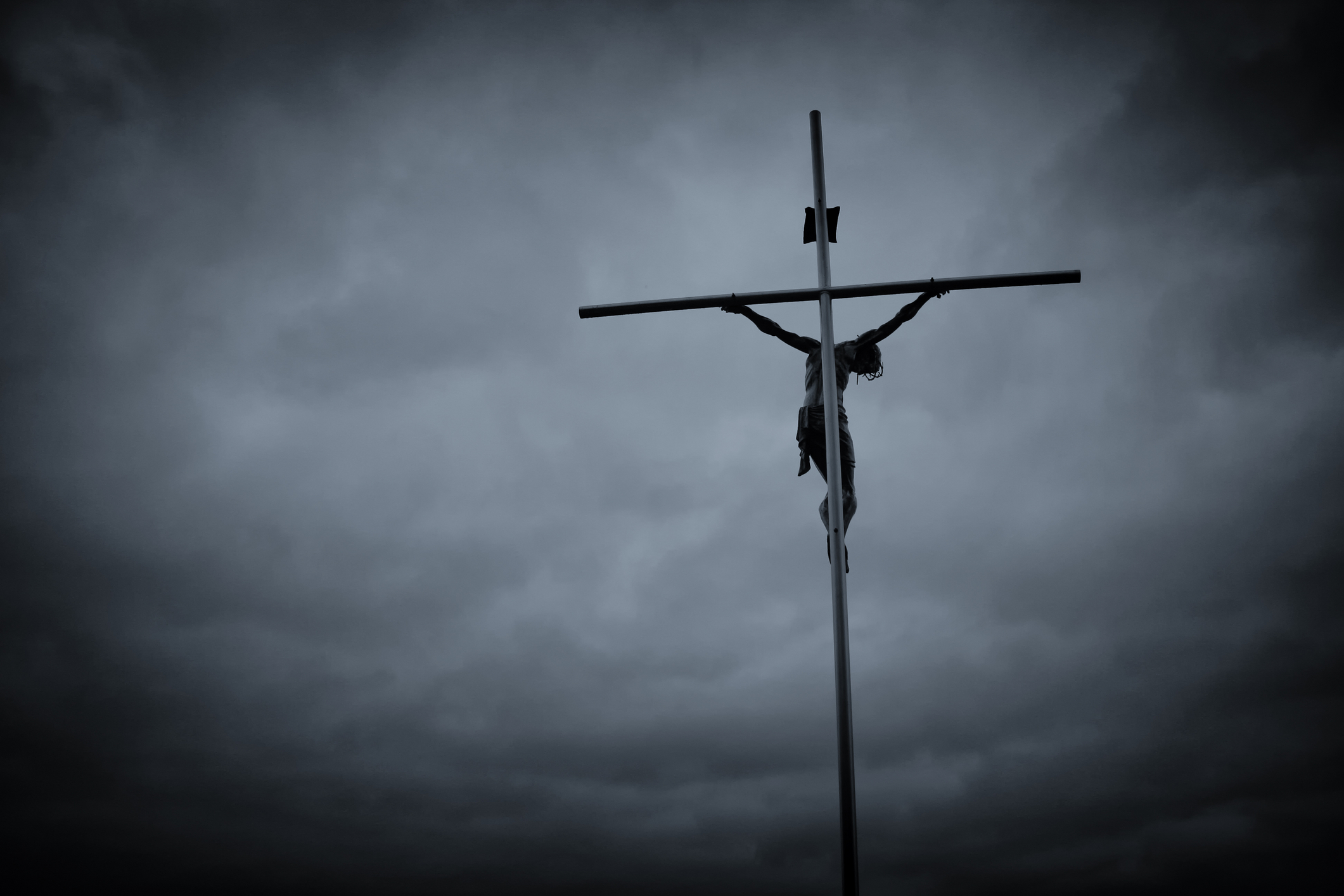
if I had a hammer…
A couple of years ago, a church here in town had a sign out front at Easter time that read, “We use duct tape, God used nails.”
Now the sign reads, “We tried to use nails, but he got loose.”
Is this not the essence of vulgarity? (“morally crude”; “lacking in cultivation, perception, or taste”). The Easter bunny has more dignity.
Happy Spring!

but first… say good-bye to winter
Its being April already—almost May!—I thought I had overshot the winter window for writing about wet, cold weather. But we had snow on the 15th, and again on the 19th and 20th, so we’re still in its thrall. As I write this, it’s 46 degrees and I have a window open. The snow is gone, for now. I watch every day for signs that the buds will come out on the trees soon, and flare green.

The House Was Quiet on a Winter Afternoon
Someone was reading in the back,
two travelers had gone somewhere,
maybe to Chicago,
a boy was out walking, muffled up,
alert on the frozen creek,
a sauce was simmering on the stove.
Birds outside at the feeder
threw themselves softly
from branch to branch.
Suddenly I did not want my life
to be any different.
I was where I needed to be.
The birds swirled in the dusk.
The boy came back from the creek.
The dead were holding us up
the way the ice held him,
helping us breathe the way
air helps snowflakes swirl and fall.
And the sadness felt just right,
like a still and moving wave
on which the sun shone brilliantly.
—David Young
(Reprinted with permission of the author)
you don’t need a weatherman…
My sister Barb called one evening in early March to ask if my “hatches were battened down”: We were due to get hit by a big winter storm within the next 6 or 7 hours. “Oh?” I asked, only vaguely aware of the thing called “weather” taking place outside my cozy homestead.
About a year after I moved back to my hometown, she had called with another weather warning, this time about a tornado that was whirling and dervishing its way across northern Wisconsin and the U.P. I took her seriously and ended up in the downstairs bathroom, sitting in the tub on a comforter (wishing I’d brought a book), two cats closed in with me along with their litter box, food and water. I had my radio tuned to the weather channel, and the ominous, staticky voice (as if carried on radio waves from a ship on a distant ocean) kept announcing at-risk counties and specific deadlines (8:15 to 8:45) past which you could breathe a sigh of relief, assuming the tornado had not already whisked you and your pets and lawn furniture above the tree line. Luther was pretty copacetic—he’s a born follower—but Brutus was literally climbing the walls. At one point, sensing movement above my head, I looked up to see him hanging straight down, by his claws, from a swinging cabinet door. Hang in there, baby! So we hung in there until the weatherman announced the all-clear. I vowed never to be led down this bad-weather path again by my well-meaning sister.
But in this case, it was just snow on the way, predictable and fluffy. I had an hour before Van’s IGA closed, so I ran (drove) down there, delightedly rationalizing to myself that though I had plenty of “real” food on hand… egg salad, fresh bread, penne with Italian sausage, tomatoes, and cream (which I had cooked myself, personally!), and broccoli… if I couldn’t get out of my driveway the next day I would be seriously bereft of snacks. I knew, in the rational part of my brain, that it wasn’t going to be a huge deal, my nephew would plow me out and I could surely last 24-48 hours without potato chips, but the reptilian brain that’s addicted to said thin slices of spud and sea salt took the weather warning ball and ran (drove) with it. I stalked the aisles of the little store, assessing the best bang for my buck: Ruffles, Doritos, chocolate chip cookies? I needed eggs anyway, so I got those, and, in the spirit of “gettin’ while the gettin’s good,” picked up some breakfast sausage too, because I didn’t want to be caught without a source of protein. I took a stroll past the freezer section, eyed the Mackinac Island Fudge ice cream, but kept on walking, proud of this minor act of restraint.
I’m reminded of Anne Lamott describing her desperate purchases of alcohol back in the day. For better or worse, I’m my mother’s daughter more than my Irish alcoholic father’s. In my refrigerator are a few bottles of Bud Light and some raspberry-flavored Smirnoff that I bought longer ago than I can remember, plus a half bottle of gin in a cupboard that a houseguest left behind. It never occurs to me to drink any of them.
So… I slept for a few hours, and when I woke up the snow was coming down in droves, the poor birds were pecking around, trying to unearth (unsnow) the seeds and nuts they remembered from yesterday, and mourning doves were lined up on the fence, quite content, it seemed, to be sitting in a fluffy downfall, knowing that spring was near despite all evidence to the contrary. I don’t envy them their need to scavenge in harsh conditions, but, Ah, the beauty of flight, to live above it all.
The snow fell and the storm passed. Was it too soon to hope for signs of spring?
Yes, it was. Father Snow—or is it Mother who covers us with those cold but beautiful blankets?—was not done with us yet. Two and a half days after “the first day of spring”—an impractical joke that is played on us Midwesterners every year—we got the worst storm I’ve seen here, a total white-out. And it was the oddest thing: The temperature had been hovering just above to just below freezing, so Nature split the difference and brought us loud cracking thunder just as the snowish-rain or rainish-snow began to fall. For the next 36 hours it sounded like all hell had broken loose, as blinding blowing gusts of snow flung themselves against the windows, creating intricate crystal-doily designs.
In the daylight hours, I watched the birdfeeders blowing back and forth from white-thick branches, the little birds holding on to the perches for dear life and the bigger ones hunched together in the trees, feathers ruffling like petticoats in the wind. I felt especially bad for the one cardinal that comes around in the wintertime, contrasting gloriously red against the driven snow, because it has no one to be of a feather with. The squirrels are plentiful, but it’s hard to make out their relationships: no coats of a different color, and when we think they’re playing?… chasing one another up and down the tree trunks? No, it’s life and death, a Masterpiece Theatre of drama with a plot that’s impossible to follow. Is it brother versus brother out there, like in the Civil War? Are all the womensquirrelfolk back in some hidey-hole, keeping the home fires burning? Is it a tragic story?… or just one of the many quirks of Mother Nature, who put large populations of incompatible creatures on the earth and then made them compete for limited resources?
I was snowbound for an entire day, and when I woke up the morning after that, the sun was shining on the white wonder windless winter land. The birds were back in force, pecking holes in the snow so they could feast on the fat seeds that lay beneath. I stood at one of my upstairs windows and spotted a mixed flight of birds—united in their birdiness regardless of feather identification—rise up and flee en masse. That usually means they have seen me peeking through the blinds, but this time, right at eye level, I saw a small hawk sitting imperiously in the birch tree, its head swiveling and eyes beadily scanning for prey. It either didn’t notice me or wasn’t bothered—human-behind-glass, big deal. I watched the beautiful creature until it swooped down and through my yard and disappeared from sight.
I know that, to truly appreciate Nature, I’m supposed to be out there getting cold and wet and buffeted by the harsh wind, being One With It All. Maybe this is hubris, but I feel like we’re already One. I may be like a small Russian doll inside my house-within-a-bigger-Doll, seemingly uninvolved, unexposed, a creature intent on her own comfort, abstractly appreciating but not truly interacting with that which is “outside” me. But in a larger sense, none of it is outside, it’s all inside me, all the feeling that comes through sight and sound and caring-about and caring-for those innocent winged and fluffy-tailed ones that feast on my largess. I am practically bursting with involvement, my heart exposed, they are not background to my life, they and Brutus and Luther, my cats, are integral to my life, as are the sad-dog, sad-cat, sad-elephant or -horse pictures in magazines. They have a physical existence apart from me (especially the ones on paper), but I take them into my heart—no, they are already there, we coexist in our animalness, our together-on-this-earth-ness, our depth of love and hopeless signaling to or fleeing from one another, like birds of a different feather but One flightless shared soul.
changes in l’attitude…
In every pot of ointment soon appears a fly. Your good fortune lies in not needing to forget it or deny it. In every situation hides some creative chance.—Sidney Cox
Lately, the family seams are being stretched a bit. I blame the Republicans and my brother-in-law, not necessarily in that order. During the huge protests in Madison about the rights of public sector workers, there was a mostly unvoiced but palpable tension between the unionized retired teacher (sister Barb) and the nonunionized, still-working factory worker (sister K). Every night on the news, shills for the GOP hammered home the fiction—and the contradiction—that teachers are the New Elite who (a) think they’re better than their family members and neighbors who work in grocery stores and factories—as if Republicans were siding with the “true” working class—but (b) engage in “class warfare” against the poor, misunderstood plutocrats and fat cats. I have to hand it to those guys: They can twist words, and they know just whose neck to twist them around. Bankers are extolled as a class that “performs a wonderful service and creates jobs”—and does it for measly millions in bonuses and golden parachutes. Much is made of teachers working short days and having summers off. But everyone who knows a teacher knows that they rarely have an evening or weekend free of grading papers, planning ways to keep their students interested in class, or dealing with demanding parents. Barb spent at least half of each summer planning for the coming school year because the administrators kept giving her new classes to teach. She was as dedicated to her work and the kids in her charge as anyone I’ve ever known.
Nothing much was said around the family hearth (TV) on Friday nights, but it wasn’t too hard to see what was going on. K muttered that the protesters “couldn’t live there” (the state capitol in Madison) and offered up a coworker’s opinion that they could try Gov. Walker’s budget plan for a year or so, and if it didn’t help the economy, they could go back. Barb and I exclaimed in unison, “They never go back!!” Her statement assumed that the Republicans were just trying to do their best to help everyone get through the hard times. Her naivety was alarming. So there was bad (or at least slightly tainted) blood bubbling just under the surface, but both Barb and I were afraid to push it. K and my nephew believe that unions “do nothing for you but take your money,” so it was strange that they envied other union members who supposedly make too much. There’s not a lot of rationality when the non-college-going members of the family start spouting off. And I’m not being snarky, it’s just a fact that if your information comes only from the local TV news, you’re at the mercy of any well-coiffed reader of a teleprompter. According to one Green Bay news anchor, the teachers were not protesting but merely complaining. Words matter.
In other Wisconsin news, the lieutenant governor, Rebecca Kleefisch, opined that if gay people are allowed to get married, people will surely want to marry their furniture. (I must have missed those marches.) “Can I marry this table,” she asks, “or this, you know, clock?” I would love to see this, by the way. Right now you can marry a serial killer or a drunk you just met in a bar as long as you have opposing genitalia. But if you want stable relationships, I can think of worse combinations than a guy and a table. (Two guys and a table would, of course, be outlawed.) Inanimate polyamory is another possibility: “And the dish ran away with the spoon” (but two forks? no way!).
A week after this mostly silent, thin-lipped brouhaha, I was uncharacteristically looking forward to seeing my peeps, downing a burger or two or a fish fry, watching some harmless crime shows, and hopefully having a few laughs. When I arrived, everyone else was already there, doing the usual comparison shopping between fast food places: “What are you in the mood for?” “I don’t know, what are you going to get?” Right off the bat I felt uneasy, I don’t know why—like I didn’t belong there. It could be because my nephew’s girlfriend always acknowledges (if you can call it that) my arrival by flicking her eyes over me and then looking away. OK, so she’s “nobody” in the grand scheme of things, but it’s annoying.
A new plan had been announced for Friday nights; now we were each supposed to pay for our own food, rather than take turns paying for everyone. I’m sure this had to do with my questioning MP (brother-in-law, a.k.a. blood-in-law) last week about paying only for his own food, so that (it seemed to me) he never had to spend a penny on anyone else. The “plan” is changed often, because my sister K is all about streamlining; she once suggested that we all eat before we get there, and I suggested that it would be even more efficient if we didn’t get together at all. Gosh, do you think my smart-ass self could be part of the problem?
After we ate our greasy portions of meat or fish, we checked to see what shows they had recorded during the week: not much, because there had been a lot of reruns. It was decided that we would watch “NCIS.”
It’s MP’s “job” (prerogative) to handle the remote… which becomes a problem when he falls asleep, which he does every week. When awake, he fast-forwards through the commercials, or mutes them if we’re watching live TV, but tonight he has to be nudged awake. So he hits the fast-forward button and apparently falls back asleep, because the rest of the show goes whizzing by, way beyond the one commercial break. “You went too far!,” my sisters cry. So he rewinds and then goes practically all the way back to the beginning. “Oh no! We’ve seen this part already!” I make one of my trademark, only slightly barbed, observations: “Maybe someone who doesn’t fall asleep should keep the remote.” He stops the show in the part we already saw (and it wasn’t that good the first time) and stomps out of the room, his usual way of expressing his annoyance with one of us “girls.” Barb hands the remote to K, thinking she can take over, and K says, grimly, “I don’t know how to use it.” And then she adds, “You shouldn’t mess with the guy who runs the TV.” That’s a criticism of me, for stating the obvious and not being willing to enable the man of the house in his delusions of grandeur. She’s quiet for the rest of the evening, and MP never comes back out, so I decide to leave early. Barb gets up to go too. Her approach to MP is not to let him know that he gets to her, so she calls out, “Good night, MP,” as she always does, and I don’t say anything because my attitude is—not to put too fine a point on it—“Fuck ‘im.” If K stood up to him once in a while, he wouldn’t be able to get away with that prima don act. But her attitude has always been that it’s better not to challenge him so as to “keep the peace.” An uneasy peace, if you ask me—if it’s any kind of peace at all.
I’ve been dealing with this situation for 6 and a half years now, with greater or lesser degrees of success…. trying to use humor to deflect his moods… keeping my mouth shut when he makes disgusting remarks about brothers of another color… trying, for the sake of my sister, not to cause a scene. But I know that this is just the “wages of family”—like the wages of sin—not death, but endless cycles of compromise and drama and rebellion, from each according to her ability to cope, to each according to his place in the family dynamic.
This straw having shattered the camel’s aching back, we all realized that something had to change. We agreed to “play it by ear,” and it was understood that we wouldn’t be getting together in the same configuration for a few weeks. The following Friday, Barb and I happily ate at The Landing, dining high on the hog, or at least the chicken—cacciatore and marsala—for a change. We entertained thoughts of future rendezvous at the local medium-to-high-end restaurants in the area: Table 6, Little Nugget Golf Club, Riverside Country Club. If we include Green Bay as a destination, the possibilities are, if not endless, at least more appetizing than the round of fast food places we usually have to choose from.
The following Friday sounded promising, as K, Barb and I were planning a sisters’ breakfast out and shopping. We arranged to meet at Schloegel’s at 8:00 a.m. I got there a bit early and waited in the Jeep for them to arrive… and soon, what to my wondering eyes should appear, but… MP. K had thought he was working that day, but he wasn’t, so she told him he “could come with if [he] didn’t want to be alone.” It felt bizarre to be sitting together in a restaurant so early in the day, especially when we had been expecting a laugh-fest sister-clatch. After breakfast (for which MP paid—reflecting generosity, or his assertion of control?) MP drove us to Peshtigo and Marinette to buy a recliner for Barb and miscellaneous necessities at Shopko and Penney’s for her and K.
I actually ended up buying some beautiful dining room chairs, so the day wasn’t a complete loss. MP stayed in the truck at each store, which I’m sure put pressure on my sisters to hurry through their browsings and purchasings. Oddly, I sat in the truck with him for much of the time, because my legs hurt and I didn’t need anything in particular. He was perfectly amenable; I actually feel very comfortable with him most of the time—it just seemed like he was exerting his control over K (indeed, all of us) by impinging on our sisterly fun.
Is this what being close to someone means—knowing their limitations, their ego-boosting delusions and self-serving grottiness, as well as you know your own? Being able to predict their reactions, their facial expressions, down to the last word and grimace, so that disappointment and a sickening sense of predictability surge up and crush the breath out of you the moment you clap eyes on them, before anyone’s uttered a word? —Sophie Hannah
As family dramas go, ours is no Downstairs, Downstairs. Or maybe that’s exactly what it is. The complaints are petty, secrecy is prized, and self-awareness is “more honor’d in the breach than the observance.” Conflict is expressed in veiled glances, cold silence, and premature departures. For all my fancy talk and psychological sophistication, I’m as primitive as anyone else. I’d like to find a way to achieve harmony with my bloods and blood-in-law without exposing all the messy differences between us. I want them to be a book I’ve already read and can put down with satisfaction as I sip my glass of wine and perhaps take an aspirin for the slight headache caused by my intense concentration. One of my favorite memories* of college life was being alone in the apartment one night while my roommates were away; I finished reading Katharine Anne Porter’s Ship of Fools, heated up a can of tomato soup, and then went out for a long walk in the snowy, silent night. I enjoyed the feeling of being immersed in a drama that did not, strictly speaking, involve me… except as an engrossed but disinterested reader in a position to write several pages about it for Dr. Burhans. Literature allowed me to enter into relationships that distracted me from my own life and then to withdraw at The End. With one’s real-life relationships, there seems to be no End. (My mother died 20 years ago, and yet my blood still boils at certain memories of her.)
*I know, it’s pathetic: a favorite memory of college life is a night alone with a book? Welcome to my world.
Funny how fallin’ feels like flyin’… for a little while. —Jeff Bridges, singing in “Crazy Heart”
Yes, news flash: Real relationship is messy, and family relationships may be the messiest of all. The bond that holds us together is stronger than preference or delight; friends may float away if there’s a falling out, but there’s no floating and plenty of falling from the family tree—it’s all guts and no glory, unbreakable but no easier for all that.
The uneasy peace lasts for a few weeks. Barb and I have our Pleasant Valley Fridays, but there’s no clear sense of how things are supposed to change or who’s supposed to make the first move. Finally, we’re invited back, but I’m clear that I don’t want to simply revert to the same routine. There’s talk of going out for Easter brunch, if we can find a good one. Barb keeps me informed of all the news by e-mail, since my sleeping schedule is so erratic that it’s “better not to call.” (I got them to stop “dropping by” years ago.) So that’s a buffer that I cherish.
Then there are two strange occurrences. Though I’ve been grumbling about various annoying aspects of MP, I’m reading the New Yorker one day and come upon an article about a book he’s been waiting to come out for 3 years. In fact, the article is about how everyone has been waiting for it for 3 years: George R.R. Martin’s A Dance with Dragons. I cut the article out and mail it to him with a note signed “Love,” along with money for Josh’s last snowplowing of my driveway. It’s not that I decided to make up with him or anything, it was action first, and feeling followed.
Then, within a day of my attempt at rapprochement, MP becomes ill in the middle of the night and is taken by ambulance to Green Bay. It is feared that he has spinal meningitis. Barb e-mails me the news, and I call K to offer to drive her down to the hospital. She thanks me but later passes the news along, through Barb, that my nephew is going to drive her. I had not talked to her since our pseudo sister visit, but there is no hint of discomfort or caution. I have already made a gesture of peace to MP, which he will get when he returns home from the hospital, and the offer of a ride to K is not even a gesture, it’s just plain, down-home assurance: “I’m here if you need me.” Fortunately, MP didn’t have meningitis, it was an infection from a badly administered tetanus shot. The VA works in mysterious ways.
The following Friday, we all took our usual places on couch and recliners, and it was as if nothing had changed—and not in a good way. I don’t know what’s going to happen next. I guess I’m still waiting for my creative chance.
Finally, we come to some good news. I underwent a screening for calcium in my heart arteries, and to my amazement, I scored 0%! The nurse couldn’t believe it either; she said she’d trade with me if she could. She went on and on about how great it was, exclaiming, “You’re going to live a long, long time!” And I kid you not, my first thought was, “Oh shit.” She followed that up with, “You’d better get your retirement money together!” Again, “Oh shit.” She was so enthusiastic on my behalf that it made me go all quiet and just nod and nod with a fake half-smile, even though I was thrilled also. Excitable people wear me out. After spending half an hour lecturing me about heart attacks and blocked arteries, etc. (Why? I’m obviously invincible, cardio-wise), she helped me on with my coat, complimented me on it, shook my hand, and walked me partway down the hall to be sure I found the right exit. I half expected her to ask if she could see me again.
I like when I hear something in passing, at random, a peep or a croak almost beyond my awareness, a peripheral vision of the ear. And it sounds so simple, obvious, what-else-is-new, and yet it sums up an essential fact of my being. This happened one day when I was listening to a podcast by the comedian Marc Maron (wtfpod.com). It was a simple statement that overeating isn’t about food, it’s about anxiety. Obvious, right? But it struck me, and stuck with me. Later in the day, I was thinking about how Barb was going to drive her son down to the Green Bay airport so he could return to Texas. And I had a familiar feeling of anxiety about her driving in possibly treacherous conditions. And suddenly I connected that feeling to my longtime dread, my constant wondering of, Who’s going to die next? When will the next tragedy strike? My grandmother, with whom I was very close, died when I was 4; my little brother died of leukemia when I was 6; and my father became incapacitated by multiple sclerosis when I was 7; it was as if he had died, because he came home after several months in the VA hospital so changed (physically and mentally) that he didn’t seem like my father at all. For the next few years I could hardly bear to let my mother out of my sight, because for all I knew, this was simply what happened: People died—in droves—dropped like flies—consecutively checked out every couple of years, and the next to go was surely my mother. When she would go down the basement to change a fuse, I would practically hold my breath, picturing her standing in the water that had spilled over from the wringer washer and being struck down by fuse lightning. Of course, there were many other scenarios, infinite ways in which death could come again.
I just thought of this, how my father, who was able to walk with a cane for a few years after his initial diagnosis, was eventually confined to his recliner and a wheelchair. His anxiety (and anger) expressed itself in the same way mine did, but a little more vocally. My mother worked at Montgomery Ward for a while, and he would listen to the radio when she went to work, and if he heard about a car accident happening in town, he would immediately think it was her, and he would get all agitated and call her at work to find out if she was all right. He was also extremely jealous (hey, me too!) and would accuse her of resting her breasts on the card table during our Scrabble games with their “handicapped” friends, supposedly as a way of enticing Vince, who had a milder version of MS. But my dad had an autoimmune disease, what was my excuse? Just growing up in that household, observing how the world seemed to work, how fears and frustrations combined to construct a personality, a point of view? I’ve always assumed that I took my cues from my mother, her passive-aggressive response to a life of hardship and enforced care giving for a man she had wanted to divorce before his illness… not that my circumstances were similar, but I surely adopted another of her defense/attack ploys: eating. Being an observant sponge, I took bits from Mom and bits from Dad and created my own chef’s blend of anger, anxiety, and food substitution.
life is short: eat the Doritos first
I was a skinny kid and adolescent; I weighed only 112 in college. So it wasn’t obvious that I had a thing about food. But I remember, as a teenager, lying on the couch watching “Perry Mason,” and a character saying, “I was so upset, I couldn’t eat.” And I thought, “There’s no way I wouldn’t be able to eat.” And that has proved to be true.
I went to NutriSystem the first time when I weighed 148. And everyone there exclaimed that I didn’t look like I needed to lose weight, but I was trying to nip myself in the bud. I got down to 117, prompting one of my friends to say I looked like a concentration camp victim. Now she’s lecturing me the other way. Of course, the weight slowly piled back on, like snow flakes that look so insubstantial drifting in the air but build up on the ground in minutes. The diet industry will never go away, because the process is stacked against you, like the odds in a casino. You deprive yourself for the period of the diet, and when you’re done and feel invincibly thin, a mouthful of the simplest food tastes like manna: a piece of toast with a bit of butter: heaven! But it’s not long before your taste buds long for Mexican food, or Chinese. And at first it seems you’re getting away with it, because your new pounds come on so slowly, like those snowflakes again. (Is every pound unique, I wonder?) The mantra of the diet industry is that you should change your whole way of eating, yeah, duh. But they count on no one being willing or able to do that. And programs like NutriSystem keep offering better and better tasting food (according to them), so you’re still rewarding yourself with food, just temporarily less caloric.
It feels good to be thin, but more important to me is that when I’m thin I look better, thus avoid (that particular) judgment from others—a judgment that is grossly unfair, but that’s human beings for ya. A thin person who eats like a pig with no visible consequences is envied… but an obese one on a perpetual diet is considered lazy and lacking in self-discipline. Nothing stands in the way of the media excoriating Midwesterners (especially), all that stock footage of headless fat people trudging toward their next meal, presumably. Fatness is immoral. Even pedophiles, though reviled, are understood to not be able to help it.
In a side note, you’ve probably noticed that those shots of the overly large on the evening news are all of white people, in some sort of perverse fear of accusing black people of anything… just as “white trash” is a respectable, widely understood term, but it would be unthinkable to refer to “black trash.” I read recently that the term “white trash” is actually an insult to black people, because if you drop the modifier “white,” then all you have is trash. I don’t buy this. “White trash” is an insult to poor white people, an acceptable target. Poor black people are equally (or more) despised, but it would be so impolite to admit it. Do I have to say this explicitly?—that I’m no apologist for racism: my point is that there are lots of ways that racism in this country has turned from rabid to subtle (but still real), and one of those ways is to divert attention from our uncomfortable feelings about race by attacking poor and working class whites for their (often rabider) racism and overall uncouthness, such as having poor taste in clothes and, you know, being fat.
I’ve always felt that I’m “afraid” to be hungry. It’s not that I went hungry as a child, but I have an association with food as a bulwark against… something…. In concrete terms, it seems that it keeps me from feeling sick. There is a sublime sense of security when my belly is full. So I’m thinking about my constant pursuit of food as a sign of my baseline anxiety. I stay up all night most nights, and so there are long, empty hours when I want to eat. The night after I rediscovered the association between anxiety and eating, I got through the night without going downstairs and raiding the freezer for ice cream bars; it wasn’t what I really wanted. What I really wanted was for no one close to me to ever die again.
Anxiety’s doppelgänger is anger. Another duh, I suppose. But sometimes insights catch you flat-footed, telling you something viscerally that you thought you already knew.
I was thinking about anger one day, and this is exactly how the sentence went in my head: “I don’t know why I’m still so hungry, I mean, angry.” Those words are already forever linked by being the only two words in the English language that end in “-gry.” As with the connection between hunger and anxiety, it helped for a few days to focus on my anger whenever I wanted to eat. But the internal forces demanding to be satisfied greatly outweigh (so to speak) those that are willing to face the truth. You can call it laziness, but I think it has more to do with an overwhelming sense that what your “better judgment” is asking you to do is simply impossible.
finally—family fun!
In our hiatus from Friday nights at K&MP’s, Barb and I usually get together to eat good food and watch quality TV or movies. The night before Easter, we ate at Table 6 (or Ta6le Six, as they like to call it—foiling all attempts at alphabetization). We both had versions of pasta carbonara/alfredo, plus salad. I tried a new sauvignon blanc from Germany, and Barb finally found a wine that was sweet enough for her—a Riesling—also from Germany. We passed on dessert. Then we went back to her house to watch 2 episodes of “Nurse Jackie” that she had recorded; “The King’s Speech,” which I had gotten from Netflix; and “Black Swan,” on Movies on Demand. All were excellent except for “BS,” which was compelling but extremely unpleasant to watch. When it was over, I actually wished I hadn’t seen it.
For Easter—a beautiful sunny day (52 degrees but felt like 70)—Barb and I went out to the country to have dinner with her daughter and her husband and two boys. We had ham, cheesy potatoes, jello salad (but good! with cranberries and walnuts), corn, rolls, lemon cake, and pumpkin bread. I ate exactly twice as much as I should have, then took home the equivalent of another 2 meals and repeated the whole experience later that night.
After dinner, we waddled out to the barn to see their newly acquired baby chicks and ducks. I held a little chick for a long time, stroking its soft yellow head and wishing I could take it home with me. (I don’t think the cats would mind, do you?) The chicks are for eventual egg-laying, but the ducks are pets. The 16-year-old named his duck Bruce Willis (no explanation forthcoming), and the 10-year-old named his Sarge. Since that one is a female, my niece asked him why the name? He said, “Women are in the armed forces, and they can be sergeants.” I thought this was hilarious and amazing. He is an extremely intelligent, loveable, creative kid. His older brother got a job for the summer, working as a receptionist in a nursing home. He aced the job interview when he was asked to waylay a resident who was trying to escape out the front door. He went up to her, asked if he could take her hand, and spoke to her so gently that she went with him without a fuss. He too is highly intelligent, an excellent student, and an athlete. And he and his brother are both avid readers! These lovely boys and their gentle, hard-working father contravene my long-held generalizations about males.
It was a beautiful Easter after all.
Au revoir! Bon appetit!
[Mary McKenney]

 http:/www.editorite.com