Archive for the ‘Uncategorized’ Category

mary’zine #48: January 2011

January 4, 2011

to San Francisco and partway back

[Guide to my itinerary: Menominee to Green Bay by car, G.B. to Chicago O’Hare by puddlejumper, Chicago to San Francisco by 747, 1 day of lounging and 7 days of painting, then S.F. to Chicago again, and for the rest you’ll have to read on.]

I can’t claim there were no humorous moments on my United Airlines flights last month, but the only one I can recall is when the pilot coming into Chicago on my way home turned off the seatbelt sign at the gate and announced over the PA, “All rise.” Pretty funny. But anything would have made me smile at that point, because I had only a short hop to Green Bay and an hour-long drive ahead of me and then I’d be home! My travel nightmare was almost over.

Or was it…?

I had arranged to get a wheelchair at O’Hare to ferry me between terminals, because the one for the big plane is far, far away from the one for the little plane, even though they’re both United. I was so happy to be going home that I gave the wheelchair pusher a $20 tip. “Merry Christmas!” I cried, in the spirit of the season. But I spoke too soon. One minute before we were set to board, they canceled the flight. How I love those empty apologies: “Sorry for any inconvenience.” They have to put that “any” in there, in case someone experienced no inconvenience whatsoever. Sure, they were justified in blaming the weather this time—it was right at the beginning of the Great Winter Storm of 2010, before winter had even officially started!, and Chicago was at the leading edge—but United is no more reliable when the skies are clear and flocks of angels are ready to guide the plane safely onward. Last year, during a 6-hour delay in the same airport, the gate agent announced that “It’s not our fault.” So she didn’t even have to offer the empty apology. I’ve never known an organization so hostile to its paying customers.

So I was stuck inside of Mobile with the Memphis blues again. Without my luggage.

Do I sound bitter? I was pretty… pretty… pretty… bitter. But I should explain why I was in that situation. I flew out to San Francisco for the annual December 7-day painting intensive at the Painting Studio (ccesf.org). Flying is always a dicey proposition for me, partly because of the Dramamine I have to take, which knocks me out, but it was worse this year because my knees have been killing me, and I was really concerned about sitting in coach for hours and trying to navigate not only the airports but the streets of the City. So when I was making my reservations online, a window came up that offered me a one-time-only opportunity to upgrade to First Class. Wow, First Class! I felt daring, out of my league. Not only was I the first person in my family to go to college, but here I was the first one to fly in the company of rich people, or at least men wearing suits! It was going to be the experience of a lifetime!

So on December 2, I drove from Menominee to the Green Bay airport and left my Jeep in long-term parking. I know the airport and I know the security drill, and the TSA people there are perfectly nice because—what do they have to worry about? We got to O’Hare on time, no problem, and when I boarded the 747 to S.F. I almost gasped: I had this large, open, curved cubicle all to myself. I could sit down and stretch my legs all the way forward without hitting anything. There were built-in trays, and shelves on which to stash your bag, none of that “under the seat in front of you,” because there is no “seat in front of you”! The seat itself was very comfortable and had more positions than the Kama Sutra. I never quite got the hang of turning it into a bed, but that was OK. Before we even started taxiing, a parade of flight attendants marched through with beverages, hot nuts (not sure how heat is supposed to improve them), and anything else you could think to ask for. Later, there was spinach lasagna for lunch that wasn’t bad, not bad at all.

Do you sense a “but” coming? Maybe not, but here it is anyway. Almost as soon as we got in the air, I got the horrible restless leg feelings, which I assure you are no joke. I was absolutely miserable, even in that lap of luxury, even knowing it would have been 10 times worse in coach. I writhed and squirmed my way through the whole 4 hours, and even the snacks, lunch, and breathless service didn’t help.

The bigger “but” (don’t say it) came on the way back from S.F. to Chicago. (I’m telling this out of chronological order, try to keep up.) The plane was smaller than a 747, and I was shocked to see that what they called First Class was barely distinguishable from coach. There was a little more leg room and a console between you and your seatmate, but getting up out of the seat and out to the aisle was as awkward as anything I’ve experienced back with the hoi polloi. And I again had the restless legs, made worse by the close proximity of a very nice British man who politely ignored my constant squirming and twice uncomplainingly turned off his movie, put away his laptop, took off his headset, and stood up to let me by to get to the toilet. I had selected an aisle seat online, but they (as is United’s wont) had switched planes, so now I was stuck by the window.

So I’ve already told you about landing in Chicago and finding out that I couldn’t get home that day, which was a Saturday. Fortunately—in a rare moment of thinking ahead and taking action—I had called the Chicago Airport Hilton from my S.F. hotel room to make a reservation, thinking it was worth it for my peace of mind even if I lost the $129 if I didn’t need the room. So at O’Hare I got another wheelchair ride to the hotel, which is theoretically in the airport but still a long, long way from anything that truly qualifies as the airport. I had cash on me but had to stop handing out the exorbitant tips. My room was much nicer (and a lot cheaper) than the one at the Laurel Inn—no offense, Laurel Inn!—so while I was unhappy about the layover, I was grateful to have the resources to afford that option. I ordered room service a couple times (another never-before luxury for me), and the food was damn good and only a leetle overpriced: $31 for a cheeseburger, fries, and Coke, once they added on all their fees and taxes and gratuitous gratuities. I watched mostly regular TV (lots of Weather Channel) but did splurge by purchasing the last two episodes of “Dexter” that I had missed ($6.95 apiece) and the movie “The Town” ($14.95). But I’m getting ahead of myself.

The smartest thing I had done besides reserve a hotel room was to bring my cell phone charger in my carry-on bag. I was getting frequent recorded messages from the airline, which kept me apprised of what was happening (mostly after I already knew, but still). They automatically rebooked me on a flight for the next morning, though I had little hope of flying then because the storm was still looking bad. But I called the recording at 5 a.m. Sunday, and the flight was still scheduled to leave on time. I took all my stuff with me, including my key card in case I had to come back to the room, and set out to find the gate at least 2 hours before departure time. I have a little piece of advice for whoever makes those recordings. When you pronounce “Concourse C” and “Concourse E” exactly the same way, and to my ear I think you’re saying Concourse C when there is no Concourse C in Terminal 2, you are going to cause me a world of hurt. I hobbled off in the direction of the airport with my father’s old wooden cane and couldn’t make heads or tails out of the signs. Also, the “moving” sidewalk that would have eased my progress was not moving. I’m sure the airport was terribly “sorry for any inconvenience,” but it was fortunate for the homeless and/or travel-stranded men I saw sleeping on it. There are at least 3 levels in the airport, reached variously by escalator, elevator, or stairs, and as I followed signs that led nowhere or dumped me back in the same areas I had just covered, I felt a close kinship with Franz Kafka. I expected to metamorphose into an ungeheures Ungeziefer (literally, monstrous vermin) at any moment, if I hadn’t already. But no, I seemed to have all my human appendages. When I finally found the United Airlines counter, it was devoid of human life, and a handwritten sign directed my weary wayward self to Terminal 1, which was supposedly “down this way and to the left.” There was a “this way” but no “left,” and the surly uniformed lass who was sitting there told me I had to “go outside” (she points behind her, which is not where the doors are) or (and?)  “take the train.” I had no idea what she was talking about, where this train was or where it would take me. Mostly, I just needed a wheelchair and some confirmation of where the gate was, so I hobbled downstairs again, looking in vain for Concourse C. The United employees were presumably swilling their morning coffee and cracking jokes in some Shangri-La I had no hope of finding.

So I continued to hobble up and down (I’ll have to find another word for hobble), trying to get my bearings. I finally found a long line waiting to get to Concourse E, and I remembered that my previous flight had been supposed to leave from gate E4. So I joined the line, and the nice man ahead of me said I was in the right place, because the tiny United Express planes leave from Terminal 2, not Terminal 1. Good to know! (I routinely found fellow passengers more helpful than airline or airport staff.)

I think I have adequately expressed how physically miserable I was, but I soldiered on and finally arrived at security. I was on the verge of tears and beyond common courtesy at that point, so instead of smiling politely at the man who checked my ID, I just inched my way forward like the cow or monstrous vermin I truly was. At least they didn’t have those new body scanners, and I didn’t see anyone being patted down, so thank God for small favors. I wobbled down to look at a departures board, only to discover that the flight had been canceled. I have to give myself this: I didn’t completely freak out. I whispered a frustrated “FUCK” and found somewhere to sit down and figure out what to do next.

Naturally, I called the United Airlines recording to see what could be done, and for some reason I wasn’t able to give the required answers in the allotted time. He/it would ask for my Mileage Plus number, and as I started to say “zero…,” he would say, “For example….” or “and then touch the star key.” All communication would break down, because when I finished giving the 11-digit number, he would repeat it back to me with an extra zero, I would say NO, and he would fakily, mechanically apologize, though, I must say, he sounded more sincere than any of the live humans I’d dealt with. I went through this 3 times and finally managed to spit out the requested number to his satisfaction. Then he told me that the wait time to speak to a human was “60 minutes.” FUCK.

(This is hilarious: According to United Airlines, my name is “MARYMS MCKENNEY” [they put the “Ms.” in the wrong place]. So when saying my name, the recording robot pronounces it “Mary Mil-seconds MICKinny.” I’ve always wanted a nickname: how about “Mil-seconds”?)

I found a gate agent who cursorily informed me that all flights for the rest of the day and the next day were sold out. I was now fully in tears—tears for fears. (Did you know that the “Tears For Fears” band name came from the book Primal Scream by Arthur Janov, “tears as a replacement for fears”? In my case, tears just joined the fears, they didn’t replace them). So he reserved a seat for me on an early morning Tuesday flight. It seemed like forever to me. Whoever heard of getting stuck in Chicago for 3 days??

To avoid spending more money on tips, I throbbled back to the hotel—at least I was starting to get my bearings, but I had taken 2 Dramamine already and was seriously fried. From my room I called down to the front desk to see if I could extend my stay by 2 more nights. The person I talked to said she would check and “call [me] right back.” I waited in vain for 2 hours to hear back from her. I spent the time counterproductively worrying that I would be thrown out on the street and have to fend for myself, or sleep on the non-moving sidewalk. For all I knew, the “hundreds” (according to the gate agent) of stranded travelers had filled up the Hilton and all surrounding hotels, and I would have to rent a car and drive into the storm and die in some snow-filled ditch, frozen and clutching my dead cell phone. You see where my mind goes.

I finally called back downstairs and the woman said yes, I could stay 2 more nights. If I could have jumped in the air, I would have. Instead, I fell back on the bed with relief. She called back a minute later to say, “Oh I forgot,” the rate had changed from $129 to $209/night. All the staff have been trained to say “My pleasure” whenever you thank them for anything, but it was a bit odd to be told how much “pleasure” she took in informing me of the outrageous price hike.

Long story even longer: On Monday I took the hotel shuttle over to Terminal 1 to get a boarding pass for my flight the next day. After I did that, I didn’t know how to get back, so I checked the “Visitor’s Information” kiosk to maybe find out the shuttle’s schedule, but guess what? Of 15 or so hotels, the Hilton wasn’t listed! Ha! Was I surprised? Fuck, no! I ended up whrobbling back to my room. I was surprised that the room hadn’t been cleaned yet, so I found the housekeeping person, who told me she had me marked down as checking out that day. I straightened it out with the front desk and went down to the restaurant to have breakfast—some excellent chilaquiles (eggs scrambled with tortilla strips, queso fresco, and salsa). I thought it would be cheaper than room service, but with orange juice and coffee and a tip it still came to $31.

When I got back upstairs, my key card didn’t work. I asked the housekeeping person what to do, and she called security. He showed up finally, interrogated me about my identity, and wondered why a person named “Yvette” had been given my room. After he opened the door for me and checked the bathroom to be sure no one was hiding in there, I called back downstairs. The witless front desk person (not the original one) cheerfully told me that it would be “[his] pleasure” to extend my stay for another night.

I told him to be sure to charge me for 3 nights, not 4. His pleasure. But when I got my Visa bill, I was surprised to see that I had been charged a grand total of $1,069.25. He had indeed put me down for 4 nights. The bastard.

Tuesday a.m., I thrwobble back over to the gate—by this time I know exactly where I’m going, hurrah!—and get in line for security. All the special people—troops, etc.—are allowed to go ahead, so we stand there without moving for half an hour. Finally, they open another line. I go through the motions—dumping shoes, bag, coat, cane, cell phone in the bins—and await deliverance. The TSA performs its ritual of checking the number of ounces of lotion, hair gel, and toothpaste I am carrying and gratuitously tosses my gel. But in her zeal to deprive me of manageable hair, she doesn’t notice the 7-inch metal dental instrument with two sharp hook ends that was wrapped in a paper napkin in the same plastic bag. So I was thwarted from slathering my fellow passengers with hair gel, but I could have done some serious damage with that pick.

We are hunting bin Laden by pawing through my purse, as if I’ve hidden him there, have hidden a wire in my shoe, a liquid in my pocket, a bomb in my underwear. We lost our way in the dark but are looking for it under a lamppost because the light is better there.

Anyway, this plane managed to get off the ground, my luggage was waiting for me at Green Bay, and my Jeep started right up in the bitter cold. The kitties were happy to see me, I think, though they may now prefer my sister, who read to them every day while I was gone. It was heaven to be home.
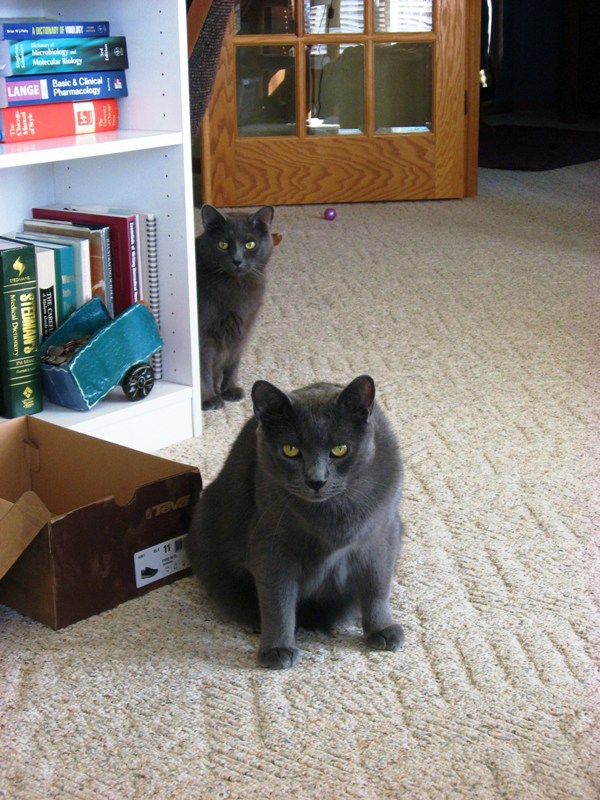
Brutus (front) and Luther, posing for the cover of their first album, “U.P. Catz.” Photo by P. DuPont.


forget the journey, here’s where I talk about the destination

One of the best things about the painting intensives is seeing old friends again. Diane L., Diane D., Terry and I dined out just about every day in our old haunts, especially Chloe’s, a little café on Church St., and started a couple of new traditions: On Saturday night, T and I met DD, DL, and DL’s man Chris at the Clement St. Bar & Grill. I have a horror of trying to park on the streets of S.F., especially on a Saturday night, but we easily found a spot and joined our friends for a rousing urban outing: pasta, burgers, wine and black Russians, jostling in the aisles, attentive waiters, and shouted conversation. It’s what I miss most about the City, I think. Well, first, having friends available to go out, and then knowing people who know interesting places to go. Later in the week, we headed over to the Buckeye Roadhouse in Marin, in the rain, me driving, trying to remember how to get there. Either they moved the road (unlikely) or I didn’t know where I was going (ya think?), and I ended up having to turn around on Tennessee Valley Road. But then, in a burst of glory, I drove into the parking lot, handed my car over to the valet, and we entered the bright, shiny world of the Buckeye. Drinks (the raspberry lemonade was superb), ahi tuna and spicy pork sandwiches, lots of hoopla, again an urban-style experience made more special by the sparkly decorations and holiday spirit in the air. I love you, D, D, and T.

In the middle of the week, the studio always springs for a pizza lunch, which we eat in the sharing room. This time the pizzas came from an Indian place, which, no thanks, but there was also a really good pepperoni pizza, and Alyssa had made a raw kale salad. I don’t think I have to tell you that I do not eat this kind of thing, so I can’t believe I even took some, but it was great! I even got the recipe from her later. You can find “Chef Alyssa” at http://www.earthenfeast.com. She is amazing, and not just for her mad food skillz. She had us in stitches with her story the morning after seeing Roger Waters The Wall Live.

More shout-outs: I was going to name others with whom I had special moments, but that can be tricky because of whom I might leave out, so: You know who you are. I loved painting and being with you all. And I have a special shout-out to Sima, but you’ll have to read on for that.

On Friday night, at the end of the intensive, I went out with my friends from Oregon, who had driven down just to have dinner with me, P’s and my godchild, and the godly child’s husband and mother. It’s always somewhat bizarre to go from the intimacy of the painting studio and my friends there to my “other” world. We went to a noisy Italian restaurant south of Market, and it was both overwhelming and gratifying to banter and catch up with one another. Plus, the food was excellent. Then P&C brought me back to my hotel, and I got a few measly winks before having to get up at 2 a.m. to leave for home (ha!).

***

It’s easier to write about the obvious targets—the airlines, security, and hotel staff—and the fun times than to put words to the indescribable experience of painting for process, but I will do my best.

“I hear the paint falling…”

Barbara was telling us about someone dropping a container of paint, but I heard poetry. In my world, a lot was falling: rain outside; tears on the paper and on my face inside; mercy, mercy everywhere….

All week I painted a young man who had killed himself after holding a room full of high school students, including my great-nephew, hostage. No one else was hurt, unless you count scarred-for-life. During the stand-off, my fearful thoughts were of course for my great-nephew and his parents, but when I came to paint, suddenly there he was, the 15-year-old boy who couldn’t even say what he wanted, who had no demands, except possibly the demand for attention, to be taken seriously, who knows what goes on in the mind of a teen-age boy? So I painted him with the gun to his head, in the grave, as a spirit rising from the grave. Mind you, I didn’t know him, but his tragedy was the vehicle for 7 intense days of painting.

At first I painted a lot of guns, bullets, blood. The boy (I know his name but don’t want to name him, I don’t know why) was a hunter, as is my great-nephew, so I painted deer as targets, then deer pointing their own guns. Sometimes the imagery becomes so satisfying to paint that you get carried away. I told Barbara I wanted to paint a forest with hunters, deer, mayhem. She got me to focus on the painting in front of me, to see what could be coming in or out. So I connected all the beings on the painting with white cords, felt the connectedness of life whether the ties are visible or not, and still she asked what could be connected. But there was nothing else, just shapes! just colors! I had made the obvious connections, she was asking me to do the impossible. But it turns out that how you face the impossible is kind of the point: Finally, I was neither fighting nor holding back, and though I didn’t think of the word at the time, I had “surrendered.”

At some point a quotation from “The Merchant of Venice” started running through my mind. It was the same quote that came when I painted my late brother-in-law many years ago.

The quality of mercy is not strain’d,
It droppeth as the gentle rain from heaven
Upon the place beneath. It is twice blest:
It blesseth him that gives and him that takes.

I painted tears falling from the faces on the painting and from the unknown sky above. I didn’t know where the feelings were coming from, what they “meant,” why I was focusing on this boy. The teacher and the other students had done their best to keep the boy calm, talking to him about hunting and fishing, and then the SWAT team came busting in and it was all over, the boy shot himself. My great-nephew seemed to be OK immediately afterward, and his mother, my niece, was euphoric that he survived, but post-traumatic stress had come, predictable as clockwork.

I was far enough removed from the story that I knew virtually nothing objectively, but my feeling state was a projection of the boy’s loneliness, despair, lack of choices, forced into a corner, thinking the gun and the attention of the other students would tell him what to do now, how to go on, whether to go on.

As happens when you paint so intensely for so long, the story faded away and I just followed the mysterious feelings for the rest of the week, painted whatever came next, not like clockwork but like some organic heartbeat leading me on.


an intruder in our midst

There was one man in the intensive, among 22 or so women; we’ve had them before, it’s not a big deal. But this one seemed different from the gentle souls who had painted with us in the past. On the very first day, someone referred to being (psychologically) “naked” in front of the painting, and he offered that she “had [his] permission.” That was rather jarring, this male insistence on making everything about sex, but no one said anything. He (I’ll call him “Dick”) made a few other comments over the next few days, joked about how he could paint his penis as long as he wanted. I wanted to say to him, “You know, Dick, it’s not about the length, it’s the girth.” But we’re not supposed to comment on other people’s sharings, so I zipped it, no pun intended.

One of the painters had been doing some very sexual paintings, and she talked about feeling exposed, wondering if she was doing the right thing, not wanting anyone to see—questioning what was going on with her, as we all do when the mind is not in charge and imagery seems to have its own power and direction. Sexual imagery can feel very liberating to paint, but it brings all the baggage with it, one’s fantasies and fears, the expectations from the culture. So at one point, “Dick,” who had been painting near her, shared that he had “wanted to watch” and that he could “feel the excitement” from her corner, and he said these things in the group while looking intently at her, a burst of inappropriate, unwelcome testosterone, entitled and insistent, flooding the room. The rest of us, the women, the targets of male entitlement in and out of “safe” places, sat there as if stunned, as if shot with a paralyzing agent, not lethal, not like he put a gun to our heads, but stunned into silence and submission. Barbara reminded the group at large that we were not to comment on one another’s paintings, and apparently the point was not lost on Dick. Afterward, things were said in private, apologies were made, epiphanies may or may not have been achieved, but I wasn’t part of all that. I just felt the reverberations from his statements, his obvious glee and sexual response, and a lifetime of unwelcome comments and advances made me furious that we had to endure this kind of thing in our “sanctuary.” But sanctuary is not necessarily what it seems. The painting studio is a sanctuary in which to feel unsafe, to take risks, to not know what we’re going to feel, let alone say. It’s a contradiction wrapped in an enigma and all that.

When we reconvened for the next morning’s sharing, the women’s voices started to come forward about what had happened. It was unusual to have a “meta” talk like that, and it was disturbing, especially considering the tender feelings that we encounter, in ourselves and in one another, when painting for so long. After a few people had spoken, I realized I was practically quivering with a phrase that had come to me in the night. It seemed that to say it in the group would be like dropping a bomb in the middle of a marketplace, blowing myself up along with everyone else. But it was so strong in my throat to voice it: I said that the aftermath of Dick’s comment the day before had been like “passive little girls being word-raped.” No one seemed to know what I was talking about. What?? Repeat that. Explain that. It’s always strange to put something personal or explosive into words, whereas you can paint literally anything and no one will be shocked.  I was afraid that what I said was too strong, too (God forbid) “feminist” or “man-hating” or any of the other shields that women use to deflect just or unjust criticism of men. Barbara engaged me, encouraged me to see where this was coming from in me, what more I could say, didn’t let me just drop my bomb and disappear. I don’t remember exactly how it happened, but after a while I paused and said, “But… I’m having so much compassion for this boy who killed himself, whom I didn’t even know.” And my energy changed from reacting against one man to feeling for another man, and there was no more contradiction, just an appreciation for the complexity of our beings, and for Barbara’s skill in bringing me to a truer place than mere reaction. (Barbara, I am more grateful to you than I can say.)

Here’s my Sima shout-out. I happened to be wearing my “Bitch Is the New Black” t-shirt that day, and after the morning sharing she came over to me and said, “Brave Is the New Bitch.” That was so cool! I had thought of another t-shirt I wanted to make for next year, with a phrase I had seen on a car that morning: “It Don’t Matter to Jesus.” I have since learned that it’s a quote from “The Big Lebowski” (one of my favorite movies, actually), not an illiterate paean to the son of God. But I guess it can mean whatever I want it to mean. “It Don’t Matter to Mary”? The only problem with wearing these t-shirts is having to explain them to people, such as my “Not here today, not gone tomorrow” original. Contact me if you wish to purchase.

***

One of the things Barbara wanted to explore in the sharings was how to make use of the extraordinary opportunity to relate with one another in the group the way that we paint—not just sharing details of our day or our individual feelings, but to speak in the same spirit that informs our paintings. But while painting, we’re in our own worlds, backs to each other, no one really knowing what’s going on with anyone else unless we overhear them talking with Barbara. And it’s hard to know how to “relate” when we’re not supposed to make judgments or offer advice. We all have a tendency to want to help someone who’s feeling bad, but there’s a freedom in just being able to express ourselves without being bombarded with well-meaning suggestions. Even so, the feeling of connection in the sharings is just incredible: the silence so deep that it vibrates.

We talked a lot about what it meant to be “inappropriate” while speaking in the group. Later in the week, I’m not sure how it came about, I was probably going on about the contradiction of having “rules” in the sharing that we don’t have in the painting. So Barbara invited me to “say something inappropriate.” I had no idea what to say, and I usually freeze when put on the spot like that. But then it popped into my head to ask, “Can I speak to a person?” Barbara hesitated but said OK, and I looked at Dick and said… [I imagined the room holding its collective breath] “I was going to ignore you for the rest of the week, but I got over it and now I know it’s not about you.” Barbara beamed, “That’s good!” She asked Dick how he felt about what I had said and of course he was fine “…since it’s not about me.” I’m not sure if he learned anything from the whole experience, but I learned that if I’m honest about my feelings, I can get past them.

There was another time in the group when I said something that was very difficult to admit to, but I’m not going to go into it here. What I said wasn’t the important part anyway, it was my reaction afterward when I feared the judgment of others and couldn’t stop thinking about it. Back at my painting, Barbara urged me to feel, not think. As soon as someone tells you not to think, your mind thinks even harder: How do I not think, are you crazy? But somehow my defenses had been worn down, I was a soggy mess from crying, and I just kept going back to the wordless feeling whenever I found myself on the Think Train again. I kept painting, it didn’t matter what. And then it happened. It was as if the feelings, so deep, so heart-felt, so powerful and seemingly destructive, eased out and spread out as if on a broad plain, flooding all my defenses and finally dissipating into wordlessness, fearlessness. And then another “falling” quote came to me: “The rain in Spain falls mainly on the plain.” And look, the word “pain” is right in there.

***

So the week of painting (and traveling) for me was about raining, flooding, cold particles falling, breaking the levees of self-protection, pure feeling rising, emerging with or without words, dissipating in riots of color and shape and image; and it was also the opposite: erecting boundaries, patrolling the perimeter, rifling through my own mental carry-on bags for dangerous implements of self-knowledge, thinking security will save me, in turn resisting and surrendering, tears fighting fears. It’s all related, we’re all connected, the hazards are everywhere, the target is indistinct and constantly moving, clarity is hard to find.

But in the midst of the chaos and the misdirection, our country’s loss of good faith in the pursuit of blind faith, we painters persist, 22 or 23 at a time, in facing the simplest and deepest truths in ourselves, which is to say, in humanity. The effect on our loved ones or distant strangers cannot be measured, but the painting energy goes out into the world and a little more light is shed, not where the lamppost stands but in the darkest corners where we struggle and cry, laugh and love, and live lives of quiet exhilaration.

[Mary McKenney]

mary’zine #47: November 2010

November 7, 2010

Above is another of P. DuPont’s wonderful pictures of the Bay-called-Green. Every year or so, she comes to visit me for my birthday, which, unfortunately for her, is in late October, so she freezes the whole time. This year, she had an agenda: She had offered to paint my upstairs bathroom, kitchen ceiling, and part of another room where my contractor had repaired some cracks and plastered them over. I guess she likes to have a purpose in life. (I would rather pay other people to carry out my purposes in life, at least when they involve house maintenance and yard work. Of course, I “paid” her only in sparkling conversation.)

She also wanted to see the 49’ers game—a problem, because I got rid of my TV some months ago. (I’m not a TV snob; just wanted to save some money.)  I watch “Modern Family” on hulu.com, buy season passes to “Mad Men,” “Breaking Bad,” and “The Good Wife” on iTunes, and beg my sister Barb to let me come over and watch “Dexter” and “In Treatment” on Sunday nights (like an ex-smoker who doesn’t buy cigarettes anymore but cadges them off other people). Then it turned out that P’s beloved S.F. Giants were in the World Series, so it became a project to figure out how she could see or at least hear some of the games.

Oct. 27: As usual, I drove down to Green Bay to pick her up. She was supposed to arrive at about 10 p.m., but in the “It Goes Without Saying” Department, her plane was late. So I found myself sitting all alone—no passengers, no one else waiting for an arrival, not even an employee in sight—in the airport at 11:30, staring at the monitor of arrivals and departures, searching in vain for any record of her flight. We were apparently going to begin Airport Life anew the next morning at 6 a.m. I took this as a bad sign. It was an odd feeling, like I had missed the End of the World and was stuck there alone forever with only the peanuts and candy bars in the vending machine for sustenance. I called United, and the friendly robot voice informed me that P’s plane was indeed in the air between Chicago and G.B., so that was comforting. An employee eventually turned up, asked me where the plane was, and I told her it was expected at 12:03 but was already 20 minutes late. She chuckled at the fact that the flight had “dropped off the board a while ago” so she’d had to get the information from me, a mere nobody. I could have trashed the restroom and set fire to the seats in the waiting area while she lounged in some back room doing God knows what, but I guess they don’t worry about security at midnight in the middle of the week.

Oct. 28: P rooted around in the garage and found the paint my sister K had used for the kitchen ceiling—“Travertine Beige”—a really nice color that I call “Yellow”—and set about the task of repainting the large area that had been covered by my ancient fluorescent light fixture. Later, we drove back down to Green Bay for dinner at the Republic Chophouse, which P had found online. The food was excellent, and I couldn’t get over how nice the booths were: secluded, with generously sized, upholstered benches rather than naugahyde-over-foam repaired in spots with duct tape. I also exclaimed over the cloth napkins, told P I hadn’t eaten anywhere in 6 years where the silverware wasn’t wrapped and taped into a paper napkin (I exaggerated slightly, as is my wont). I have made the transition to hick in record time. On the way home we found the World Series game on the radio. The Giants had already won Game 1, so P was stoked. When we got back to my house, we tried to get reception on my tiny Sony radio, but it was hard going. Still, we managed to listen and marveled at the number of runs her team was racking up. In the eighth inning, with 2 out and a comfortable lead of 6 to nothing, she inexplicably decided to call C in Oregon to tell her about our day. I heard her asking C if the cat missed her. I took the radio upstairs, where the reception was only marginally better, and suddenly—I must have spaced out or just didn’t understand what was happening—the Giants got 3 more runs, and I’m yelling down to P, “9 to nothing! 9 to nothing!” She came upstairs and started looking for the game streaming online (never found it), while I continued to listen with the radio up to my ear, reporting on every pitch until it was over. It was a weird role reversal.

Oct. 29: To Menard’s (home improvement store) to get supplies for the bathroom paint job. P suggested a dark gray to cover the boring white, and while I was skeptical of the color she picked out, we appreciated the aptness of the name—“Family Ties.” (They don’t bother to name colors colors anymore.) I can barely walk lately, so after the excruciating torment of navigating the huge store—paint in one far corner, cashiers in opposite far corner—I mostly napped while she worked (she actually whistled) until it was time to go to the ritual birthday dinner at Schussler’s with my sisters (Barb and K) and brother-in-law (MP). They first met P not long after I did and get along fine. P and K, in particular, are hilarious together. They both laugh a lot, so the two of them in K’s kitchen trying to cut the birthday cake and transfer it to plates was apparently the height of comedy. P and MP talked football and baseball, and I sat in (K’s) recliner starring as the Birthday Girl and raking in the many generous gifts. The World Series wasn’t on that day, so we didn’t have to worry about finding the game.

Oct. 30: My birthday! I don’t remember much about it, actually, but I never forget a meal, so I can report that P and I had a wonderful dinner at The Landing, now one of two (S.F.) Bay Area-quality restaurants in “historic downtown Menominee.” My favorite waitress, Cindy, was working, and I got to brag about having a friend who not only came all the way from Oregon for my birthday but was painting my bathroom. Cindy was suitably impressed. She had met Terry and Jean (from Massachusetts), and Diane (from San Francisco) 2 years ago so has this image of me as someone who is much loved by friends from all over (which is true, amazingly enough). Conversely, when Cindy came by my sister’s garage sale last summer, MP could hardly believe that I knew someone locally that he didn’t know.


Oct. 31: I met the dog next door, who’s named Buttons and is as cute as one. I was outside feeding the birds and she was barking up a storm, anxious to get at me, so there but for the grace of 2 fences went my rabid attacker. When I turned to see what the commotion was all about, there was my neighbor waving at me. He and Buttons were both dressed for winter, and I was out there in a t-shirt and shorts. My body is apparently “burning up from the inside” (according to an alarming article I found online), so I’m always hot, and it might also be the cause of my sudden-onset “arthritis” in both knees. I’m not one to ask, “Why me?,” but it’s funny how put out I feel at having anything go wrong with my body, even at the age of the Beatles’ lyrics, “Will you still need me, will you still feed me….” Like: Am I really expected to hobble painfully for the rest of my life?

K called and invited us over to watch the Packer game and order pizza for lunch. I started obsessing about what to do, because we had already made plans with Barb. P calmly pointed out that we could go to K&MP’s for football and Barb’s for the World Series. Which is what we did. We brought take-out to Barb’s from our new Mexican restaurant, La Cabaña—I’m so excited—The citizenry has taken to La Cabaña in droves. It may not be the best Mexican food I’ve ever had, but it’s way better than Taco Bell or Taco John’s, and it’s run by real Mexicans. According to my haircutter, the owner worked in his father’s restaurants in Chicago and moved up here because he found the area so beautiful. I’ve heard all my life about how much Chicagoans love the U.P, which I guess they see as wild rather than boring. Well, come on down! Or UP, rather.

Nov. 1: By now, pages were flying off the calendar like in a Frank Capra movie. Only 2 days to P’s departure. She finished painting the bathroom and did a beautiful job; she was right about the color, a kind of gray/brown that changes subtly with the light. We went to Schloegel’s (family dining establishment) for supper. I had lobbied for Mexican again, but she didn’t go for that. So when she was perusing the menu at Schloegel’s, it took me a few seconds to respond to her idle question, “Have you ever had their taco salad?” When it finally hit me, I said, “If you order a taco salad, I’m going to kill you.” We both laughed like madwomen—the main pleasure in having her here, along with the long, leisurely talks that we usually conduct on the phone once a week. She’d overheard a woman in a nearby booth tell the waitress that she preferred Taco Bell to the new Mexican restaurant (which is next door to Schloegel’s) because it’s “pricey” ($7.99 for 3 steak enchiladas, rice, salad, and chips). Some people have also remarked that there’s a “language barrier” there, as if we have to point and grunt at the menu to be understood. We just don’t know how to handle the differently ethnic around here.

Nov. 2: P has a calming influence on me when it comes to doing what needs to be done. It was election day, and I had reluctantly concluded that I wasn’t on permanent absentee ballot status as I had thought—meaning that I had to go to the high school, find the gym, and remember how to vote in public. (I was a permanent absentee voter in California for many years.) I devoutly wished that I could just forget the whole thing, but I knew that both P and my sister (who wanted me to vote for certain school board members) wouldn’t hear of it. We also had to go back to Menard’s to see if we could find a match for the paint in the cats’ room*. And I had to buy food for the little beasts, and I wanted to get a sandwich for lunch because I knew I’d never make it to our 7:30 dinner reservation. I was stressing about the effort it would take to accomplish all this, but P couldn’t have been more calm about it—but then, she can walk.

*Yes, Brutus and Luther have their own room.

We made all the requisite stops and I even managed to get through it all without having to pee. The voting place was well hidden: I guess you’re just supposed to know where it is, having lived here all your life. It was annoyingly unorganized, but I got through it, and I later found out that one of the board members on Barb’s list won by 1 vote! Mine! She was happy about that, and in another example of my sudden wielding of serendipitous power, I mentioned that the flat white thing she described finding in her cat’s litter could be a tapeworm—and it was! She was ecstatic (that she was able to get him treated for it), and I felt, temporarily, like I could do no wrong. Didn’t last long, but you know.

That night P and Barb and I tried our newest restaurant, Table Six, which is upscale Italian. I can’t believe we now have two high-end restaurants barely a block from each other. The owners of The Landing are apparently all pissy about the new place and have gone to great lengths to keep Table Six customers from parking in their lot. Small-town rancor is alive and well. We were delighted to discover that the food at Table Six is excellent. Barb and I played it safe with lasagna, but P had steak and asparagus risotto (risotto? in Menominee?), which I know was great because I got the leftovers.

Nov. 3: I drove P to the airport and reluctantly let her go back to her life. I returned to mine by having an early lunch at El Sarape on the east side of Green Bay. I can’t get enough of Mexican food, it seems.

***

I rarely read the poems in The New Yorker because they’re usually so obscure, but this one caught my eye because of the title (I’m drawn to anything that mentions social security, having finally attained it.) I like the poem a lot and especially appreciate finding a new (to me) poet.

AT THE MANHATTAN SOCIAL SECURITY OFFICE

The mind seeks what is dead, for what is living escapes it. —Miguel de Unamuno

I’m practicing the stoic art of insouciance,

not because I prefer not thinking about

what signing up for Medicare means,

or why so many who came after me are being

called first, but because downstairs

my soul was examined for signs of violence

and duplicity. Its fatigue and ambivalence

weren’t visible, apparently. In the next row

a man is telling a girl bobbing to an iPhone

to sit still before the guard returns.

When I was her age signing up meant going

to Vietnam, which meant practicing

the Zen art of vanishing. At the windows

a blind man is asking why he didn’t receive

his disability payments in prison,

he needs his “…sustenance.” Behind me,

another man is asking to see my paper,

he’s looking for work, he says. Happy

to be free of “Afghanistan: What Could Work,”

I hand him my New York Review of Books.

Bismarck said explaining was a weakness.

As her father explains the necessity

of securing her future, the girl squirms.

She fears only boredom. I feared everything.

In five months my father would die

and mother and I would live on the $200 a month

his Social Security paid. At the windows

the blind man is practicing the existential art

of grovelling, exposing the stitches on his scalp

to a clerk who’s practicing the cynical art

of indifference. The girl’s soul, hovering near

the ceiling, is enjoying its moment of radiance.

My soul, fretfully pacing the water cooler,

is practicing the fatalistic art of understanding

that nothing can be done about Afghanistan,

that in order to influence the future we must kill it.

—Philip Schultz


my body, my (plunged, prodded, and poked) self

Last time, I left you with kind of a cliff-hanger about my medical condition. Well, I have neither fallen off the cliff nor been rescued in the meantime. The wheels of the medical-industrial complex grind slowly, but they grind exceedingly fine.

At least it has been established that I do not have colon cancer, and I do not have breast cancer. That leaves xn places in my body where they may still find something horribly wrong. I feel like the elephant in the fable about the blind men touching its trunk, tail, ears, etc., and trying to guess what it is.

As part of the follow-up to my physical, I’ve had a colonoscopy, a mammogram, an ultrasound when they found something on the mammogram, and a biopsy of the something they found on the mammogram. Still to be resolved are the high cholesterol, high C-reactive protein (CRP), and abnormal white blood cell count. Oh, and a heart murmur. The high CRP was something I knew about before, but the lab tests keep coming back with wildly different results. When I went to a screening clinic for heart desire (Freudian slip! I mean “heart disease”!) a couple years ago, it was 10 (supposed to be no more than 3). A month or so ago, it was 29, and when they checked it again a week or so later it was 14. Also, my heart rate has been erratic at the doctor’s office—between 80 and 116 at different times, for no apparent reason.

Before the colonoscopy, a nurse who had just taken my blood pressure proceeded to ask me a million questions that I had already answered a million times. Those people are thorough—different nurses kept popping up and asking me my name and birthdate as if they were trying to catch me in a lie. While the first nurse was questioning me and entering my answers into a computer, another nurse was trying to get the IV needle in my arm. My sisters and I all have veins that strongly resist capture. So she’s fussing with my arms and hands, poking here and there, and the Question Nurse comes to “Do you have high blood pressure?” And I quip, “I don’t know, you tell me!” (See, she had just taken it. Do I have to explain everything?) And the Needle Nurse smiles! At last! Someone appreciates my feeble attempt at humor! And eventually the needle goes in, mission accomplished.

Part of my problem in joking with strangers is that I don’t have the courage of my convictions. I don’t sell it, or I don’t sell it with the requisite ha-ha or strong, confident deadpan. My deadpan only seems to work with people who’ve heard it many times before. I met my new doctor (I think I told you), and at my physical, he was crouched on the floor with one of my feet in each hand for some reason, while I sat in my “gown” on the end of the examining table. I thought of restraining my immediate association but then decided to go ahead. I said, “I’d like to see something in a nice loafer?” See, that questioning uplift at the end of the sentence conveyed my lack of confidence. He just said, “I can’t help you with that,” and when I croaked, “JOKE,” he said, “Oh, I didn’t know you were joking.” I don’t really blame him; he’s doing his thing, and I’m making some bizarre commentary that he has no context for. He’s Barb’s doctor, too, and she had an appointment with him a couple days after mine. She said to him, “It took you a while to get the loafer joke, didn’t it?” He had to agree.

The next time I saw him, I said, “I’ve never felt comfortable with a doctor in my whole life before.” He asked if I was comfortable there, and I said, “Very much.” He seemed pleased. It’s really true, and I still can’t believe it. Is it because it’s the U.P.—no, actually, it’s N.E.W. (Northeastern Wisconsin), but close enough—that they have to try harder? When you go to the hospital (“BA”MC) (I explained that last time, look it up), there are signs everywhere saying “Thank you for choosing BAMC.” And I always think, “I didn’t know I had a choice.” But maybe they’re sensitive because it’s common knowledge that “people from Menominee/Marinette go to Green Bay for health care, and people from Green Bay go to Milwaukee.” I suppose Milwaukeeans set their sights on Chicago. Anyway, everyone who works at the hospital here seems to be genuinely friendly and just busting out all over in their desire to please. That was not my experience in the real (S.F.) Bay Area.

***

So I’m lying on a hospital bed with an IV sticking out of my hand, waiting to be taken for my colonoscopy. Barb is sitting in the recliner next to the bed crocheting a scarf. (She is an inveterate crocheter, an unrepentant, unregenerate crocheter.) Mounted on the wall is a TV, which is showing a series of nature photographs, but because I don’t have my glasses on, all I can see are blobs of green and blue. I wonder idly what’s in the IV bag, and Barb thinks there must be a mild sedative, though I am feeling anything but sedated—or loopy, one of the consolations I was looking forward to after enduring the 6-hour trial of drinking 9 tall glasses of lemonade-like liquid the night before. (“Lemonade-like” in the sense that someone must have waved a lemon in the general direction of a small dune of powdered laxative before it got to me.) I insisted I wasn’t in the “feeling no pain” zone, but then I started paying closer attention to the blobs of nature on the TV and noticed that now there were fluffy white clouds streaming leftward against a blue background. And I started giggling. Like, if you’re feeling anxious about the soon-to-be hose stuck up your ass, surely you’ll be pleasantly distracted by these faux clouds drifting by. I pointed out to Barb that one of the clouds looked like Dick Cheney, but she did not find this quip amusing, and usually she’s highly amused by me, so that’s when I decided I must indeed be intravenously ingesting some sort of happy concoction. Then I had one of my patented epiphanies when I realized that, in the future, the world will be like the movie Beetlejuice in that there will be no “outside.” You’ll spend your life in rooms without windows (there will be nuclear winter beyond the walls, or maybe just abstract patterns or white noise) but you’ll have a TV monitor—or maybe they will have perfected the showing of images on your retinas—to feed you scenes of life as it used to be. Old people will tell their grandchildren about the far-away long-ago when you could actually be in the picture and surrounded by the picture as you were now surrounded by blank walls and closed-circuit TVs, and the young’uns will roll their eyes at Grandma and Grandpa’s lame, pointless memories, as they do now when we oldsters start waxing nostalgic about Grateful Dead concerts and safe, cheap recreational drugs. As I was going on about all this, I had the distinct feeling that Barb wasn’t listening. Well, at least I was amusing myself. I mean, somebody has to.

They finally come for me, and the last thing I remember is being told to turn on my side. Next thing I know, I’m back in my “room,” Barb is still crocheting, and I have disagreeable pain in my stomach, which lasts all the way through the recovery period and on to the car and the restaurant, Schloegel’s, where I’m desperate to eat something after more than 32 hours of fasting. I’m trying to discreetly let a little air out of my bum in little toots. The Recovery Nurse had said I could eat “anything” now, so I took her at her word and ordered Swedish pancakes and sausage—except that I told the waitress “Swedish meatballs and sausage,” and fortunately Barb noticed and I was spared a meat overdose. At the hospital everyone had been adamant that I wouldn’t remember a thing the doctor or the nurses said to me after the procedure, so I was equally adamant that I was perfectly alert, though I could tell that my glazed eyes betrayed me. And I did remember pretty much everything, which boiled down to “Don’t do anything for the rest of the day; tomorrow you can resume your normal life.” Since my “normal life” consists of not doing much of anything anyway, I did not find this instruction difficult to follow.

After we ate, I needed to get some groceries, and I asked Barb if she thought I “deserved” to buy a batch of bakery cookies after everything I’d been through, and she wholeheartedly agreed, which I knew she would. So I bought white chocolate-macadamia nut cookies, some broccoli, and the all-too-seldom-appearing cream of broccoli soup from the soup bar. I could give up cookies if I absolutely had to, but I couldn’t give up broccoli. Barb dropped me off at home, and I got set up in my comfy armchair with the cookies and a Thermos of water by my side and spent the next 10 hours alternately sleeping and waking up long enough to eat a couple of cookies, add a word or two to the crossword puzzle I was working on, and go back to sleep. I felt great when I woke up.

Oh, the doctor found a “medium-size” polyp in me that was presumably benign and sternly announced that I would have to have another colonoscopy in 3 years. Hey, piece o’ cake, doc. 3 years is like forever.

***

And on we go. Two days later, I went for my mammogram—which always makes me think of “candygram” from the “Saturday Night Live” sketch about the land shark; I picture a tech in a white smock knocking on my door with the coy implication that she has something wonderful to give me. I was sitting in the waiting room and looked up to see that several large panels in the ceiling—alternating with regular gray acoustic tiles—showed clouds and blue sky like in the colonoscopy room, but they weren’t moving. It was an odd look, and it made me wonder, Who designs this shit? And of course everything was pink. I hate pink, therefore I am not a real woman. (I was once told to my face that I wasn’t a real woman, and it’s surprising how much it hurt, as if I had been born with 2 heads or something. This was back in the ‘70s when I worked at Commerce Clearing House in San Rafael, and a coworker who’d been asked if she and her roommate [an obvious dyke] were lesbians said it was like being called a prostitute. Another coworker was describing someone as “queer,” and I, being newly recruited to the cause [though I never got my toaster], piped up, “I’m queer,” whereupon another coworker friendly to me said, “Oh, Mary, you are not.” I wasn’t sure how to take that, but I knew she meant well. That’s when someone else said, perfectly seriously, that I wasn’t a real woman. Thank God no one around this Bay Area seems to know what dykes look like, because if they did, half the farm women in town would be openly ostracized. I’ve gotten a couple of leers and sneers from men on diner stools, but I easily stare them down. Living here for me is like being an imperialist in a colonial outpost. Because you’ve been exposed to more of the real world than they have, you can culturally lord it over them. So the backwater men here still think they’re at the top of the totem pole, but I can pierce them with my unintimidated gaze like a lean and hungry yon Cassius—or fat and hungry in my case.)

***

So as I said, they found “something” on the mammogram, so I had to have a biopsy. The surgeon who did it is very well liked (I liked him, too), and my niece said he’s “the best cutter in town.” So I had a sodden thought: If he lived in the Middle East, he could be the best cutter in Qatar. (I swear I’ve heard that name pronounced the same as “cutter,” but the online dictionary claims it rhymes with: afar, ajar, all-star, armoire, and about 150 other words. I include this superfluous information just in case there are any poets out there looking for a rhyme for a small emirate—though it may be easier to use emirate in the first place. Mais non: There are over 400 rhymes for “emirate,” including Watergate, welfare state, and welterweight! I suggest you write about something else.)

The biopsy wasn’t a big deal, but the discharge instructions said I couldn’t lift more than 10 pounds for a few days. Guess who weighs more than 10 pounds each? Fatty McBrutus and Fatty McLuther. Even if I don’t lift them, they’re used to using my body, especially my chest, as an alternative bed-slash-stomping ground. I had to keep shooing them away or trying to hold on to them with only one arm. Try explaining that to a couple of selfish felines. But the excision healed up nicely, and the “something” turned out to be “nothing.”

At the follow-up appointment a week later, nice Dr. Surgeon called me “young lady.” I had vowed to educate the next person (always a man) who called me that in the mistaken belief that I would be flattered by the obvious lie. But it backfired on me. Dr. Surgeon said he was sorry if he offended me (though he was clearly the one who was offended) and that he thought of me as “young”—his last two patients had been 87 and 89. Well, OK. He then suggested that he call me “pleasant lady” because I’m “pleasant.” Was that a dig? By then I wished I had kept my mouth shut. What do you ever get for bucking the system, I ask you?

If you’re still with me, congratulations. You are a real trouper, which is why I’ve always liked you.

Cheers!

[Mary McKenney]

mary’zine #46: September 2010

September 17, 2010

my body, my selves

It was my first time in a doctor’s office since the spring of 2000. The nurse’s first order of business was to weigh me—while I was fully clothed and wearing wooden clogs. So I figure 10 pounds of that were not me. Then she took me to an examining room where there were two chairs against the wall to my left, and she told me to sit in “the first seat.” Have I mentioned that I sometimes feel like Rain Man without a feel for numbers? Here is exactly what passed through my mind when faced with this seemingly simple command: Well, it depends where you start counting, doesn’t it? So I did a rapid calculation—too rapid for the ordinary human brain to comprehend—and chose to sit in the farther chair. This made perfect sense to me at the time, but of course she meant the chair closer to me, i.e., “the first seat.”

It’s as if my brain responds to cues that are completely generated from within. A person of normal intelligence would immediately know that “the first seat” was the first one she came to. I, on the other hand, had to turn it into a complex binary equation-cum-philosophical query into the order of numbers, and I don’t even think there is such a thing. In the 2 milliseconds I spent trying to work this out, I did not take into account the situation and the environmental cues, such as the fact that there was a small table next to “the first seat,” where the nurse was obviously going to sit to take my blood pressure, temperature, and heart rate. But no, I was operating in an intellectual vacuum. And I felt like an idiot when she made me move to the other chair. Now I contend that mistakes like this may be evidence of high intelligence (I’m only half joking): People with “smart people’s disease” see ambiguities where the average person sees only the obvious. I’ll bet you that if I were editing IQ tests today, I’d find many such ambiguities, as I do in papers on cardiac surgery or asthma. “Book-smart” people are often mocked for lacking in common sense, and this may be part of the explanation. Look at me, turning lemons into lemonade! I know I sound terribly full of myself, but I readily admit that my E and S Q’s (Emotional and Social quotients) are sadly below average.

I hasten to clarify that people of high intelligence who have no trouble distinguishing the obvious from the inexplicable are blessed with a refined sense of their surroundings and should be thankful instead of judging me for looking for a silver lining.

I’m not sure if the following is evidence for or against my theory. Lately I’ve been noticing that I use the phrase “didn’t occur to me” an awful lot. I bought a product at Mighty Pet that you add to your cat’s drinking water to keep his teeth clean or give him better breath or something. The directions said to add a capful of the stuff to 16 oz. of water. I didn’t have a big enough water bowl to hold 16 oz., so I bought a bigger bowl, but my cats wouldn’t drink out of it. My sister Barb asked if I tried putting half a capful into 8 oz. of water, and I had to admit it “didn’t occur to me.” One day I locked my keys in the car at a farm market. When I told P about it later, she said, “Good thing you have AAA.” And I thought, Damn! It didn’t occur to me! (A nice policeman helped me out.) Even after this realization, I started to worry in advance about my Jeep’s gears freezing in the Green Bay airport parking lot while I’m in San Francisco for the painting intensive in December, like they did last year. Finally, I remembered, Oh, yeah, if it happens again I can call AAA! I haven’t used my AAA card in 20 years, and somehow I had stopped connecting the $48 annual fee with actually needing the service.

Am I embarrassed to be making these revelations? Yes, a bit. But I’m more interested in observing the wormholes in my personal “brainscape.” (That word, which I thought I made up, is actually the name of “a database for resting state functional connectivity studies… [for] mapping the intrinsic functional topography of the brain, evaluating neuroanatomical models, and investigating neurological and psychiatric disease.” The website has a drawing of a brain with colored splotches on it, and it looks like a painter’s palette! Think of the connections!) I’m not a scientist, and I couldn’t be more surprised at what I ended up doing for a living (editing for scientists). Quirky writing and metaphorical exploration are much more fun for me.

As I chart the waters at the horizon of the flat earth of my life span, wondering if I’m going to fall off the edge or pursue the horizon as it gets farther and farther away—or, less poetically, as I get closer to oblivion—I’ve vowed not to repeat my mother’s mantra in her later years, “It’s hell to get old.” She was talking not only about the body complaints but about the brain blips that I am now very familiar with, the “I walked into this room and now I have no idea what I’m doing here” natural loss of short-term whatchamacallit, memory. She died before she got dementia, thankfully. I hear that dementia is frightening, but would it have to be? I hypothesize (i.e., wishfully speculate) that it may be possible to keep one foot, or two tippy toes, on a safe spot while surrounded by confusion and loss of identity. Could I have myself a laugh while the aides at The Home tut-tut about my wearing panties on my head? Not knowing which chair to sit in will be small potatoes indeed. Could self-acceptance go so far as to allow one to celebrate being painted into a corner, having given up real estate but found the perfect place to preserve the brain’s eyes and ears and low-level functioning? My doctors and alternative healers never knew that I cured myself of agoraphobia and lower back pain through reading self-help books. So can I take my night dreams of death-acceptance and my autodidactic survey of self and my experience of painting beyond anything in the known world and create my own befuddled but privately cherished corner of the universe? I almost look forward to testing this out.

*

I’ve written before about having odd sentences pop into my mind when I’m in the twilight zone between wake and sleep. Recent example: “We had to resign from school all the way in.” And a more colorful one: “We would definitely become topless bitches.” What goes on in there?

*

You’ve heard of “Overheard”? Well, this is a new feature: “Overread.”  In Bob Dylan in America, Sean Wilhentz quotes someone saying that Dylan wasn’t stoned in a session, he “wasn’t hooked on anything but time and space.” Am I the only one who finds this  hilarious?

back to my body

Because I’ve been AWOL from the medical-industrial complex for so long, I now have to get lab work, X-rays, and a full physical, including a colonoscopy, a mammogram, and a vaginal invasion. Oh Lordy. The sky over the doctor’s office is dark with chickens coming home to roost. Back in 2000, my last doctor “visit” (as if you sit around chatting over a cup of tea: “How you been?” “Good… you?”) had culminated in gallbladder surgery, a shot in the dark by a doctor who had no idea how literal my mind-body connection really is. (When I googled “mind-body” to find the noun that goes after it, a listing on the first page of results was for “pole dance classes.” I decided not to try to figure out the connection—ah, the word I wanted!). Like a whole string of other physical problems that were actually based in emotional trauma, sublimation, ignorance, or stress, the tightening band of pain around my abdomen was still there after the gallbladder was gone, and I think in the past 10 years I’ve hoped that I’d meet my maker by getting hit by a bus or falling out of a window before I had to go back into the belly of the beast.

The reason I was finally forced to return was pain in both knees that came on all of a sudden as I was walking down the stairs. The pain lasted for 6 or 7 weeks, and I could no longer talk myself into the “That’s OK, I’ll probably die of bird flu before it becomes a real problem” avoidance tactic. My sister Barb likes her doctor, so I decided to go to him.

I tarted myself up by shaving my legs (first time this century) and wearing my “Olds Cool” t-shirt so he’d know I’m hip and happenin’ despite my chronological age. I had to run over to Walgreen’s the night before to buy a shaver. That was a waste, because I didn’t have to take my clothes off for the “visit,” and the hair is just going to grow back. It didn’t occur to me (there it goes again) to shave my armpits. For my physical, which is in a week or so, I’ll be sure to do all the appropriate personal grooming.

“Dr. T” is youngish—early 40s, I’d say—and a handsome devil. He assured me that “we live in America” so I don’t have to do anything he recommends. What a switch. Doctors used to browbeat us about giving up caffeine and losing weight, and airlines barely registered our existence. He dictated all my vital information into a recorder as I was sitting there so I could confirm or correct it on the spot. However, I suspect that he adds an addendum after the patient leaves, because he didn’t reveal his first impressions of me (“Patient is a 63-year-old woman with bad skin, dykey haircut, weird taste in clothes, and overweight due to wearing heavy clogs”).

In my provincial, West-Coast-leaning way, I had figured that doctors in the Midwest would be subpar because, Why would they want to live here? But so far I’ve been pleasantly surprised by the competence and friendliness of everyone I’ve encountered. I had spent several hours at the hospital—which they insist on calling “Bay Area” Medical Center (“BA”MC)—when my sister K (ironically) had knee surgery last month. It was one big happy family as RNs, LPNs, and MDs stopped by her room to say hi to the three members of my family who have been going to them for various ailments over the years. My sisters introduced me, and I’ve finally lost the label “sister from California.” I have gone native at last.

tech-no-no-how

I don’t have a smart phone, but it’s still a devious little thing. It lives in my pocket and connives to perform various functions when I am leaning forward, squatting down, or otherwise causing one of the buttons on the front of the phone to ping. It might turn itself off (then on), go to my contact list, try to send a text message, come this close to going online. Once at 4 a.m., I heard the telltale ping in my pocket, and I took it out to see what it was up to. Nothing was pressing against it, so I didn’t think my body language had sent any unintentional messages. When I looked at it, the screen was showing my contact list at M. P—. Before I could press End—like grabbing the cat before it escapes out the door—it rang. I press Talk and there’s nothing. I say, “M—“? and my sister K says, “This is his wife, can I help you?” But if I called him, why did my phone ring? I quickly say, “It’s Mary!” and we have a confusing back-and-forth about why are you calling, why are you calling? I explain that it was my cell phone’s doing. As we’re about to hang up, K says, “Thank you for not being ‘the other woman’.” We giggle and say bye. Later, MP refuses to believe that my phone called him all by itself. I have since learned that this is called “pocket dialing.” You would think that the geniuses at Apple or wherever would have come up with a way to prevent this. Flip phones are still popular on TV shows, because they make a dramatic and satisfying snik when they snap shut. But with my slide phone I pay extra every month for junk text messages (received, not sent) and “Casual Data Usage,” whatever that is.

Later that day, I force myself to leave the house and drive the seemingly interminable 5.83 miles (per Mapquest) to Shopko to get a prescription filled. I pull into the parking lot and find a spot near the door to the pharmacy. The car next to me is just starting to pull out. I get out of the Jeep, lock up, and turn to see that the driver of the other car is my other sister Barb. Now, this might not sound that unusual, but I rarely see anyone I know when I’m out and about. In the 6 years since I moved back to my hometown, I’ve run into K maybe 2 or 3 times at Angeli’s, Barb once before at Shopko, and MP a few times on the road, where we wave and grin maniacally at each other as we pass, as if it’s the most amazing thing in the world. (To defend myself against the charge of not recognizing my sister’s car, she got rid of the big purple truck and now drives a generic black SUV.)

So my brain puts these two unlikely events together—the errant phone call and the precise juxtaposition of Barb’s and my shopping trips, and I think, This has got to mean something. I’ve never really believed in coincidence. I’ve been determined to make sense out of the world (or, if necessary, impose sense on it) since I was first capable of wishful thinking. I’ve gone through periods when absolutely everything seemed like a message from The Universe. One day in the 1980s I found a dime on the ground in each of three different counties: San Francisco, Marin, and Alameda. Instead of just glorying in my 30-cent windfall, I set the parameters for significance. Surely there must be a meaningful pattern here? But then what could I do with that information? Unless some psychology grad student was going around dropping coins all over the Bay Area to study, I don’t know, dime migration, there was no way to decode the mystery. (Strangely, each dime had a little metal tag on it… now I’m just being silly.) I think a mathematician would say that each dime-finding was a separate event, with separate odds. But I insist on taking geography and time into account, making it one multi-event with supposedly low, low odds. This is why I’m not a mathematician: the rules! the absolutes! Plus, no feel for numbers.

It was lovely when I took Deepak Chopra at his word that “The universe is infinitely correlated.” I can’t know definitively that it’s not, but it’s suspiciously comforting, like the idea that Jesus is waiting for us up in heaven—or is he coming back here first? I’m not clear on that. I’ve had a long love affair with synchronicity, but it presupposes an order that is not necessarily there. So I’m down to not believing in anything, really—not in a nihilistic, depressing way, but just standing here on the edge of the Unknown, open to possibilities and opportunities, without trying to fit scenarios onto it like it’s a paper doll with infinite wardrobe choices.

*

Here in the U.P. and N.E.W. (Northeastern Wisconsin; I didn’t make it up), the stories keep rolling in. A formerly close friend of the family robs a Cash&Go (Check&Go? Well, Rob&Go, now) across the street from his house, to which he drives right after the heist. An ex-wife gets arrested for shoplifting at WalMart. A long-lost brother is discovered after supposedly jumping out of a 7-story building in California. The police have identified him from his fingerprints, but there is still some suspicion on this end that it may not be him because “it’s not that hard to fake fingerprints.” It’s not? I feel like I’ve lived such a normal, unassuming life up to this point, but back here in my “boring” Midwestern hometown these bizarre happenings are commonplace, as if the real action takes place in the middle of the country while people on the coasts sit around reading books and thinking great thoughts.

People around here divorce and move their kids to Madison or Texas while the other spouse moves also and then bemoans how far away the kids are. Or lives closer but resents being invited to the ex’s new place only to find that he is expected to babysit while the ex goes out. This is considered unconscionable, even after I retort that he’s the father. People take drugs and deal them, start fights in bars, go deep into debt (“How can you afford that trailer, Brian?” “Go into debt!” [an actual quote]), lose track of their grown kids. A 37-year-old man is estranged from certain family members over his involvement with a much younger cousin; he got out of that situation only to move in with a man he supervises at work and then took up with the guy’s 21-year-old daughter, who now lives with them. The roommate is threatening various things. The “drama queen,” as he is now known, calls home to Mama, who can only give him advice he should be able to figure out on his own.

The saddest thing for me in this flurry of dissolution and dislocation is that I lost my connection with two of Barb’s granddaughters (who are sisters). They have different fathers and now live with their mother and another man who is not the father of their new little sister. When I saw them frequently, one of them told me she wanted to take an after-school gymnastics class at the Y in Menominee, but her parents said they couldn’t afford it. So, using Barb as a go-between, I offered to pay for the class. Word filtered back to me that she couldn’t go anyway, because she had no way to get there (2.74 miles). So I offered to pick her up at school and drive her to the Y, then back again when the class was over. It was only twice a week, and I had nothing better to do. There was no word and no filter after that, just a big silent door slam. Were they suspicious of my motives? That could just be my paranoia, but I’ll never know. I do know that people without money are innately suspicious of others’ generosity, seeing it as lording it over them. No one wants to be beholden. You have to have something of your own to believe that someone with more is not trying to humiliate you. With my grandniece, I just wanted to help out my extended family. But the family did not extend itself to me.

*

I love my mostly solitary life, but some days are packjam with human contact, and those are nice, too. One day I had delightful visits (real ones) with my niece Lorraine and my haircutter Lois. Later, I stopped off at Barb’s house to help her with a problem she was having with her computer. Then I lay down on her couch and found it overwhelmingly comfortable, so I stayed while we watched 5 episodes of “Nurse Jackie” and ordered a pizza. Finally, I stumbled on home to find an e-mail from a second cousin, Sharon, who was offering scanned images of old photos of my mother’s family. Over the next few days, we corresponded about the photos and traded family stories. It was slightly disconcerting to realize that I had never really thought about any of my ancestors beyond my grandparents’ generation. But here was evidence that I did not emerge full-blown from the forehead of Grandpa Larsen: a photo of my great-grandfather Pieter Larsen, sitting at a desk back there in the 19th century. It was humbling.

Although it’s perhaps natural to think of oneself as the glorious culmination of thousands of years of procreation, it also occurred to me that, in the great pantheon of life as lived by the great-great-greats, none of it has much to do with me. Let’s say I’m a drop of water in a tiny creek in a cow pasture. (My sisters and I played in one across the road from our house.) As that water drop, I’m all about the creek, the cows, the trees, the changes of weather. Then I find out about the rivers in the area—the Menominee and Peshtigo rivers and their tributaries, Wausaukee, Pike, Pemebonwon, Little Popple, Pine, Popple, Brule, Little Peshtigo, Thunder, and Rat. Then there’s Green Bay off Lake Michigan, and all the Great Lakes, and it just goes on and on. You could argue that, as a drop in a tiny creek, I am not a product of these larger bodies of water but an antecedent, and you wouldn’t be wrong—but if the creek dried up, the other bodies would not be affected at all. So there you have it: my watery analogy for the significance, to me, of my untold myriad of ancestors: I am but a drop (or a drip). So if I were found to be distantly related to, say, Captain Lars Larsen of the Viking Navy, it would add barely a molecule of significance to my life. I admit I’m curious about the McKenney line too, but I’m not going to search it out. I’d rather explore my more immediate influences—the creek waters of which I am a part, the stones in the creek, the cow pies—do they go in the creek too?—the spring flowers, buttercups, violets, the splashing of summer and the frozen rigidity of winter. My ancestors are part of the geologic/physiologic past that formed me, but I’d rather stay in the present than search for remnants of self in those long-ago, many-times-diluted family ties.

*

So, the X-rays of my knees came back with the diagnosis, “degenerative changes,” meaning arthritis. When I was having lower back pain for a year and a half in the early ‘90s, I read about a study in which the X-rays or MRIs of people complaining of back pain were no more indicative of degeneration than were those of people who had no pain. The inescapable conclusion was that doctors see structural changes and then attribute the perceived pain to those changes. The book that cured me of my emotionally based pain (Healing Back Pain, by Dr. John Sarno) includes several references to knees. So now I have my work cut out for me: If I can banish the pain in the next 2 weeks, I won’t have to get a cortisone injection and/or be crippled for life. The power of the mind (and the duplicity of the body) is strong indeed. But I plan to wrestle my errant brain cells to the ground, saving the few that will keep me babbling incoherently at The Home while chuckling up my sleeve in my safe corner, free to think and ponder the secrets of the universe to my heart’s content.

You are here. Which is “the first” number?

[Mary McKenney]

mary’zine #45: July 2010

July 7, 2010

Non calor sed umor est qui nobis incommodat. (“It’s not the heat, it’s the humidity.”)

It’s full-blown summer in the U.P., and here are the only 3 things I like about it:

1. The green, green trees of home.

2. Early sunrise (5 a.m. or so). The birds start chirping about half an hour before the sky lightens, and even though I haven’t technically been to bed yet, it’s my favorite part of the day. It’s as if I’ve been babysitting the night, and the parents have finally stumbled in at dawn and relieved me of the responsibility of staying alert. I sleep much better in daylight.

3. Fresh fruit… corn on the cob… tomatoes… a short-lived alternative to burgers, pizza, and tacos. One Friday night we called in a to-go order from the Downtown Sub Shop, and I requested the deep-fried cauliflower to go with my grilled cheeseburger. (Around here, that’s a burger inside a grilled cheese sandwich.) K had warned me that the cauliflower wasn’t “fresh.” No kidding, I assured her. A couple weeks before that, we were getting pizza from Brothers Three, and I asked for onions and black olives on mine. K was shocked—her jaw actually dropped. “That’s all? No meat?” And I said, “Some people get it plain!” Which reminds me, I’d love to have a margherita pizza from Il Fornaio… mmmm…. decent pizza….

Mostly, I prefer winter, for these reasons:

1. Pay less for outdoor maintenance (occasional snow blowing vs. weekly lawn mowing).

2. I can wear a jacket everywhere and thus have pockets to carry wallet, 2 pairs of glasses, aspirin, phone, keys, etc.

3. Also jacket related: Can easily hide braless torso. In summer am forced to go around in a t-shirt and be self-conscious about nipple visibility. Strange, because if I wore a halter top and had cleavage down to here like half the women in town, it wouldn’t be an issue. There must be something especially naughty about being a fat dyke with floppy breasts wearing an unflattering 4x t-shirt. (It also wouldn’t be an issue if I wore a bra, but come on.) Recently, my sister Barb and I were invited to a family BBQ for her grandson’s confirmation, and there was a good chance the minister was going to be there. One week before the event, having worried about nipplage but not having done anything about it, I finally went to Amazon.com and searched for “nipple covering.” I was astounded at what I found there. Rhinestone pasties. Tasseled pasties. Sequin pasties. Heart-shaped sequin nipple pasties with tassels. Jeweled breast tattoos. Sexy Sheer Plus Size Lingerie Open Bust Babydoll Cupless Peek-a-Boo [something somethingnow, where was I?] Oh yeah, and the all-important Pastie Glue. I passed by all these, plus the Miss Oops Show Stoppers, because I don’t want to stop the show, I want the show to keep going without me. But morbid curiosity compelled me to keep checking the “related products.” Pure Style Girlfriends Women’s Pick Me Up Breast Lift Tape. Handzoff Anti-Masturbatory Gum (huh?? there are no customer reviews to explain this one) and, for the woman or man who wants to be handzon: Masturbation Kit. I have to quote from this:

  • The Masturbation Kit includes a latex glove, condom pouch with novelty condom and a moist towelette
  • The Masturbation Kit is perfect for sanitary and mess free masturbation!
  • The Masturbation Kit measures 15 cm x 20 cm x 0.5 cm
  • The Masturbation Kits condom is for masturbation use only and not for family planning
  • The Masturbation Kit is an adult novelty gift, perfect for ages 16 to 160!

Frankly, this was disturbing. I’m going to masturbate wearing a latex glove? What should I do with the condom? “Not for family planning”? Thanks for the heads up! And… if I live to be 160, I’m pretty sure my desire for self-stimulation will be a thing of the past. Again, no customer reviews, but here are the tags that Amazon or Amazon’s customers think are “relevant”: “masterbatory [sic], gardening, turgid, scarecrow, deer deterrent, whole grain, luscious, heart rate monitor, oral hygiene, wet.”

If you put all those keywords together, would you be able to guess the product? I think not. I especially like “deer deterrent.” Do deer come running when you masturbate?

OK, I was obviously looking in the wrong place. I tried a new search for “nipple cover up,” which sounds like the same thing as “covering” but turned out to be the right term for the nonpornographic nipple products, and I found Pure Style Girlfriends Women’s Smooth ‘Em Nipple Concealers. I ended up buying these family-friendly, minister-appropriate, silicone “seamless look under the thinnest fabrics” suction-ish cups, which are to a bra what a thong is to granny panties. One pair cost $17, and because I waited so long to order, I had to pay $20 for 2nd day air to be sure they arrived in time for the event.

Thus fit to appear in public without embarrassing my kin, my presence at the Christian BBQ was unremarkable… though the minister didn’t show. And neither did I, if you know what I mean.

My niece Lorraine had cooked up a mountain of food, and her husband Aaron grilled burgers, brats, and hot dogs. While I was admiring the spread on the dining room table, I spotted a plate of deviled eggs and whooped with appreciation. Lorraine grinned from ear to ear and said she had made an extra batch for me to take home because she knew it would make me happy. Sometimes it’s the little things, you know? I first met Lorraine when she was 8 years old. Barb had married a guy in the Air Force with 2 kids, and they were living on base in Arkansas. In the few days I was there visiting, Lorraine became very attached to me. It was odd but quite enjoyable to be on the other side of crushville for a change. But she grew up, got married, had 2 kids of her own, and I rarely saw her until her dad died and I moved back here. It took us a while to get reacquainted, but unlike her cousin Mike, who gave up childish things like being in love with his auntie when he was old enough to get married, have 2 kids, and get divorced*, she and I have become very close. She’s a smart, cool character, funny as anyone I’ve ever known, and has 2 intelligent, creative, well-mannered boys of 8 and 14.

*Those are the choices around here: married, 2 kids; or married, 2 kids, divorced.

So, back to the party. Barb and I and the other guests, who were mainly Aaron’s brothers and their families, spent most of the time out on the back deck, almost dying of the heat until a slight mercy-breeze came up. It was interesting for me to observe—from behind my cool Hollywood shades and my smoothly concealed nipples—someone else’s family dynamics for a change. There was talk about kids, work (or the lack of it), and family members who weren’t there. I didn’t have much to contribute, but it was a load off my mind to be simply Barb’s “sister from California” (as she still insists on calling me), a mostly invisible, innocuous onlooker. Even so, her late husband’s brother managed to make the requisite comment about my big house. He described it, and then, leaning forward in his seat, he says, “And here’s the thing: She lives there all by herself.” There was a pause as everyone processed this information, and no one laughed when I protested that I share it with 2 cats.

Confirmation boy loved the card I gave him (it didn’t hurt that there was $50 inside). I had been looking for something suitable at Angeli’s market, but the selection was limited and I was not about to give him a sappy religious card with sayings from “God” in it. (Christians don’t even quote the Bible anymore, they just make shit up and attribute it directly to the source. “I knew you when you were in the womb.—God.”) So I looked through the “Congratulations” section and found one where part of the front of the card was cut out, and through the opening you could see a cartoon animal saying what appeared to be “You suc.” And on the inside it says “You succeeded.” Ha! I bought it and then worried that it was inappropriate for the occasion. It would have been safer to buy a conventional card that he would glance at and throw away. But something always drives me to take that risk, to inch a little farther out on the limb of what other people will deem acceptable. Fortunately, Lorraine didn’t make him open all his cards and read them in front of everyone, like a friend of hers had done with her son. I can just imagine the stunned silence that would have followed if he had taken my card out of the envelope and said, “This is from Aunt Mary. ‘You suc!’ ”

So that’s why I prefer winter.

*

more news of the pious

Catholic News Agency (CNA):

The priestly pedophiles in the Catholic Church are not to blame for their transgressions, Satan is! According to “noted Italian exorcist” Father Gabriele Amorth, “the devil ‘uses’ priests in order to cast blame upon the entire Church: ‘The devil wants the death of the Church because she is the mother of all the saints. He combats the Church through the men of the Church, but he can do nothing to the Church.’ ”

Of course Satan can do nothing to the Church! This invisible, fallen nonidentical Twin is part and parcel of the Church. Where would it be without him? When you’ve established that an invisible force or entity you call “God”—whom you directly represent—has a worthy opponent, also invisible, you call “Satan,” the tragicomedy ensues. If you operate within a closed system in which all the players are created and kept alive by you, this makes total sense. It’s diabolical, if you’ll forgive the devilish pun.

“The exorcist went on to note that Satan tempts holy men, ‘and so we should not be surprised if priests too… fall into temptation. They also live in the world and can fall like men of the world.’ ”

So first you play the Satan card. Then the obligatory “[X] is only a man,” as in Tammy Wynette’s paean to cheating husbands:

You’ll have bad times
And he’ll have good times
Doin things that you don’t understand
But if you love him
You’ll forgive him
Even though he’s hard to understand
And if you love him
Oh, be proud of him
Cause after all he’s just a man

Yes, the tactics used to keep religious folks dependent and confused are the same as those used to counsel women to simultaneously revere, submit to, and condescend to their man. If it’s worked for centuries, why change now?

More from the CNA:

4-9-10: “Peruvian reporter denounces witch hunt against Catholic Church.”

Witch hunt! Ironic! The abuser is repurposed as the abused.

7-16-09: “The Archbishop of Mexico City, Cardinal Norberto Rivera Carrera, said yesterday that the existence of the devil must be taken as fact.”

But of course! What would be the point if he were taken as a figment of the collective imagination? You can’t ask people to believe in that!

Can you?

As a scapegoat of last resort—when Satan doesn’t seem to frighten the masses like he used to—they blame “homosexuality.” But (a) there doesn’t seem to be a rash of consenting-adult sex between priests and other men, it’s mostly victim-sex with children. And (b) if you’re going to blame a “condition,” why not blame “pedophilia”? Apparently, to blame “homosexuality” shifts the responsibility away from the Church, because: “What’re you gonna do?” It’s as misleading as blaming “heterosexuality” when a priest preys on young girls. Maybe abused boys get all the attention because it seems more outrageous when boys are the victims. In a chilling documentary called “Deliver Us from Evil,” a church apologist defends the decision to take no action against the abuser of a young girl because the sexuality in that case was “normal.” Yes, the Church has a “homo” problem all right, but the problem isn’t individual homosexuals, it’s the homosocial, homoerotic men’s club of dress-wearing weavers of fantasy and demonizers of women who want us to take their word as gospel… and their gospel as truth.

*

rescue me?

A couple of readers were alarmed by the tone of the last issue of the mary’zine (#44) because I delved into some of the difficulties of being with my family. I thought I did a pretty good job of describing the innate conundrum (wrapped in a riddle, etc.) of dropping back into my Midwestern roots (rhymes with foots) after 30 years in the San Francisco Bay Area. It’s not that it’s all bad, or even close to all bad. It’s just that I wasn’t sure if I should let the inevitable differences and disappointments slide off my back, or whether I should continue to engage and, at times, challenge their views and their preferred mode of communicating—taking turns telling their “news,” vs. having a real conversation—and even the way I phrase that is telling, isn’t it? Was I hopelessly snobbish and judgmental, or was it not unreasonable for me to “want more”? At least that’s how I framed my central question. If I can’t change them, can and should I change myself?

For whatever reason, I’ve felt much better since writing that issue. It’s not as though I came up with any answers—I just asked the questions, or at least lodged the complaints. But somehow just naming and exploring what was going on with me left me feeling more peaceful, like there’s nothing to be done, really, nothing to be fixed. I still get annoyed with “blood and blood-in-law,” as my friend V rechristened my family ties. But now the annoyance feels more fleeting, like I don’t have to hold onto it and work myself into a lather. Also, I’ve since made 2 separate “day trips” to Green Bay for shopping and Mexican food, one with K and one with Barb, that were completely fine. I hadn’t been alone with K since I-don’t-know-when, and I was slightly worried that we wouldn’t have anything to talk about. But it was effortless: We had a great time, with plenty of laughs. This is what I didn’t emphasize enough, apparently, in #44: the miracle of connection with my sisters despite very little common ground.

Sodden thought: Sometimes I wish I could publish my own little version of “My Weekly Reader”—jot down everything that occurs to me during the week and give them each a copy on Friday night. Obviously, that’s not the point, but it tells you where I stand on face-to-face communication. Writing is so much easier, I get to edit and revise and authorize the final product. One of my classic “failures” in therapy (that my therapist got mighty sick of me whining about) was putting together an assortment of writings and cartoons and stickers—maybe 12 pages, with lots of space—that I entitled “What I Did on My Therapist’s Summer Vacation.” I loved doing it and thought she would enjoy it, too. I often wrote her letters liberally sprinkled with insights and stickers, and this was just more of the same, sort of like an illustrated diary of thoughts I’d had over the 2 or 3 weeks she was gone. Much to my surprise, she wasn’t thrilled to death by this; I think it was overwhelming and, far from being a treat for her, felt more like a demand. She had said she enjoyed my letters but she’d always rather be with me… whereas I felt so much more confident about communicating through the written word, badly drawn cartoon, and slyly appropriate sticker. Sitting there on her couch, fumbling for the right words, feeling self-conscious in the extreme about what my face and body were doing—which she saw as primal and I saw as hopelessly inadequate—was so painful. I see her point, of course. On paper you have control; in person it’s anybody’s guess what’s going to happen. Obviously. Wow, great example of self-knowledge there, Mare.

On one hand, I see this as a problem; I’m like a performer who’s comfortable on stage but shy off it, needing that distance, that structure—only substitute page for stage. So, depending on how you look at it… here comes the half full/half empty glass metaphor again…. I can dwell on the ways in which my family and I don’t synch up with one another, or I can marvel at the ways we do. Or I can take the mystery ride of both these things being true.

One day I woke up with this thought: Everything is interesting. If something doesn’t go the way I think it should, it’s still interesting. If I’m bored in certain company, it’s interesting to look at why. Not knowing is interesting when you don’t turn it into a problem, or somebody’s fault. And it doesn’t require action, attack, or resolution. In the face of not knowing, there is nothing to do but be. Of course you still pack your things, move halfway across the country, buy a house, and settle into an entirely different rhythm of life—as I did back in ‘04—but you don’t force anything, or overthink it. You just open yourself up to finding out what’s beneath that sense of what to do?, you put your hand in the hand of the man from… no wait, that’s something else. There’s no imperative to act like a transitive verb all over the place. Being “intransitive” (in my personal grammar) doesn’t mean being passive, holding back, worrying the bone of your rampant worries and thoughts, going down those well-trod pathways of self-blame and self-disgust, self self self. You be, and then you see.

Being feels to me, not like floating on an inflatable raft in a pool with a fruity drink (though I wouldn’t turn that down), but being on the verge, the edge of the vast nowhere, the nothing ahead that we can name—or what we call “ahead,” because we’re hard wired to think in linear terms… but let’s go with it… Behind is the great mass of the Known (whether I “know” it all or not), the Past, the solid ground, the “before,” the previous, the life already lived…. And Ahead is… nothing, or Nothing, which is Everything still inchoate, to be born, no trail here, no prepackaging, no guide or road map… “Where we’re going, we don’t need roads”… and the amazing thing is that this no-place is not an exotic otherworld, it’s where we live… always…. We say “you can’t take it with you,” but we try… our lessons, our experience, our precious memories… but you can’t take it with you, ever, it’s always new. But you can’t Think your way into that great Beyond, that Nothing that is so full, that is only a silly millimeter away—you’re in it NOW—and then NOW again—but it’s always new, even if everything looks the same. Inwardly, despite all our plans and the roofs over our heads and our chotchkes and pets and even friends and family, there is nothing solid, nothing defined, it’s all new all the time, what Krishnamurti meant by “dying psychologically every day.”

Heaven is a place where nothing ever happens.—Talking Heads

Painting for process is the perfect means to experience this evanescent present (title of my next book?), because it doesn’t work if you cheat, if you try to use your literal mind to get a leg up, to help out the great Creative Being that we all are, like turning gold into iron because iron is easier to deal with. Every stroke of the brush is a gesture, a step into the Unknown, and it leaves a trace—“The Moving Finger writes; and, having writ, Moves on…”—but Creation is the movement, not what is left on the page. “Movement” is even the wrong word, it being time-and-space-limited, there’s actually no movement, just that “standing” on the edge at every “moment,” perfectly still, perfectly silent, All and Nothing coexisting with no contradiction. And with death, that fearsome change that we think is the negation of life, nothing really changes, it’s still that no-movement, the engine with no moving parts, the force that does not force a thing, the great stillness, the no-happening. “Where will you spend eternity?” reads a hand-painted sign on the highway between Green Bay and home. I’m fond of that sign for some reason, but oh, there is so much wrong with that question! Heaven or hell? Still with the duality, the moralistic so-called choice of being “good” or “bad,” punished by a fiction, a figment, a fragment of someone’s imagination way back in the early days of our species. “Where”? What do you mean, “where”? That’s space. “Spend”? What “spend”? That’s time. “You”? Who’re “you”? “Eternity”? A non-entity, a word only, an inherent no-time-no-space-no-continuum. So much metaphysics on one homemade sign… maybe it serves a purpose after all. If Eternity is the question, what is the answer? Wrong! There is no answer.

The map is not the terrain, the questions do not have answers in fine print, upside down, at the bottom of the page. There is no closed system, no off hours or out of order, or due to a death in the family. It’s all open, it’s all available, but not by grasping and desiring, no wishin’ and hopin’ and thinkin’ and prayin’, no words writ, no fucking words that do anything but sketch a wave in the air, like a va va voom outline of a female form. It’s all evanescent, it’s not here today and it’s not gone tomorrow. And that’s the good news!

*

speaking of time/space…

I read on The Daily Beast that the Afghan Taliban has a saying: “Americans may own the watches. But we’ve got the time.” Do you think they listen to Hank Williams records up in them thar hills? “If you’ve got the money, honey, I’ve got the time.”

It strikes me that the push for globalization via technology may have made for a  small, small world, a global village, but what happens when you live in a different time zone from your neighbor? When I drive 50 miles north to Escanaba, it’s a minor inconvenience to have to remember that it’s an hour later up there. Or when I want to call someone on the West Coast I have to quick do the math: 2 hours earlier. But what about when your “neighbor” lives in a different century? How is a network of tubes supposed to connect us with Before Christian Era sheepherders in any but the most superficial ways? We’re like time travelers from a future that is neither believable nor desirable to those who still live in Bible times. Can we afford to wait for the primitive peoples (men) of the world to catch up with our quaint 2nd millennial notions that, oh, to pick one at random, women are not subhuman?

… and other continuums

Even now, even here, it’s questionable whether women will ever fully escape the male gaze and its self-serving stereotypes. Elena Kagan sits without crossing her legs! She has played softball in the past! She is not a beauty queen! She has to have character witnesses to testify that she has “just never found the right man”! Because God forbid a sexual deviant carrying a few too many pounds sit in judgment of others! And if it turns out that she’s just an unattractive woman (still a sexual deviant by definition?), God forbid she get any respect! Maybe Janet Reno will be relieved to give up her crown as most-sneered-at-for-not-being-beautiful. She’s been holding it a long time. The weird thing is… men who dismiss accomplished women who don’t live up to their precious, privileged demand for eye candy are equally dismissive of the blonde and buxom beautiful, because yeah they’re fuckable, but they don’t have a brain in their pretty little heads! Ergo, men are superior in every possible way. (Unless they’re queer.) QED!

*

if a bat mitzvah is a coming of age, applying for Social Security must be a going of age

And I am going, going, gone. Work has been the opposite of plentiful—pitiful?—for a couple years now, so I decided to begin sucking on the government teat. I’m excited about this. I now get about $950/mo. from my UC retirement, and I should get about $1,650/mo. from the rapidly diminishing pot of gold that is Social Security. I suppose I should feel guilty about this, for being a greedy Boomer, but… nah. I haven’t felt Secure for the past 14 years of self-employment. You kids will just have to muddle through like we did. Anyway, I’m ready to get what’s due me. Cuz I’m in the warm September of my years, and other Sinatra lyrics. I’m doing it my way.

*

what my sister did for me

Have I ever told you that Barb loves my paintings? She has a whole wall of them in her house that she calls the Mare Wall. I had given her a choice of an original painting, plus she had several others framed that she had enlarged to 8×10 from photos I had sent her.

I was looking at the Wall one day and noticed a painting that I had given (the original of) away, and I lamented that I didn’t have it anymore. I don’t name my paintings, but I think of that one as “Blue Jesus.”

A month or so later, I arrived at K&MP’s for our usual Friday night gathering, sat down in K’s recliner, and glanced toward the TV. I could not believe my eyes when I saw, leaning against a shelf… “Blue Jesus”—full size! I stuttered, “What… how… who…?” and looked over at Barb, who was beaming. For a millisecond, I wondered if she had somehow got in touch with my friend and got the painting back from her, but no, she didn’t even know my friend. So she explained that she had taken the photo and had it enlarged to 20×26, and then had that framed by Mark who’s framed all my other paintings, with the same glass and frame, etc.  [You can see “Blue Jesus” in “cool paintings by m”]

I was so touched by that, and thrilled to have (a near replica of) my painting back. The colors are slightly darker, but you would never know it’s not the original. I hung it on my bedroom wall, where I will cherish it, not only for the blue Jesusness of it, but for the loving gesture on Barb’s part, which I surely don’t deserve.

*

p.s. Here are pics of my godchild Kelly and her newlywed husband Duncan (my “godson-in-law”) on stilts at their wedding ceremony on Stinson Beach. The bride carried a bouquet of broccoli. Mazel tov to them and their new life together. I feel privileged to be part of their extended family.

photos by J. Moore

[Mary McKenney]

mary’zine #44: June 2010

June 2, 2010

I have one foot in the grave and 3 feet on a banana peel.—“Fantastic Mr. Fox”

That was one of my father’s favorite sayings, but with 2 extra feet. Would that joke work with a centipede? I’m not going to chance it.

***

Unbelievably, it was 6 years ago that I arrived in my hometown to spend some time livin’ and learnin’ and seein’ if it would be feasible, desirable, or even possible to move back here, after 30-some years in the San Francisco Bay Area. I found that it was indeed all those things, so I took the plunge. Yes, there have been disappointments, some loss of the honeymoon sheen, but all in all I’ve been very happy. And I still am, don’t get me wrong. But life experiences that start out on such a high peak do tend to follow a certain downward, thorny path, and at some point the path disappears and there you are—dazed and confused and slightly bloodied—you know, from the thorns? So lately I’ve been trying to figure out exactly what I’m doing here, with these people I call “family.” What is my mission, now that I have chosen to accept it?

In these pages (on these screens) I feel as if I’ve gotten into the habit of alternating happy and not-so-happy stories of family life. I had some doozies to tell you this time. But I questioned the point of piling up the anecdotal evidence without taking a broader view of what’s going on. So I’ve spent some time thinkin’ and wonderin’ and talkin’ with my [don’t know what to call her] old, old friend and ex-partner P about “these changes in latitudes, changes in attitudes.”

***

I become enraged in two situations:

1. When I know something is despicable: Sarah Palin, the Pope, the UCSF Accounting Dept.

2. When I don’t know what’s going on but I’m having frustrating, conflicting feelings and I think I should know, not only what’s going on but what to do about it: My family.

Although I’m the one on anti-depressants, it’s my family who seem drugged, who seem to have filters in place, blinders securely fastened, intent on bringing nothing new into the room. The women talk about their cats, household purchases, and the weather. And the men blow hard all the livelong day—except when they’re playing prima donna and refuse to speak at all. As for me? I’m a ticking time bomb in my (sister’s) recliner every Friday night, often seething with ambivalence over what is worth bringing up and what should be shoved under the rug. (I was wondering what all those bumps were under there.)

So I try to tune out but mostly can’t. My brother-in-law (MP) and my nephew (JP) are still going on about how we had to go to war in Iraq to “pay them back” for 9/11. I pipe up, “They’re not the ones who did 9/11.” They pay no attention. Now they’re at the part where we should have “bombed the shit out of them.” I say my bit again. When I finally get their attention, I add, “They [the 9/11 attackers] were from Saudi Arabia, and so is bin Laden.” Of course they have nothing to say to that, the facts aren’t really the point. And to keep the peace, my sister brightly changes the subject. There’s a lot of subject-changing around there, further putting me off.

After the health care reform bill passed, they ranted about the government and our “lost freedoms.” My nephew says: “I predicted this, and it’s not my fault, because I didn’t vote.” To which his girlfriend, surprisingly, points out that it could be considered his fault because he didn’t vote for “the other side,” and MP reveals for the first time that he voted for “Palin and that McCain guy.”

I try to consider the subtext here. What is it that’s fueling their rage? They’re “white men,” but they’re not the white men who rule the world; they’re working-class men who work hard at physically demanding jobs for little money and who get none of the benefits they’re convinced are showered on “non-European-Americans,”  to put it delicately. They feel powerless, thus they have no empathy.

But I can hardly get mad at them for their rage without acknowledging my own.

“Rage” is an intransitive verb, thus basically impotent. You can’t “rage something,” you can only rage at it, about it, around it, you can rage up one side and down the other, but you can’t directly rage it—unless, of course, you climb the bell tower and start shooting. Even then, the true target is inaccessible, invisible… perhaps internal.

I’ve been thinking about Xeno’s Paradox. Basically, it says that if you move toward a goal in stages but only go half the remaining distance each time, you will never get there. Or you will, but only after Infinity finally bestows on you a “Close enough there, eh?” dispensation and you call it a day. Thus it is that my attempts to reach the goal of changing my family into thoughtful, responsive, intellectually and politically aware citizens falls short and will always do so.

Maybe that’s where rage resides: in the infinitesimal but uncrossable space between where you are and where you want to be.

It’s a fairly simple matter to react to my male relatives’ boneheaded opinions, but it’s worse when I feel cut off from my sisters. Barb jumps in to fill the slightest gap in any conversation, so I constantly find myself taking a breath to say something and she’s already moved on. Or I can get one sentence in, but two are too many. Meanwhile, she can fill the entire car ride from Marinette to Green Bay and back (100 miles) with detailed stories about her job, her cats, and her grandkids. K is quieter, but I’ve noticed that, when we’re alone and I try to talk about anything in my life from “before,” she invariably interrupts me, and the thing is, I don’t even think she notices. She admits that her attention span is short. Like the t-shirt says, “I don’t have A.D.D., it’s just that Oh look a bunny!” But it seems to be especially short where I’m concerned.

Do I give up too easily and retreat into victim mode? When I’m in my groove, I can enliven the place with quips and silliness. But I admit to being unusually laconic when I feel underappreciated. I get the one question just about every week, “What’s new with you, Mare?” It’s an open-ended question I’ve come to dread. If I don’t have something easy to relate, like “Paul finished putting in the garage doors” or “I had to take Luther back to the vet,” I usually say “Nothing,” because they don’t want to hear what books I’ve read or what interactions I’ve had by e-mail or phone with people they don’t know. “Work” is a safe topic, though. They’ll say, “Do you have work?” and I’ll say, “Yeah, I have a paper from Italy and a grant from San Francisco.” If they’re being really curious, or polite, they might ask if it’s a “big” paper or grant. I tried to explain to K once that I could tell them all sorts of stuff about my life, but… and she finishes the thought: “… it’s not worth it.” Well, that’s not exactly what I meant.

So usually I revert to either being silent or asking them questions, “showing an interest.” I’ve heard the stories about their respective long-term marriages dozens of times. No one asks about anything to do with my life in California—I’m here now, that’s all that counts. But surely the half of my life that I lived away from here is the more interesting half, at least to me.

I recently read an article in the New Yorker (4-19-10) by an American who lived and worked in China for many years before returning to the U.S. He wrote,

People in China didn’t like to be the center of attention, and they took little pleasure in narrative …. Many Americans were great talkers, but they didn’t like to listen. If I told somebody in a small town that I had lived overseas for fifteen years, the initial response was invariably the same: “Were you in the military?” After that, people had few questions…. At times, the lack of curiosity depressed me. I remembered all those questions in China, where even uneducated people wanted to hear something about the outside world, and I wondered why Americans weren’t the same…. In a small town, people asked very little of an outsider—really, all you had to do was listen.

So I guess I shouldn’t take it personally that my traveling to San Francisco once or twice a year for a painting intensive does not raise any interest at all upon my return. If I volunteer that I “had a good time,” that lets them off the hook and we can move on to what they’ve been doing. It reminds me of when my middle-class librarian friends in San Francisco could think of nothing to say to my then-partner P beyond a perfunctory “How’s work?,” because she had what they thought of as a lower-class job (claims adjuster) and thus couldn’t possibly relate to our heady discussions of intellectual freedom and political militancy. However, they were different from my sisters: They thought there was nothing of interest going on “beneath” their social stratum, whereas my sisters just haven’t been exposed to much “above” theirs.

You might be wondering if what’s really going on is that I refuse to open up despite their repeated attempts to engage with me. It’s true that I can be as passive-aggressive as the next person, but I really don’t know what to say. I get that they simply don’t know what to talk about with me unless they talk about themselves. But if I do consider mentioning that, say, one of my university clients is demanding that I get professional liability insurance, I imagine Barb waiting to jump in with her insurance stories, K just looking puzzled… and I don’t have to imagine what MP is thinking, because the minute he loses interest he un-mutes the TV and raises the volume. Subtle!

Here is a tiny, odd annoyance: On Friday nights, when MP falls asleep in his recliner, my sisters invariably nudge each other, then get my attention, and point at him with indulgent smiles, like what could be cuter? I cannot fathom their fascination with this, so I either ignore when they do this or say “So what?” They do the same to me, I’m sure, because I do on occasion “rest my eyes.” What’s so goddamn cute about that? I mean, cats are cute; an adult with eyes closed is not. This practice probably originated with our mother, who once took a picture of an uncle who’d fallen asleep during one of her vacation slide presentations and then included it in subsequent slide shows. (She was an avid documentarian of our family trips, but when you’ve seen 20 slides of Yellowstone and we still have to get to California and back….) So I guess it’s a family tradition to make a big deal out of someone falling asleep in front of “company.” But if the company weren’t so darn soporific….

And yet, I can be surprised. K asked me earlier this month, “Don’t you usually go to California for your painting right about now?” I couldn’t believe she remembered! Or on the way to Green Bay I’ll tell Barb about a new theory of the universe that postulates that the world is literally inside our heads, a projection of our senses, and that if we’re not perceiving something in the moment it’s not there! (Biocentrism by Robert Lanza.) She remembers this, and on the next trip she’ll say, as we’re whizzing past Peshtigo on the new highway bypass, “Too bad Peshtigo isn’t there.” I’m pathetically grateful for these moments of connection: “You heard me, you really heard me!” But I’m starting to see that I’m not just a passive object of their nonattention: I’m contributing to the situation, too.

I know I make them into cartoon bad guys who are not on the same page as me: I’m culturally and politically aware, I read books that aren’t vampire fantasies. Hell, I read books. K said she’s read three books in her life, all assigned in high school. She already feels inferior to the rest of us in brain power, but she’s not stupid. And I’m an ass for wishing I could get her to read. But do I have any real sense of what goes on in her head? No. I’ve made the convenient assumption that a world without books is a pale planet indeed. But her world and her heart are still whole, making it possible for us to connect in surprising ways. We meet in laughing eye contact, in the memories of a complicated childhood, we meet on the fringes, at certain strange crossroads when one of us says what she’s thinking and the other says, “I was just thinking that!” When we’re watching TV, she invariably questions the same things I do, looking for the glitch in logic, the bad writing, the fake acting. “Why doesn’t she call somebody?” “How did she get in the house if he took the keys?” “They could have chosen any name for him, why ‘Jane’?’’ One night on “CSI” we watch as an actor drops a “dead” woman to the ground, where, instead of falling naturally, the actress carefully eases her head down. K and I glance at each other; yes, we both caught that.

It’s one thing to spot the easy targets they present. But the rage really flares up when I see my own intolerance, or when I realize that I do the same thing I’m accusing them of doing. “How can she eat that big piece of cake and ice cream when she just announced she was ‘stuffed’ from dinner?” Yet I know I’m no better. If only I could stay on my high horse, smugly separate, certain of my own inviolability, confident that I have an answer for everything. (It would help if I were skinny.) I’ve been moody, entitled, and unkind—but also generous and loving. And I can’t seem to accept that they too are made up of both extremes.

When I moved back here 6 years ago, I thought I was leaving my urban-suburban/high-crime/high-traffic world behind for one with a better fit. I thought I was entering a simpler world of down-home food, easy parking, and quaint customs—sort of like Canada. I thought I knew my family and accepted them as they were. I thought I didn’t have to bring anything with me that would make them uncomfortable. I never saw myself as challenging them or trying to change them. Therefore, I never thought that I would be challenged, or changed.

I tend to think that relationship is about “talking it out” and forcing people who are not big into self-examination to relate on my terms, to learn and respect my point of view, as if I can turn the whole living room TV-watching thing into an encounter group, at least until I’m satisfied that they’re under my all-knowing thumb and I can go back to watching “The Mentalist” or “CSI” while idly pondering which snacks to pick up on the way home. I want to commandeer the situation, inform the atmosphere with my experience of talk therapy—would they like to learn some somatic ways of dealing with stress?—take control, get everything off my chest and onto theirs, air my grievances as though it’s the Paris Peace Talks and I’m the world power stacked up against those little people from halfway around the world. I’m all Henry Kissinger except for the accent and the aphrodisiacal power. I must toughen up for the upcoming war (or Peace) and yet be soft-bellied enough to be sincere and caring, let everyone have their say, use a talking pillow or a yoni stick so everyone has a chance to speak.

It’s only now becoming clear to me that I’ve set myself apart all along. Even my ecstatic re-entry into family life was a measure of how long I’d been gone and how novel this “simple” relational structure was to me. I’d grown up watching “Father Knows Best” and bemoaning, even at 6 years old, the distance between TV and reality. For my sisters, “family” is not just a fuzzy concept, it’s experienced on a sliding scale, from a low of obligations and challenges to a high of overindulging grandchildren. So I drop into the mix wearing my rose-colored glasses and oohing and ahhing over the quaintness of small town life and the novelty of family-centered holidays.

I’ve looked at family from both sides now, and surely they’ve also gotten a closer look at me and my book-learnin’ attitudes that I once so naively claimed to have given up: “Don’t mind your grammar around me, I won’t judge!” Now it’s “Really? ‘Her and her husband’ went to the movies? Would you say ‘Her’ went to the movies”?” By now we’ve all seen each other at our worst, and we know pretty much what to expect. I have my roster of complaints about them, but I know that I hold my education and my worldly knowledge over their heads. When we’re watching “Jeopardy” or “Are You Smarter Than a Fifth Grader?” I feel an unholy competitive spirit come over me, as if I have to prove my superiority by shouting out the answers—as if I should know them all, which of course I don’t.

I suppose it’s a simple matter of expansion and contraction, like accordion bellows (my dad’s instrument). I’ll feel all warm and fuzzy one week and the next I want to bite somebody’s head off. MP and I are the moody ones; K and Barb are more even-keeled, or hide their angst better. They try their best to think of benign conversation, but when MP and I are on fire, wow. Schussler’s is often the backdrop, because who can complain over food and spirits? We went there for Easter brunch, and I—mellow from mimosa—and MP—the same from a plate of meat—did our dueling smartasses thing. He waxed on about how he “used to be an asshole.” He told about his son JP recently buying new tires for his truck and giving the old tires to MP, who found someone to buy them and gave the money to JP. Though he would have liked JP to give him “a little something” for his trouble, of course that didn’t happen. And MP couldn’t get over the fact that, at one time, he would have been royally pissed off, but now he just shrugged it off, like, oh well, what’re you gonna do?

So I say, “You’re too good, that’s your problem.” [smirk] Then: “I’m surprised you didn’t try to get rid of me.”

“When?”

“When you were an asshole.”

And the saving grace of my sisters’ laughter keeps us from getting into it further.

But when one of us is feeling testy, you don’t want to light a match around us. One night I wanted to find out if K would be willing to paint my upstairs bathroom. She’s the resident wall-painting expert. She recently calculated that she has repainted the same five rooms in her house 46 times. She had painted almost every room in my house when I first moved in, and when I tentatively approached her about taking money for it she’d said, “I knew you were going to come with something like that.” So I didn’t want to insult her by not asking her, but if she agreed to do it, I wanted to pay her. So I start to ask her about it and, as always, MP jumps in and tries to answer for her. “What color? What have you got in there now?” I’m not looking for technical advice, I want to know how K feels…. So I turn to MP and do that quick point to him then to me then to him then to me and say “…Were we…?” meaning, “Was I talking to you?” but not, I thought, in an overly insulting way. He, however, takes it badly and sulks through the rest of the evening, even as I try to humor him into compliance and appeal to his sense of the absurd by calling him “ole man” and other terms of endearment. When I ask him a direct question—“Did you record ‘Justified’ for me?,” he refuses to answer. I’ve been called stubborn, and not without cause, but this guy…  I could never beat him in a staring contest. An hour or so later I try cajolery again, and he comes out of his punishing sulk long enough to gesture to Barb to tell me why he’s upset. She promptly clues me in that I had basically told him to shut up. Thanks, Barb! Whose side are you on?

So K pipes up and directs me to tell MP I’m sorry “and will never do it again” and commands him to accept my apology. She says this in a light-hearted way and I know she’s well intentioned, but it kind of irks me, because… really? I’m supposed to apologize for trying to ask my sister a direct question without her husband barging in and talking right over her? But I go along with it and say to MP, “I’m sorry, and I’ll probably do it again but I’ll be sorry then, too.” Naturally, he doesn’t say his part, and I only know he’s “forgiven” me when he later makes some gratuitous statement with a glance in my direction—the nonverbal vernacular of no-fault remorse.

I never did find out what I wanted to know from K.

***

In my family—maybe in everyone’s?—not everything that’s meant is said, and not everything that’s said is meant. Navigating this terrain can be treacherous, but the rest of them are old hands at it and seem to be able to interpret the nuances, or ignore them. But I’ve been away for 30 years and it drives me crazy to have to figure out whether and when the spoken word is code for the agreed-upon unspoken truth… which makes me a blunt instrument indeed, unable to do the Midwestern dance of evasion, insinuation, and equivocation, all under the guise of benign niceness (at least by the women—the guys don’t bother with guise [!]). But when I do try to tunnel down and find out what’s really going on, I find that the reality is as mushy and indeterminate as my desire for clarity is cold and hard, like a diamond glinting in the winter sun. (Oh, brother.)

To stay with the winter metaphor, which I realize is anachronistic at this point, navigating this mysterious terrain is like skating…. no, like sitting on thin ice in your ice-fishing house, dangling your line in the hole, having a beer and minding your own business, when the hole starts widening and you’re scrambling for safety—let the cooler and the space heater go, this is serious—and you somehow manage to get to your Ford F150 and drive the hell out of there before the whole bay crashes in on you. (Does it surprise you that an ice fisherman would have a space heater in his ice house? My niece’s husband has a recliner in his deer blind. We are a hardy but comfort-loving people.)

When my nephew goes on another rant about those who are “not-white-like-me,” Barb keeps her mouth shut, whereas I jump in and am openly skeptical and, yes, judgmental, and ask him where he gets his information. I may be kidding myself, but it occurs to me that maybe he’s never heard the other side. Since then, he and I (him and me) have been eyeing each other over the barricades, and when I (or Barb, for that matter) walk in the door, he glances up and then away again, as does his girlfriend. This sends me into a frenzy of resentment, so I take his abuse and raise him one by not saying good-bye when they leave! So there! Whereas Barb has now ramped up her enthusiastic greetings to him, as if he’ll get the hint that he’s being rude—in her own mind she’s a freakin’ diplomat. But he doesn’t notice or doesn’t care.

So, to abandon the ice metaphor for something even more dangerous, it strikes me lately that I’m walking a thin line in that group, maintaining my balance on the high wire with the long pole of contempt for their shortcomings. And, believe me, I have not been trained in this performance art. I’m like a Flying Wallenda who flew the coop early on and is now back in the fold, blithely acting like I belong, swinging across the Big Top, assuming that someone will be there to catch me at the other end. I did grow up down the road from the Wallenders—but they were not Flying Wallenders.

When I start adding up the perceived insults and assaults from family members, I get pissy and distant, which makes matters worse. I know that. I drift farther and farther away from the honest communication I claim to want. It’s like I can’t navigate in the actual waters of relationship, I want to patch any leaks in my raft on the shore, by myself, and then bring my repaired self back to the party, no one the wiser. Since I’m mixing my metaphors anyway, I’m going to run another one up the flagpole and see if anybody salutes.

One of my favorites is Archimedes’ postulating that, given a place to stand, he could move the world. He was talking about the simple mechanics of the lever, but for me the idea of standing apart and manipulating a situation—on a separate planet if need be, or at least in my own head—perfectly describes my way of thinking. If I can’t be physically separate—if I can’t beg off Friday night by coming up with a good excuse—work or a headache—then I duly arrive and take part in the negotiations over supper and watch whatever comes up on the teevee, and leave at 9 or 10 p.m. none the worse for wear (usually), and stop and buy my snacks and revel in the solitude + cats that is my real life.

Despite having lived with P for 12 years, in the prime of my life and the prime of my stupidity, I don’t seem to have learned much about relationship. If I accept that I am who I am, I’m quite proud of having figured out the part about living alone and making forays out into the world for short-time relating, then back to cats and home and self. But being thrown into the pot with a stew of other people has me either clamming up or acting out.

One night, MP said that I had been “stuck in one place” (California) for 30-odd years, whereas he had been “everywhere.” Naturally, this was highly annoying. But to judge him for claiming to be more worldly than me is to show that I really think the reverse is true. And maybe it is, in some ways. But the real truth is that I don’t know him, aside from the obvious macho posturing and attitudes born of a poor education. I don’t know any of them, really. Whether they are deliberately hiding themselves (which I doubt) or are just living in worlds so different from mine that I have no tools with which to understand their experience, it is hubristic of me to sit there all entitled in my (sister’s) recliner and compare them with my friends from what I think of as the larger world—and who’s to say what’s “larger”? So one sister has worked a dirty job in a factory for 30 years. I can blow that off like a piece of lint: “But she doesn’t read books!” And my other sister has taught 7th and 8th graders for 30 years, big deal: “She has no critical faculty!” If you operate from the position that you are the norm—which I think we all do, to some extent—then anything else looks lesser because different.

Am I making this whole thing more complicated than necessary? One of my petty grievances is that they assume that reading, thinking, and “analyzing” are hallmarks of those who are not-really-living: i.e., you can’t “live” if you think too much, because “living” is about enjoying the simple pleasures, having kids, watching crime shows, going to Wal-Mart and Erik’s Garden Center on the weekend. K once said that she’d be “bored to death” in my house (meaning, in my life) with only books and silence to occupy herself—cuz that’s all she thinks I have. That’s the sort of thing that sends me scuttling back to my separate planet, my place to stand with lever in hand, to defend myself with walls and metaphors of my own making.

Given all that, it’s quite astonishing that we have those moments of hilarity and harmony when I’m just being a weirdo (but working-class rube at heart) making strange and often funny observations that they completely relate to. That’s probably because my sisters “knew me when”—I was always who I am but on a smaller scale. The larger mystery is how MP gets me at all, how I can make him belly-laugh even when he’d rather not, even when I use my “seventy-five-dollar words.” Is there a bit of my dad in how I see him, how K chose him? There was a huge chasm between my dad and me, first, because he got sick with MS and his personality and physicality changed radically when I was too young to understand, and second, because I was clearly on a path to college whereas he had left school after the fifth grade. By all accounts, including photos, we were very close before he got sick. But afterward, my mother became the dominant force in the household and he became, of necessity, both a victim and a helpless villain, wielder of empty threats. I often wonder if the loss of that close relationship at the age of 7 fixed me for all time with a certain attitude toward men, that they are alternately weak and predatory—well, that’s probably a big “Duh.”

Nature or nurture, I suppose we all end up where we were meant to be, and we bounce off each other like ping pong balls in the lottery hopper. Mostly we get to choose who we go through life with, our friends and lovers, but in the family we’re faced with the essence of human contradiction: sitting at the same Thanksgiving table (or in front of the same TV) perhaps, but wildly dissimilar in personality, motivation, goals and interests, even as we publicly celebrate the ties and values of blood.

***

When we meet up at K and MP’s to go to Schussler’s for Barb’s birthday dinner, I get annoyed right off the bat because MP is pretending to have no say over which “vehicle” we should take. He tells K she’s “an adult” and can “do what she wants,” but he, she, and we all know that he/she/we always do what he wants. Then I find out that JP and his girlfriend are coming, too. So K and MP end up riding with them, while Barb and I—like country cousins, not quite part of the inner circle—go in my Jeep. They get there before we do, of course, because JP, like his dad, drives like a madman, and MP smugly asks if we “went through town,” versus his far superior way of going farther down the highway bypass and then cutting across. I’m fuming while trying to rise above. It’s really hard to rise above, even when you know how ludicrous it is to be bothered by this stuff. Then Mark, the owner of Schussler’s, comes in the bar and says (which he always does), “There’s the P—–’s!” And I mutter (which I always do), “I’m not a P—–!” Three of the six of us are McKenney’s, or were. Yes, this is how low I’ve sunk.

So I take a seat at the bar, at the far edge of the group, determined to just wallow in my ill will. I give up any attempt to rise above, to be better than I am, better than I’m feeling, or cooperative or conciliatory in any way. I’ve let myself off the hook, not in the most gracious way perhaps, but I’m done striving. Deb the bartender is known for her margaritas, and I sip at mine in solitary splendor, while Barb tells the others all the stories she told me on the way there. Damn, that margarita’s good.

About halfway through my drink, I’m starting to feel better. Of course, you idiot! It’s alcohol! We all troop into the dining room, but I’m the last to arrive at our table and discover I’m sitting across from JP, whom I’ve been ostentatiously ignoring for a few weeks now. But in my slight alcoholic haze (I’m on margarita #2, my limit), I realize that it doesn’t matter, I’m not trying to be anything, I’m not trying to either continue the one-sided passive-aggressive war or commit fake camaraderie, I’m just feeling relaxed, and there is absolutely no issue between us. I find myself saying some nice things to him and his girlfriend about their couple-cuteness. I’ve been on a crusade to freeze out my poor nephew on political and racial-bigotry grounds, but now it seems too much like work to maintain this offended attitude toward him.

My friend P agrees that, ultimately, the “change” has to take place without the alcohol, but the point is that I can learn from what happened in the bar: If I relax and allow myself to be spontaneous rather than rigid, then there’s no war to fight, no point to pound home, no obligation to grab the young lad by his ear and steer him in the right direction. I can still wallow, as in the warm bath of an earlier metaphor, but the ill will dissipates when I don’t keep feeding it in order to maintain my prideful umbrage. P says that that was how we used to use “smoking”—to mellow out and see things more clearly and with less anxiety. I say that I don’t remember her ever smoking, and she exclaims, “Marijuana! Jeez!” Oh. Yeah. Now the only consciousness-altering substances I take (if you don’t count Zoloft, a big “if”) are the two margaritas or two Cosmopolitans I have at Schussler’s with my salad, steak, and potato. (In college I would have eaten the same meal, but with scotch on the rocks. It’s as if I never spent 30 years in a land of culinary bounty and variety.)

***

Well, looky here. This was supposed to be a grand summary of my situation, my position in the family, my raison d’être. I was supposed to have readdressed my mission and wrapped up all the loose ends, like a season finale, perhaps with a cliffhanger to keep you coming back for more: a package of Truth wrapped in a big bow rather than another assortment of anecdotal evidence, slanted in my favor despite my attempts to be fair.

Could it be as simple as this? That not everything needs to be such a big deal? I’m with them, I’m of them, and I’m a thing apart, all at the same time. I’ve been trying to control every situation, impose my standards on people who couldn’t care less, play the part of the prodigal sister, aunt, and sister-in-law, cling to my separateness like it’s a beloved teddy bear. I’ve been “all about me” all along, withdrawing or complaining and licking my wounds. They don’t understand me! They don’t ask me questions about my glorious past, boo hoo! But I’m not here to save anybody. I probably won’t improve my attitude any more than they’ll awaken to theirs. I’ll count on my sisters to change the subject, to keep the guys in check, to ease the fractiousness that can erupt within this ungainly family gestalt. I’ll let them do the heavy lifting while I float in my recliner “bath,” secure in my own righteousness, never meeting the twain, falling asleep when I can manage to forget that I’ll be the object of indulgent smiles and pointing fingers. Safe within the bosom of a family for whom I have unconditional love but very, very conditional like.

[Mary McKenney]

mary’zine #43: March 2010

March 16, 2010

… an engaging, intermittently exciting but ultimately frustrating mix of assertion, reminiscence, free association, repetition, clowning and showing off, with just enough talent on display to keep you [reading]. —from a book review in the New York Times

Sometimes I wonder: Can you be a narcissist if you have the insight to wonder if you’re a narcissist? My mother surely never thought of herself that way, but she was incapable of seeing her children as separate beings. Sometimes I feel like a Ph.D. candidate working in an obscure field such as the use of alliteration in 19th century Albanian literature. Except my obscure field is me.

A friend of mine, new to the mary‘zine, wrote me:

I am surely no extrovert, but you are researching every nook of your self! … I myself see me as a configuration of matter who perhaps finds out more about it(self), but in the end, were there not pain and happiness, find it not important whether it is me or not.

To which I responded:

You came very close to calling me egotistical, but I see my explicated introversive excavations as inquiries into the self, not necessarily mine. You could say I’m detecting my own personal particles, the better to understand what we’re all made of and how we’re divided, sometimes by being slammed against each other at high speeds.

I love having the power to slant anything I want in my favor.

Now you may be wondering: Where the heck did that come from? Well, as I was reading the book review quoted above (a biography of Little Richard), I had a strong sense of déjà vu, as if I had read (or written!) those lines before. If you want to call that “making everything about me,” so be it. If being a narcissist is a crime, then put me in jail and throw away the key. At least I’ll be in good company.

makes you wanna holler!

It’s balmy days in the U.P.—low to mid 30s, and even edging into the 40s at times. Wait—I can’t keep up—now we’re up to 53! There’s an icebreaker boat out on the bay, and they’ve taken away the little ice fishing houses. Ice!—it’s a thing of the past, almost! The frozen, bent trunk of my birch tree that I was so worried about a couple months ago has sprung back impressively. The birds are out in force, chirping like a Greek chorus with only good things to say. They’re even more excited about spring than I am, because I live indoors and can order takeout over the phone. They’re on their own, except for my largess—store-bought seeds, heated bathwater, etc. I’m going broke keeping them in the style to which they have become accustomed.

I’m in that transitional period between paying for snow-plowing and paying for lawn-mowing. It’s a sweet spot that won’t last, but it all adds up. In February I saved a bundle in housecleaning money because my niece’s back went out and she couldn’t do anything strenuous for a couple weeks. It’s terrible to look at things that way, but times are tough. My grand total of earnings for December, January, and February was $1,445. It’s time to start thinking about withdrawing funds from my IRAs, though I’m putting off signing up for social security until I can’t manage without it. (I have a suggestion for a nomenclature change: How about we reject the terms “seniors” and “boomers” and start calling ourselves “the socially secure.” Ha, ha. With a bitter top note of irony.) By the way, I love how the old folks “randomly selected” to be interviewed on Fox “News” for their views on health care reform were all in agreement that government-sponsored benefits are just the worst thing since Teddy Roosevelt—except for their own social security and Medicare, I presume. Some old guy at a rally was carrying a sign that read “Keep the Govmint Out of My Medicare.” Hey, take another look at your checks, old-timer. And really: “Govmint”? Walter Brennan called and wants his hillbilly dictionary back.

I don’t write about politics much, partly because it’s too depressing to see my Obama hopes go the way of my Clinton hopes, and partly because others can do it so much better. If you’re not reading Frank Rich in the Sunday New York Times, you’re missing one of our national treasures. His column on February 27, 2010, “The Axis of the Obsessed and Deranged,” brilliantly analyzes the antics and dangers of the so-called tea partyers and the old-time Republicans. It’s hard sometimes to see the future of this country in positive terms, when I was all giddy with excitement a year ago. I just can’t reconcile the idiocy that’s all over the news these days with the fact that a majority of voting Americans elected a black man to the presidency with great fanfare. Have progressives become the new Silent Majority, now that the regressives have taken center stage?

I would like Frank Rich to write about the “open carriers” (of guns) who have been cropping up in the Bay Area, flaunting their right to wear a pistol on one hip and ammo on the other. (One guy said he could get his gun out of the holster, remove the clip, get the ammo out of the other holster, and load his gun in 2 seconds flat—making the claim of “unloaded” pretty meaningless.) Some of them even question the right of the police to stop them to see if the guns are actually unloaded. I get crazy when I read about people like this, and it’s not hard to make the mental leap to Nazi Germany. When this practice becomes commonplace, and these guys—too many to stop and check on—are walking the streets (and Starbucks) with their attitude of entitlement and macho posture of faux populist vigilantism, I see no plus side. Guns don’t kill people, people with guns kill people.

home-moanership

I was going to say that 2009 was a quiet year for house repairs, but actually that’s when I got my new green siding, new doors, new driveway, etc. Now it’s raining men again. It started with a small flood (of water, not men!) around my downstairs toilet, and then my upstairs toilet, which had been giving me trouble for a while, finally met its maker (How do you do, Mr. Kohler; sorry I crapped out on you). Around the same time, two ceiling fans broke on me—one I couldn’t turn on, and one I couldn’t turn off. It was like an episode of “Bewitched.” Then my shower fixtures developed a leak, and I noticed mold on the ceiling of the garage, right under the bathroom. Plus, I’d put off having the rest of my roof replaced when I had the front, older part done 2 years ago, so this summer I’ll get the rest of it done. I’m fortunate to have a competent, reliable contractor, so I want to use him (till I use h-i-i-i-m up) as much as possible before he retires. My sisters have had horrible experiences with builders and roofers: K&MP had to sue one guy for doing a terrible job on their deck, and the guy who replaced the roof on Barb’s garage got drunk and told her to fuck off: Apparently one of his workers had offered to do some other work for her, and she thought he was working with the original guy, but he was poaching, if that’s the right word for stealing jobs behind somebody’s back. And here I come waltzing in from California, knowing nothing about the construction trade and less about the local talent, and I get this good guy.

Oh, and as long as he was here to fix the toilets, I had him fill some major cracks between the wall and the ceiling in four different rooms. Then I had to get my hands dirty and paint over all the plaster. It was horrible—all that leaning and reaching and trying not to drip and trying to keep the cats out from under foot—why does anyone choose to do physical work when they could sit in a comfortable chair and think about words all day?—and even though I managed to get the same colors from when K painted all my interior walls when I first moved in, you can still tell where I did the touch-ups.

The upstairs bathroom had the most cracks, and it was the one room K didn’t paint, so I’m faced with either painting it myself or asking her to do it on her infrequent days off. She wouldn’t say no, and she might even be offended if I don’t ask her—it’s so hard to read the social clues from someone who purposely hides them—but I told Peggy I was going to “put on my big girl panties” (a phrase I have never used before and, with luck, will never use again) and do it myself. I painted the attic room (see pics in #35), but that was fun because I could do anything I wanted. Bathrooms bring out the conventional side of me.

So today, Paul and a helper are tearing out the drywall in the garage, and Paul is fixing the plumbing in the shower. K&MP dropped by to bring me the leftover pizza I had forgotten at their house last night, and MP stood around and criticized everything the guys were doing until his bad knee started to give way. I really hate that macho bullshit—especially when I’m paying one guy to do something he says absolutely needs to be done in a certain way, and another guy tells me I’m being taken. My nephew says he wouldn’t trust Paul any farther than he could throw him, but he barely knows the guy. I trust Paul completely, but I still get nervous about agreeing to things I know nothing about. When the weather’s nice enough to put the roof on, it’ll be like it was 2 years ago: all men all the time, trooping in and out to use the bathroom and get a can of pop, and probably neighbors stopping by to ask if I’m married (see #35).

old folks’ night out

It’s 4:30 on a Saturday afternoon in February, and my sisters and brother-in-law and I are going out to Schussler’s, our favorite supper club. We’d had our usual Friday night gathering the night before, with takeout from McDonald’s, Applebee’s and Culver’s, but tonight we’re dining higher on the hog. Dinner is going to be on me, to thank them for taking care of my cats Brutus and Luther when I was in San Francisco.

K has just woken up from a nap, so she’s in the bathroom freshening up, and MP is watching one of those horrible movies where a dinosaur/dragon hybrid is harassing a couple of people in a forest. The dialogue is almost worth paying attention to, but not really. “On the highway are bodies as far as the eye can see,” a bald sheriff brandishing a rifle is saying. “It’s not letting anyone out!” [of where, exactly, I’m not sure]. Our hero and heroine are unhurt so far, even though the creature recently pounced on the car where the scared woman was trying to stay out of its clutches, while the man was off looking for it. She shoots the creature several times, to no avail, and the hero hears the shots and runs back, but now the creature is gone. Meanwhile, back at the ranch, the same bald sheriff (how did he “get out”?) hesitantly hands a woman a rifle: “Do you know how to use this?” he condescends. I pipe up, “Yeah, even a woman knows how to pull a trigger,” whereupon MP challenges me as to whether I could handle a 357. “Yeah, you pull the trigger,” I repeat. I think he and I are in some sort of evil competition to see who can out-macho the other. I have to give him credit for holding up under my superior word power, but he’s got the advantage of threatening to show me his penis, whereupon I squeal like a girl and back off.

K hurries out of the bathroom to head off any possible fisticuffs, which only MP and I seem to understand will never happen: this is fun for us. We all get on our coats and boots, and K and Barb hurry out the door (“like George Costanza,” Barb says, as she closes the door in our faces; I guess she’s referring to George [on “Seinfeld”] pushing and shoving his way out of a burning building, knocking down old ladies in his way). I tell MP we should pretend to be having a real fight, so we both start yelling “OW,” “Stop!” and “You kicked me in the nuts!” (that was MP; I’m not that macho). K yells through the door to not make her come in there and kick our butts.

Then we’re outside, deciding whose vehicle to take. Barb offers to drive, but MP needs room for his recently-operated-on leg to stretch out, so he wants to take his truck. However, I have just closed the door to the house, which locks, and he doesn’t have his keys or a garage door remote on him, so he calls me a roundhead. K has keys, but she tries to open the deadbolt first, which wasn’t locked, so he calls her a roundhead. She finally gets the door open, MP gets in his big Ford truck, roars out of the garage, and we hoist ourselves up into the cab. We do not yet need mechanical assistance to do this, but that day is not far off. K is as agile as when she was a girl, but Barb and I are fighting the good (anti-gravity) fight. MP backs out of the driveway and then stops in the middle of the street to fumble around for the seatbelt extension for Barb (I have miraculously managed to fit into the regular one), and finally we’re ready to go. As he steps on the gas I say, “Old folks’ night out,” and we’re off.

We arrive at Schussler’s without further incident and troop into the bar, where there are 5 or 6 people enjoying a peaceful drink or two before going into the dining room. We sit down at the bar, and for some reason I go into performer mode—could it be because there’s an audience??—and so does MP. He starts the ball rolling, when he announces to the room, “She kicked me in the nuts!” I retort, “I hurt my toe! My little toe!” Everyone goes “Oooooo,” and I put my dukes up in case he’s going to come after me. I glance across the bar and see a woman smiling behind her hand. Thus emboldened, I ask MP why he’s sitting so far away. He says, “That’s where the chair was!” so of course I ask if the chair was facing the wall would he have sat there? He claims yes. I say, “If Johnny jumped off the bridge, would you….” and he responds, “Yes, I’d jump in after him.” We play-pummel each other’s upper arms. Oh, the fun we old-timers have. You kids have no idea.

I imagine K and Barb are trying to disavow any knowledge of us, which is difficult since we came in together, but they’re laughing whenever I look their way, so what the hell. When I next look to the other side of the bar, the audience has mysteriously vanished, so we have only the bartender to play to. I tell him that I like to challenge MP. He asks why I have to challenge him so hard, and I say, “It’s not hard.”

MP, probably exhausted from all the fun, goes off to find our table and be first at the salad bar, as I finish up my first margarita and ask for a second. Fortunately, our favorite waitress, Jackie, is working, and she earns her $30 tip by running our steaks back and forth to the kitchen, because they’re always too rare the first or second time around. She claims the cook doesn’t mind, and there’s no evidence of spittle on my tenderloin, but then there wouldn’t be, would there? Jackie looks like an older version of Carol, the receptionist on the Bob Newhart show where he plays a psychologist. She has the knack for making us feel like we’re her favorite customers, though I know she is beloved by all. I’m sure the big tips have something to do with it, but she does like us, and we don’t misbehave in the dining room like we do in the bar. We often hug as we’re leaving. She’s going to retire soon, and she’s planning to hand us down to her daughter, who also works there. Still, it’ll be a sad day.

So we enjoy our respective steaks and chicken and salmon, but we pass on dessert, because Midwestern desserts tend to be high in sugar and fat but low in taste—how is that even possible?—especially once you’ve had the real thing (“How you gonna keep ‘em down on the farm once they’ve seen San Francisco?”).

Back in the truck, headed for home, it’s pitch dark out, but I notice on the dashboard clock that it’s only 6:15. That’s what happens when you go to dinner at 4:30. At K&MP’s, the two cats, Psycho and Orph, are ensconced on “my” recliner—one on the back and one on the footrest—so I awkwardly plop into the chair sideways, hanging awkwardly over the arm, which, later, K has to help me get out of. (I was an English major, can you tell?)

Over dinner I had mentioned that I’d gone to the Playgirl website to check out what’s-his-name (almost son-in-law of “Caribou Barbie”)’s semi-nude pictures and was surprised to see that the magazine is no longer the prim, harmless collection of photos of shirtless men with no visible cocks or only small, flaccid ones. Now it’s actively going after gay men, showing pics of pecs and awkwardly arranged poses, super-sized units, and purple tumescent prose such as “Young Billy has a hard, hot cock that wants to be sucked all night long!” (With that sentence, is Google going to insert my innocent little ‘zine into the results with all the bad-ass porn, I wonder?) After browsing the website but seeing nothing much of interest, I tried to leave, but pop-up ads for porn sites kept coming (is everything a double entendre, or is it just me?) as fast as I could close them. I’m pretty sure I’d still be trying to get out of there if I hadn’t pulled the plug on Firefox. When I restarted it, there was no sign of the multiplying marauders, but since I’m quite the sophisticated computer user, I know about cookies. (Who makes up the names for these things?) So I went to my cookie file and deleted all the ones that contained the words “porn,” “hot,” “sex,” “horny,” and anything else that looked suspicious. MP asked me how to remove cookies, so when we got back to the house I showed him what to do. I discreetly looked away so as not to see what he has listed there, though it can’t be any worse than mine.

By then it’s 6:45, it’s too hot in the house, and it looks like we’re not even going to watch TV, so I decide to call it a night. They all thank me for dinner, and I’m off. I stop at Angeli’s for broccoli, bread, a pre-made ham sandwich for tomorrow, and “reduced fat” (no two words are more beloved by the would-be dieter and self-deluded potato chip addict) Ruffles, and go home to spend the next several hours figuring out how to convert my TIFF photos to JPEG and uploading them (see “family photos rescued from 50-year-old slides” under “About” on the right side of the home page). I love that I can do anything I want with my site, including foisting digitized versions of yellow’d, pink’d, and orange’d moldy old slides on an unsuspecting public. It’s not about great production values for me, though I do envy the professional-looking sites of others. I tell myself that my crappy photos from 1960 are suitably impressionistic, vague, and out of focus, like my imperfect memories. I’m trying to turn lemons into lemonade here.

Google me Elmo

(Nothing to do with Elmo, so don’t get your hopes up.) I took a little unexpected walk down memory lane the other night. I occasionally Google myself, mostly to see how far down in the results my blog appears. The first time I searched for myself online, years ago, I couldn’t find anything about me, but there was an awful lot of information about someone with my name who was born and died in the 1800s. What made her so great, huh?, that’s what I want to know. But now my name and exploits are sprinkled throughout the results, from various sources, and I got bored with searching after about 8 pages… proving that even narcissists get sick of themselves at some point.

What was interesting this time was that I came upon all this old stuff from my days as a “radical librarian” in the early ‘70s. It was kind of cool but also mystifying to see that a world I was part of only briefly (in librarian years) is now part of history. (Or herstory, one of many ‘60s neologisms that never really caught on). There are some librarians now who are actually interested in that period and possibly envious of our radical shenanigans, like starting “underground” publications, writing upstart screeds for the big traditional journals, and protesting/infiltrating events at American Library Association conventions. Even though I was politically engaged at the time, all my activities felt kind of small and personal. I did get attention for writing an article on gay liberation for School Library Journal (!) in 1972 (!), writing scathing reviews of traditional women’s magazines for a reference book called Magazines for Libraries, and reviewing underground and extremist newspapers and journals for From Radical Left to Extreme Right. Also, after I was fired from my one and only library job at a small college in Maryland, I spent a year researching a bibliography on divorce (of all things) which was published as a hardbound book in 1975: You can still buy the one extant copy for $5.00 on Amazon. As long as I’m sharing my curriculum vitae, I wrote an article on “Class and Professionalism” that was published in a radical librarian magazine called Booklegger and reprinted in Quest, a feminist journal, and then in Library Lit. 7: The Best of 1976.

I was also a co-publisher of the Alternative Press Index and had great fun corresponding with volunteer indexer-librarians for a year before moving to the small college library in Maryland and causing a big rumpus on campus after getting fired for “undermining the director.” I realize that this recitation of my accomplishments from 30-40 years ago is kind of obnoxious, but I might as well throw in the fact that Library Journal received an angry letter from Gloria Steinem about my review of Ms.’s first issue, which I thought was woefully bourgeois. I don’t blame her for being upset—I was horribly self-righteous like the rest of my generation…. But if I had it to do over again, I wouldn’t change a thing.

When I became a scientific editor—first at the American Journal of Respiratory Disease and later at UCSF—and got out of the radical librarian racket, I sort of forgot about all that. Now there are scholarly books in which my name appears in reference to my writing, publishing, indexing, and rabble-rousing. Daring to Find Our Names: The Search for Lesbigay Library History looked like the perfect place to look up my youthful legacy, but it costs $119.95. Sorry, I’m not that interested. And plus: Lesbigay?? I found the book on a site that would give me a free trial for 1 day, and then if I didn’t cancel, I’d be charged $19.95/mo. until I canceled. And nowhere on the site did it say how to cancel! I did get the page numbers where my name appears, so when I found excerpts from the book in Google Books, I looked up those pages. It was bizarre to see my no-longer self cited for all the things I falsely modestly bragged about in the paragraph above. Not bad for being an actual librarian for less than a year.

And of course (we’re still Googling) there are lots of citations from when I was listed in the acknowledgments of articles I edited at UCSF, and this blog turns up every now and then, causing strangers to visit my site looking for “dinosaur traps” (5 times!), “paintings of dew drops,” “canvas fix guide awning” (?), “lark coaxing,” and “derelict boiler rooms.” One person got to my site from Googling “everybody loses from potato bruises,” which I did mention somewhere in these pages because I was puzzled at seeing that phrase on a bumper sticker. She (or he) left this comment:

This is currently the only page on the internet with the phrase “Everybody Loses From Potato Bruises,” according to Google. We saw that bumper sticker today, too! Some old Nissan or something clunking around in the Ballard neighborhood of Seattle, WA. We were similarly nonplussed. Oh, they had a Denver Broncos bumper sticker too. Hmm.

Well, now it will appear on the internets twice. Maybe we can start a movement!

fonda Fond du Lac

A friend of mine was telling me about some of her youthful, and not so youthful, craziness, which often featured the telling of whopper lies just to mess with people. She and a friend were at the hospital visiting someone, and she told a nurse that they were lesbian moms who were there to pick up their new baby. (The friend didn’t appreciate that.) Just recently, she told an elderly woman at her church that she “ran crack” back in the ‘80s. I think she told her doctor that one, too. She has a deadpan delivery and tends to assume that everyone will know she’s joking. I reminded her that she had once told a boyfriend in high school that she was either (a) transgender or (b) born with both male and female genitalia. (I couldn’t remember the story exactly.) She vehemently denied it, but I’m sure it was something like that (but what would be “like that”?). Anyway, my favorite story of hers is that she and some friends were at a bar, and they met this guy who had just gotten out of prison. So she decided to pretend she had done time herself. She had seen lots of “Lock-Up” episodes on TV so had picked up some prison slang. So she says to the guy, “I did a nickel down in Fond du Lac.” (I’m sure you know that in prison lingo, “nickel” =  5 years.) When she told me this, we both doubled over laughing. I love that sentence so much that I want to use it as my epitaph. Let future generations wonder. Before she made the fatal mistake of telling the guy, “I’m just fuckin’ with ya,” a male friend of hers hustled her out of there, sure that the guy would kick her ass (or worse) if he found out she was lying.

Well, that seems an awkward note to go out on, and I have no grand statement with which to tie all the stories, such as they are, together. Frankly, I don’t even know what I wrote about this time. Here, I’ll try to think of it without looking back. Library glory days, playing dangerous games with ex-cons and brothers-in-law, the weather (always fascinating!), my poor house (which may yet send me to the poorhouse), and… Levi Johnston?? Help! Someone get me some new ideas! Is it better to have boring stuff to read than nothing at all? We shall see. Happy Spring, Almost!

[Mary McKenney]

mary’zine random redux: #6 August 2000

January 28, 2010

I’m having a really hard time writing this issue. I have lots of ideas, images, some great analogies, but they’re scattered around my brain like pieces of a jigsaw puzzle—where the puzzle is of a polar bear in a snowstorm—or, more appropriately, a can of worms that someone has unwisely opened and now worms, worms everywhere. I’m blaming the chaos on my current state of caffeine deficiency, but I’ll be really depressed if I get through the withdrawal period and still can’t rub two thoughts together to make a fire.

As everyone knows, the way to start a jigsaw puzzle is to find and snap together all the straight-edged pieces so you at least have a frame of the picture. That’s supposed to be the easy part. But unfortunately, life doesn’t come with straight-edged pieces—or in a box with a picture of itself on the cover, for that matter—so I’m just going to have to wing it.

***

In what universe is caffeine not a drug? —Jon Carroll, S.F. Chronicle

I’m on the coffee wagon. I mean, not the latte and bagel kind, but the metaphorical kind you fall off of. The other night, I was sitting here at the computer at 12:30 a.m., feeling ridiculous. I tried to go one whole day without ingesting caffeine in any form, and I almost made it. But I spent the day nodding off in front of “Oral and Pharyngeal Reflexes in the Mammalian Nervous System”; taking frequent breaks and three (3) naps; growing a headache as the day progressed, until I couldn’t stand it anymore—knowing relief was as close as the little green plastic bottle on my desk—and swallowed two Excedrin at 9:00 p.m. (Excedrin contains 65 mg of caffeine.) Of course, my headache disappeared, I became euphoric, and I was wide awake in the middle of the night wondering if there’s such a thing as Caffeine Anonymous.

I’ve tried quitting before—usually when my stomach is bothering me and I’ve narrowed the list of culprits down to one. The withdrawal is brutal… the headaches, the depression, the logy feeling that lingers all day…. So before I know it, I’m sneaking an Excedrin or two for the caffeine hit. I say “sneaking” even though there’s no one here to care—Pookie, knowing which side his cat food is buttered on, turns a blind eye to my drug habit. But when I’m falling asleep at my desk, or the headache is driving me crazy, or I don’t want to live, I have to concoct a good enough rationalization to drown out the little voice that says, “If you stick it out, you’ll feel better eventually.”

It’s the same thing with food. The part of me that thinks I shouldn’t have the forbidden fruit (+sugar+pastry) is easily overpowered. I’m like the classic 99-pound weakling on the beach. But instead of the bully kicking sand in my face, he comes along with a dessert cart. “Oh no!” I squeal, “Don’t make me eat that cherry pie!” And so I get to put on my little show—“I really shouldn’t!”—before succumbing to the inevitable.

I’ve been known to come up with a pretty good rationalization—“If I don’t eat (drink/take) it now, I’ll just keep thinking about it, and I know I’m going to eat (drink/take) it anyway, so I might as well get it over with so I can get some work done.” What’s the rebuttal to that? There is none, except “I really shouldn’t.” So I’ll say, “Good one, Mare!,” and it actually makes me feel better about what I’m about to do. I know it’s a trick, but I’m half-convinced in spite of myself. And half is plenty.

I’m not the only one who’s ever thought of the Excedrin solution. One day I was with a friend, nutritionally correct in most things, who asked her kids after lunch, “Who wants an Excedrin?” I laughed my head off (OK, I smiled), and she looked a little miffed, as if she thought I was judging her, but in fact I was just relieved to know I was not the only one who used Excedrin as a pick-me-up. I wonder about the kids, though. Aren’t parents usually trying to calm them down?

So one day I’m sitting there with the Excedrin bottle in front of me, weighing my options, and I’m not sure if I should take a whole one, in case it bothers my stomach. My compromise is to take half—which is like deciding to eat half a cookie, the ultimate in self-delusion—can the other half be far behind? So I tap one lonely little pill with the big E on it out of the bottle onto my desk, and with a paring knife I attempt to cut it in half, hoping not to (a) crush it into a powder or (b) send pieces of it careening around the room. At that moment I feel two things. One: I am every bit as creepy and desperate as someone shooting up heroin with trembling fingers. And two: I am ridiculous, centering my addiction drama on a substance that is socially acceptable and readily available in liquid, pill, or capsule form. Good thing I haven’t had much exposure to the hard stuff. WILL YOU JUST TAKE THE DAMN PILL?, the bully cries out in frustration. So I do.

***

It all started with my mother. (And what didn’t?) She saw coffee drinking as a sign of maturity—so much so that the switch from milk to coffee as one’s primary beverage denoted a coming-of-age, a kind of Lutheran bat mitzvah.

From the time I went off to college, my mother would ask me every time I came home, “Do you drink coffee yet?” I’d say no, and she would sigh; what a disappointment I was. Of course I didn’t mention that I was drinking scotch on the rocks and smoking marijuana on a regular basis—oh yes, I’m an adult, substance-ingestion-wise, don’t you worry about that, Mom.

When I finally took the plunge into caffeine dependency, in my late 20s, I was pleased to make the announcement on my next visit home: “YES, I’ll have coffee!” My mother heaved a sign of relief—her little girl had become a woman at last. That’s when I discovered that her coffee was so weak as to be undrinkable. I took to leaving the house early in the morning on some pretext so I could go down to the donut shop for my daily fix. The coffee was pretty pedestrian by Starbucks’ standards, but it did the job. And to this day, I prefer coffee shop coffee to the fancy stuff. You can take the girl out of the U.P….

Come to think of it, I gave up hard liquor and marijuana years ago, but the bearded, turbaned man on the red Hills Bros. can still calls to me. Mom would be proud.

***

So… I was going crazy, playing these little games with myself—I’ll just have 0.75 of an Excedrin today, or two-thirds of a cup of coffee, or some other ridiculous copout, and I finally gave myself over to my higher power—my therapist, J. (Just kidding, J!) And she made a practical suggestion. Usually, I hate practical suggestions; I’d rather analyze the problem to death. But I was willing to listen when I heard the magic words, “This will keep you from getting headaches.” The suggestion was to drink green tea until I get through the withdrawal period. I knew I needed more help than that, so I pushed her to be more directive with me. My fantasy was that she would march over to my house and take the coffee mug or the Excedrin bottle right out of my hand if she suspected I was cheating. J was not about to play Attila the Hun with me, but she agreed that she would like me to quit and that she’d be disappointed if I didn’t give the green tea a fair trial, but it wouldn’t affect our relationship. I latched on to that word, “disappointed.” The desire not to disappoint (the mother figure) is a powerful motivator.

So I embarked upon my withdrawal. The tea helped, but of course, the little bit of caffeine I got from it didn’t work any magic. As J had warned, “It will keep you from getting headaches, but it won’t make you HIGH.” And yet, to me, HIGH is the whole point! I wonder if people who drink this stuff for pleasure have ever tried coffee.

***

Making a cup of green tea, I stop the war. —Stephen Levine

In his book Healing into Life and Death, Stephen Levine has a chapter called “Stopping the War,” by which he means being present in each moment rather than waiting for the next thing to happen. “Waiting is war. Impatience is war. The moment is unsatisfactory, and there is no peace to be found.”

He describes the act of making a pot of green tea without waiting, without wanting something more than this moment:

Watching, noticing, tasting the desire for tea as the hand extends to the teapot. Feeling the cold metal of the teapot handle in the warm flesh of the hand. Feeling the texture of the handle…. Feeling the floor beneath your feet as you walk to the sink.

He goes on like this for two pages.

…feeling the changes in the musculature of the arms as the pot is tilted toward the cup….

By this point I want to scream. This is not how making green tea makes me feel. After all, I’m only in it for the 25 mg of caffeine. I’m caught ‘twixt the words of spiritually unredemptive coffee and life-affirming, war-stopping tea, wanting the one, dutifully sipping the other, but resisting the precious awareness of every bend of knee or touch of metal on flesh on bone….

Finally, he asks, “Reading this story, do you stop the war, or do you continue it?” And I say, “Damn the torpedoes—full speed ahead!”

***

I can resist everything except temptation. —Oscar Wilde

My twin “addictions”—food and caffeine—go together like–well, like pie and coffee. Maybe it’s stretching it to call them addictions—technically, caffeine doesn’t cause addiction, just dependency. And you do need food to live—but possibly not chocolate éclairs. But there’s some sort of compulsion going on here.

It makes me feel like a big weenie to be so lacking in willpower. Driving home from the supermarket, so many times I “come to” and realize that, whereas I went to the store to get, say bing cherries (a healthy snack), I have come out with a four-pack of Frappuccino, blackberry scones, and a bag of “99% fat-free “ (yeah, right) potato chips. What’s surprising about this is that I’m always surprised—astonished, really, that I could have such resolve on the way there and then just somehow gloss over the moment when my hand plucks up the brownie or the peanut butter cookie and plops it into my basket, while my eyes—silent co-conspirators with the hand—turn away like a security guard friendly to the local pickpockets. “Hm? What? How did those chocolate muffins get in there?”

This is denial at its best. This is denial as an art form. This is grabbing the Renoir right out from under the museum guard’s nose. This is ridiculous.

I try to tell myself in advance to be “present” during those moments of temptation, as though I could transform myself into a good little Buddhist and be just so gosh-darned self-aware that I wouldn’t even want those goodies anymore. (I saw a bumper sticker, “Do something that would make the Buddha happy,” and I thought, Would it make the Buddha happy if I refrained from eating anything fattening today? Didn’t think so.)

But telling myself to be present is like going into battle armed with a feather. I saw this with my own eyes one day when I witnessed the telltale moment. As I stood at the deli counter waiting for my quarter pound of ham to be sliced, my eyes drifted down to a dazzling array of individually wrapped desserts that looked up at me like—well, I was going to say, like kittens begging to be taken home from the shelter, each mewing and romping and competing for my attention—but no, their appeal was less innocent, more lascivious… moist hunks of carrot cake with their voluptuous, creamy white icing… deep-dish fruit pies spilling their luscious juices out from between golden latticework crusts… lemon bars so thickly yellow, so purely lemony that I started salivating on the spot—and I watched myself pick up—yes, the lemon bar—and drop it into my basket. As I did so, I said to myself, “Yes, that’s how it works. The hand just puts it in the basket. Nothing could be simpler.” No guilt, no rationalization, just a bow to the inevitable. My kingdom come, my will be done, on earth as it is in Andronico’s.

So self-awareness hasn’t helped me yet. And policing myself definitely doesn’t work; it’s just playing one side off the other, and I have a feeling the criminal mind thrives on the game of cops and robbers.

I think it must be the reptilian part of my brain—we all have one, don’t look at me like that—that is responsible. It’s so old, so primitive, so “Me want cookie NOW” as it defies the more civilized neural add-ons, the Johnny-come-latelies with their grandiose ideas about deferred gratification. What’s deferred instead is the inevitable moment when She Who Made the Decision Not To Eat Dessert Today wakes up and wonders, “What happened?”

I was in the grocery store the other day and saw a mother and daughter in the coffee and tea aisle. The mother was standing in front of a huge display of Slim Fast (located conveniently across from the cookies). The daughter asked, “You drink that stuff?” and the mother said, “I’m going to try it.” I looked at her. She must have been a size 3—or a 2, if they have 2’s. She needed Slim Fast like I need a hole in the head. But it made me realize I’m not the only one who experiences grocery shopping as positively primeval—all those deep cookie instincts aligned against the forces of self-deprivation, American-style.

My mother looked down on alcoholics, as if their weakness before the bottle were a moral failing. She never made the connection with her own weakness before a lemon meringue pie. I make the connection but wonder what good it does me.

***

When I saw J again, 2 weeks into my caffeine withdrawal, I fully expected her to praise and commiserate with me. I didn’t really know where the conversation would go from there, but my agenda was definitely similar to that of a cat who brings home a dead mouse and drops it lovingly at the feel of her mistress.

To my surprise, J had bigger fish for me to fry; she had never cared that much about the caffeine drama in the first place. I was the one who had pushed her to play Mommy. She matter-of-factly took in the information that I had lasted the 2 weeks, but she was more interested in what lay beneath the surface. She wanted me to see that my energy doesn’t come from outside, from a substance, that there are other ways to get it—breathing, movement, etc. I was mostly into being a victim—so tired all the time now, blah blah blah. She was challenging my belief that I was nothing without the artificial high. And I was all: “Leave me alone, I’m going to be depressed for the rest of my life. If only I could drink COFFEE, waaaaah.”

After the session, as I was winding my way tearfully through Albany to the freeway, I childishly planned how I was going to go straight home and make a pot of coffee. “Oh, she doesn’t care, does she? Well, I’ll show HER.” I dimly realized that this was ridiculous, but I let myself indulge in my little revenge fantasy. A lot can happen between Berkeley and San Rafael.

Sure enough—somewhere over the Richmond-San Rafael bridge, I got it. It really isn’t about the caffeine! All the drama I manufacture around substances is a diversionary tactic that has no value. The point isn’t the means by which I run away from myself, it’s the fact that I run away from myself.

When I focus all my attention on the battle between indulgence and deprivation—the elusive high and its inevitable aftermath of penance—I can’t see where my energy really comes from, where desire and meaning come from.

I wanted caffeine to be the substitute for my own life energies. When that didn’t work anymore, I wanted J to embalm me in her unconditional positive regard. I wanted her to take away the pain, I wanted her to stop the war. I didn’t want to see myself as the kamikaze pilot of my own life.

We’re in green tea territory now.

And yet—as soon as I got home—I made a pot of coffee. My motive was no longer to spite J; I just had a dim feeling that I needed to test my insights. You could argue that a purer test would have been to do without, but too bad—you weren’t there. I drank one cup, and I got my long-awaited “high,” but I knew even as I was feeling the wired energy erupt in my veins—It’s not about this! It’s just a physiological thing!—what it does to me when I drink it, how I feel when I don’t, but it’s not the truth about my life. I have more important things to think about! This drama is not worthy of me! Imagine if Shakespeare wrote all his plays about whether to have a cup of coffee or not and had no time left to be or not to be!

***

Well I won’t have to chop no wood, I can be bad or I can be good, I can be any way that I feel, one of these days. —Emmy Lou Harris

It’s not as if this insight gave me an instantaneous feeling of peace and purpose, but sometimes the war slows down a bit. Midmorning, I take a break from my work—a paper about hospital statistics written by an Austrian doctor (you haven’t lived…)—and sit out on the sunny patio in a lawn chair with my feet up, drinking my tea and watching Pookie roll on his back or nibble leaves. At times, the scent of honeysuckle or a whiff of the ocean fills all four of our nostrils, and we both put our noses up in the air, catching the perfumey breeze. Pookie occasionally hunkers down by the fence, straining to see under it, as though calculating how much dirt he’d have to displace to make his escape (a lot). These moments of grace are rare, but when they come, I try to enjoy them. Try to keep from hunkering down under my own (self-created) fence, plotting my own escape. Try to make the Buddha happy.

parallel what?

Did you see the article in the paper about the new theory in physics? I was too lazy to cut it out, and now it’s gone to recycling—but the idea was that there are parallel universes next to ours that are sort of folded over one another like a ham sandwich (??? I distinctly remember the ham sandwich part—of course—but I’m not sure how the metaphor works). All these universes exist just nano-somethings away from us, but we can’t perceive them.

This comes pretty close to some of my own theories, if I do say so myself.

The most chilling—or thrilling—part of the article was that we might all be on this side of an infinitesimally thin membrane that separates us (doing our innocent grocery shopping in a clean, well-lighted place for food) from the bottom of the ocean floor of a completely alien universe. My heart practically leaped out of my chest when I read that. To me this is scary-exciting and a lot more believable than little green men with big heads flying around in saucers.

The physicist quoted in the article seemed to think that this theory, if true, is on a par with humans finding out the sun doesn’t orbit the earth, that we are not the center of the universe, but indeed even smaller and less significant than we thought. But I have a different take on it. The idea of these ham-sandwich universes makes me feel BIG, like I’m an integral part of something massively weird and strange and powerful—like a surfer who may look like a meaningless dot at the mercy of the huge waves but who embodies that power and mystery and is energized by it.

In fact, I’m getting my “high” right now from contemplating that mystery, from writing about it. It’s a feeling of elation that comes from way down deep. (Do you think every cell has its own universal counterpart of cellular ham sandwichness?)

Without the caffeine crutch, I feel like I’m scrabbling along on the ocean floor of my own weird universe—but it’s my universe, it’s my ham to some unimaginable parallel slice of bread—the universe(s) encompassed in a food metaphor, I love it!

***

You don’t really think I’m going to put all those puzzle pieces together at the end here, do you? The magician pulls the rabbit out of a hat, but you don’t ask him to stuff it back in. The can of worms, the raging battlefield, the coffee, the food, Mom, my relationship with J, the universal deli—I mean, dilemma— Stop me before I metamorphize again, I mean metaphorize. I’m out of control, it’s true. The can of worms I mentioned early on is spilling in all directions. And as Hemingway said, if a can of worms is opened on page 1, the worms had better be dispersed by the end of the story. Actually, he was talking about a shotgun, but I’m sure it’s the same principle.

Well, it’s not going to happen. It’s all worm soup at this point. (Though I must interject that our physicist friend John told us the worm was the first creature to have a heart—precursor of our own—so we owe an enormous debt to our squiggly brothers and sisters.) There’s no grand snapped-together puzzle or theory that will finally vindicate and explain our lives. I love explanations, but they don’t help me live in my own wormy heart.

I have reason to believe we all will be received in Graceland. —Paul Simon

I don’t know if we die and meet up with the old folks in the light at the end of the tunnel, or we slip through the nano-thin veil and join the new world order of a whole different universe. Regardless of our final destination, I suspect we don’t have to be thin or caffeine-free to go there. And if Graceland is right here, right now, I’d better get to work on stopping that damn war.

[Mary McKenney]

mary’zine random redux: #5 June 2000

January 28, 2010

Life has been so full lately. You got your broken eyeglasses, you got your vandalized car antenna, your lump in the armpit, your continued gastrointestinal disturbance without a gallbladder to blame it on, your “area of concern” on the latest mammogram, your carpal tunnel toe. You got your endless tome on immunopathology to edit, your continually crashing Internet connection, your hairball-expectorating cat, your estimated taxes due. You got your iron-poor blood—can’t even give it away.

In the plus column…. let me think…. well, the lump was nothing…. and I expect the “area of concern” will be nothing, too. (I’m reminded of one of my father’s favorite songs: “I got plenty a nothin’, and nothin’s plenty for me…”)…. and I survived the latest heat wave, which only lasted about a day and a half but felt like forever. It was easily 100 degrees upstairs where I spend most of my time—95 degrees on the downstairs thermostat, and as I walked up the stairs it was like going from the frying pan into the fire. I was so concerned for my computer that I shut it down around 5 p.m., a personal sacrifice on my part since it meant no more e-mail for the rest of the day. I tried to think how to cool off Pookie, but I couldn’t figure out the logistics. One enormous, hydrophobic cat versus me and a cold, wet towel? Forget it. Then, to my surprise, the heater came on! I thought maybe it had a secret air-conditioning feature that only kicked in when you really, really needed it—like a special surprise from the manufacturer. But the air coming out of the vents was hot, and the temperature went up another 5 degrees in 15 minutes. I had visions of being cooked in my own 3-bedroom oven by a furnace gone berserk. So I called PG&E, and they told me it was just the fan and how to turn it off. I slept on my big purple couch downstairs until 4 a.m., woke up with a complaining back, and grudgingly ascended to the still-stifling second floor to get a few more winks before the sun came up to torture me again. Did I mention I don’t like the heat? And my friend Barbara, whose motto is “No such thing as too hot,” is over there in f-f-frigid San Francisco, coveting what is making me miserable. Life is strange.

on hearing robert pinsky, poet laureate, read his poem “to television” on television

With all my petty and sundry complaints, I’ve been rather depressed, and my self-medication, in addition to the obvious quadrumvirate (it’s a real word—I’m as surprised as you are) of caffeine, sugar, salt, and fat, often takes the form of watching TV for hours at a time, zoning out with the remote in my hand, clicking away, creating my own diverse programming, the endless loop of odd and compelling snippets that I race through from channel 42 (Bay TV) down to 2 (Fox) and back again. I know where all the treasures are likely to be buried, so I hurry past the C-SPAN and foreign-language channels between 28 and 21 hoping to find anything but another John Candy movie on Comedy Central. Often, of course, the channels that are most likely to produce an amusing divertissement are showing commercials when I click by, but no worries, I’ll get back to them in the next go-round.

I can’t deny that I often get into a zombified state doing this, especially if the pickin’s are slim, as on Friday or Saturday nights. I’ll find myself watching things I would never choose to watch, simply because I landed on the channel and some small shiny-object-of-a-detail catches my attention and holds me until I realize I’ve been sitting there for 5 minutes watching liquefied fat being drained out of a man’s body and rising inexorably in a glass jar, and some dim shred of self-respect fights its way up from the depths and I click onward.

But the tendency of the cable channels to rerun everything to death provides unexpected benefits when they’re rerunning something I’d like to see again—like the guitarist Laurence Juber playing a mesmerizing version of “I Saw Her Standing There,” which I caught four times. I think that’s the record, but it’s amazing how many times I’ll come upon a rerun of a show I’ve never seen in its entirety and they’re showing the same scene I saw 2 weeks or 6 months before—giving me the eerie feeling that I’m in a Twilight Zone episode in which a socially isolated woman becomes so attached to the remote that she becomes the rerun while the TV watches her.

You and me baby ain’t nothin’ but mammals, so let’s do it like they do on the Discovery channel. —The Bloodhound Gang

If you are what you eat, then you probably are what you watch, too, which may or may not explain my delight in happening twice upon an otherwise forgettable movie right at the scene where a 13-year-old boy is masturbating Laura Dern, the actress who played Ellen DeGeneres’s girlfriend in the coming-out episode, to a crashing orgasm. Now that was a great example of TV viewing as a found-art form. (I prefer that term to “channel surfing,” which is so, I don’t know, pre-Internet.) I haven’t seen much else of a sexual nature that appeals to me, including the barely dressed young women on MTV’s ubiquitous spring vacations. As Ronald Reagan famously said about the redwoods, you see one (thong bikini), you’ve seen ‘em all. And I don’t know what the Bloodhound Gang is watching on the Discovery channel, but I’m picky about which mammals I choose to see in compromising positions. But let’s leave the topic of how polymorphous is my perversity and move on to satisfactions of a higher nature.

What really makes it worth trilling up and down this do-re-mi scale of continually renewing imagery is that sometimes I’m jolted out of the mindless loop of political talking heads, music videos, so-called reality shows (“reality” being defined as human criminality, degradation, stupidity, or emergency), old obscure movies, new obscure movies, quiz shows, nature shows (Pookie enjoys seeing the close-ups—2-foot-high hummingbirds filling the screen as his eyes widen in wonder), late-20th-century sitcoms that have ascended to the perpetual motion machine of syndication, early-21st-century sitcoms that will never ever be shown again if there is a God, so-called women’s programming that seems to specialize in rape and child snatching as if nothing else could possibly be of interest to the fairer sex, proof of the origins of the universe and/or the existence of aliens in our midst (science fact/science fiction—equally implausible), biographies of increasingly obscure celebrities and reformed rock ‘n’ roll druggies, infomercials touting the yin-yang of gadgets for losing weight and other gadgets for making the food you shouldn’t eat taste better, screaming talk shows, news news news, sports sports sports, earnest pledge drives, stock market analyses, legal analyses, weddings, live births, continual retellings of Janet Reno’s or Bill Clinton’s latest exploits, and—BAM—unexpectedly, I’ll come upon Adrienne Rich, Fran Lebowitz, or Molly Ivins casting their pearls before swine (oink oink), or Coleman Barks speaking his version of the words of Rumi from 8 centuries ago, or Emmy Lou Harris singing “The Price You Pay,” something in her heartbreaking voice reminding me of my father and making me weep uncontrollably, or Drew Carey, dumb old comedian, on Who Wants To Be a Millionaire, winning $500,000 for the libraries of his childhood, or stories of gay couples, struggling farmers, or black kids in the projects, and it’s all worth it, I get to laugh or cry or be mesmerized by the beauty of the human heart. This is true interactive television. Human contact is where you find it, and where I’m finding it in this moment is listening to the poet laureate of the U S of A read his tribute to the small screen (“Homey miracle, tub/Of acquiescence, vein of defiance”), from Sid Caesar to Oprah Winfrey, as he finds life and legitimacy in this most scorned form of American media, followed by a poem about Jesus that has me reeling, not the Bible story Jesus but a powerful evocation of this centuries-old mystery by a Jewish poet master, and I am stunned by the brilliance of human thought and language and the sheer ubiquity of divine love and fully glad to be alive.

swelled head

I saw a few of my friends from the painting group soon after the first issue of the mary’zine came out, and they told me how much they loved it and how much they looked forward to the next one. I was on cloud nine.

The next day I went out for groceries, and when I got home I noticed I had a little headache. The headache kept building, even after I took some aspirin. It felt sharper and more persistent than my usual sort of headache, and the worse it got, the more my mind went reeling in the direction of “brain aneurysm.” I even had some imagined genetic justification for this, because my uncle Ronnie died of one. I learned about his death in the usual way. I came home from school one day and immediately headed down the hall to my room. My father stopped me in my tracks with: “You know your uncle Ronnie?” I knew immediately he was dead. In my family, every death is announced with that ominous preface: “You know your aunt Edith? You know your friend Francis?” Anyway, he said Uncle Ronnie, who was barely 40 years old, went bowling one night, came home complaining of a headache, and was dead within hours.

Headache or no, I had work to do, so I sat down to edit a chapter called “Sizes of the Escherichia coli and Human Genomes.” With one part of my brain, I pondered the ponderous prose, and with another part, I planned my memorial service and all the wonderful things my friends would say about me. I thought how cruel it was that I would die so young (if 53 can still be considered young, and I think it can), with just one issue of the mary’zine off the presses—hardly a major mark to have left on the world.

I was thinking all this as matter-of-factly as if I were composing a grocery list—while continuing to make little superscript marks and deletions and coding the headings for the printer—spending possibly my last day on earth trying to decide such weighty matters as whether to use caps or lowercase for the index entries. And I wondered if maybe all those nice comments of my friends the night before had literally gone to my head, swelling it beyond endurance. Maybe I would be the first person to actually die of self-aggrandizement. I happened to be listening to bluegrass gospel music at the time (what—you thought I was an opera buff?), and Ralph Stanley was singing, “Jesus on the mainline, tell ‘im what you want to,” and I thought, “Jesus? Is that you? Are you a-comin’?”

I’m so curious about death—what it’s going to be like, how and when it will come. I’m fascinated by news stories of sudden death, especially when it could have been me… like the woman driving on 101 in Marin whose car was smashed by a truck that fell over the side of the overpass…. or the woman who was killed on the Golden Gate Bridge when a man having an epileptic seizure crossed the center line and hit her head on. I’m not so curious that I want to kill myself to find out—don’t get me wrong—but I’ll be very interested to see if I wake up from this life as from a dream. There’s so much we don’t know about consciousness (like—everything). The physical world is so incredibly detailed and complex that consciousness itself—the dreamer that created this world and creates our experience every moment—must be even more so.

A hundred years ago, Einstein proved that the world is not what it seems. The physics of Newton’s time—the falling apples, the balls rolling down boards, the feathers dropping from towers—was forever changed. Yet most of us still think of ourselves as separate entities moving around in the obvious three-dimensional world of our senses. Except for the crazy goings-on in outer space or down at the subatomic level, what we see seems to be what we get. You push me, I fall down go boom. But despite how solid our tables and chairs, our roads, the earth itself may seem, science tells us that the molecules that make up these things are only miniscule nonentities—now a wave, now a particle—spinning in vast regions of space relative to each other. There is literally no there there.

It’s as if we play-act our drama called Life on a remarkable stage set—so multidimensional, so convincing, so bloody real. But what if all this glorious detail exists only at a certain frequency—just as we tune in our radios and TVs to receive transmissions that exist only on that channel or at that position of the dial at that precise time of day? We have become inured to technology, we think nothing of watching events on TV that are taking place half a world away—we know that the New Year’s Eve celebration we’re seeing in London is not happening in our living rooms; and if we see a replay of the same event the next day, we know it is now “in the past.” And these tricks of space and time have been created by us barely evolved humans—imagine what consciousness itself is doing!

What if our senses are the filters that allow us to distinguish only the “things” of this frequency—just as we see a solid oak desk in front of us and not a bunch of swirling electrons? Death may be just the turning of the dial to one of an infinite number of other frequencies, other “realities,” other universes with their own laws, their own physics, their own variety of consciousness. And dreaming may be our practice for encountering these other realities.

***

OK, let’s come back to earth for a little bit. When my mother was dying, I stayed alone in her house for two weeks—she was in the hospital in a kind of waking coma; that is, she couldn’t communicate, and we couldn’t tell if she understood what we said to her. Also, she would cry at almost anything. I had lots of dreams during that time, some of them involving earthquakes and waterfalls—pretty obvious images for the emotional turmoil I was feeling. One night I dreamed I was in bed, in the room I was actually in, and I wondered about my father alone in my parents’ room—Who was taking care of him now that my mother was in the hospital? I went in there (still in the dream), and he was sitting up in bed, looking absolutely beautiful. He said, “I’m healing,” and my heart melted. When I saw my mother the next day (in waking life), I told her the dream. When she cried, I had no way of knowing if she understood, or if the tears were a result of the cancer touching into some emotional center in her brain.

My father had been dead for 20 years. Was the dream image really him, finally healing after a lifetime of strife and illness? Or was time healing my relationship with him? Or was it my mother, one parent removed, borrowing his image to convey the knowledge that she was “healing into death,” in Stephen Levine’s phrase?

The morning after my mother died, I woke up with a feeling of ecstasy. It’s hard to explain, and it didn’t last, but in the peaceful relief of her long-time passing, I experienced the warm, sunny June day as a world in which she was no longer trapped in suffering. I didn’t feel her absence; on the contrary, I felt her immense presence, all around me—and not her cantankerous lifetime presence but the life force that had propelled her, that was now liberated into wholeness.

I remembered this experience years later, when our friend Dot died. I wrote the following to the painting group:

One of the rafting people who spoke at the service said he stood on the cliff near where Dot had drowned and felt her spirit expanding so that she was as big as the cliff. The truth of that hit me hard. I had been thinking she had disappeared, but in fact she just got bigger, encompassing everything. What a wonderful way to see the death of an individual manifestation—that the specificity of the form expands to the universal—as if we are all God scrunched into our quirky, separate selves until the mold explodes and we become the One.

As I petted my mother’s cat Charlie, who rolled over, back and forth, in a pool of sunshine, I was pierced with the knowledge that, in some fundamental way, nothing had changed. There was no rent in the fabric of reality; the world was still seamless, nothing missing. Obviously, my mother’s death had a profound effect in my little world, but in life itself, there was no loss. No gain with birth, no loss with death. Not a closed system so much as an irreducible whole.

And I felt acutely that Charlie knew this truth. I know that most people would say that Charlie was merely a typical self-centered cat who didn’t even notice that his human companion of 10 years was gone. One female person with access to a can opener was as good as another. In the popular imagination, cats are euphemistically “independent” to the point of complete indifference. I say we don’t know a damn thing about cats, or any other animals—or much of anything else, for that matter.

In the first months after my mother died, I dreamed about her often. At first, she appeared very confused, as if she had completely lost her bearings. More than once, I had to break the news to her that she was dead. In one dream, I tried to tune in a car radio to reach her, and she asked for help but then we lost the connection. Another time, I had died and got lost in a large building with no windows and went up and down in elevators and through long hallways asking, “When do we get to die?” Obviously, I didn’t know anything about the world she was in, either—but I always felt, on awakening, that I was providing some kind of stability or guidance for her. In life, she had been very involved in church affairs but was not spiritually inclined. It was as if she saw the church as a form of community but had no patience for that “holy” stuff, the romanticism of the Roman Catholics. Maybe that’s the legacy of Martin Luther, a kind of anti-religiosity, all bare-bones practicality. Though she was a stalwart warrior in life, I can’t imagine anyone less prepared to wake up in the afterlife.

One night I had one of those dreams that feel completely real. In the dream, I got out of bed and went downstairs, where I heard some people talking. My mother was sitting on the couch. (I knew she was dead.) She looked very uncomfortable, as if the light hurt her eyes. She said she couldn’t do this for very long. Some other people were there, including Michele, who I thought of as my spiritual teacher at the time. Then my mother was sitting in shadow under the stairs, where she seemed less exposed, less frightened. I asked her if she had sent me a message the other night (in another dream). She asked, “What did it say?” In that dream she had “run away” and left me a message saying, “I’m sorry I’m gone—it’s a journey.” So I repeated the message to her in this dream, only I said the message was, “I’m sorry I’m gone—the journey is over.” When I told her that, her face lit up and she said, “Yes, I said that.” Suddenly—poof! she disappeared, and I started screaming—keening—with my whole being. Michele calmly offered me some comfort food from my childhood, canned Mary Kitchen’s Roast Beef Hash.

Over the months, I continued to dream about my mother, but less and less about her death; it was as if we were both making a transition, adapting to a new reality. One night I dreamed she was happily playing right field in a softball game (I would have thought she’d be out in left field—ooh, that’s mean) and singing a song called “It Was a Good Thing.” Later, I dreamed I was looking into a dark house through a screen door. She appeared as a little flash of light (like Tinkerbell) that moved rapidly toward me and through the door over my head. I said, “Mom?” and reached up, trying to go up with her, but I stumbled. She said my name, in the most loving voice I had ever heard, and was gone.

Finally, I dreamed that I was driving a car and saw her in my rear-view mirror, driving behind me. As I watched her in the mirror, she turned off, waving gaily at me. It felt like our journey now was truly over, that she—or whoever “she” was now—had moved on.

Maybe all those dreams were just reflections of my own grieving process. Maybe I wasn’t guiding her after all, maybe it was just about me traversing this new terrain of motherlessness. Maybe I was the one who had moved on. I just don’t know. Death is a mystery, and aren’t you glad you read all this way for that pearl of wisdom?

***

As my reverie passes, so too does my headache—no brain aneurysm for me today—and I go downstairs for lunch. I turn on the radio and there’s Bob Marley singing one of my favorite songs, “Could You Be Loved,” which we danced to on our painting groups’ “prom night” a few years ago. So I take five minutes out of my day (my memorial service already forgotten) to dance wildly in my living room, in the bright-eyed company of Pookie, spiritual descendant of Charlie… imagining myself giving a public reading of “the best of the mary’zine” and performing my own dance numbers for the parts of my story for which there are no words.

[Mary McKenney]

mary’zine random redux: #20 January 2002

January 28, 2010

Scientifically proven to be the World’s Funniest ‘Zine! (also the Second Funniest)

… with occasional commentary by Pookie: Proud to be a Feline-American (watch for comments in italics, lowercase, no punctuation, plenty of sarcasm)

I can honestly say that this issue of the mary’zine is the world’s funniest ‘zine, because it contains the “world’s funniest joke” as determined by scientists in London. I kid you not. A professor at the University of Hertfordshire devised an experiment in conjunction with the British Association for the Advancement of Science (so you know it’s real science), in which 100,000 people around the world voted on the world’s funniest joke. Here it is:

Sherlock Holmes and Dr. Watson go camping, and pitch their tent under the stars. During the night, Holmes wakes his companion and says: “Watson, look up at the stars, and tell me what you deduce.”

Watson says, “I see millions of stars, and even if a few of those have planets, it’s quite likely there are some planets like Earth, and if there are a few planets like Earth out there, there might also be life.”

Holmes replies: “Watson, you idiot. Somebody stole our tent.”

To lay claim to also being the second funniest ‘zine, here is the joke voted second funniest:

Two hunters from New Jersey are out in the woods when one of them falls to the ground. He doesn’t seem to be breathing. The other whips out his mobile phone and calls the emergency services. He gasps out to the operator: “My friend is dead. What can I do?”

The operator in a calm soothing voice says “Just take it easy. First let’s make sure he’s dead.”

There is a silence, then a shot is heard. The guy’s voice comes back on the line. He says: “OK, now what?”

No one asked for my vote, but here is one of my all-time favorites:

Q: How do you know when an elephant is having her period?

A: There’s a dime on your purse and your mattress is gone.

I guess you have to be old enough to remember sanitary napkins to get that one.

***

OK, enough frivolity. Happy Y2K+2, everybody! It’s hard to believe we’ve already come this far into the brave new century. If only Edward Bellamy were still around to update his vision for the future. In 1888 he wrote Looking Backward, a utopian novel that describes the U.S. in the year 2000 as “an ideal socialist state featuring cooperation, brotherhood, and industry geared to human need.” And how right he was! No, wait, I must be thinking of Brave New World, “a nightmarish vision of a future society.” Or Nineteen Eighty-four, which continues to echo down through the years. On second thought—never mind. Let’s stop trying to imagine the future and just learn how to be in the present, shall we?

I mean, look at what we thought 2000 had in store for us. I still have my bag packed from 2 years ago. Still haven’t read that Patricia Cornwell novel I stuffed in there. The underwear and t-shirts surely don’t fit me anymore, and the aspirin probably expired months ago. The survival food bricks in the earthquake kit in the trunk of my car must be even more similar to real bricks by now. It’s hard to believe in preparing for the future when the most significant disaster we collectively experienced in the past year was unpredicted and seemingly unpredictable.

Well, at least—partly as a result of 9/11—I now have a cell phone that I can carry with me instead of the clunky AAA phone I had to plug into the cigarette lighter in my car. I haven’t had a real use for it so far, but I’ve made a few gratuitous calls to Peggy when I was driving home from the city. One day she called me back when I was on the Golden Gate Bridge—it was thrilling, my first call—and we basically spent 20 minutes reporting on our respective whereabouts.

M: Where are you?

P: Van Ness.

M: I’m on the bridge, ha ha. [we were both going north]

[Five minutes later]

M: Where are you now?

P: The Waldo Tunnel.

M: I’m at Paradise Drive already!

Do you think I could get a screenplay out of this material?

We did talk about other things, of course—like the weather.

P: Is it still raining where you are?

M: Yeah, but I can see blue sky!

P: So can I.

M: I wonder if we’re looking at the same clouds.

P: Probably.

M: I feel so close to you right now.

P: O-kaaaay.

And our respective physical states.

M: My arm isn’t very comfortable holding this thing.

P: Really? My door armrest is right at the right place.

M: I can’t turn corners very well with one hand.

P: That’s because you’re a pantywaist. [She didn’t really say that; I’m just trying to spice up the dialogue.]

After exhausting all the possible conversational topics specific to driving while on the phone, we hung up.

So my worst suspicions about cell phones have been confirmed. Not only was the call completely unnecessary, but my attention was, shall we say, frequently compromised. But too bad, we are now living in the apocalyptic 00’s, and we’ll take our anytime minutes any damn time we can get them.

***

It was a quiet Christmas in Lake Wobegon. Had a wonderful dinner at P&C’s and played with their kitties, Willie and Coco. Came home with catnip on my collar, but Pookie pretended not to notice. He’s long since decided that, in Ann Landers’ famous words, he’s better off with me than without me. He knows there are Other Cats, but as long as he doesn’t have to hear the gory details—the scratching of the tummy, the cooed endearments—he can deal.

Besides, I brought him home an armload of tissue paper, which now covers my upstairs hallway. It’s like swishing through a pile of autumn leaves every time I walk through. He hides his “cat dancer” with the furry mouse under the paper and then pounces on it and wrestles it into submission. He’s completely bored by the mouse when it’s in plain sight. Substandard intelligence is bliss, eh, Pookie?

Eh, Pookie?

dont bother me im napping

My friends and I didn’t help out the Xmas economy very much. We loosely followed the “white elephant exchange” model by bringing anonymously wrapped $5 presents and taking turns either choosing a wrapped gift or “stealing” one that someone had already opened. It’s a fairly new tradition that is acquiring more rules and more controversy every year. Do you get to choose a gift you brought yourself? Does the one couple in the group get to use a tag-team approach to claim their own gifts? (“I can steal this; she bought it.”) Can an unwrapped gift be stolen more than once? Forget how many angels can dance on the head of a pin, these are tough questions.

You think you can’t buy anything for $5? I came away with a bottle of organic olive oil, a wooden spoon set, one of those chocolate-orange balls that you whack to separate the wedges—it sent signals to me from the kitchen cupboard {{EAT ME}} until I had to give in—a vanilla-scented candle, some cool cocktail stirrers, a “nitelite” (the English language is going to hell in a handbasket), and the pièce de resistance, a lipstick holder, which I promptly took home and transformed into a coffin for a tiny skeleton. I am nothing if not

weird

I thought you were napping.

zzzzzzzzzz….

***

What a difference therapy, psychiatric drugs, painting, dream work, and human relationships make. I’m feeling 100% better than I did the last time I wrote. The impotent rage is gone, or at least it’s retreated back into its cave in my inner Afghanistan. I don’t know if it was the “inner work” or the extra Zoloft, but it’s a blessing to be in this lighter state. I suppose the rage will always be a part of me, but it doesn’t have to be front and center all the time. “You can be angry at some of the people some of the time and all of the people some of the time, but you can’t be angry at all of the people all of the time.”

In December I was blessed to take part in a 7-day painting intensive at the CCE (www.ccesf.org). Even though the studio is in San Francisco and I go home every night, painting for so many days in a row feels like total immersion. It’s a very powerful thing to spend several hours a day in such intimate contact with yourself—especially in the company of other people who are doing the same. Far from being alienating, being with yourself without distraction creates bonds with other people that go very deep. By the end of 7 days, the thrumming in my chest that means I’m in contact with a Source that shall remain Unnamed extends to everyone in the group and beyond. The intuitive painting process strips away the masks we wear with others and even with ourselves. It’s a sometimes painful but also exquisitely beautiful and reassuring process—and what it comes down to is the knowledge (in the midst of so much unknowing) that we are all born of that Unnamed Source. (“Sources high in the Deity said today….”)

Painting in this way leads inevitably to a change in perception. When I go out into the world between painting sessions, I connect more, I feel more, I take in more. I see beauty in unlikely places—like the complicated network of chimneys and vents on the tops of buildings. Everything that happens is fascinating. I share a laugh and a few words with a man at the deli counter in Andronico’s. It feels intimate, in a nonthreatening way; I’m more open to friendly vibes in this state. At the other end of the spectrum, a young guy tries to claim the parking space I’m waiting for. He lifts his middle finger in the rearview mirror just as I’m wondering if I dare to lift mine. He roars off in a burst of testosterone and fossil fuel, and I feel alternately relieved (to have won the parking space) and hurt (by his digital insult, which pierces my crumbling armor). But I see the mirroring that has just taken place: my “thought” finger anticipating his “real” finger; my parking greed played out in his manly aggression. We are the same force in different forms.

It’s like being in a lucid dream where you know everyone is a version of you and everything that happens has great significance. You see the interrelatedness of things. Three times during the week, twice at the exact same intersection near the studio, I heard a song on the radio with the lyric “Right here, right now; there is no other place I want to be.” And my chest started thrumming. In other words, you get to see how you create the world around you by what you notice, what you take in. Of course, the world also exists independently (doesn’t it?), but the perception with which you view it is crucial.

As with the angry parking rival, this hypersensitivity can be disconcerting. On day 4, I’m driving to the studio, and I hear on the radio that Vinnie of the morning show on Alice 96.3 radio is at the Any Mountain store in Corte Madera taking contributions for Toys for Tots—an annual event at which Marines collect money to buy Christmas toys for needy children in the area. The reports on the radio are all about how thrilling and lively the scene is, with listeners driving up to hand over checks or cash or toys to the rousing thank-yous of the radio people and the Marines. I get caught up in the spirit of the thing, and it seems like serendipity that I’m right near the Corte Madera exit. So I impulsively turn off and drive to the little shopping center where Vinnie and the Marines are waiting to cheer my Christmas spirit.

I expect a long line of cars, with helpers running out to the drivers’ windows to collect the contributions in high excitement. On the radio they say they’re handing out free t-shirts plus coffee and pastries. A party atmosphere, no doubt. But when I locate the Alice truck, mine is the only car there. Out on the sidewalk, shivering in the morning cold, are a few Marines standing around a table. I stop in front of them, but no one makes a move. I get out of my car, cash in hand. A guy holding a stack of t-shirts is standing right by the curb but doesn’t say anything. I mutter under my breath, “Who do I give it to?”

I approach the table feeling like I’m walking out onto a stage in front of hundreds of people. The Marines have become a blur of uniforms, but I recognize Vinnie. He’s not looking at me, which seems odd since I’m the only “civilian” around. Unlike my other experiences of heightened perception during the week, my gaze now is completely turned inward. I don’t look at the table at all; there might be a donut (doughnut) there with my name on it, but all I can think about is getting off that stage.

I walk up and hand Vinnie my $40, saying softly, “Hey.” Apparently, many other female listeners have been showing Vinnie their breasts or pinching his butt or at least screaming a little bit. But I feel like I’ve just walked into a time warp. I realize with a jolt that I don’t exactly fit the demographics of this station. I’ve never really thought about the fact that the DJs and most of the listeners are 20-somethings, or 30-somethings at the most. I have reached the age of something-something, and no matter how young at heart I may feel (no moldie-oldie station like KFOG for me), my image and persona in the world are quite different. The curse of being “old” in this society is that no one can see you for who you really are, or at least who you think you are (ouch). But that’s a diatribe for another time. Vinnie gives me a warm smile and says “Thank you,” but I can’t shake the feeling that he and the Marines are going to talk smack about me after I leave. “How did she hear about the toy drive? From her grandchildren?”

I accept the free t-shirt, which is from AAA and sports the message, “Santa Claus is coming to town—don’t hit him.” And then I get back in my car, shaken by the disconnect between my inner world and the world out there—although I’ve since realized that I was only doing my usual projecting. What do I really know about what any of the other players on that stage were thinking? I’ve come to value projection highly; it teaches you a lot about yourself if you can catch it in time. And a painting intensive is the perfect time to do that.

My fellow painters are also having some interesting perceptions this week. Diane L. tells how she arrived home the night before, and her boyfriend, a man of entrenched routine, wasn’t there. So she was sure he was dead, but she still walked down to Walgreen’s to get him some beer, because she was holding both things in her mind, that he was dead and not dead. But considering Schrödinger’s classic thought experiment in which the cat in the box is both dead and not dead until the experimenter opens the box, she was completely in tune with subatomic principles. In fact, I think that’s where both the “contact” and the “disconnect” come from when you paint. Painting puts you in touch with the world beneath the usual senses, so you perceive both the inherent beauty of things and the gap between your everyday idea of “objective reality” and the many possible interpretations that arise when you’re in a flowing state of perception.

do you really think anybody is still reading this psychobabble

I refuse to engage in a battle of wits with an unarmed cat.

oh youre funny

Do you like living indoors?

zzzzzzzzzzz….

***

On day 1, Barbara had stated that she was “not in charge,” that it was up to all of us to create the experience of the 7 days together. I remembered this on day 5, when I drove to Irving St. to get a burrito and saw some graffiti on a wall—in those curly, hard-to-read letters—that I thought said “Change is in Charge.” I was so impressed with this example of synchronicity. Yes! How true! Barbara’s not in charge, change is! When I got back to my car and drove past the graffiti again, I saw that it said “Charles is in Charge.” So much for synchronicity.

Barbara had also reminded us that we never really know what’s going to happen, even though we constantly act as if we do. That night as I drive home, I think about that. I see her theoretical point, of course, but I believe that I do know what’s going to happen this evening. I’m going to eat some oatmeal and ice cream and curl up in bed in front of NYPD Blue. After painting all day I don’t cook, I don’t work, I don’t read. When Pookie comes around to “say his prayers”—Give us this day our daily tuna-flavored laxative—I pet him, but I feel too wiped out to engage. Luckily, Pookie makes very few demands. Either he’s extremely content, or he’s planning my assassination, it’s hard to tell with him

heh heh

Anyway, contrary to expectation, I arrive home to find a message on my answering machine. It’s my sister Barb, and she’s crying so hard I can hardly understand her. I freeze. Someone must have died, probably her husband Skip, who’s in very poor health. I strain to hear what she’s saying. Yes, Skip has had a heart attack, but he’s still alive. They don’t know how bad it is yet. She hangs up, and I curse the creator of this unpredictable world. Whose bright idea was this concept of constant change? I’m sorry, Charles, but Change really is in Charge.

I spend the evening in a terror of what may lie ahead. If he dies, I’ll have to go back to Michigan for the funeral. It’s the dead of winter, and I don’t have the clothes for it. I haven’t seen snow in 30 years, but I remember it in every excruciating detail. Worse, I’ll have to reenter a family drama that I have been avoiding for the past 10 years. I don’t feel comfortable telling the whole story here, but basically I became estranged from Skip at a time when I was overwhelmed with grief at my mother’s impending death. At the most vulnerable time in my entire life—as he was driving me to my mother’s deathbed, my first visit to her in 2 or 3 years—Skip confided a deep secret to me and then spent the next 2 weeks cornering me to talk about it at every opportunity, with a stunning lack of clue about what I was going through. This was before I started therapy with J, before I had any idea of how to deal with other people’s intrusiveness. At the best of times, my boundaries were easily shattered, and at that point they were like a flimsy fence that had been completely trampled by my inner cattle stampeding out and other people’s inner cattle surging in.

My mother died soon after, but Skip wasn’t about to give up his new confidante. Months later, when I finally reached a breaking point—he was calling long-distance twice a week and expecting me to talk for hours at a time—I tried to explain to him that I “needed some space.” Then he’d call and say, “I’m going to take some of your space now.” After I wrote him what I thought was a tactful letter explaining my feelings, he got angry and withdrew—shades of my mother. So of course I withdrew, too—mother lives on in me. We have both refused to acknowledge each other’s existence ever since.

So that’s the background. I tried to call Barb the morning after I got her message, but she was at the hospital, so I called my other sister, K. We have little in common—she’s a factory worker, married, with children and grandchildren, and never left the area where we grew up. She’s 6 years younger than me, and we rarely talk or even write. But we have a bond that I always forget about until something happens to throw us together again.

Since 9/11, every time I heard that “we are all cherishing our families now more than ever,” I wondered why I had no such impulses. But as K and I talked, I felt that bond keenly. We talked about work, we compared middle-age maladies (hair falling out, for starters), and when her husband came home for lunch and found her talking on the phone while lying on the bed naked, holding her toothbrush, we laughed like sisters, like women who passeth the understanding of men.

***

The next morning, day 6, I’m grateful to have 2 full days left in which to confront my feelings about Skip in the painting process. I had never even painted my sisters before, except once or twice as little children, because they weren’t part of the primeval family drama of me, my brother who died, and my parents. (That my sisters had their own primeval family dramas going on never really occurred to me.) But on this day, I paint my sisters and their husbands, their children, and myself. I paint Death standing behind Skip, ready to claim him. Skip’s heart is being struck by lightning, and Barb’s heart is connected to his with strong ties. I paint little energy lines that eventually go from each person to every other person in the painting, and I feel the power of that energy that courses through all of us, beneath our conscious awareness.

As the hours pass and I get deeper into the altered state that is the hallmark of the painting process, I realize that some words are going through my mind, over and over. It’s a quotation from Shakespeare’s The Merchant of Venice.

The quality of mercy is not strain’d;

It droppeth like the gentle rain from heaven

Upon the place beneath. It is twice blest:

It blesseth him that gives and him that takes.

The feeling that is coming with these words is so strong that I can hardly contain it. I have been painting drops of white coming down on all the figures in the painting, and I have added paper on top to paint God’s heart. Suddenly everything falls into place, and I know that the drops are mercy coming from God’s heart, and that it falls on all of us, regardless of our thoughtlessness or our boundary-overstepping. The realization is beautiful as only truth can be. I’m not sure why “mercy” is exactly the right word. “Forgiveness,” “compassion,” and even “love” are not quite right. I realize that I’ve been withholding mercy from Skip for 10 years, and that by withholding mercy from others, I withhold it also from myself.

In the afternoon sharing, I talk about the mercy painting and about the words and understanding that came to me. Later, Bonnie says one of the most astonishing things I’ve heard in a long time. First, she says that I’m “honest.” It’s always embarrassing to hear that, because I feel like such a fraud. Moi, honest? But that’s not what is astonishing. Bonnie also says that, the way it looks to her, my “honesty” shows that I love myself.

Are you reeling with me, dear reader? LOVE myself? How can that be? I am the Queen of the Bad Self-Image! But Bonnie’s words have stayed with me and have, in fact, created or encouraged a wave of self-love in their wake—the very best example of self-fulfilling prophecy. When I saw Jeremy recently, he also found self-acceptance in my dreams—including the I-have-a-giant-penis dream I described in the last issue. In a “dream joke” about how men equate the size of their penis with their self-worth, I discover, via this massive organ, that my self-worth is far in excess of what I had thought. Maybe it’s just the Zoloft, but I feel as if I’m being reborn—or, rather, reclaiming a knowledge from very early childhood that subsequent tragic events and my own fears and doubts have hidden from my conscious mind all these years.

***

One of the things I got to observe during the painting week was my jealousy. Kate and Jan and Kerry had come from out of town for the intensive and were staying with Barbara. In my imagination (and probably also in reality, let’s face it) they were all having a rollicking good time back at B’s house every evening, and old feelings of being “out of the loop” came rushing back to me. On the last day of the intensive, I tried one of my patented, transparent methods of getting reassurance when I “joked” to B that I was afraid she no longer loved me. I’ll never forget what she said. “That’s just human love, when you love one more than another.” It wasn’t exactly what I wanted to hear, but I saw the truth of it. (B doesn’t even remember saying this, so let the mary’zine be the publication of record for what really happens at these painting events.)

Got love? That human craving never really goes away. But thanks to a beautiful poem of Jan’s that she read to us on day 7, I realized that I do have a choice about which world I want to live in—the one where I am engaged in an endless, irresolvable cycle of conflict over a succession of pointless worries and judgments, or the one where I am free to accept myself and others as the Unnamed Source made us. As Jan’s poem (“The Lover”) asks, “…what kind of lover do you want?… [One] will always guard you against invasion, protect you from strange enemies and the unknown, a valiant soldier and bodyguard never leaving your side.” But “There is another lover…/The true you is the one he adores/He will leave you unprotected, sure in the trust of truth/He will delight in you wandering the unknown/This lover wants you to be yourself….”

I feel closer to choosing that second “lover” than I’ve ever been. Or maybe I’m just realizing that I’ve already made my choice.

***

On the last night of the intensive, after going out for a Kahlua drink and a fish sandwich at an Irish bar in the Mission with Diane L. and Diane D. (geez, I never mentioned how much fun I had with them this week), I dream that Barbara has file folders with lots of my old stuff in them, including several old pairs of glasses. It does seem as if the painting process—with the help of Barbara and my fellow painters—has taken away some of my old ways of seeing.

***

The next day, at home, like the proverbial morning after, I feel hung over. I wander from room to room in a daze, trying to remember what I normally do with my life. Taking some time to get back into my routine, I dawdle over the newspaper. The events that have taken place in the world in the past week are unreal. The story about John Walker, captured while fighting with the Taliban—the world cannot be that strange. They’re going after a fanatical foreigner and they come up with a kid from Fairfax?

Wandering around the house some more, I investigate the fridge. There is little there besides half-empty soda bottles (oh, OK, half full). Part of an old burrito. Green beans from another life. Clearly, I need to buy groceries. I’ve been pigging out, I mean eating out, no I mean pigging out, all week, so now would be a good time to start eating sensibly, ah-hahahahaha.

The house is a mess. The carpet is crunchy with cat litter bits that lodge between Pookie’s fat toes and drop like bread crumbs wherever he goes. And during the painting week, I have not had “time” (i.e., inclination) to clean up the stains from his latest barf episode, so there are tissues covering all the spots. I’ll never be one of those old ladies who keep dozens of cats, because I can’t even keep up with one.

But I have to put off my housekeeping duties for a while longer, because I promised Daniel, a doctor in Zurich, that I would edit his paper on perioperative transesophageal echocardiography this weekend. I find it pleasurable in a somewhat masochistic way—rather like driving while stoned—to try to comprehend the words of this German speaker as he explains the intricate workings of medical machinery and the human heart. But today scientific and even regular English words are escaping me. I have to use a thesaurus to find the word he means when he writes “stand against.” Hinder, block, impede, foil, parry, defeat, frustrate, thwart. Nothing works. I finally find “prevent,” and I realize that I’m the victim of dueling brain hemispheres. My right brain has been king of the hill all week and wants to retain its dominance. But my left brain is the half that brings home the proverbial bacon and must reassert its control. My solution is to alternate serious medical editing with rambling stream-of-consciousness riffs into my microcassette tape recorder, playing Pong with my fluid consciousness, or, I should say, being Pong as played by the Unnamed Source.

***

Skip is doing OK. A few days after he got home from the hospital, he left a message on my answering machine, thanking me for my concern about his health. With that reconciliatory gesture, and the softening toward him that I’d been feeling since painting him, a tremendous burden was lifted from me. My horoscope in the Sunday paper that week read as follows:

If you’ve neglected someone close, now’s the time to heal the split, Recognize that resentment may be justified on both sides, but you can afford to be generous. After all, you’re supposed to be the spiritual, enlightened one. Be honest with yourself. How much are you capable of giving? Then go for it—no more, no less!

***

Well, Pookie is still napping—quelle surprise—so I’m going to tiptoe out of here now. I want to be sure I get the last words in—it’s called the MARY’zine for a reason. Happy new year to all, and to all a good night.

dont let the bedbugs bite

heh heh

[Mary McKenney]

mary’zine random redux: #11 pt2 February 2001

January 25, 2010

I was a teenage beatnik wannabe

“You had friends in high school??” —my therapist J, sounding just a bit too incredulous

At the end of a 5-day painting intensive, a woman who was fairly new to the group said she had been nervous about coming. “I thought it would be like high school,” she said. “A clique running the ‘school’ and me on the outside like always.” I knew what she meant—you’re never too old to feel like a dorky freshman in a new group—but I wanted to say, “Honey, if this were like high school, I wouldn’t be hanging out with the popular kids—don’t worry about it.”

Back in ’61-’64, my friends Jerry and Gordy and I were on the cutting edge (in our own little small-town way) of the coming countercultural heyday that came to be known as “the sixties.” But the cutting edge is not always the place to be, when you see yourself as potentially infinitely cool for listening to Bob Dylan records, reading J.D. Salinger and the Saturday Review of Literature, and longing to have your own “pad” in New York City—while the rest of your little world sees you as three dorky musketeers, twerps in sheep’s clothing. The literary magazine we started as seniors—we called it Review IV because it was our fourth year of high school—hardly made a ripple on the local scene, but the aspiring poets who read our bulletin board notice at City Lights Bookstore in the magical city of San Francisco sent us their earnest young compositions, never the wiser about who we actually were. I still have the original submissions in a box somewhere, but unfortunately I haven’t unearthed any hidden gems from now-famous poets. Most of the poems we got from that ad were along the lines of “Here are a few of my favorite things/puppy dogs and sunshine…” (the women) or else raw cries of existential angst (the men).

I shouldn’t talk—I was writing truly terrible poetry at the time. One poem started, “All life comes in a-sordid colors.” I was so proud of that pun, I couldn’t really get past it. Unbeknownst to me, I actually made a start in the right direction when I wrote a long, free verse poem for senior English about going for a walk and finding a dead bird. Of course it was hokey, but it was at least from my heart and in my own voice. But pre-1965, the literary world was the ultimate boys’ club, and the boys were still caught up in the postwar heroic despair of looking for meaning in a meaningless universe. And believe me, dead birds were not the way to go. Jerry made such fun of the poem that I stopped writing poetry then and there. Not that he ever wrote anything, but he was a born connoisseur of literary excellence, just ask him.

Long before the days when student rebellion was as de rigueur as sock hops and football games, Gordy and I staged little defiant acts that centered, in those more innocent times, on dress codes. Being the girl, I played the supporting role. Boys were required to wear belts to school, and we all had to stand for the pledge of allegiance every morning. So Gordy rebelled against two birds with one stone. As the rest of us heaved ourselves out of our chairs for the obligatory nationalistic display, he ostentatiously removed his belt and handed it off to me. Then he slouched smugly in his seat while I stood there with my right hand over my heart and my left hand clutching this symbol of (Gordy’s) chains of oppression, feeling like a doofus in my mother-enforced frizzy hairdo, pink-rimmed glasses, and unredeemably dorky Montgomery Wards rust-colored skirt and blouse. As a teenager, the distance between how I felt and how I was allowed to present myself was infinitely large. I was primed for “the sixties” like you wouldn’t believe.

***

Jerry turned out to be gay. He’d had season tickets to the civic symphony since he was 12, which definitely made him “queer” in the general sense, but no one around there knew what “gay” was, least of all me. So all through high school I waged a pointless battle for his romantic attention. He was every bit the ugly duckling I was—painfully thin, unruly hair, glasses; his father worked in a print shop, and they didn’t even own a car—but Jerry was way, way above such considerations. He was my mentor in all things cool because he was so sure of himself, for no reason any of us could figure out. He was a terrible student but saw himself destined for great things. He moved to Indonesia right after college; he was a misfit here, but he lives like a king surrounded by nubile houseboys over there.

I spent so much time with Jerry—hatching our literary aspirations (I was going to be the William Faulkner of the U.P.), listening to classical records he got from the library to educate me—that my mother said to me bitterly when she came to pick me up one day, “Why don’t you just marry the guy?” I didn’t get it then, and I don’t get it now. I knew she was jealous of my crush on my English teacher, Ruth, but I know of no reason why she wouldn’t want me to be friends with this perfectly harmless boy.

Gordy, on the other hand, had a motorcycle and would take me riding while my mother fretted at home. This at least made more sense than her disdain for Jerry, but for someone who supposedly wanted me to have a social life—she’d counsel me before school dances (to which I went alone, of course), “Just walk up to a boy and say, “Hi! I’m Mary McKenney!”—she had a funny way of showing it.

Gordy was not gay but was so shy that it took me a good 15 years to realize that he had been waging a small battle for my romantic attention all through junior high and high school. Once again, my life takes on the aura of an O. Henry story. By the tenth grade, I bore the scars of years of being the ugly girl—boys making fun of me, snickering to one another when they had to dance with me during a “ladies’ choice,” Vernon Lemke holding me at arm’s length, one hand in my armpit to stave off any closer contact. So when Gordy became part of Jerry’s and my bohemian clique, I still saw him as the squirrelly kid who had pulled my hair and grabbed my purse in junior high. He had beautiful straight black hair, cut like the Beatles’, but he was short and swarthy (I realize now that he looked a little like Prince, but that look was way ahead of its time) and terribly insecure. We were both Jerry’s intellectual protégés, so in going after Jerry, I was, in effect, choosing the “alpha male,” such as he was.

I was so far from being able to imagine any boy being interested in me that I completely ignored the clues—that Gordy and I would lie on my bed in the dark, at his insistence (where was my intrusive mother?), listening to Bob Dylan or Peter, Paul and Mary records; that he gave me a wagon wheel he had burnt half-black with a torch and attached a rusty chain to (he was the artistic one of the trio—his bedroom had a fishnet draped from the ceiling, black walls, and lots of Chianti bottles with candles dripping multicolored wax all over them); that he once pulled his jacket over his head and threw a ring at me, in an apparent bid to make me his “girl.” I laughed it off, not having even the faintest idea that he could be serious. In my rare moments of feeling empathy for teenage boys in their quest for female acceptance, I think of Gordy. And even now, I wonder if I could be imagining the whole thing.

After high school, Gordy disappeared somewhere and later surfaced in Maui, where he lives to this day, as far as I know. Jerry and I both went to Michigan State; we saw each other on campus occasionally, but he had bigger fish to fry. He collected a series of beautiful, emotionally unstable gay men he took home to Menominee for visits, his mother glad he had so many “friends.” I learned about lesbianism from the first joke I heard in college. One roommate says to the other, “I want to be frank with you.” The other says, “No, I want to be Frank.” (I had to have this explained to me.) In my sophomore year, there were two lesbians in my creative writing class. I would see them walking on campus while surreptitiously holding hands behind their backs. I was totally creeped out and said contemptuously to Jerry that I had seen some queers. He was so deeply closeted that he didn’t say a word.

***

… she might well have wondered what there could be but a future of pain for a woman who cannot be a part of conventional society. Poor Elvira! Think of the anguish, being on the fringes of real life, not having a family, not producing roly-poly grandchildren, going from spiky-haired woman to spiky-haired woman, marching in so many parades, spending vast sums of money on therapy, keeping a houseful of cats. —Jane Hamilton, Disobedience

Then I fell in love with my roommate. BR (her name was Barb, but I don’t want you to confuse her with my sister) was a beautiful, voluptuous girl from Detroit who was acting out like crazy, in retaliation (I surmised) against her psychologist mother. She would sleep with men on the first date and then come back to the dorm and get in bed with me and weep on my chest. Unfortunately, we were total closet cases. We joked about “being Frank” all the time; we held hands, I sat on her lap, and she gave me excruciatingly so-near-and-yet-so-far backrubs, but neither of us had the nerve to go any further. When I realized what I was feeling, I looked up “lesbianism” in the library and was not put off in the least by all the declarations of “perversion.” (Remember, in 1965 no other interpretation was available, at least in mainstream sources. We have indeed come a long way.) I was already in counterculture mode and was relieved to find out why I had always felt “different.” Now I know that there’s a whole slew of reasons for my feeling of differentness, but at the time it was a liberating discovery.

My desire for BR was stronger than anything I had ever felt. My pursuit of Jerry and my crush on my English teacher were nothing in comparison. I can still see her creamy white breasts gleaming in the moonlight as she swept into my room, robe flying apart, but I could no more have touched her or spoken about my feelings than I could have flown to the moon—which we also didn’t know was possible in those days. All I could do was watch her and suffer in silence, letting Peter & Gordon’s song—“Woman, do you love me?”—express the unsayable.

BR and I planned to drop out of college after our sophomore year and move to New York City, where her autoworker stepfather could get us secretarial jobs in the union office. But in the meantime she acquired a boyfriend, Jim, whom she tried to get me to sleep with (Freudian much?), and went to the college counseling office for help in making her choice. The counselor told her to choose the man, and she did. She married and quickly divorced him, then married another guy. In one of her later letters to me, she revealingly said, “He’s fun, but he’s not you.” I’ll always wonder what would have happened if I had declared my interest. But something tells me I would have been just as unsuccessful with her as Gordy was with me. If you’re not ready for something, you can’t see it even when it’s standing right in front of you, its jacket over its head, tossing you a ring.

As it turned out, I dropped out of college anyway, but I didn’t run off to New York, I just hung around East Lansing with my remaining roommates, getting stoned out of my mind and celebrating—ironically—the Summer of Love.

***

If you come to a fork in the road, take it. —Yogi Berra

When I was in the tenth grade, a few of us nerdy types started a literature & philosophy club called PhiLi. We met in the popular kids’ hangout, a funky little restaurant at the intersection of Highways 41 and 35 that everyone called “The Pit.” We did not meet at the same times that the popular kids did. (Once, I was invited to The Pit by the popular kids after a rehearsal of the school play—I was a makeup girl, believe it or not—and I remember just sitting there frozen, speechless, having not the faintest idea of what to say to people who had it in them to be homecoming kings and queens.) In PhiLi, we read William James and debated some of the eternal questions, such as: If you’re walking around a tree on which a squirrel is scrambling around the trunk, are you also walking around the squirrel?… and … (of somewhat more immediate interest): Are we governed by fate, or do we have free will? i.e., did we each make a free decision to come to The Pit tonight, and what if we had come halfway and then turned around and gone home, would that mean it was fate that we didn’t come, or that we had exercised our free will?

The club didn’t last very long.

But the question about fate vs. free will is, of course, always with us, and I still wonder if the forks in the road we come upon really represent choices or if there’s some inner compass that causes us to forge ahead on our One True Path regardless of other so-called possibilities. Is my present life merely a consequence of not becoming lovers with BR, of not going to New York? Is it only because these things didn’t happen that I became a librarian, that I met Peggy in my first (and last) library job, that I moved to the Bay Area and started an editing career, that I was led to a fulfilling, creative life through painting….? To this day, I’ve never even been to New York. Is there a Mary in a parallel universe who lives in the Village, who became an editor in a publishing company instead of a university, who rides the subway instead of the ferry? Or was I destined to come to the Left Coast, to ply my trade and write my little ‘zine (far, far from the literary pretensions of Review IV)? It’s not as if these questions keep me awake at night, but when I’m between work assignments and have spent the afternoon napping and reading the latest John Grisham novel, and the sun is setting pinkishly through the window above my computer, and I have pan-fried filet of sole to look forward to for dinner (pan-fried for me by the chefs at Woodlands Market)… what the hell?

***

Lately, I’m continually bombarded with images from random moments of my past, as if I’m flipping through a photo album of my life, or spinning a wheel of fortune that lands briefly on this or that person or scene. I’m beginning to see why old people spend so much time thinking about the past. You spend your 20s and 30s building your life, having relationships and making a career—thinking you’ve escaped whatever gruesome childhood and adolescence you endured—and then when you turn 50 or so, there it is, staring you in the face again, demanding to be acknowledged, like a slo-mo version of your life flashing in front of your eyes. It seems as if the past doesn’t get more and more distant, as logic would dictate. It curves, maybe, like space, coming back around again, feeling like yesterday. Maybe when you die, your life is revealed to have been lived all in one “day,” all as accessible to you as what you had for breakfast this morning.

I was sitting at my desk the other day, editing a book about all the horrible things that bacteria can do to cheese, milk, meat, vegetables, grains, i.e., every food item we hold dear—there’s even a “cocoa and chocolate” chapter—and I had a visceral kind of insight, an undeniable sense that we think in terms of horizontal, i.e., time “going by,” linear, us floating in it—when actually our experience is vertical—nothing moves, we are like pillars standing in time, and what “happens” to us is all happening at the same “time,” like when the laser printer messes up and all the letters of your sentence pile on top of one another. We think our lives are like sentences, paragraphs, like we’re volumes in a great library of never-ending rows of shelves. But actually it’s as if there’s a plumb line going from God, down through our center into the earth and beyond. Everything’s happening on this line. All our experience is equally present (if a bit compacted), there’s no such thing as “movement.” Which is why, I suppose, we’re exhorted by the Buddhists to “live in the moment,” because there’s nowhere else to be.

I know this is abstract, but when I had this insight, I was thinking about our December painting intensive and of some of the wonderful moments I had with people there, and I realized that those moments are still alive—even the moments we had last year, or 3 years ago—they are not “lost in time,” any more than loving someone who lives 3,000 miles away is diluted because of the space between you. The profound experiences I’ve had are all here now; all the people I’ve ever loved (or not) are here, patiently waiting their turn in the line at the memory bank, ready to make a deposit or a withdrawal, nobody’s going nowhere.

It’s like nothing is ever lost. And maybe the body itself is the memory bank—the bricks&mortar/flesh&bone institution that organizes the experience. So maybe it’s not about choosing roads more or less traveled by but about simply being. I don’t think I missed out on my “real life” by not recognizing Gordy’s interest, or by BR not recognizing (or acting on) mine. I did finally meet someone, we recognized each other’s interest, and the laughs and tears ensued. Maybe it always looks “meant to be” when you look back on your life, but I can’t help thinking it’s a true perception. You start out as an acorn, end up as an oak tree; where does “choice” come in?

I don’t know if anyone else is interested in these crackpot theories, these half-baked intuitive fantasies of what the world is really like. I suppose I could take a poll of my readers and see what percentage wants to read about: (1) cats, (2) travel, (3) food, (4) “physics,” or (5) sex (eek!), but don’t fence me in, you know? Sometimes I feel like a kitten chasing a ball of yarn, I just like to see it all unravel.

[Mary McKenney]