Posts Tagged ‘cat’

mary’zine random redux: #15 June 2001

April 5, 2009

(the underground sensation that’s waiting to happen… and waiting… and waiting…)

Saturday, May 12, 2001

I have the afternoon unexpectedly free, because I finished editing the latest Manual of Clinical Laboratory Immunology chapters, and more work isn’t due to arrive until Monday or Tuesday. This sort of lull always feels like a double-edged sword (if a lull can be compared to a sword, and I’m pretty sure it can’t), because there’s always that guilty voice in my head that says, You shouldn’t be lying in bed reading—or sitting at the computer typing—you should be sorting out the clothes you’ll never wear again (all those Levi’s with the shrunken waists) or dusting around the daddy longlegs that has taken over the bottom shelf of the bookcase (I’m the first person to actually live on a web site, ha ha). But for now, anyway, I’m going to ignore that voice. That’s one of the perks of living alone, or I should say, living with an animal companion who gives even less of a damn about housekeeping than I do.

I just got home from my little foray into the world. Usually, I try to avoid the world on Saturdays, because that’s when everyone else is in it, doing the chores that I could theoretically do any day of the week. It’s always a nightmare trying to find a parking place in Montecito shopping center on Saturday, but I manage to snag one next to an SUV that’s taking up two “compact” spaces. Why is it that you read annoyed letters to the editor in the paper every day about how much everyone hates SUVs, but whenever you leave the house, they’re everywhere? It doesn’t seem like there are enough people left to hate them. At some point, the regular car drivers are going to feel like manual typewriter enthusiasts complaining about those newfangled computin’ machines, and no one will care—not that they do now. To quote an SUV buyer who was informed of how much damage those things can do to a regular car in a collision: “All that matters is that my family is safe.

What I want to know is: Why is everyone so goddamn self-absorbed? Why do we insist on pulling around the wagons (or the light trucks) and seeing everyone else as the enemy? Why is the basic construction of social reality “us versus them”? “Us” can be a country, a political party, a state, a city, a school, a neighborhood, a block, a family. The square root of “us,” of course, is “me.” Me and mine. Screw you and yours. Does this antagonism toward “the other” stem from a childhood of choosing sides for Red Rover? Or is it our “selfish genes”? Are we trying to survive as the fittest by constantly walling ourselves off and defining ourselves as different from everybody else? It’s as if we’re all aliens with—instead of exoskeletons—exo-immune systems, wearing our star wars defenses on our sleeves as we go around attacking one “nonself” after another.

I include myself in this, never fear. There are the rare feelin’-groovy days when I can leave the house and more or less float on a cloud of good will and compassion. On those days, it feels like it’s my karmic duty—even my pleasure—to be courteous to other drivers, patient in long lines, solicitous of harried store clerks. Some days, I’m on the borderline, don’t know which way I’ll fall in a crunch. That’s when a friendly clerk or a bitchy fellow customer can make or ruin my day.

In the last issue of the ‘zine, I wrote about how we stereotype other cultural and racial groups. When someone makes a bad move in traffic, we check out the driver and think, uh huh, Asian. If someone’s driving too slow—uh huh, Hispanic. But when it’s someone of your own general complexion and geographic origin, you have to find something else to pin on them—uh huh, SUV, talking on a cell phone. Like this one—pulls ahead of me into the parking lot when no way is it her turn… then sits there blocking my progress to wait for someone else to pull out who hasn’t even gotten in their car yet, when she could have kept going and found another spot farther away from the store and would it have killed her to walk the extra 10 yards?? In our cars, we dehumanize one another on a regular basis—idiot! asshole! Maybe the true pollution of the planet is coming not from our exhaust pipes but from our toxic thoughts.

So at the ATM, I deposit the $15 “tax break” I received from the DMV. How stupid is government (or Republicans), that they’d rather give a dime to every man, woman, and child than fund schools, libraries, and fire departments??

Excuse me, I seem to have stumbled into the Department of Curmudgeonly Rants.

After making the deposit, which will swell my bank account hardly at all even as it bankrupts California’s, I go next door to Silver Screen Video to rent the first few episodes of “The Sopranos”—I have finally broken down and decided to see what all the fuss is about. [Thumbs way, way up!]

Then I drive down to Woodlands Market in Kentfield, which is an absurdly long way to go, but they have the best gourmet deli in Marin, and I’m addicted to their pan-fried filet of sole, chicken tacos, quesadillas, and even (gasp!) roasted vegetables. The problem is, I never know when they’re going to have my favorites, so I’m trekking over there every few days. I justify the extra mileage by reminding myself that at least I don’t drive an SUV. (Apologies to my dear readers who may be thusly vehicularly endowed; if it’s any consolation, I shall soon turn my attention to a group you probably have issues with, too.)

(As I was typing that last sentence, I saw a little bitty object floating by—the smallest spider I have ever seen. I grabbed the thread it was presumably hanging from—surely it wasn’t doing the Australian crawl in mid air—and started pulling it back in the other direction so it would drop to the floor and not into my keyboard. It fought me, flailing its little legs to keep going in it original direction, as if it had an important appointment on the other side of my desk. But I proved to be the victor in this little struggle between Woman and Nature. I flicked my fingers a few times to get the spider to drop, and now it’s probably crossing the desert of the plastic mat my desk chair sits on, cursing [in tiny spidery nonverbal epithets] the surface roads and me—that huge invisible [i.e., too big to comprehend] force that pulled it off its path. Of course, when this sort of thing happens, you can’t help but make it into a metaphor for your own out-of-control life and wonder what giant being is sitting at its cosmic computer typing the latest issue of the cosmo’zine when you float by, hanging by your own tenuous thread, thinking you know exactly where you’re going until you are plucked out of thin air and made to start over on much rougher terrain. Can you?)

In my high school, the reigning “pet peeve” was “people who think they’re better than other people.” I used to make fun of this cliché—I thought I was better than people who spoke in clichés—but I’ve come to believe that this is the universal complaint. Arrogant America hates arrogant China. Arrogant men hate uppity (arrogant for women) women. Arrogant bike riders hate arrogant car drivers who hate arrogant pedestrians. We are not our mode of transportation, as closely as we may identify with it at times—I mean, SUV drivers, if you prick them do they not bleed? But we all seem to be convinced on some deep molecular level that other people are the problem, when in fact the problem is us, and we are all, all of us, us. The next time you’re cursing the traffic, think about who you are at that moment—traffic. And sure, work toward alternative modes of transportation and all that, but how about addressing a root cause or two, such as our bloody insistence on separating self from nonself when there is no earthly reason to do so. Cooperation would get us across town more quickly and more pleasantly, but that doesn’t seem to occur to anyone. (Oh, how I exaggerate. There are plenty of mensches out there on the road, and whenever I encounter one of them, my gratitude is boundless.)

Being as self-centered as the next person, I hate all other operators of transportation—maybe especially the arrogant bike riders—who hate me for driving anything with a combustion engine, no points for fuel efficiency or, for that matter, physical limitations that make it impossible for some people—your aged, your infirm—to peddle to and fro morally superiorly. I barely notice the thoughtful, careful bicyclists, because I’m fixated on the ones who shoot through stop signs and force cars going in their direction to cross over the center line and risk head-on collisions so as not to run them over. And the thanks we (car people) get for not wanting to crush them under our wheels is to be excoriated as selfish road hogs and polluters, as if everyone who’s not 25 and physically fit and a vision in spandex and God forbid has to carry a passenger or several bags of groceries should just die now and leave the spoked-persons to live out their joyful green existences until they too turn 40 or 50 and have to start riding sitting down with the help of four wheels and a seat cushion and then we’ll see…. I find that one of the consolations of aging is that you get to see what’s in store for the young whippersnappers who think they invented youth (when everyone knows it was invented in the late ‘60s).

So Woodlands Market is overflowing with people—I really should have known better. And of course in my current frame of mind, I notice every inconsiderate shopper who leaves her cart sitting in the middle of the aisle or—worse—pushes the cart into the store and stops just inside the door to gape around at all the motion and color or to root in her handbag for her glasses or shopping list, then shuffle forward just as I’m trying to go around her. Naturally, I don’t see myself and my cart as a hindrance.

Well, the only item the deli has today that I want any part of is the flank steak quesadilla, so I manage to swim upstream far enough to get my number called and get waited on and then gratefully leave the main tributary for one of the smaller streams that will take me to the less-populated produce department where I can pick up my obligatory broccoli and bananas and gaze longingly at the raspberries, which are still $3.99 for a package of about 10.

I check my shopping list, pick up the Sunday Chronicle, and, right on cue, start hearing the siren call of the Mountain of Baked Goods over on the other side of the store. My cart weaves its way through the crowds, suddenly as agile and single-minded as a horse heading for the barn, and I spot some individually wrapped cookies and actually pick up and hold in my hand a huge, fat peanut butter cookie, squeezing it just enough to see that it’s soft the way I like them…. I will hate myself if I don’t buy it, but I’ll hate myself more if I do, so I heroically put it down and get in the checkout line like the martyr that I am. It would be nice to think that my act of self-sacrifice will really make a difference, i.e., produce weight loss, but nooooooo… the only thinness in my future is the thin moral victory of occasionally taking the high road and leaving behind the peanut butter or chocolate chip cookie, only to succumb to the key lime tart at the next stop. As I leave the store, I wonder, How can I believe in a God who created a world in which fat and sugar are both ubiquitous and off-limits? It’s the Adam and Eve story all over again—He puts temptation in your face and then punishes you for succumbing to it. “You call this Paradise??,” I cry in frustration. (If I’m struck by lightning before the next issue comes out, you’ll know I went too far with my religious humor.)

Last stop, the post office to mail some invoices, a birthday card to my sister, and the last of the ‘zines. Arriving home, I look forward to a lazy afternoon napping followed by an evening watching “The Sopranos.” The red light on my answering machine is blinking, and I push the button, wondering why leaving the house seems to create a force field that attracts incoming phone calls. The message is from someone I don’t know who has found my ATM card in the machine next to Silver Screen Video. Needless to say, she didn’t have to interrupt her own busy day to look my name up in the phone book and call me, much less offer to meet me somewhere to hand the card over in person. When I call her back, she’s on a cell phone, no doubt cruising the area parking lots in her SUV, annoying everyone in her path. Maybe she already annoyed me an hour or so ago as I was leaving the shopping center unknowingly sans my ATM card, railing against her choice of transportation and her total arrogance and disrespect, never dreaming she would turn out to be such a decent person.

Opposite of the Life Force

Recently, I spent 5 days painting the Opposite of the Life Force. It’s amazing, the things you learn while painting intuitively for long periods.

For example, Death, contrary to popular opinion, is not the Opposite of the Life Force. The Opposite of the Life Force, at least in my world, at least for those 5 days, is or was a kind of sucking, dragging force that operates from within—like a parasite that attaches to a host and sucks it dry. It’s closer to what we call depression, which is an involuntary refusal to face up to Life and its demands.

Day 1: I have not been looking forward to this painting intensive, because I’ve been depressed, probably as a result of barricading myself (figuratively) in my condo for the last 6 months, leaving the house only to do battle with my fellow drivers on the way to the supermarket, where I fight a different kind of battle (in which the word “bulge” figures prominently). In the morning session I feel temporarily liberated, as if indifference to product can be equated with freedom, but that pseudo-confidence quickly breaks down. I spend the afternoon struggling, “trying to surrender” (an oxymoronic phrase if I’ve ever heard one). In the group sharing at the end of the day, I call it Mind Participation Day because I spent the whole day trying to keep up with or stay ahead of or stay on top of or in some other way be in control of the creative process. Barbara talks about “contraction,” and I feel the word echoing in all my dry and clenched parts. My whole life feels contracted lately, as I retreat into greater and greater isolation. And my body conveniently carries out the theme, with a sensation in my upper abdomen that’s like a fist, or a glacier—an example of my lifelong tendency to curl various parts of myself up into a tight, defensive knot.

Day 2: It seems like a good sign that I get weepy in the shower. Maybe my inner glacier is starting to melt. I arrive at the studio sodden with tears and tell Barbara half- (or maybe 10%) seriously that if I could kill myself but make people think it was an accident, I’d do it. Barbara shoots glances at me during the sharing, and I finally say a few words that I can’t remember now. The words aren’t important, anyway; what’s important is that I’m starting to shake and crack. My carefully constructed façade—“I am a rock, I am an island”—is falling apart. No one has yet been able to satisfactorily explain how standing in front of a sheet of paper all day, painting whatever wants to come out, reflects so faithfully what’s going on inside. But it does. The mind may run along behind, like a dog trying to catch a car, but the creative process goes from zero to sixty in nothing flat, and it’s good-bye to your carefully calculated avoidance.

I paint myself embraced by—or crushed between, is that the same thing?—my dead parents, the three of us bound together by golden ropes. Then I paint some of the other people I’ve known who have died—Grandma and Grandpa Larsen; Aunt Doris and Uncle Sonny; my baby brother Mike; Francis the drowned 10-year-old friend; adult friends Jo, Sue, and Dot—and finally I paint the anonymous dead. It’s soothing, believe it or not. (I’m taking a chance by writing about this for people who don’t paint, because it’s bound to sound weird. But it’s liberating to paint taboo or scary images. It’s as if exaggerating the fear collapses it, revealing the lie it’s based on.)

It feels good to cry while I paint, but at lunchtime I just want out of there, so I get in my car and start driving. It’s Bay to Breakers race day, and the city is inundated with people in tiny shorts carrying water bottles. It’s a beautiful, sunny, windy, foggy-over-the-Gate day, and I have the sun roof open and “The Sopranos” soundtrack on tape. I’m blasting The Lost Boys, Elvis Costello, The Stones, Bob Dylan, the Pretenders, Van Morrison, and the Eurythmics—like a real California girl, driving down the road with the wind in my hair and a song on my lips. Before I know it, I’m over the bridge into Marin. I have lunch at a food court in a shopping center, of all places—it’s surreal to walk among the Sunday shoppers in the 90° heat, as if I’ve been beamed to another planet. I’m close to San Rafael, so afterward I go home and take a nap. My 2-hour lunch has turned into 3, but somehow it’s what I needed—to touch base with the familiar. As I drive back to S.F. across the windy bridge, I hold tight to the steering wheel. It’s not so much that I want to live after all as that I don’t want Barbara to think I deliberately crashed if God does decide to take me in a head-on collision.

In the sharing at the end of the day, everyone is giddy with nonlinear thought, having abandoned the left side of the brain for 2 days in favor of this other, nonverbal language. What people are saying would sound strange to a nonpainter—“I tried to paint the flesh first but I had to paint the bone and put the flesh on after! And it turned out exactly the same!”—but everyone is nodding knowingly. It’s like discovering that words float on the surface of an ocean we’re usually not aware of. It’s only the second day and we’re already submerged deep in that ocean, waving to each other as we glide by, pointing and gesturing with words that work better on dry land but that carry our meaning nonetheless.

As always happens in a painting intensive, I connect with my old friends and discover one or two people I’ve never really noticed before. In the sharing, an Israeli woman talks about feeling “unsafe.” Later, I ask her what she meant, and she tells me about being born in Israel right after the Holocaust and feeling unsafe in the world as a Jew. Because I’m blasted wide open at that point (painting = an explosive force for good), I find myself responding from my heart, without my usual self-censorship.

I say, “I think this is the perfect place to be Jewish.” (My mind looks on in amazement: What are you talking about?)

Then I say, “I’ve always felt deeply connected to Jewish people.” (Oh Lordy, what a lame thing to say.)

But my words seem to touch her, and we hug and beam at each other. It’s a mystery and a gift how these sudden, inexplicable connections happen after a few days of painting. There we are, standing literally with our backs to each other all day, and yet when we come face to face afterward, it’s as if we’re looking into our own eyes.

The sky was dark with chickens coming home to roost.
—Line from some old movie

Day 3: I’m tired, wrung out. Trying not to pop an Excedrin for the energy boost. (Barbara has asked us to consider our unspoken beliefs, and I realize I believe that I can only get energy from caffeine.) It’s that horrible feeling of no escape. Barbara works with me to see how I can get my own energy going on the painting. She asks how I feel in my body, and I say it’s like a force dragging me down. I call it the Opposite of the Life Force. This sparks something in me, so I start painting the Opposite of the Life Force as a monstrous-looking, multicolored creature. My interest and energy level pick up immediately, but after I paint for a bit, I start to feel physically tortured, as if the Opposite of the Life Force (OLF) and the Life Force (LF) are using my body as a battleground. I can’t sit still, can’t stand still, my back hurts, I go outside, can’t stay there, lie on the couch, can’t lie there. I feel like I’m being mangled and battered and beat up. I tell Barbara this, and she says, in all seriousness, “That’s exactly what’s happening to you.”

If there are states of Grace in painting, when painting is sheer bliss, there are also states of Torture—which may be the same thing in the end. The only thing that keeps me going, besides the fact that there’s no rescue anywhere, no fucking Choice, is that I know it means “something is happening”—the iceberg is melting and the contraction is painfully releasing, at least on some level. It’s like some sort of visceral fight for life, the natural desire of the mind-body-being to live. I spend 2 or 3 hours in this physical torment, and there’s no relief even after I finish the painting. When there’s only about 10 minutes left in the session, Barbara works with me on how to start a new painting. We talk about various possibilities, and finally she asks how the OLF sucks the LF out of people. It takes me a minute to come up with the obvious: sucking tubes that attach to all the tender places.  So I start a new painting with another big OLF creature with all these tubes attaching to my body, and—I swear—I immediately become completely calm and quiet inside… it’s that dramatic. And a good thing, too, because it’s almost time for my friends Liz and Eric, who are visiting from Oklahoma, to come by and take me to dinner. I’m exhausted from the day’s battle, but instead of wanting to rush home and hide, or sleep, I look forward to seeing them.

the world—bring it on

It can feel strange to go out into the world after painting all day, especially in the company of nonpainters, but this time it’s exhilarating. We end up at Goat Hill Pizza on Potrero Hill, where’s it’s all-you-can-eat night, so it’s filled with pizza lovers partying like it’s 1999. We eat salad and pizza and drink wine and catch up on our news. I feel great, and I can’t explain why. I tell my friends about the OLF, and instead of my usual feeling that I have to portion myself out to suit the sensibilities of whichever “type” of friend I’m with, I realize I can be myself in all my complexities and contradictions, like an actor with a meaty, complex role instead of a walk-on part. What a gift.

Day 4: Now we come to the more challenging part of my story, because you’d expect me to be in painting bliss for the next two days, after my “breakthrough.” But I revert to depressed mode. I have a slight hangover and didn’t get enough sleep, still want the temporary boost from caffeine, and don’t feel up to another day of fighting the OLF. The thing about painting is that, though there can be periods of deep peace, you can’t know ahead of time which way it’s going to go. So there’s no choice but to keep painting and deal with whatever the moment brings. (Barbara has pointed out that, when we say we want to live “in the moment,” we usually have an image of “the moment” being all peaceful and serene—when actually, “the moment” is constantly changing.)

On my new painting, I enjoy creating gruesome combinations of colors—smears of blue, black, yellow, and red. Strangely, the uglier I try to make the OLFs, the more colorful, cheerful, and lively they look, as if they’re being transformed into their “opposite” as I paint them—the Opposite of the Opposite of the Life Force. Eventually, I notice that I no longer know what these creatures are about—they still have sucking tubes coming out of their bodies, but they also have crosses on their foreheads, and the image I’ve painted of myself getting devoured by them looks quite peaceful. It’s such a relief when you say good-bye to the duality of the thought process—all those either/or’s. Painting—to return to the ocean metaphor—is like submerging in deep waters, leaving behind the panicked, bobbing lifeboat of our surface lives. Such drama up there on the surface!—thinking we know what Life is all about—or that we’re supposed to.

At the end of the day, John Irwin, our beloved physicist friend, comes to talk to the group about life and the universe from a different point of view. As he tells us about cell division and the Big Bang and the “100,000 Club,” his words wash over me. More than the scientific facts, what I’m receiving is his deep love of studying the physical universe. I marvel at how we all have something inside that drives us to greater depths—none of us lives on the surface, not really—regardless of how different it may look from what drives other people.

Day 5: Painting is easy, but I get caught in looking for a result—not the result of a beautiful painting, which is what I used to want, but the result of having my physical symptom subside. It’s tempting to think of painting as a panacea, a switch I can turn on to eliminate whatever problem I’m having. In the afternoon, Barbara and I discover that I’m avoiding painting anything on the “peaceful me” that’s being “peacefully” devoured by the suddenly “peaceful” OLF. So I paint two black wedge shapes on the body at waist level (where I feel the pressure in my actual body), and I immediately know that Death is standing behind me with its “wings” gripping me from behind. So I paint the hooded, skull-faced Death figure, and I realize that death is not the opposite of the life force, that Death and Life are just doing a dance—they’re the Fred Astaire and Ginger Rogers of the Universe (Life does everything Death does, but backwards and in high heels). But my stomach symptom is bothering me more and more. I’m disturbed that all my breakthroughs in the painting haven’t affected my somatic reality (at least not for the better), and so I climb on my “vicious cycle” and pedal back down the path of hopelessness.

Again, writing for nonpainters, it’s hard not to feel like painting’s earthly representative, its priestess or pope, as if it’s my job to hand down the received wisdom from on high. If I were writing a propaganda tract to convince you to try it, I probably wouldn’t include such information as “I was just as depressed at the end of the 5 days as I was at the beginning.” This is one of the many mysteries of the creative process. You don’t put your quarter in the slot and punch the button beneath the treat you’ve decided you want. Like God, painting works in mysterious ways. Like prayer, it’s a surrender to a higher will, not a wish list you mail to Santa. What it does is to get something moving, and it may be weeks or months before you get a clue as to what was really going on.

In the final sharing, the woman from Israel who had felt “unsafe” earlier in the week talks about how strongly she had felt while painting that she was “stopping the war” with each stroke of the brush. (“Making a cup of green tea, I stop the war.”) She feels that by doing this deep inner work we are “in service of something”—though it seems impossible to name what that “something” is—a thought I’ve had before, too. As Krishnamurti said, “You are the world and the world is you…. You do not have similar consciousnesses, you have the same consciousness.” Though the mind has its place—like seeing how I project my own bad thoughts onto other drivers and shoppers and people in general—this knowledge has to be felt deep in consciousness, at some core level of being where there is only you (=the world), no escape, no choice but to respond honestly and fully. The reward is a deep feeling of connection with all of life. This is what I trust about painting and about the wonderful community of souls with whom I share it.

pookie sleeps around

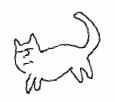
It’s a mystery how cats decide where their favorite “spot” is and an even greater mystery why it changes from day to day or week to week. Pookie has a perfectly good bed; in fact, he has the mezzanine suite (upstairs hallway). His sheepskin bed is tucked in the corner by the water heater closet, and across from that are a large piece of cardboard and a couple of wine corks for his batting pleasure. The cat dancer dangles invitingly from the stair railing, but he ignores it unless the human motivator (yours truly) gets it bopping up and down and bumping against his back and swinging just out of reach of his paws. This is not a cat with a whole lot of get-up-and-go. (As my father would say, his get-up-and-go just got up and went.) Despite this perfectly comfy arrangement, he adopts various other sleeping spots, which I suppose, for one who sleeps 23 hours out of every day, is appropriate—[Note to self: Explore metaphor of Eskimos having lots of different words for snow—oops, someone’s at the door]—

ha who is she kiddin theres no one at the door and if there was she wouldnt answer it. shes as bad as howard hughes for gods sake. shes probably down in the kitchen trollin for snacks which believe me in this household are few and far between at least the ones that are any good. she hoards that tuna flavored laxative like it was gold. in case you havent guessed this is pookie god help me with such a name. it wasnt easy gettin up on this blasted chair its got wheels and its hard for me to balance   ohhnooooo… 23erghmffffbb blxxxxzz,,, sorry about that i almost took a tumble. ok ive got a lot to say and not much time so listen up. i am not the weird one in this family believe me. the stories i could tell… shes a wild one when no one is watchin no one except me of course not that i count for beans around here. youll have to fill in the exclamation points which believe me this paragraph is full of at least in my head but i cant seem to work the bloody shift key. oh oh here she comes xxzgaluuffffmmb…

Well, there was no one at the door after all, sorry about that [munch, slurp]. Now where was I? Well, one of his favorite afternoon sleeping spots is under a stepstool in the bedroom. I thoughtfully keep it draped with my clean laundry so he has the illusion of privacy, at least that’s my excuse for never putting my laundry away, ha ha! He thinks he’s hiding but doesn’t realize that his big furry rear is sticking out the side. Sometimes I’ll be looking distractedly in that direction and realize there are two big green eyes looking back at me from between the sleeves of the draped t-shirts. As soon as we make eye contact, he comes lumbering out, creaking like an old man, sometimes one leg buckling slightly under his considerable weight. [Hold that thought, I think I hear the mailman…]

hi its me again geez any excuse to go down to the kitchen eh// considerable weight can you believe that111111111111 big furry rear1111 you should see her in the bathroom in the mornin now theres a sight111. i mean if there was ever a case of the pot callin the kettle black … o shit njxkmv,bn/mbbf//,,,,

That’s funny, I could have sworn I heard the mailman [gulp, crunch]. Let’s see. Oh yeah, lately he’s adopted the cramped space between the dresser and the nightstand, where he lies on a bed of Kleenex (never mind how it got there), crammed in between the books strewn under the nightstand and the crowbar I keep for earthquake- and intruder-related emergencies. He has to climb over the duffel bag I still have packed from Y2K to get in and out of there… weird… [Now that’s got to be the mailman…]

who the heck is she kiddin///// what could she be findin to eat down there///// nkkkco886hfjfl;lsamd;;;/

Ah, that’s better. I feel quite refreshed after walking up and down the stairs a few times. Hmmm, how come my chair is moved every time I come back here? And what are those cat litter crumbs doing—POOKIE!!!!! OK, just for that, I’m going to dish some real dirt. You think the name Pookie is undignified? Well, how about I tell the nice folks what your previous humans called you, the ones who abused you. SQUEAKY. There, how do you like that? And furthermore, I’m done telling cute stories about you, you ungrateful little… hey!—NO FAIR—don’t you dare cough up hairballs at me! why I oughta… Get over here!!

i will not use the computer without permission
nkkaakco88p0hhfjfl;amd;;;/

THE END.

[Mary McKenney]
mary’zine random redux #17 Sept./Oct. 2001

March 26, 2009

life goes on within us and without us

You can kill birds. But you can’t kill all birds.
—Krishnamurti

dear friends,

I have started writing this issue many times, in many different moods, and with uniformly disappointing results. Whenever I reread what I’ve written, I see there is no way I can send such disjointed, inappropriate, maudlin, not maudlin enough, one-sided, too-many-sided musings out into the world. You are probably being overwhelmed by points of view just as I am. You are teetering between your own constantly changing states of mind. You are feeling connected and disconnected, close to your heart and far away, back and forth, on again, off again, just as I am. Why should I add to the deluge? I think the answer is simple: I want to take part.

My hopes and expectations for this issue can never be met. I want to strike just the right balance between horror and hope, sorrow and inspiration, with just the right tone—not too heavy, not too light, juuuust right. You’ll note that the word “right” keeps popping up. My way of dealing with most things is to figure out what’s “right” and then plant my flag, so to speak, there. That was a lot easier to do when I was younger, I’ll tell you. Or maybe it’s the nature of what happened, the complexity of an enemy without a face—or with one face that we’ve demonized so we can think there’s a clear target. Regardless of the terrorists’ extreme methods, they do reflect the feelings of a certain segment of the world’s population. “One person’s terrorist is another person’s freedom fighter.”

***
Sometimes it has felt as if there is just too much to take in—too much sorrow, too much suffering, even too much beauty. I can’t watch the crying firemen anymore, or hear the beautiful stories of sacrifice and love. The tireless rescue effort, the photos of loved ones. The two people who jumped from one of the towers hand in hand. The immense grief, the immense generosity, the immense compassion. My heart resists the workout it’s getting. My brain, too. Every time I turn on the TV or read the newspaper, there’s new input to consider, new tragedies, new strategies, new acts of heroism, new acts of scapegoating, new warnings that we have entered a new world in this new millennium. I am tired of the new.

I see us all creating narratives out of what happened, as if we’re little kids wanting a goodnight moon story before bed. And maybe, at heart, we are. Some people have fashioned a scenario of how Flight 93 went down; it’s just a story, but we have powerful incentives to believe it. In our minds, we’ve already cast the movie—Tom Hanks, Ben Affleck, and Matt Damon, ordinary/extraordinary guys who heroically band together to bring the plane down to save the lives of their fellow Americans.

Other people are trying to “decode the message” sent by the hijackers—September 11 is 9/11, get it?, and two of the flight numbers are eerily close to the latitude of lower Manhattan. I told Peggy about this, and she said, “I think we got the message.”

Everything I read and see gives me a different perspective and wipes out the one I had five minutes ago. My spine unwillingly tingles when I hear “God Bless America.” Some part of me responds to the fist-shaking of G.W. Bush and despairs of the “give peace a chance” crowd who don’t seem to have both feet in reality. But another part of me—the legacy of the ‘60s—will probably never be able to fully embrace the American flag. Too much horror has been perpetrated in its name. Bush’s disingenuous use of the term “bully” to refer to the terrorists strikes me as ludicrously inaccurate. If the U.S. is Goliath, which by all accounts it is, then the stone that David throws at us is not the act of a bully, it is the act—no matter how misguided—of an underdog who sees no other way to bring the giant down. We Americans should understand this better than anyone, we the proud historians of our own revolutionary beginnings. But I suppose that is one of the lessons, that the underdog grows up to be the top dog and adopts the posture of top dogs everywhere: We’ll do what we want—because we can. And those of us who live in the top dog’s kennel (am I getting carried away with my dog metaphor?) have been so complacent, so entitled as “Americans—leaders of the free world.” Like we really deserve all our riches.

I wrote the following to Terry late in the first week:

My feelings and thoughts are all over the map. Mostly there’s just a disconnect and confusion, dotted with moments of anger—no fear, though, strangely. Alternately heart-open and heart-closed, for no apparent reason. Going grocery shopping, I’m half extra-kind and compassionate, and half irritated if anyone gets in my way…. It feels like the best of times and the worst of times. Yes, the best of times. It truly does feel as if good could come of this, though it’s often only temporarily that people realize the preciousness of life and have good will toward their fellow humans. I keep being surprised and not surprised and angry and not angry. I am not about to start flying the American flag. Is that a vestige of my misguided youth, or is it good to keep a level head and not dive right into rabid nationalism? Confused, confused, confused…. I read the widely circulated Canadian journalist’s defense of America (which was written in 1973, by the way, not this week) and I think, yeah, we always help out other countries, rah rah for us, and then I think about all the havoc we’ve wreaked in the world in the name of patriotic zeal and anticommunism—defending our oil interests, making alliances with dictators; we’ve been on the wrong side so often. And now I’m identifying with this “we”? Who are “we”? I’m impatient with both the left and the right, with any politics at all, though I know it must come down to that….

Intermittently, I stop thinking and just let myself watch and feel. Jon Stewart of “The Daily Show” choking back tears as he describes the former view from his apartment—the World Trade Center—and the view he has now—the Statue of Liberty. Dan Rather crying on David Letterman’s show—not discreet, manly tears but a crumbling of his stern newsman face. I’ve never seen so many men cry.

And then my brain takes over again. Dan Rather asserts that this “war” is not a clash between cultures, between religions, or between wealth and poverty—it’s about good and evil. They hate us for no reason. They just want us dead. And so I lose my previous (five minutes ago) certainty and start questioning again.

My questions chase their own tails.

***
Dust settles, mind does not.
—headline over Joan Ryan’s column in the
Chronicle

It’s unreal. It’s scary. I can forget it; I can’t forget it.
—my friend E in Washington, D.C.

***
I thought about writing this issue as a series of journal entries so I could focus on what I was thinking and feeling on a given day. But I realized that the entries would have to be constantly updated:

9:05 a.m.—Heart touched by the plight of Afghani refugees fleeing their country in advance of war.
9:10—Anger at people who think they’re the only real Americans because they came here from lighter-skinned parts of the world.
9:15—Grateful for national leaders who emphasize that Arab Americans are—hello!—Americans. At least we’re getting a much-needed education in Islam.
9:30—Anger at headline, “Falwell says U.S. has lost God’s protection because of spiritual void.” Is he HIGH?
10:05—Heart touched by hug from my favorite grocery store clerk.
10:40—Irritated by “violence only leads to violence” argument.
11:15—Fearful of “violence is the only thing they understand” argument.
11:20—Feel I have to choose one argument over the other. Can’t.
11:30—Horrified by images I can’t get out of my head—scads of shoes on the ground from falling bodies. [2009 update: A TV ad (for shoes, I guess) has shoes falling all over a city street, and I gasp: Did the imagery not ring a bell for anyone at the ad agency?]
11:42—Moved by stories of firemen’s heroism and self-deprecation (“just doing our job”).
12:05 p.m.—Up to here with images of wistful beauty and elegiac sadness.
2:10—Sick that this happened after Bush became president.
2:15—Wondering if Bush could be the right man for the job after all—can’t see Al Gore doing much for the national morale.
2:20—Friend I say this to writes it off to shock.
2:21—Realize she’s right.

And so on.

***
Some of you know that I put the mary’zine on hold this summer because of an unintended side effect of taking Zoloft, the anti-depressant, anti-anxiety, anti-obsessive-compulsive-disorder medication that I have come to know and love (and just in time). No one could have been more surprised than I that I lost the desire to sit on some literary observation deck above my life and describe its ins and outs, its ups and downs, in witty or soulful terms for the edification of dozens. My “new self” no longer felt it had to justify its existence by writing or publishing.

But that was one of the few down sides, and I was willing to give up the ‘zine if I had to, because Zoloft rocked my world. Or I should say, it steadied it. It was as if my brain, body, and soul—victim(s) of brain chemistry or life experience or unexplained personality defects—soaked up this neuron-connecting drug like a parched begonia, leaving me calmer, less self-conscious, less afraid of what other people think of me, less judgmental of others, content to do the little tasks that are required to maintain a household. I first noticed the drug was working when I realized, to my amazement, that I was perfectly happy to be sitting on a stool out on my patio in the morning sunshine washing and laying out on a blanket approximately 5,000 separate sand tray items that hadn’t been dusted in years, from skulls to plastic hearts to spiders and beyond. I had a sublime moment of realizing that there was nowhere to get, nothing to achieve—that doing this task mattered more than finishing it. At last, I knew what it meant to be “in my body” and to simply be without the usual internal litany of “I’d rather be [reading, sleeping, eating]” (not necessarily in that order).

And then the Events of September 11 happened (“Event” is my chosen euphemism, a good substitute, I think, for “first war of the new millennium”). It’s a cliché, but my foundation felt shaken, like after the 1989 earthquake. After a couple days of total shock and media overload, I e-mailed Diane, saying in part,

… by turns I’m a prickly pear and a dish of mush and an unconcerned Zoloftian and a selfish Bay Arean who doesn’t know anyone directly involved and was damn glad to know that you, my chick-a-dee-dee, were driving and not flying on the fateful day.

In her reply, Diane suggested that I had the beginnings of the next issue of the ‘zine. So she was the first to put the bug in my ear, the bee in my bonnet, the ants in my pants to get the ‘zine back on track. I began to hear the call of the blank computer screen, even as I wondered what I could possibly add that would be of value to a world already saturated with expressions of grief, loss, anger, and love.

***
All week, I kept hearing people in the media talk about how in times of tragedy, everyone instinctively reaches out to make contact with their loved ones. I sat here alone in my home office, editing yet another book about microbes, wondering why my loved ones weren’t reaching out to me. Of course, I wasn’t reaching out to them, either. But I did turn on the ringer on my phone, way up to 4 rings, which is huge for me—to dare to answer the phone without knowing who is there. Eventually, some of my loved ones did reach out, and I want to thank Kerry, Sissypuss, Diane, Terry, and Kate for calling or e-mailing during the freshness and rawness of that first awful week.

***
A week after the Events, Rob Morse wrote in the Chronicle,

Last week we were slammed over and over again with the most horrendous reality TV of all time. Then the electronic media decided to censor anything that could conceivably trigger memories of the violence they had broadcast.

Some radio stations were dropping any song that referred to airplanes, plus REM’s “It’s the End of the World as We Know It.” But besides the contradiction Rob Morse pointed out, protecting us from reminders is a hopeless cause. Most popular songs are about love or loss, so there’s no way to avoid thinking about our own vulnerability. Just being alive is a reminder.

With predictable timing, the pundits began telling us to try to get back to normal. For once, they were right. I felt palpably relieved whenever I turned off the TV and stepped outside to breathe the fragrant, cool air, or when I listened to the blue jay splashing away in the bird bath on the patio. It was good to be reminded of the natural world. Laughing with a friend on the phone eased my heart and soothed my nerves. Going out to dinner at the Lark Creek Inn to celebrate a friend’s birthday felt alternately like a relief and a guilty pleasure. After we ordered dinner, the waitress informed us that there were candles out front in case we wanted to go outside for the national moment of silence at 7 p.m. We didn’t. We had had our fill—one friend had already sung two “Amazing Grace”s and had two moments of silence at the school where she works. It seemed more important right then to be sitting at a table together, waiting for our petrale sole and our heirloom tomato salad and our butterscotch pudding to arrive, talking of little things and big Events and laughing when we could.

My goddaughter Kelly, age 25, was having dinner with us. I told her I might not be writing the ‘zine anymore. She said I couldn’t stop now. Why? “Because you haven’t written about me yet!” So I teased her that I was going to dig up some embarrassing stories from her childhood. She mentioned the time she peed in my bed, which I don’t even remember. But Peggy said to her, “No, she’s going to write about your saying you want her to write about you.” The woman knows me, I must say.

This year I’ve been struck by the fact that Kelly is the same age I was when I met Peggy 30 years ago. Let’s have a moment of eerie silence to contemplate that horrific number. (“Eerie silence” and “horrific” were the terms we decided we were most tired of hearing in the wake of the Events.) Even though my political agenda back then was quite different from hers (she’s an ardent environmentalist, health-foodist, bike rider), I feel the connection of having been, like her, an idealistic young person with a desire to create change.

But what’s also fascinating to me, beyond seeing the similarities and differences between our life paths, is that contemplating her young life puts my middle-age-hood in perspective. It’s interesting to see some of the ancient truisms coming, in fact, true—such as the one that says the older you get, the more you realize you don’t know. That’s not as frightening as it may sound. It even makes life more interesting and less depressing—there is more to learn, more windows of opportunity, more ports in a storm, more facets of every diamond in the rough, more complexity and more grace. More ability to change, rather than less, which is what I used to think. So to all those who fear growing older—you won’t know the benefits until you get here.

***
In the newspaper the other day, there was a photograph of Ukrainian Americans in Golden Gate Park celebrating the 10th anniversary of Ukrainian independence. One of the women in the photograph leaped out at me. (Not literally—I have not completely lost touch with reality.) Sturdy and rather grim-(or determined-)looking, as if she’d seen it all and then some, she reminded me of my Danish peasant grandmother. Wrapped in a warm coat, her purse on her lap, she held a small American flag. And in that moment I got it about the flag. How it’s the immigrants from poor or war-torn countries who carry the American dream forward, who claim the flag as their own, who consecrate it rather than embarrass it. She wasn’t holding a symbol of world power or hegemony, she was holding a symbol of freedom and all the other American ideals that seem so false and fragile at times. I was humbled by this. In my youth, it was easy to disavow this symbol of America’s hypocrisy. But this woman wasn’t holding the same flag that’s waved by the patriotic jerks who want to bomb a country of innocents into the Stone Age. In her hands, it meant something good and true.

I cut out the picture of this woman and taped it to the side of my computer. At first, I thought I may have to take it down, because the wrenching of my heart every time I looked at it was hard to take. The picture gave me something important, something I valued, but the brain (enjoyer of certainty and habit) fights any attempt of the heart to be open, to let love and suffering coexist in a contradiction that will always be linked.

Soon the picture became part of my desktop landscape, and I had to strain to reexperience what had felt like “too much” only days before. This is the other part of the contradiction: the love, the suffering… and the ability to move on. Thomas Friedman, who has written extensively about the Middle East, said on NPR’s “Fresh Air” that people who live with terrorism every day are either survivors or thrivers. The survivors are consumed by fear; the thrivers are appropriately careful, but they don’t let fear rule their lives. He wished for us all to be thrivers.

One of my friends flew back East 5 days after the Events. Another friend doesn’t want to fly again until she knows what’s going to happen. I wonder if we will ever “know what’s going to happen.” One thing I have not felt much during this topsy-turvy time is fear. It could be the Zoloft working its magic, or it could be the enormity of the Events, the vagueness of the threat, and the pointlessness of being afraid. It seems likely that the terrorists who are still out there won’t target the airlines again—we’ve already rushed to close that barn door after the horse was gone. For all we know, having made their symbolic statement about American finance and military might, they will start planting bombs in random small towns and cities throughout the country—San Rafael, Boulder, Taos, Ashfield—but it’s all too amorphous. Why not just go ahead and worry about Death and be done with it? For me, at least, the Events have not so much struck terror in me (though I could still be in the shock stage) as they have made me realize it’s pointless to fear the unpredictable and the unexpected—which is to say, Life itself. I could die on a hijacked airplane or be hit by a bus or get crushed in the next earthquake. Speaking of which, to quote myself, “They say there’s a 60% chance of earthquake. Well, there’s a 100% chance of death.” Who are we trying to kid?

***
Overall, I’d have to say that during these last weeks, thanks to the Zoloft, I have been more forgiving of myself than I would have been in the past. I have mostly allowed myself to experience whatever life brings me: the sweetness of the only cartoon in this week’s New Yorker (a violinist with her head bowed, stopping the music, and her cat covering its eyes), the sadness even when it does not bring tears, the irritability when it does not achieve righteous anger, the hardening and softening of my heart in seemingly alternating pulses, the occasional fear, the love, the lack of fear, the lack of love, the political confusion, the selfishness, the compassion. I think I have never before felt so much a part of humanity. I don’t want to give up that feeling—that sane connection with reality—but I don’t know if I can stand it. Sometimes it is just too heartbreaking to be alive, and to feel so much.

***
Almost last, but certainly not least, Diane sent a group of us the following poem. My first thought when I saw it was, “I don’t want a goddamn poem.” I was already up to here with beautiful expressions of loss, love, and gratitude. But the poem is exceptional, and so I share it here.

Thanks

Listen
with the night falling we are saying thank you
we are stopping on the bridge to bow from the railings
we are running out of the glass rooms
with our mouths full of food to look at the sky
and say thank you
we are standing by the water looking out
in different directions

back from a series of hospitals back from a mugging
after funerals we are saying thank you
after the news of the dead
whether or not we knew them we are saying thank you
in a culture up to its chin in shame
living in the stench it has chosen we are saying thank you

over telephones we are saying thank you
in doorways and in the backs of cars and in elevators
remembering wars and the police at the back door
and the beatings on stairs we are saying thank you
in the banks that use us we are saying thank you
with the crooks in office with the rich and fashionable
unchanged we go on saying thank you thank you

with all the animals dying around us
our lost feelings we are saying thank you
with the forests falling faster than the minutes
of our lives we are saying thank you
with the words going out like cells of a brain
with the cities growing over us like the earth
we are saying thank you faster and faster
with nobody listening we are saying thank you
we are saying thank you and waving
dark though it is

—W.S. Merwin

from The Rain in the Trees, copyright© 1998 by W.S. Merwin.

***
And now—I don’t know about you, but I need a freakin’ break. So here is a guest contributor to take our minds off our own species’ troubles.

my life with mare—a work in progress
by pookie (poet manqué)

so i live with this human… they call her mare like a horse haha…. ive been studyin her for about 14 years now… observin her closely takin copious mental notes. i do my surveillance with eyes half closed so she thinks im sleepin but im always on the job.

mary is remarkably unselfconscious in front of me which tells me she has no clue as to my true mental capacity. i play the dumb kitty cat pretty good if i do say so myself. she doesnt even check for my whereabouts when she gets out her magic wand. i have to say, thats kind of insultin, i mean what am i, chopped liver/she thinks i can sleep through that racket/well someone has to maintain the proper boundaries around here so i quietly leave the room and find somethin to do downstairs like visit the litter box… though i usually like to save that for mealtimes, just to get her goat….

i used to enjoy a little self-diddlin myself; she had this fuzzy lavender blanket that i just loved; but as soon as i got my paws on it and got my mojo workin, shed grab it away. but those days are long gone and not even kitty viagra would help me now.

its hell to get old.

i have to admit that not that much happens to me. its a big day if she lets me go out on the patio to lie on the sticker plants. i dont much care for the sticker removal process but its so nice to get a whiff of fresh air that isnt comin from a window three feet above my head. lots of interestin smells out there. i try to hide in the honeysuckle vines, hopin shell forget im there but she never does. ive been studyin the fence, which has a possible way out if i could dig deep enough… but im not gettin any younger….

ok heres the big confession. i was abused as a kitten. i know its very trendy to talk about those things now, but i had to get it off my chest. this horrible man used to throw things at me and even throw me when he could catch me. it was pretty brutal but it was the only life i knew. then mare took me in when no one else would have me and for that im grateful. but there was that time she almost let me die of a bladder infection. for once i wished i could speak cuz she sure wasnt gettin the first clue about how much pain i was in. i have to admit since then her attitude has changed for the better… she pets me a lot more and talks to me in that high, funny voice they all have when they like us, and i gotta admit it feels pretty good.

sorry i was so cranky last time i wrote. thats what happens when you dont get your tuna-flavored laxative when you want it. i gotta admit the spoken vocabulary of my species leaves much to be desired… meow… mew… erkk… there just isnt a lot of range when youre askin for somethin specific. she has this cartoon of a cat lyin on a shrinks couch and hes sayin to the shrink im startin to feel dependent and boy can i relate to that.

anyway i came into her life when i was a tough young tomcat with a chip on my shoulder and a few problems with anxiety and depression… from the kittenhood abuse of course. when i was just startin to get the hang of the new place and still had the strength to jump up on the dinin room table and the washin machine and actually look out the freakin window she brought in a little girl cat that she called tweeter and i called ms priss… oy gevalt… i think mare thought she was doin me a favor but what favor thats what i want to know. ms priss was a connivin little thing actin all sweet to mares face but talkin mighty catty behind her back… meow… she even played this stupid game fetchin little wadded up pieces of paper that mare would throw and then bringin em back and droppin em at her feet lookin up at her all cutesy gag me with a spoon. i tried to get on mares good side by runnin after corks but i was too proud to bring em back so little ms priss got all the best seats in the house like the bed and that damn lavender blanket. i used to pounce on her when she walked by… ms priss that is… what a brainless girly girl she was shed squeal and mare would come runnin.

since ms priss went away life has been pretty uneventful. i eat sleep beg for treats lie on cardboard sometimes walk back and forth between mares legs when shes workin on the computer which is pretty much all the time unless shes stretched out like a corpse on the bed. it’s not a bad life all in all.

well i guess id better skedaddle. til next time yrs truly
p

p.s. good luck people, god bless humanity and all creatures great and small

[Mary McKenney]

mary’zine random redux: #10 January 2001

March 18, 2009

With this issue, I boldly go where I never thought I could go before—into the XXX Zone. I have a hard time talking about sex. I have never used the word “masturbation” in 8 years of therapy. I’m no Betty Dodson or Suzie Bright. But this ‘zine is my place to explore, and you are the lucky recipients of my intrepid findings.

Those who do not wish to enter the XXX Zone may proceed directly to Story #2, which is considerably more decorous and in which the word “nipple” does not appear even once. Ha! I dare you to skip over it now.

mary’s first porno

As I sit here at the computer, wondering where to start, I ponder the title of this story for a while, and it occurs to me that I have unconsciously made an association between sexuality and childhood—Mary’s first steps, Mary’s first word, Mary’s first porno—and I suppose that is accurate after all. Before you get too scandalized, let me just state that I’m referring to watching a porno, not starring in one (…as if…).

I had my first sexual experiences at the age of 10, at the hands of my older cousin John. It’s hard to put myself back in that time and understand why I couldn’t refuse, why I couldn’t tell anyone. But like many other things that had happened to me, this unwanted attention was like a fact of life, like a death or an illness. It wasn’t something I chose, and therefore I had no choice.

Something was awakened in me by those encounters in the woods, the basement, and our “fort” on the sand hill, but not in the sense of the handsome prince awakening the beautiful princess with a kiss. It was an awakening of fear, guilt, shame, and pleasurable physical sensation in a mixture that was most confusing. The way I found to deal with the confusion was to try to separate the pleasure from the rest of it—or to own my own body, if you want to get feministic about it.

This new awareness of my lower body morphed into inspired masturbation under the very noses of my grade school classmates and teachers. The large institutional swing set at Grant School had fine, sturdy poles, up which I climbed like the boys—humping my way slowly and deliciously to the top, then sliding down after climax—instead of the dainty swinging back and forth on the underside of the pole that the girls were supposed to do, all work and no play whatsoever. The bell to end recess would ring, the other kids would go running, and Miss Magnuson, the second grade teacher, would call up to me from the ground, “Come now, Mary!” And so I did.

When the swing set was no longer a viable option—“When I was a child, I humped like a child, but when I became a woman, I put away childish things”—it took me years to realize that there were other means to accomplish the same end and even books to help you do it. When it comes to erotic materials, I have always been more a fan of the written word than the visual image. I have had little enough exposure even to the written word (I mean, those written words). My first awareness of pornography was finding my father’s hidden copy of Nudist Holiday when I was 10 or 11. I can’t imagine why my mother let him keep it—my father lost all property rights after he got sick with MS—unless—oh, horrors—it was hers. The book was pretty soft-core. I remember the bobbing breasts of the ubiquitous volleyball players—do real nudists love this sport above all others, or is that a smutty-book and movie cliché?—but I don’t remember any big swinging members or anything that truly shocked me.

Recently I had cause to contact a woman-friendly sex appliance store in San Francisco called Good Vibrations. I found it on the Web when I was forced to replace my Hitachi Magic Wand after the cord became frayed and started emitting little sparks. An ex-girlfriend had given it to me some 13 years before, so you know it was ready for the scrap heap. Whenever I succumbed to an onanistic session—staring death by electrocution in the face—I imagined the humiliation of being found dead in my bed days later with the foot-long accidental-suicide weapon in one hand and Nancy Friday’s My Secret Garden in the other. I could only hope that my spirit would be long gone by then and wouldn’t still be hanging around the ceiling looking down on the body, watching its surprised friends and family get an eyeful. At least I don’t indulge in any really strange practices, like autoasphyxiation or dressing up in women’s clothes.

When the Wand arrived (I wonder if the Hitachi Corp. really thinks people are using this thing to massage their backs and shoulders?), I looked through the catalog that came with it and noticed that they also sell videos. I figured it was time to satisfy my curiosity about—oh, one thing and another—so I pored over the descriptions and finally settled on a bisexual video called “Curious?”:

Two attractive same-sex couples living under the same roof wonder what it would be like to succumb to their curiosity and swap partners. Enjoy steamy gay and lesbian sex, a woman learning blowjob techniques from a gay man, and a not-to-be-missed four-way in which one of the men becomes the center of everyone’s attention.

I thought, naively, that a video featuring gay men and lesbians would be kinder and gentler, more wholesome somehow, than your usual porno. Obviously, I didn’t think this through. For one thing, it doesn’t get more down-and-dirty than two guys getting it on (despite the fruity-fairy stereotypes), and I had forgotten that pornos showing women together are made to satisfy the fantasies of straight men, not your Birkenstock-wearin’ middle-aged wimmin-lovin’ wimmin. One of the women in this video was named Candy Apples, which should have been my first clue. For viewers with no imagination, the two parts of her name were tattooed on her chest, one above each… apple.

Now that I think of it, I’m not even sure who would want to watch this mishmash of gay, lesbian, and straight sex. Gay men and straight women wouldn’t be interested in the bulbously breasted women, and straight men and lesbians wouldn’t care to see the Long Dong Silvered men… leaving, I supposed, the true bisexuals and those, like me, who are indeed curious or just confused.

So why did I select the bisexual video? I am quite ambidextrous in my sexual response—it’s only emotionally that I walk the gay and narrow—so I admit I was interested in seeing some “towering columns of stiff male meat,” as the women in Nancy Friday’s books like to say. I mean, I’ve experienced my share of said columns, but it’s been awhile. Not everyone knows this, but I’ve been around the block with several penii. In the days before I knew that women were an option, I fooled around a fair bit with the boys but never found one who could begin to intrigue or attract me intellectually or emotionally the way legions, scores, and oodles of women have in my life. Talk about your Mars and Venus. I’m a same-planet girl.

***
[Hetero sidebar] In my 20s, I was naïve enough to believe in the so-called sexual revolution, so when I was first seeing P, I also got involved with two married male librarians. And an unmarried one, if you count my boss, the library director, who got me drunk one night and tried to seduce me, insisting that he knew “gay ways of making love.” He later fired me, but we didn’t know about sexual harassment back then. One of my fondest hetero memories (ah, I am a real woman, after all) was the night the two married men faced off like two stags in the log cabin I was living in. C drove me home after an after-hours rendezvous in the library, and J followed us from town and burst through the door in a jealous rage. I’m glad handguns weren’t readily available back then (at least to librarians). I just sat there, the helpless damsel, in my gay-liberation-button-festooned army shirt, flabbergasted and pleased at this rare display of machismo on my behalf. (No, I can’t explain why I was messing around with these guys. It was the “sixties”; we were insane.)

At the ripe old age of 40, I became temporarily enamored of an older man—a VIP in the Krishnamurti crowd in Ojai, Calif. My 12-year relationship with P had ended, and I guess I figured it was time to sow some wild oats. I didn’t realize right away that what I was enamored of was feeling “normal” out in the world. I loved being seen with a man, going to restaurants with him, walking down the street. It was like suddenly being admitted to an exclusive club. Was I imagining that I was treated entirely differently, that I was receiving the respect and nonchalant approval I had never felt as a dyke? It was a heady experience, to say the least. It almost seemed worth it to “switch,” even though this man turned out to be emotionally cruel and very conflicted about women. Also, he’d had a lifelong problem with impotence—I mean, not occasionally, but completely. I don’t think he had ever really “done it.” I figured this was fate’s way of confirming that I wasn’t meant to go down that path.

***
Back to the porno. As soon as the video arrived, I rushed to put it in the VCR. Frankly, I was stunned, right from the beginning. The video started out with several minutes of ads for male/male 900 numbers and lurid close-ups of men’s frontal and rearal anatomies. I still had hopes that the “story” would provide more titillation—was it too much to hope for a little subtlety, a little eroticism?—and less of an anatomy lesson.

I hadn’t really expected the acting to be any good, but I was frankly astounded to see how bad and insincere it was. They stumbled their way woodenly through the dialogue necessary to move the two guys from the top of the washing machine and the two girls from the bathtub into the joint living space where they could satisfy their “curiosity” about the mysteries of hetero love. But what shocked me was that they couldn’t even act the sex very well. They didn’t seem to be feeling anything. I’m not talking about emotionally, but sexually. The guys wore stoic (or bored) faces—presumably, they were thinking about dead puppies or stock quotes in order to keep going—and had very little dialogue, but “Yeah baby, get your lipstick all over that baby” was a mood killer for sure.

And the women were so obviously faking it, it wasn’t even funny. I mean, it was funny. It was as if they started with a crashing orgasm and then just kept it going and going—move over, Energizer bunny. But since their enthusiasm was not even slightly credible, there was nowhere for it to go. You had to wonder if they were feeling anything at all, or if they had become completely desensitized by the constant manipulation of their parts and their faked over-the-top reactions. There was absolutely nothing sexy about these women, who are supposedly the ultimate sex objects, the ones stamped and approved by scores of porno-loving men. I really had to wonder, What kind of lesbian am I? I love women’s bodies! I find them endlessly fascinating and smooth and curvy and juicy. But if the women in the video were giving and receiving any pleasure whatsoever, you could have fooled me. And it wasn’t just the “lesbian” scenes—the women in the hetero bits acted exactly the same—all over-the-top fakiness.

So if the women were laughable with their feigned horniness, the men were a turnoff because of too much information—testicles hanging out of a guy’s pants like elephant ears; a beer-can-sized penis inserting itself quiveringly into a puckering a-hole. I suppose the organs erecti were impressive enough, but somehow the microscopic detail and the zealous slurping and handling—not to mention 5 solid minutes of the same camera angle—made the action seem about as sexy as bobbing for rubber wieners.

I’m not saying I want the soft romantic lighting, the thin white curtain stirring in the breeze, a bird flying high in the sky to represent the “culmination of the act.” I’m not a prude. But for me, the visuals are just not stimulating—whereas the words—the lick, the flick, the nipple and the clit—ahh. Give me something to dream on. Are you with me, dear reader?

Now that I’ve seen “Curious?,” I no longer am—curious, that is, And I’m more in the dark than ever about who would want to see extreme close-ups of men licking each other’s anuses and gigantic-fakily-breasted women moaning over each other’s shaved mounds—not to mention switcheroos in the middle of the action, so that the women are licking the… and the men are moaning over the….

And I can’t get those images out of my head. You know how they say that if you ever see how sausage is made, you’ll never eat it again? Well, that’s how I feel… not only about the sausage but about the biscuits, if you know what I mean. Oh, and the gravy—especially the gravy. It’s as if someone waved the Magic Wand and worked its magic in reverse. The fairy dust has disappeared, and my Hitachi is once more a mundane reliever of muscle tension, not a means of self-pleasure and delightful fantasy. I cry for my lost innocence.

And now, for something completely different…

just one

For some reason, I like to take myself out to lunch or dinner after a therapy or dreamwork session. (“Take myself out” is such a quaint, romantic concept—as if I’m also going to bring myself a corsage, come around to open my car door, and kiss myself sweetly at the end of the evening.) (Given what you have just read, this might not seem so far-fetched.) It’s as if the inner work and the relationship with J or J* make me want to open to the world, or as if I’m already open and there’s nothing for it but to go out among the human, letting myself seep into their consciousness and take them into mine.

On this particular day, I’ve had a wonderful time with J*, batting back and forth the dream images I’ve offered him out of the dozens I’ve written down since I saw him last. He does most of the batting, hitting multiple home runs. (Though if we’re “batting them back and forth,” I suppose a badminton metaphor would be more appropriate here…. Oh, never mind.) He modestly calls himself a “master of the obvious,” but if so, then it’s clear that pointing out the obvious to those who would otherwise never notice it is a particular form of genius.

Both J* and his wife have become avid readers of the ‘zine, so that adds another dimension to the relationship. They are so enthusiastic, in fact, that I feel myself turning red, wanting to disavow their praise like too-rich chocolate. I ache to hear it and yet it is a bit hard to swallow. I reflexively want to turn their words away at the door, like beautifully dressed partygoers who must have the wrong house. I imagine it’s like being praised for the sweetness of intelligence of your child—you blush to be receiving all this credit for something you’re not sure you’re responsible for, but you also marvel, “So—is that how my little one is received out in the world? Honey, I barely know ye!”

It’s 5:00 when I leave the house on Pleasant Lane—aptly named, because the street feels like a veritable boulevard of pleasantness as I walk to my car, full of feeling and torn between wanting to share it and keep it all to myself. This is where the bustling café comes in—a place where I can sit with a glass of wine and a small pizza or dish of pasta and dream over the insights of the past hour and a half—but at the same time feel the pulse of connection with the world.

I decide on Il Fornaio. It’s still early, so there should be plenty of room for my party of just-one, and it’s a relatively benign environment in which to experience that peculiar luxury-slash-torture which is dining out alone.

Despite my glow from the session, I feel as false and brittle as a mannequin walking down the row of tables behind the beautiful hostess, all the eyes of the other diners seemingly on me instead of on her deserving countenance. She first tries to seat me at the table right opposite the kitchen door, but I’ve been stuck there before. When you dine out alone, you learn to be suspicious of the host’s first choice of seating. I’m there to have a sensory experience in a refined atmosphere, and the comings and goings of the waiters in all their raucous camaraderie through a constantly swinging door are not part of my plan. Instead, I successfully negotiate for a table a little farther along, where I can keep my back to the help and pretend that I am far, far above the mechanics of dinner delivery.

Throughout the perusing of the menu, the ordering of the wine and salad and pizza margherita—grateful to the Italian waiter for instantly seeing them I am a Madame and not a Sir—I feel like a new immigrant to these shores who has only learned to say one phrase, “Thank you.” The thank yous necessary when dining out alone add up to a veritable chorus of gratitude. And because you’re not conversing with another person in between, all you hear yourself say all night long is thank you, thank you, thank you—for the table, the menu, the placing of the order, the bringing of every little thing, the taking away, the bill—as if riches are being bestowed upon you in exchange for your gracious presence rather than $37.48.

When I’m alone in a restaurant, I take self-consciousness to dizzying heights. My self inflates to take up the entire, vaulted dining room—crouching at the high ceiling, pushing against the windows, seeping under the doors, seeming to need a larger venue, the Oakland Coliseum, perhaps, to contain it. It is impossible to believe—as I know must be true—that all eyes are not on me, that judgmental glances are not taking in the falsity of my nonchalance and the obvious pose of bringing along a book to populate the tabletop. It’s a good book, actually—Writing Past Dark: Envy, Fear, Distraction, and Other Dilemmas in the Writer’s Life—but who can concentrate on written words when the outsized dimensions of the fearful ego are expanding to fill the vacuum that Nature and solitary diners abhor.

Thank God for the vino. I have nervously drunk almost the whole glass while waiting for my food, and the nice waiter asks if I want a second one with my meal—sparing me the humiliation of craning my neck in obvious alcoholic dependency as I wave down any passing busboy for more liquid courage.

The salad, when it comes, helps to focus my attention a bit, but then there’s the problem of how to hold the book in one hand and navigate the slippery pieces of lettuce and shaved parmesan with the other.

Slowly, slowly, I begin to deflate back to a manageable size. It’s probably the wine, but also, I’ve decided I want to write about this experience, this spiritual practice of sitting quietly in full public view, a “single,” a “just one?” among the paired and partying humans. The writer’s detachment comes in handy sometimes. No social experience is so awkward that it can’t be turned into a good story.

My neck and shoulders begin to loosen a bit, and I dare to take my eyes off my book and look around the room. I’m not interested in the couples or the parties of four (two couples—twice as uninteresting). Pairing is such good camouflage—allowing one to direct all the bonhomie and cheerful chatter at one’s disposal to a safe face sitting opposite, knowing that you have nothing to prove, you are accompanied by your own raison d’être. You each have an other, one who consented to be in your presence for the course of a meal. I’m not knocking it—I prefer eating with a friend, too, and basking in the companionship and the security of bringing along a flesh-and-blood person, nothing so obviously forced as a book.

My attention wanders farther and farther afield. I am really getting bold now. I look over to my right, and I see a young woman sitting alone at a table set for 10. Logically, she must feel 10 times as self-conscious as I do, because all sorts of questions are raised by her being there, surrounded by what seem like 20 wine glasses and a flurry of little plates. She must be waiting for the rest of her party, no? But it looks like some of the glasses have a little wine left in them, as if the party has long since disbanded and she’s frozen there in front of a half-drunk bottle of red, sipping from her glass and twisting a napkin in her lap.

At first I refuse to believe that she is anything but right in her element. She’s attractive, with shoulder-length dark hair, wearing a pretty dress; no one would ever mistake her for a Sir. She probably dines here every night—knows the owner—is married to the owner—is the owner.  But I’m intrigued by the ambiguity of the table settings. Is she coming or going? I’m sitting slightly behind and to her left, so I can gaze at her without being seen (thus confirming my own paranoia—who’s sitting just out of range watching me?).

After several minutes of idly pondering her situation, wondering if her inflated, insecure self is bobbing up at the ceiling along with mine, if she is silently praying for someone else to show up so she doesn’t have to sustain the curious looks from all the safely paired diners—or even those singles who were smart enough to bring a book—I realize that her hands that were twisting the napkin are now rubbing her thighs and making little gestures as if she’s talking to someone. Then I realize her lips are moving! Not animatedly, not like an out-and-out crazy person, but quietly. If I pretend that the rest of the table is populated with her nine companions, it looks like she’s having a conversation with someone across from her. Is she practicing a speech? Is she planning to break up with her boyfriend (under cover of a crowd) or confront a coworker? Or is she out-and-out crazy after all, having called in a reservation for 10 but with only her and nine imaginary friends to fill the chairs?

The waiter comes by and refills the woman’s glass, which she sips at nervously. Or excitedly. How can I know? I don’t. Maybe she’s as self-conscious as I am, or maybe she’s caught up in her own world. Maybe this is the happiest night of her life, and the celebration is about to begin. Or maybe I’m way off, maybe I could never imagine what’s going on with her. It’s as if I’m seeing the mechanics of projection laid bare—as if I can only “put myself in her place” (see her as my twin) or imagine her as my glamorous opposite. In both cases, I am setting myself as the standard, the known, the norm. Maybe we can never see one another true but must always supply the tint, the blush, the coloring from our own bag of makeup. I can’t believe I’m using makeup as a metaphor.

So I can’t size her up, but something about this reassures me. Maybe I’m not so transparent after all. Perhaps, like her, I am obvious only to myself. Obvious because I’m posing as a person of ease—an ugly duckling yearning to be perceived as a cool, gliding swan—like her. Yet as mysterious, in my own way, as any attractive stranger in a pretty dress. I don’t know her story, but if she had been watching me, would she have known mine?

Posing, always posing. Pretending to be OK when we’re not. Even pretending to be OK when we are! Now there’s a pose for you. I was perfectly OK that night—better than OK—but I insisted on feeling like a sore thumb—the girl from the sticks all growed up and just barely learned how to use a fork—the dyke in the telltale haircut—instead of… well, whoever I really am. The simplest lesson—free to be, you and me—seems to be the hardest to learn.

Too much thinking on a full stomach.

When it’s time to leave, I bid a silent farewell to my mysterious counterpart, realizing that I am just one of the multitudes of mysterious, obvious humans—obvious in our pretense sometimes, but mysterious at our core. Saying my last round of thank yous to the tactful waiter and the beautiful hostess, I glide out the door, swanlike, into the dark solitary night, back to my private self.

pookie’s christmas

Pookie is almost impossible to buy for. He turns up his nose at all manufactured “cat toys,” with their trying-too-hard-to-be-fun jingly bells and stale catnip. What does he care if the thing is in the shape of a mouse? It’s not a mouse. A real live spider at least has authenticity.

Pookie can be happy with a piece of cardboard large enough to hold his enormous sprawling self or, better yet, a box, with sides to contain him. Nothing, apparently, makes him feel more secure than a cardboard floor and four little cardboard walls. He is a founding member of the Simple Living movement. Often, I’ll have boxes lying around my office that are way too small for him—like an 8-1/2 x 11 stationery box—but he snuggles in anyway, with his furry flab hanging over all the sides, forcing himself to fit like Cinderella’s stepsister jamming her foot into the glass slipper. But cardboard boxes tend to come serendipitously, you don’t just go out and buy one. Besides, they take up a lot of room. A cute little toy mouse with a jingly bell at least ends up behind the couch, out of sight, out of mind. But a box big enough to hold Pookie is a piece of furniture in itself.

He also used to like chasing wine corks. I would see him crouching behind a chair in the living room, signaling his readiness, and I would throw the cork halfway up the stairs. He would run for it, batting it all the way back down, or—nine times out of ten—knocking it under the stairs, where I would have to crouch down to retrieve it, giving him the perfect opportunity to take a swat at my head from above. I’ve always suspected that that was the real point of the game. But he mysteriously lost interest in cork chasing after his male-to-whatever operation last spring. Better for me and my back, though. And I no longer have to extract stray corks from the vacuum cleaner hose.

Pookie also likes to lick plastic ribbon and lie on tissue paper. After my birthday and Christmas, I used to leave the wrappings on the floor for a few days, for him to pounce on like piles of leaves. But I have banned tissue paper from the house since the time he puked on some orange paper, and the dye stained the light gray carpet right in the middle of the floor. I now have a small round rug covering the evidence, but it’s like Poe’s telltale heart beating under the floorboards, I know it’s there.

I discovered the perfect gift for Pookie when I had to take him to see Dr. Bill because he was drooling. (Pookie, not Dr. Bill.) We never found out why he was drooling, but I had to pay the $54 anyway. And then the drooling stopped. A ruse, apparently, to get inside the doctor’s office and score himself some… tuna-flavored hairball laxative. The stuff comes in a tube, oozing out all brown and shiny, and is licked off the human finger. My human finger. I have to wash and wash my hands afterward like Lady Macbeth. After he’d gotten his first taste, he was after me 24-7 to get more. He lops off a big glob and then has to keep licking and licking the inside of his mouth, trying to get it all down. I entertain myself with the cruel thought, “Got milk?”

When T was staying with me during the painting intensive in December, Pookie would go begging to her for the tuna laxative, too. One day, I heard her talking to him in the next room. “I can’t give you laxative,” she said sweetly, “but I can give you love.”

And that’s what Pookie got for Christmas. Love and laxative, and plenty of it.

[Mary McKenney]

mary’zine random redux: #2 March 2000

March 16, 2009

Thank you for joining me again here in Mary-land. (Remind me to tell you about the time I worked at St. Mary’s College in St. Mary’s City, Maryland. It was quite an inflating experience, and not just because of the name recognition factor.) The response to mary’zine #1 was so gratifying that I was, of course, terrified when I realized I would have to do it again. Writers are never happy, because either they (a) don’t get the kudos they deserve or (b) get the kudos they deserve and then worry that they won’t live up to their first (accidental, fluky, one-time-only, never-to-be-repeated) success.

But putting out a ‘zine—really a glorified letter to a few friends—is doing something for me that I didn’t expect. We’re all taught that writing is torture: 10% inspiration, 90% perspiration. Traditionally, you force yourself to get up and go to your desk at some ungodly hour before the children (or cats) wake up, every day writing those morning pages whether you want to or not. Writing is usually presented as an onerous chore, and the writing that results is usually onerous, too. I’ve become more interested in finding my natural way and my natural voice—no more tortured attempts at literary descriptions of the landscape or the weather, no sad fictions about a lonely young girl in northern Michigan. Writing is fun when you surrender to who you really are—not the next Dostoyevsky, not the next Anne Lamott, but whoever you are, which you discover through the doing of it. You painters will know what I’m talking about.

I’ve also discovered that I don’t have to follow the other standard writerly advice, which is to write full out without editing, without stopping the “flow.” Since my greatest joy by far is in the editing, I’ve always hated that advice. For me, spewing a lot of unconsidered words on the page just means that I come back to a mess later and have to start over. Archaeologists don’t use a bulldozer to dig up big plots of land and then claw through the dirt looking for artifacts. They sift carefully, brushing the earth away from small chips, keeping a running account of what they’re finding and how it all fits together. Maybe those are the two extremes. The point is that we all have our own way to dig for our treasures. I was gratified to hear Fran Lebowitz say in an interview, “Writing is editing.” But she also thinks writing isn’t fun, so I’m trying to take her philosophy without the tortured spirit. Writing is editing is fun.

Let me also say for the record that I hate the ubiquitous writing exercises. “Write for 5 minutes about your grandmother’s shoulders.” I don’t even remember my grandmother, let alone her shoulders. I know these exercises are supposed to loosen you up, but I can’t bring myself to write pointlessly on random topics. And you can’t make me.

So for the past month I’ve been having a great time, writing over morning coffee or in the evenings after my paid work is done. (If you’re just joining us, I’m a self-employed scientific editor.) Some of the stories I’ve started to write are very personal—about my mother, my childhood traumas, my total isolation as a teenager. But I’m grappling with how to approach these stories, how to make them less ponderous than they felt when they were happening—how to inform the past with my present perspective.

My therapist, J, says I need to establish a relationship with my audience first. I already have a relationship with most of you, but you may still not be ready to hear about my mother finding my “sex” diary, or my phobia about throwing up in junior high, or about the alcoholism, illness, and death that dominated my early years. (I can hear you clamoring now: “Oh please, please, tell us about the alcoholism, illness, and death that dominated your early years!”) Anyway, I’m sorting these questions out and pondering such things as how to maintain the privacy of people I want to write about who aren’t dead yet.

A case in point—the above-mentioned J. She’s very supportive of this ‘zine but is afraid I’m going to write about her. At least that’s how I interpreted her saying, “I’ll have to be careful of what I say from now on.” I had referred to one of my stories as “the story about my mother,” and she said, “All your stories are about your mother,” and we both cracked up, it was so true. So I threatened to quote her in the masthead or something. Anyway, I assured her that I’m not going to write about her. (This doesn’t count, does it?) But I think there’s an old saying, “All’s fair in writing and war.” So check out mary’zine #3 for a story that encompasses J, my mother, a sweet tooth or two, and an essay contest in search of a queen.

animal lover

I’m not a vegetarian, far from it; I’m one of those classic meat-eaters who don’t want to think about where their food is really coming from. A few years ago, one of my work projects was editing a training manual for the care and use (as they put it) of laboratory animals. The first picture I saw of a rabbit being restrained, I thought I was going to throw up. And that was just a drawing! I told myself (Official Justification) I may be helping animals by making sure that scientists who work with them follow correct procedures and know how to keep them from experiencing too much pain. Still, the argument felt a little hollow even to me.

So I’m working on the manual one day, and at the same time I’m thinking about my poor cat Tweeter, whose malignant tumor has come back after being cut out a year ago, and I’m planning my dinner, Uncle Hugo’s Garlic Chicken, and I’m wondering, what is our “right relationship” to animals anyway? Who are we to each other? And especially, what is our responsibility to them? “I love cats” and “I love chicken” aren’t equivalent statements. As I’m sitting there, I notice that there’s something crawling around inside my desk lamp, which is made out of a large wine bottle I acquired back in the ‘70s. It has a lamp fixture stuck in the top with a cork, and I haven’t taken it off in 20 years, and there’s no way for a spider to have gotten in there, but there it is, crawling up to the cork and then back down, over and over again.

I don’t know if it’s the convergence of all those animal thoughts, or the idea that this is something I can do something about, but now, all I can think of is rescuing that spider. So I take the lamp thing off the bottle and take the bottle out on the patio, but some big parts of the cork have fallen down inside the bottle, so I can’t shake the spider out because it will get creamed by a flying piece of cork, and besides, there’s a hollow section of cork still in the bottleneck that the spider refuses to climb over. So I’ve got the bottle at an angle, trying to encourage it to leave, but strangely, it will only crawl toward the opening when I hold the bottle straight up. So I’m talking to it, urging it on, trying to trick it by holding the bottle up and then quickly putting the opening down by the ground so it will get a whiff of nature or something, but no. So I go back in the house and cut the cork out of the bottleneck, bring the bottle back outside, prop it on a rock so the opening is pointing downward, and then finally, finally, the spider manages to crawl through all the cork rubble and out the top, and I make sure it lands on the soil not the concrete, and I go back in the house and go back to reading about animals in cages, and feel sad for my poor cat, and think about how good my chicken dinner is going to taste.

THE POOKIE CHRONICLES

the great Pookie

judgment day

I live in my own little world, as most of you will not be surprised to hear. It’s a small kingdom—queendom—with only one subject, Pookie, a cat the shape and color of a 14-pound meatloaf. I took Pookie in sight unseen more than 12 years ago. I was supposedly rescuing him from a friend’s abusive neighbor—or at least that’s what the friend who wanted to get rid of him when she moved told me.

It’s good that the population of this sovereign domain is small, because the queen and her subject are both getting larger by the year, and the castle is condo-sized.

I used to have a little gray striped cat, Tweeter, who was the joy of my life until she died tragically young of a tumor. Tweeter was cheerfully oblivious of just about everything, including me—unless I was lying in bed, and then she would curl up in my arms, round and round, like a clock winding itself. I’m not sure she ever figured out that this nice, manageable-sized lying-down person was the same as that hulking monster who loomed over her the rest of the time.

Pookie is never oblivious, and he’s not your stereotypical cat who wants a human around only when he’s hungry or needs a warm place to curl up in. He has many doglike qualities, though thankfully he doesn’t bark or drool. When he’s feeling emotionally needy, he flings himself on his back in front of me as I’m trying to walk across the living room floor. I used to stop, squat down, and pet him every time, but that got old real quick. So sometimes I’ll just walk by, pretending not to notice—like I’m on my way to something really important in the kitchen—and when I come back through the room 10 minutes later, he’s still on his back with his paws curled in front of him, looking expectantly in my direction. When he’s feeling really needy, he’ll sit by my desk and stare up at me, his big green eyes beaming love rays. When I make eye contact, his head dips a little in acknowledgment and gratitude, but he never takes his eyes off me. That’s when I feel most queenly, like I should be touching his head with a sword or something.

(Am I the only one who finds it necessary to pretend to an animal?)

But at other times, Pookie seems to be reconsidering the wonder that is Mary. His looks are often thoughtful, speculative, as if he’s thinking about all the times I didn’t stop to pet him, the times I yelled at him for sprawling in the middle of the dining room table or tiptoeing across the kitchen counter. Now and then it’s as if a tiny light bulb goes on over his head, his eyes narrow, and the dim, distant thought begins to form that I may not be the perfect royal mistress after all. Like Columbo in his rumpled old raincoat, he seems to be biding his time, collecting evidence without giving anything away. I’m waiting for him to pause at the door and turn back and say, “Oh, one more thing….”

When his loving looks turn to darker glances, I’m afraid he’s seeing directly into the dark regions of my heart. It’s as if he’s my animal soulmate who sees all and knows all. His looks are most disconcerting when he sits a couple of steps down on the staircase and watches me in the upstairs bathroom. I’ll be sitting innocently on the toilet, minding my own business, and I’ll happen to look over, and there he is. All I can see are his ears and frowning eyes peeking over the top step, the rest of his large porky body hidden from view—as if he’s pondering his prey before making the final assault.

Let’s face it, I have not loved Pookie unconditionally, as I loved Tweeter, and I’m sure he knows this. True, my complaints are petty. He’s kind of a pest with all that flopping on his back, he leaves little bits of litter all over the house, he eats whole clumps of his own hair and then has to throw them up, he stands in the litter box with his ass hanging over the side so that the only real point of the litter is to give him something soft to stand in. He’s also very jealous. He used to jump out from behind doors and attack Tweeter, just jump on her back and sink his teeth into her neck. (He had at least 10 pounds on her.) I was constantly rescuing Tweeter and yelling at Pookie. He would turn, his eyes glittering with unspoken thoughts, and skulk away. Tweeter, happily lacking any short-term memory whatsoever, would sidle up to him five minutes later and expect to be licked about the head and shoulders. Pookie would accommodate her until he thought I wasn’t looking, and then CHOMP—Tweeter’s high-pitched cry would ring out, and I’d have to rescue her again.

As you can see, life was much more complicated when I had two subjects, so there won’t be any more little kitties coming to live with the queen until the aging Pookster finally goes to meet his Maker. [Ah, famous last words.]

Speaking of meeting one’s Maker, sometimes I get the feeling that Pookie was sent to me as a spiritual test—a test of my capacity to love an imperfect creature. (Come to think of it, I’ve been tested on this fairly often.) If so, I’m failing badly. My uncanny feeling that he can see directly into my soul makes me wonder what awaits me on Judgment Day. For one thing, what if Pookie is on the panel of judges?

Here’s how I see it going down. I’ll show up for my day in court. I don’t know if Jesus has anything to do with Judgment Day—maybe he’s the public defender. I hope so. Because on Judgment Day, I’ll stand in the dock, look up at the figures on the bench, and this is what I’ll see.

  • all the telemarketers I’ve ever hung up on;
  • almost every dog I’ve ever encountered;
  • most of my ex-girlfriends;
  • several men from my lesbian separatist period;
  • and Pookie… with a gleam in his eye that says, “I’ve got you. I’ve got you now.”

And on this day of days, I won’t be the queen of the realm anymore. I’ll be stripped of my powers, reduced to my true essence as one who failed to love God’s more annoying creatures. And all the judges will be staring down at me, balefully, the way Pookie does now—just the tops of their heads and frowning eyes sticking up over the edge of the bench. Ready to pass judgment on me for all my earthly sins. Ready to let me have it.

Take me as I am without one plea, Pookie,

I throw myself on the mercy of the court.

pet ER

Whenever I sit down at the dining room table to eat, Pookie never fails to rise from whatever heap he’s been dozing in and plod by me on his way to the litter box in the next room. “Ah, mealtime—time to take a dump!” As I watch his tail disappear around the corner, I’ve been known to mutter, “You little prick.”

I was muttering out of the other side of my mouth one day when his frequent trips to the box revealed that something wasn’t right. Unfortunately, I misdiagnosed his problem, just as I had misdiagnosed my appendicitis a couple of years before. I thought he was just constipated, so I plied him with Laxatone and tried to ignore his pathetic appearance as he hunkered oddly around the house and sought out increasingly more obscure hiding places. I checked on him regularly, but sometimes it would take me 10 minutes to find him, and it’s not that big of a place.

Naturally, I didn’t realize how bad the situation was until 11:00 that night, when I was about to go to bed. With the clarity that nighttime brings to any medical emergency, I suddenly knew it couldn’t wait until morning. So I stuffed him into his carrier and took off for the pet emergency hospital a few blocks away. (There are advantages to living in a semi-industrial area. If I want a tire, a windshield, or a piece of lumber, I have but to walk out my door. Apparently, pet hospitals aren’t wanted in the nicer neighborhoods, either.)

I naively expected to be the only one there, but the place was busy—there would be a 2-hour wait! It’s the only pet ER in Marin—or so the girl behind the counter told me when I started to huff myself back out the door with my heavy cargo—so I sat down in the plastic-chaired waiting area begrudgingly—oh so begrudgingly. I was starting to get that buzzy feeling from being up past my bedtime, and I was now convinced that Pookie was at death’s door because of my negligence. Worst of all, I hadn’t brought a book. I kicked myself for stashing a spare read in the duffel bag at home but not in the earthquake kit in the car—proving my point that emergency supplies are never in the right place when you need them. I could have lived in the waiting room for 3 days on the rations I had in the car—but there wasn’t a damn thing to read out there, unless you counted the instructions for purifying water. The only reading matter in the waiting room was Martha Stewart Living, but I wasn’t that desperate.

The other women who were waiting had thought to bring books but were mostly ignoring them in favor of chatting back and forth, encouraging one another about their respective pet emergencies. I was grumpy and didn’t feel like obeying the waiting room rules—at least the rules for women—smiling, being nice, showing an interest. I envy men the social permission they have to sit there like a bump on a log, taking up space, not putting out an iota of “please like me.” Some would say I don’t do much in the please-like-me-iota department myself, but they would be wrong.

As I sat there, trapped, feeling like I had already been tagged a troublemaker when I tried to leave for pet ERs unknown, I wondered if I was on the cusp of that charming time of life when a woman decides that it no longer matters what strangers think of her. Forget all that “When I grow old, I shall wear purple” crap; when I grow old, I shall be a royal pain in the ass to all the young women who still believe that being nice is the first commandment.

After a few minutes, I muster up a smile at the woman closest to the door and tell her I have to leave for 10 minutes. As I run to the car, I wonder if she thinks I’m abandoning my poor cat. I drive home and retrieve my book—fortunately a brilliant one about a young woman who spent a horrible summer with Lillian Hellman—ah, an old woman who had totally lost her desire to be nice! It’s a theme! When I get back with my book safely in hand, I’m able to wait out the rest of the time with equanimity and even summon a smile or two at the new incoming women who have delayed all day taking their cats to the vet.

Eventually, Pookie is diagnosed with a urinary track blockage. The situation is serious, because his kidneys could fail. I get home about 1 a.m., and in the few short remaining hours of the night, I dream that he dies and the vet bill is $30,000.

But when I go back to pick him up at 7 a.m., he’s still alive and the bill is “only” $500—at least for the ER part of the journey. Next stop, the regular vet.

It’s not looking good—both the ER doc and the regular vet say they’re “concerned”—and I’m told it will take 24 hours to get Pookie stabilized. So I try to get some work done in my sleep-deprived state, feeling guilty about all the times I called him a little prick (Pookie, not the vet), and when I come downstairs for dinner there’s a message on my answering machine from the vet saying to call him back before 6:00. It’s 6:15, and I figure it has to be bad news. I curse him (the vet, not Pookie) for not at least giving me an idea of why he was calling. I figure he wouldn’t want to leave the message, “Sorry, your cat is dead,” but I would rather hear that than “Call immediately.”

So I spend the evening worrying, trying to imagine the outcome, trying to prepare myself for the worst. I’m reminded of “Schrödinger’s Cat,” which, if you remember your quantum physics, was a thought experiment about a hypothetical cat in a box and the observer who doesn’t know if the cat is alive or dead until he opens the box. I think Schrödinger proved that the cat is both alive and dead, and so is the observer. I don’t know how that explains life in general or Pookie’s situation in particular, but the puzzle keeps my mind occupied. I can almost see that Pookie’s fate is truly undetermined until I know what it is—and I wonder if it’s true that our existence is entirely dependent on being observed. It’s like the old conundrum about whether a tree falling in the forest makes a noise when there’s no one there to hear. [News flash: the answer is no! A hearing apparatus is needed to receive the sound waves.] But before an event has revealed itself, is it possible that all contingencies are equally present? Note to self: Brush up on your quantum physics.

So in the morning I call the vet at the earliest possible time, and voila! Pookie lives! But the bad news is that he needs surgery to, as the vet delicately puts it, “turn him into a girl.” I want to say, thanks, Dr. Bill, for pointing out that girls are just boys with gashes where our thingies should be. $1,000 later, the surgery is a great success, but it has not been reported whether Pookie has started meowing in a high voice. Wait, he already did that.

So Pookie is now stranded on the planet Venus, having left Mars and certain anatomical parts (the little prick, in fact) far behind. He isn’t out of the woods yet (speaking of trees falling unheard), but I have high hopes, high apple pie in the sky hopes. Oops, there goes another rubber tree plant—

Epilog. What I’ve realized while writing this story is that my attitude toward old Pookie—fortunately, the name is androgynous—has changed. In some ways he’s more of a pain than ever. He’s now prone to urinary tract infections, which require applying ointment at one end and dropperfuls of pink viscous liquid at the other. But there was something about seeing him knock knock knocking on heaven’s door and then getting him back again (do you suppose he got to the light at the end of the tunnel and relatives told him to go back, it wasn’t his time yet?). Anyway, my heart has softened toward the big lug, and now he’s the one who gets treated like royalty.

Maybe Judgment Day won’t be so bad after all.

[Mary McKenney]